Resume Experience Section for Veterans: What Goes In and What Stays Out
Desiree landed a $135K hybrid senior financial consultant role.
Desiree, E-5, Army National Guard, the interviewer loved the resume from the top down
I had eleven assignments across my military career. Eleven. Different duty stations, different roles, different levels of responsibility. When I sat down to write my first civilian resume after separating, I tried to list every single one of them. The result was a three-page wall of text that read like a service record, not a resume. Nobody called me back for 18 months.
The experience section is where your resume either earns the interview or gets scrolled past. And for veterans, it is the hardest section to get right — because you have too much material, not too little. You have years of assignments, collateral duties, deployments, temporary duty stations, and leadership roles stacked on top of each other. The instinct is to include everything so nothing gets missed. That instinct will sink your resume.
This article is about what actually belongs in your experience section and what you need to cut. Not how to write better bullet points (we have a full guide on quantifying your military experience for that). This is about the structural decisions — which jobs to list, how to order them, what to do with 10+ assignments, and what to leave off entirely.
How Many Jobs Should You List on a Veteran Resume?
There is no universal number. But there is a framework that works: list the roles that are relevant to the job you are applying for, and cut the ones that are not. That sounds obvious, but it goes against how many veterans think about their career. In the military, your service record is your service record. Every assignment matters. On a civilian resume, only the assignments that support your candidacy matter.
For a veteran with 4-6 years of service, you probably have two to four distinct roles. You can likely include all of them, especially if you held progressively responsible positions. An E-5 who went from team member to team leader to squad leader across three assignments has a clean story to tell. All three roles show growth.
For a veteran with 10+ years, the math changes. You may have seven, eight, twelve different assignments. You cannot list them all on a two-page resume — and you should not try. Pick the four to six roles that are most relevant to your target position. If you are applying for a project management job, your tour as a Plans NCO and your assignment as an Operations Chief are more relevant than your first duty station as a junior technician doing basic maintenance.
Key Takeaway
A civilian resume is a marketing document for a specific job, not a comprehensive service history. Every role you include should earn its spot by supporting your candidacy for that particular position.
If you are unsure whether to include a role, ask yourself: does this assignment demonstrate a skill or responsibility that appears in the job posting? If yes, it stays. If not, it goes — no matter how meaningful that assignment was to your career.
Should You Include Every Military Assignment or Pick the Strongest?
Pick the strongest. Every time. I know that feels wrong. You put years into those early assignments and learned real skills there. But a hiring manager looking at a Supply Chain Analyst posting does not need to see your first year as an E-1 standing watch and doing basic tasks. They need to see the roles where you managed inventory systems, tracked millions of dollars in assets, or led a warehouse team.
There is an exception for junior veterans. If you have four years or less of service and only held two or three roles, include all of them. You need the material. A junior enlisted veteran (E-1 to E-4) with only one or two assignments should include both, plus any significant collateral duties, volunteer leadership, or training instructor roles that add substance.
For mid-career and senior veterans, being selective is not hiding experience. It is tailoring. The same way you would not submit an identical cover letter to every company, you should not submit an identical experience section to every job. When I finally started landing interviews after my 18-month drought, it was because I stopped trying to show everything and started showing only the roles that matched the job description.
Lists all 8 assignments chronologically, including E-2 duty station tasks, a temporary assignment unrelated to the target job, and two roles with nearly identical duties. Resume runs to 3 pages.
Selects 4 assignments that map directly to the target role. Each entry shows relevant responsibilities, measurable outcomes, and progressive leadership. Resume fits 2 pages cleanly.

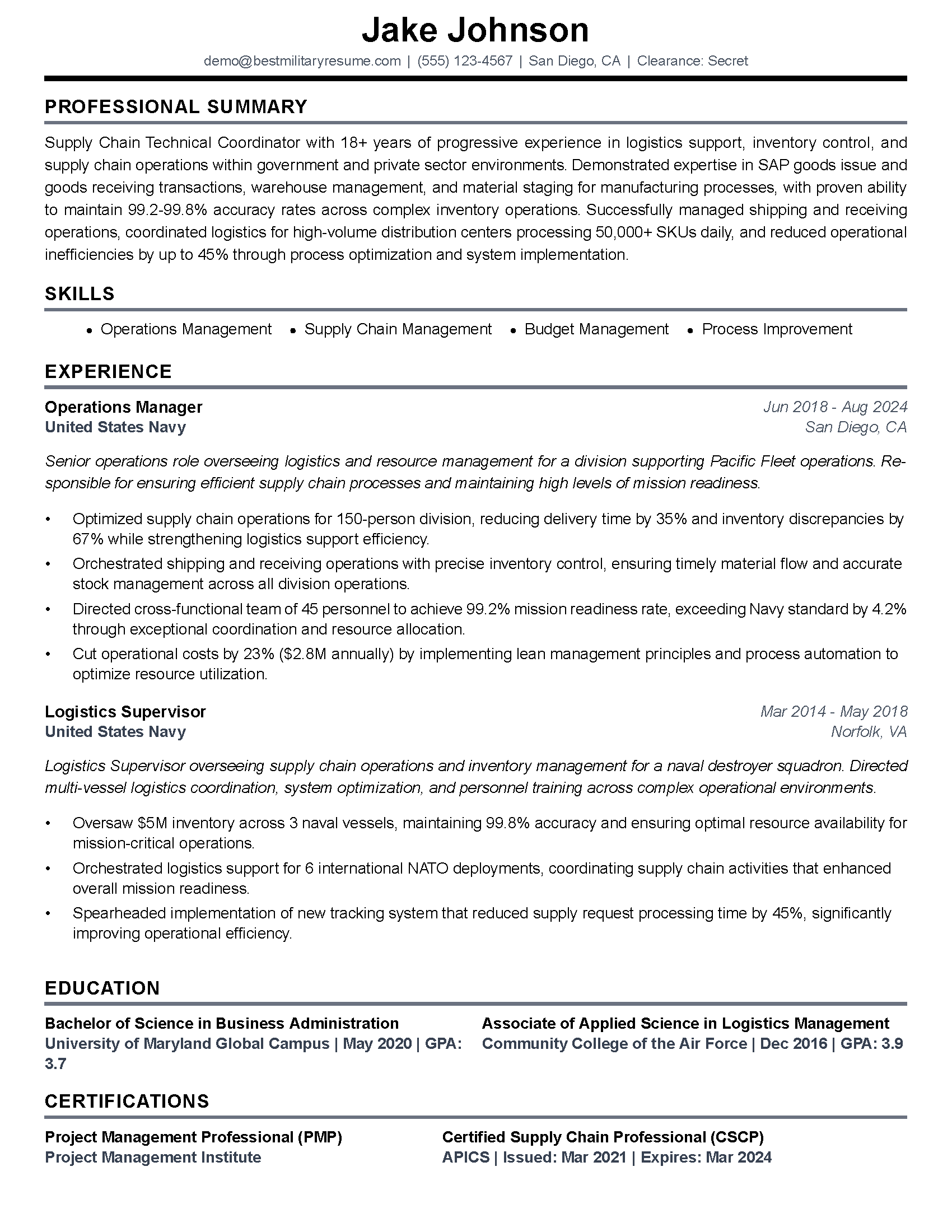
How Do You Translate Military Job Titles for the Experience Section?
Your military job title goes on the resume. But it cannot stand alone. A civilian hiring manager scanning your experience section will not know what a "68W Health Care Specialist" does, or that an "OS Operations Specialist" ran a combat information center. You need to pair the military title with a civilian-equivalent title or a plain-language description of the role.
The format that works best is: Civilian-Equivalent Title | Military Title. For example:
- Emergency Medical Technician | 68W Health Care Specialist — U.S. Army
- IT Systems Administrator | 25B Information Technology Specialist — U.S. Army
- Operations Supervisor | Operations Specialist (OS) — U.S. Navy
- Logistics Coordinator | 0431 Logistics/Embarkation Specialist — U.S. Marine Corps
This gives the hiring manager immediate context while preserving your actual military title for anyone who does recognize it. And some hiring managers — especially at defense contractors, federal agencies, and companies that actively recruit veterans — absolutely do recognize MOS codes and ratings. You want both audiences covered.
For a deeper breakdown on translating titles across every branch, check our military to civilian job titles guide. You can also use the BMR career crosswalk tool to see what civilian roles match your MOS, rating, or AFSC, along with salary data and federal position equivalents.
What Goes in Each Experience Entry?
Every entry in your experience section needs the same core information. Miss one of these and you either confuse the reader or leave gaps that make them skip to the next candidate.
Here is what each entry needs:
- Civilian-equivalent title and military title — as described above
- Organization and location — unit name (translated if needed) and base/station location with city and state
- Dates of service in that role — month and year to month and year (e.g., June 2019 - March 2022)
- Four to six bullet points — each one covering a specific responsibility or achievement with measurable results
For federal resumes, you also need hours per week (typically 40+) and your supervisor's name and phone number. Federal experience sections carry more detail than civilian ones — that is by design. The full veteran resume walkthrough covers how every section connects, including how experience entries differ between federal and private sector formats.
Title Line
Civilian title | Military title, Branch of Service
Organization and Location
Unit name (civilian equivalent if needed), City, State
Dates
Month Year - Month Year (e.g., June 2019 - March 2022)
Bullet Points
4-6 per role, each with a specific outcome or measurable result
Notice I said four to six bullets per role — not eight, not ten. If you have more than six strong bullets for a role, pick the six that best match the job posting and save the rest for your interview talking points. A bloated experience entry is just as bad as a thin one. It tells the hiring manager you could not identify what mattered.
What Should You Leave Off Your Experience Section?
This is where veterans get tripped up the most. You did real, hard, meaningful work in every assignment. Cutting any of it feels like you are underselling yourself. But a resume that includes everything is a resume that highlights nothing. Here is what stays out.
Classified Operations and Intelligence Details
This should be obvious, but it comes up constantly. If you worked in a SCIF, ran intelligence operations, or handled classified programs, you cannot put specifics on a resume. What you can do is describe the scope and impact in unclassified terms. "Managed a 12-person analytical team supporting real-time decision-making for a 3-star command" communicates the scale without revealing anything sensitive. If you held a TS/SCI clearance, list that in a qualifications section — that clearance itself is a valuable credential, especially for defense and federal roles.
Irrelevant Early Assignments
Your first duty station as an E-1 or E-2, where you were learning the basics and following instructions — that role served its purpose. But if you have 8+ years of service and more senior roles to show, those early assignments rarely add value to a civilian resume. A hiring manager for a GS-11 Program Analyst role does not need to see that you sorted mail at your first unit in 2012.
The exception: if your earliest assignment is directly relevant to your target job. An E-3 who worked as a Network Technician at their first unit and is now applying for IT roles should absolutely include that assignment regardless of rank.
Duty Descriptions Without Outcomes
Bullets that describe what you were responsible for without showing what you actually accomplished are wasted space. "Responsible for maintaining vehicles" tells the hiring manager nothing about how well you did it, how many vehicles, or what the result was. If you cannot attach a number, a result, or a specific impact to a bullet point, that bullet needs to be rewritten or cut. Our guide on quantifying military experience with real examples walks through exactly how to fix these.
"Responsible for managing supply operations and maintaining inventory accountability for the battalion."
"Managed $4.2M supply account across 6 sub-units, achieving 99.3% inventory accuracy during two consecutive command inspections."
Temporary Duty That Did Not Build Transferable Skills
A two-week TDY to support a field exercise where you did the same job you always do is not a separate experience entry. A six-month deployment where you stood up a new logistics hub and managed $12M in equipment flow? That could be its own entry or folded into the parent assignment as a high-impact bullet. The test is whether the temporary duty gave you a distinct set of responsibilities and results that differ from your primary role.
Collateral Duties That Do Not Map to the Target Job
Every veteran has a stack of collateral duties. Unit safety officer, voting assistance officer, urinalysis coordinator, key custodian. Some of these translate well — safety officer maps to OSHA compliance, training NCO maps to instructional design. Others (voting assistance officer, urinalysis coordinator) do not add value for most civilian job applications. Include collateral duties only when they demonstrate a skill the employer is looking for.
How Should Veterans Order Their Experience Section?
Reverse chronological order. Most recent role first, working backward. This is the standard for both civilian and federal resumes, and it is what hiring managers expect. When I reviewed resumes as a federal hiring manager, the ones that jumped around chronologically or grouped roles by "relevance" instead of timeline were harder to follow and got less attention.
There is one scenario where you might adjust the order: if your most recent military role was an administrative or hold-over assignment that does not represent your primary skill set. A senior NCO who spent their last six months on a medical hold or in a transition unit may want to lead with their most recent operational role and list the transition assignment briefly at the end. But even then, keep the chronological structure — just give the operational role more space and bullets.
For how resume length plays into this, especially when you are trying to decide between one and two pages, see our breakdown on 1-page vs 2-page military resumes.
What About Civilian Jobs Held Before or During Military Service?
If you held civilian jobs before enlisting — retail, food service, construction — include them only if they are relevant to your target role or if you need the material to fill a two-page resume. A 22-year-old veteran with four years of service and a pre-enlistment job as an assistant manager at a restaurant? That shows customer service and supervisory experience. Include it if you are targeting management or customer-facing roles.
A 38-year-old senior NCO with 16 years of service who worked at a gas station at 17? That is not adding value. Your military career has more than enough material.
For part-time or freelance work done while still in the military — cybersecurity consulting on the side, real estate, personal training — include it if it directly supports your target career. Side work that demonstrates industry knowledge or certifications in your target field can be a strong addition. But do not list it as a way to pad the resume. If it is not relevant, cut it.
If you are working on getting your full resume right beyond just the experience section, the what to put on your resume after military service checklist covers every section from top to bottom.
How to Handle Gaps Between Assignments
Military careers sometimes have gaps that look strange on a civilian resume. You PCS'd and had 30 days of leave. You were in a training pipeline for four months between assignments. You were on a temporary medical hold. These are normal in the military, but a civilian hiring manager might flag them.
The fix is simple: use month-and-year date formatting (not exact dates) and ensure your entries flow logically from one to the next. If you left one assignment in March 2021 and started the next in June 2021, showing "March 2021" and "June 2021" as the end and start dates leaves no visible gap on a resume formatted by month. Most military transitions between assignments fall within this window.
For longer gaps — a year of terminal leave and job searching, time spent using GI Bill before entering the workforce — address it briefly in a cover letter if the employer asks. On the resume itself, focus on what you did during that time. Were you completing a degree? Getting certified? Doing freelance work? Those fill the gap productively.
Transition Periods
If you used terminal leave plus GI Bill before your first civilian job, list your education with dates that overlap. This shows continuous activity without needing to explain a gap that every veteran has.
Does the Experience Section Change for Federal vs. Private Sector Resumes?
Yes. Significantly. The same veteran applying for a GS-12 Logistics Management Specialist and a private sector Supply Chain Manager needs two different experience sections. Not just different bullet points — different levels of detail, different formatting, and different information.
Federal experience entries require:
- Hours per week — typically 40+ for active duty
- Supervisor name and phone number — for each role
- Salary or grade — your military pay grade (e.g., E-6, O-3)
- More detailed duty descriptions — federal HR specialists need to see specific duties mapped to the qualification requirements in the job announcement
Private sector entries are leaner. No supervisor contact info, no hours per week, no salary. The focus is on results and impact, with less emphasis on duty descriptions and more on measurable outcomes.
Both formats target two pages. Federal resumes were historically much longer — my early federal resumes were 16 pages — but the current best practice is two pages with enough detail to meet the qualification standards without padding. If you are building a federal resume, the BMR federal resume builder handles the formatting differences automatically and structures your experience entries with the right fields for federal applications.
For branch-specific examples of how this looks in practice, check the military resume samples by branch — it includes both federal and private sector versions.
What to Do Next
Pull up the last resume you submitted. Look at your experience section with fresh eyes and run through this checklist:
- Does every role you listed directly support the job you applied for?
- Are there early assignments that are eating up space without adding value?
- Does each entry have four to six bullets with measurable outcomes — not just duty descriptions?
- Are your job titles translated so a civilian hiring manager can understand the role in under six seconds?
- If you have 10+ years of service, have you selected your strongest four to six roles rather than listing everything?
If you answered no to any of those, your experience section needs work. The BMR resume builder will handle the translation, formatting, and tailoring for you — paste a job posting, and it builds an experience section matched to that specific role. Two free tailored resumes included.
Frequently Asked Questions
How many jobs should I list on my military resume?
Should I include every military assignment on my resume?
How do I translate military job titles for a civilian resume?
What should I leave off my resume experience section?
Should my experience section be in chronological or relevance order?
Is the experience section different for federal vs civilian resumes?
How do I handle gaps between military assignments on my resume?
Should I include civilian jobs I held before enlisting?
About the Author
Brad Tachi is the CEO and founder of Best Military Resume and a 2025 Military Friendly Vetrepreneur of the Year award recipient for overseas excellence. A former U.S. Navy Diver with over 20 years of combined military, private sector, and federal government experience, Brad brings unparalleled expertise to help veterans and military service members successfully transition to rewarding civilian careers. Having personally navigated the military-to-civilian transition, Brad deeply understands the challenges veterans face and specializes in translating military experience into compelling resumes that capture the attention of civilian employers. Through Best Military Resume, Brad has helped thousands of service members land their dream jobs by providing expert resume writing, career coaching, and job search strategies tailored specifically for the veteran community.
