What to Put on Your Resume After Military Service
Desiree landed a $135K hybrid senior financial consultant role.
Desiree, E-5, Army National Guard, the interviewer loved the resume from the top down
You've separated or you're about to. Your DD-214 is in hand (or close to it), and now you need a resume. The blank page stares back at you, and the question hits: what actually goes on this thing?
After helping 15,000+ veterans build resumes through BMR, I can tell you the biggest problem isn't missing experience. It's not knowing how to organize what you already have. Military service gives you more transferable material than most civilian careers — the trick is knowing which pieces go where and what to leave out.
This is the complete checklist. Every section your post-military resume needs, what goes in each one, and what to skip. Print it, bookmark it, come back to it every time you apply for a new role.
What Goes in Your Contact Information Section?
This sounds basic, but veterans mess it up more than you'd expect. Your contact section sits at the top of page one and includes exactly these items:
- Full name — first and last. No rank. Drop the "SSgt" or "PO2" prefix. Civilian hiring managers don't know your rank structure and it immediately flags you as someone who hasn't adapted their materials yet.
- City and state — not your full street address. If you're applying to jobs in a different city, use the target city where you plan to relocate.
- Phone number — one number, ideally your cell. Make sure your voicemail sounds professional.
- Email address — use a professional-sounding email. [email protected] works. Your .mil email expires after separation.
- LinkedIn URL — a custom URL (linkedin.com/in/yourname) if you have a complete profile.
Skip your mailing address, marital status, date of birth, and Social Security number. None of these belong on a civilian resume.
Don't Use Your Military Email
Your .mil email address will stop working after you separate. Set up a professional civilian email before you start applying. Also check that your email signature doesn't auto-append your rank or unit — strip that out for job applications.
How Do You Write a Professional Summary That Gets Read?
The professional summary is the first block of text a hiring manager reads after your name. You get four to five lines to make them want to keep reading. Here's what it needs:
Open with your total years of experience and your primary expertise area — in civilian terms. "Operations manager with 12 years of experience leading teams of 15-80 across logistics, training, and compliance" works. "E-7 with experience in S3 operations, MDMP, and OPORD development" doesn't.
Include one or two measurable results. "Managed $8M in equipment with zero losses across 4 inventories" gives the reader a concrete reason to keep going. End with what you're targeting — the role type or industry you're pursuing.
Skip objective statements. "Seeking a challenging position where I can apply my leadership skills" tells the hiring manager nothing useful. They know you want the job — you applied for it. Use the space to prove you're qualified instead.
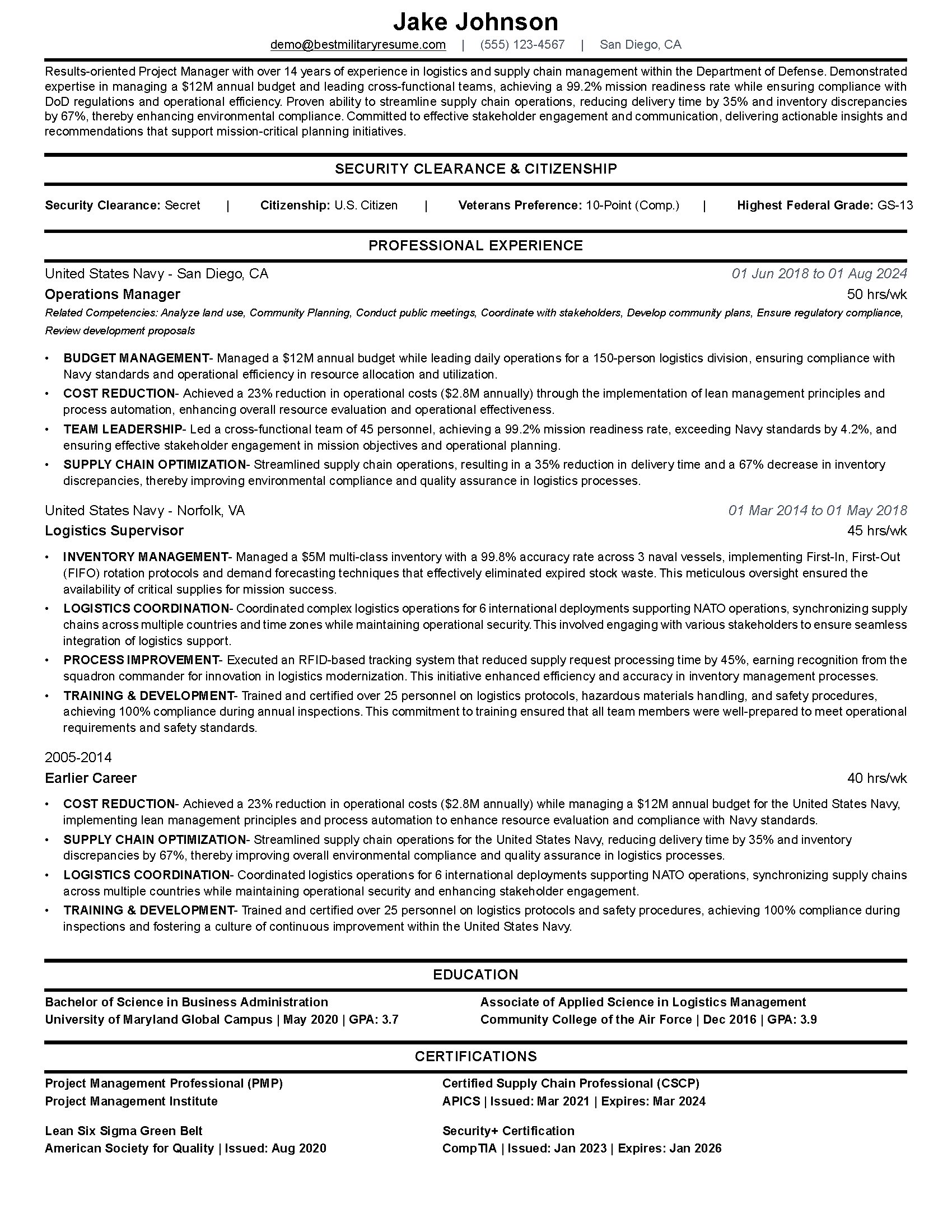
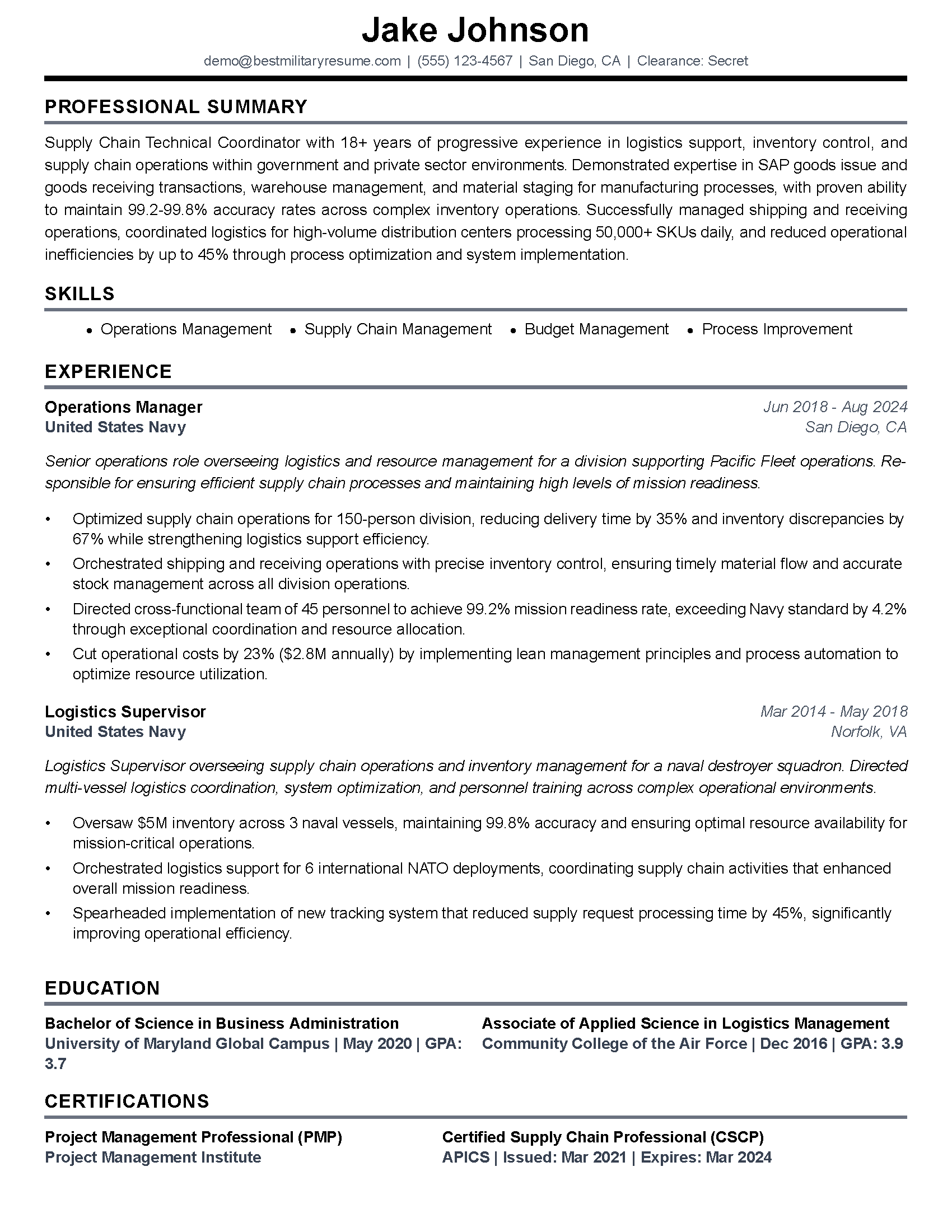
"Dedicated military professional seeking a challenging operations role where I can apply my leadership skills and work ethic to a dynamic organization."
"Operations Manager with 12 years directing logistics and training programs for teams of 15-80. Managed $8M equipment inventory with zero losses. Led compliance program achieving 100% inspection pass rate across 4 audit cycles."
Which Skills Should Go on a Post-Military Resume?
Your skills section does double duty: it gives hiring managers a quick snapshot of your capabilities, and it feeds keywords to ATS platforms that scan for job-relevant terms. Both audiences need the same thing — skills written in civilian language that match the job posting.
Pull eight to twelve skills directly from the job posting you're targeting. If the posting says "project management," your skills section says "Project Management" — not "Mission Planning" or "OPORD Development." Same skill, different language. The civilian version is what the ATS is scanning for and what the hiring manager will recognize.
Hard Skills vs. Soft Skills
Hard skills are specific, teachable capabilities: project management, budget administration, Microsoft Office Suite, data analysis, supply chain management, safety compliance. Soft skills are traits: leadership, communication, problem-solving, team building.
Prioritize hard skills in your dedicated skills section. They're more keyword-rich and more scannable. Soft skills are better demonstrated in your experience bullet points, not listed in a grid. "Led 45-person team through 8-month deployment with zero safety incidents" proves leadership better than the word "leadership" sitting in a skills box.
Security Clearance
If you hold an active security clearance, include it in your skills section or in a separate line near your contact info. An active TS/SCI or Secret clearance is worth tens of thousands of dollars to employers in defense, intelligence, and government contracting. Don't bury it — make it visible on the first page. Read more about what your clearance is worth in the job market.
1 Read the Job Posting First
2 Translate Military Terms
3 Prioritize Hard Skills
4 Feature Your Clearance
5 Match the Count to the Role
How Do You Write Military Experience for Civilian Employers?
Your work experience section is the core of your resume after military service. This is where you prove you can do the job — not by listing duties, but by showing results.
Each role needs a civilian-friendly job title, your unit or organization translated into something recognizable, your location, and the dates you served. Then four to six bullet points that each start with a strong action verb and include a measurable result.
Translating Job Titles
Your military job title goes first, followed by the civilian equivalent in parentheses if it's not obvious. "Platoon Sergeant" doesn't need a translation — most people understand that's a leadership role. But "11B Infantryman (Security Operations Specialist)" or "68W Combat Medic (Emergency Medical Technician)" gives the hiring manager immediate context.
Writing Results-Based Bullets
Every bullet point should answer one question: what did you accomplish? Not what were you responsible for — what did you actually do that made a difference?
Bad: "Responsible for maintaining unit vehicles and equipment."
Good: "Managed maintenance program for 42-vehicle fleet, reducing downtime by 28% and saving $180K in contractor repair costs over 18 months."
Numbers make bullets scannable and credible. Dollar amounts, team sizes, percentages, timelines, inventory counts — quantify everything you can. In my experience across multiple federal career fields — environmental management, supply, logistics, property management — the resumes that won interviews always led with numbers, not narratives.
"I've hired people into federal positions and I've applied for them myself. The resumes that got interviews always had numbers. Not adjectives, not paragraphs — numbers."
What Education and Certifications Should You Include?
List your highest degree first, then work down. Include the school name, degree type, major or concentration, and graduation year. If you're currently pursuing a degree, include it with "Expected graduation: [date]."
Military education counts — but be selective. Joint Professional Military Education (JPME), Senior Enlisted Academy, and similar programs show executive-level training. Basic training and initial MOS/rating school don't add value on a civilian resume unless you're fresh out of the service with minimal other education.
Military Education Worth Including
Not all military schools carry the same weight on a civilian resume. Senior-level programs like the Senior Enlisted Academy, Command and General Staff College, or War College equivalent courses signal executive-level training and strategic thinking. These are worth listing with a brief civilian description — "Executive Leadership Program (12-week senior management course)" reads better than a military school code.
Technical military training can also have civilian value. Courses in hazardous materials handling, cybersecurity fundamentals, financial management, or medical training translate directly into industry certifications or at minimum demonstrate formal training in those areas.
Certifications That Matter
Certifications are often more valuable than degrees for veteran job seekers. List any active certifications that relate to your target role. Common high-value certifications for transitioning veterans include PMP (Project Management Professional), CompTIA Security+, Six Sigma (Green or Black Belt), OSHA safety certifications, and CDL (Commercial Driver's License).
Keep certifications in a separate section or grouped with education. Include the certifying body and the date earned or expiration date. Drop expired certifications unless you plan to renew them before interviewing.
What Else Belongs on a Post-Military Resume?
Beyond the core sections, several additional elements can strengthen your resume after military service. Not all of these apply to every veteran — include what's relevant to your target role and skip the rest.
Awards and Recognition
Include military awards that translate into civilian terms. A Navy Achievement Medal becomes "Achievement award for reducing inventory discrepancies by 40%." The medal name itself means nothing to most civilian employers — the reason you earned it does. Pick your top two to four awards and describe each in terms of what you did and the result.
Volunteer Work and Community Involvement
If you've volunteered with veteran service organizations, community programs, or professional groups, include a brief section. This is especially useful if you have a gap between your separation date and your first civilian job. Volunteer roles demonstrate initiative and community engagement without claiming paid employment you didn't have.
Professional Affiliations
Membership in industry associations (SHRM for HR, PMI for project management, SAME for engineering) shows you're investing in your civilian career. Include these if you have them, but don't join organizations just to pad your resume. Hiring managers can spot a list of memberships with no real engagement behind them.
Key Takeaway
Your resume after military service should include contact info, a professional summary, skills, experience with translated titles and results-based bullets, education, certifications, and selectively — awards, volunteer work, and professional affiliations. Every item earns its place by connecting to the target job.
What Should You Leave Off Your Post-Military Resume?
Knowing what to exclude is just as important as knowing what to include. These items hurt more than they help on a civilian resume:
- Military jargon and acronyms — translate or remove. If a civilian reader wouldn't understand it without Google, rewrite it.
- Every single assignment — focus on the last 10-15 years. Compress early career roles into title and dates only.
- References — don't include them on the resume. "References available upon request" wastes a line. Hiring managers know they can ask.
- Photos or headshots — not standard practice in the U.S. and can trigger bias concerns.
- High school diploma — if you have a college degree or significant military education, the high school diploma adds no value.
- Irrelevant personal hobbies — unless a hobby directly relates to the job (e.g., competitive shooting for a law enforcement role), leave it off.
Every line on your resume costs you space. If something doesn't help you get the interview, it's costing you space that something more relevant could use.
BMR's Resume Builder handles the translation, formatting, and keyword matching automatically. Paste a job posting and it builds a tailored resume from your military experience — free for your first two resumes.
Building a resume after military service comes down to making every section work for the specific job you want. Contact info, summary, skills, experience, education, and certifications form the core. Awards, volunteer work, and affiliations add depth when they're relevant. Everything else is noise.
Tailor each resume to each job posting. The same career can produce very different resumes depending on the target role. That's not dishonesty — it's smart editing. You served. You earned the experience. Now put the right pieces on the page and go get the interview.
Frequently Asked Questions
What sections should a post-military resume include?
Should I include my military rank on my resume?
How do I list military experience on a civilian resume?
Do I need to include every military assignment?
Should I put my security clearance on my resume?
How long should my resume be after military service?
What military awards should I include on my resume?
Should I use a functional or chronological resume format after military service?
About the Author
Brad Tachi is the CEO and founder of Best Military Resume and a 2025 Military Friendly Vetrepreneur of the Year award recipient for overseas excellence. A former U.S. Navy Diver with over 20 years of combined military, private sector, and federal government experience, Brad brings unparalleled expertise to help veterans and military service members successfully transition to rewarding civilian careers. Having personally navigated the military-to-civilian transition, Brad deeply understands the challenges veterans face and specializes in translating military experience into compelling resumes that capture the attention of civilian employers. Through Best Military Resume, Brad has helped thousands of service members land their dream jobs by providing expert resume writing, career coaching, and job search strategies tailored specifically for the veteran community.
