
Your Resume Is Getting Skipped — Here's Why
You've submitted dozens of applications. Maybe hundreds. The response rate is dismal — a few automated rejections, maybe one phone screen that went nowhere, and a lot of silence. The natural assumption is that employers don't value military experience, that ATS systems are filtering you out, or that the job market is just terrible for veterans.
But in most cases, the problem isn't the market — it's the resume. After working with thousands of veterans through BMR, we see the same resume mistakes over and over. These aren't minor formatting issues. They're fundamental problems that cause hiring managers to skip your resume within seconds and move to the next candidate. The good news: every single one of these red flags is fixable.
Red Flag #1: Wall of Military Jargon
This is the most common and most damaging resume mistake veterans make. Your resume reads like an NCOER or OER — packed with acronyms, unit designations, military terminology, and references that only someone who served in your exact branch and specialty would understand.
What the hiring manager sees: A document they can't read. When a civilian recruiter encounters "Supervised 4 NCOs and 12 junior enlisted in execution of CBRN defense operations IAW AR 350-1, maintaining 100% compliance with quarterly training requirements for a FORSCOM BCT," they don't see an accomplished leader. They see a foreign language document. Their eyes glaze over, they spend less than 6 seconds on your resume, and they move to the next candidate.
The fix: Translate everything. Every acronym gets spelled out or replaced with a civilian equivalent. Every military-specific role gets a civilian parallel. "Led a 16-person operations team responsible for emergency response planning, equipment maintenance, and safety compliance training across a 650-person organization. Maintained 100% compliance with federal safety regulations through quarterly audits and a proactive training schedule." Same experience, accessible language.

Red Flag #2: Responsibilities Without Results
Your resume lists what you were responsible for but doesn't show what you accomplished. "Responsible for maintenance of 47 vehicles." "Managed inventory of 2,300 line items." "Supervised a team of 12 personnel." These are job descriptions, not accomplishments. They tell the hiring manager what your job was, not how well you did it or what impact you had.
What the hiring manager sees: A candidate who shows up and does the minimum. Responsibility without results suggests you filled a slot but didn't excel. Every candidate who held your position was "responsible for" the same things — what made you different?
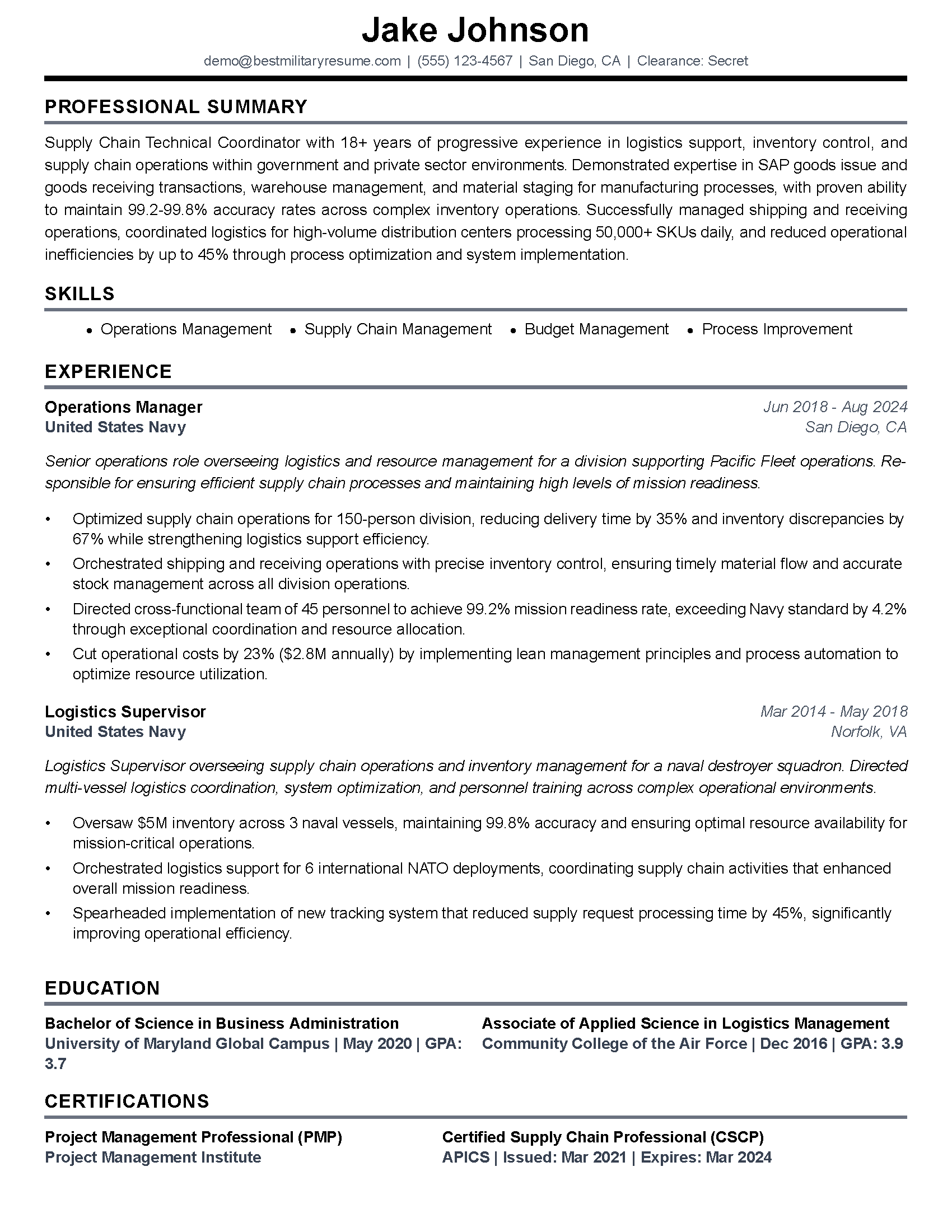
The fix: Add the "so what" to every bullet point. "Maintained a 47-vehicle fleet at 98% operational readiness — highest in the organization — through a preventive maintenance scheduling system that reduced unplanned downtime by 35% and saved $127,000 in emergency repair costs annually." Now the hiring manager sees a problem-solver with measurable impact. Every bullet should include a number, a result, or both.
Red Flag #3: One Generic Resume for Every Application
You wrote one resume and you're submitting the exact same document to every job posting — project management positions, logistics roles, operations jobs, analyst positions. The resume is a general overview of your military career without specific alignment to any particular civilian role.
What happens: Your resume ranks low in ATS because the keywords don't match the specific job posting. The hiring manager who does see it doesn't immediately connect your experience to their specific needs. You're making them do the translation work, and they won't.
The fix: Tailor your resume for each application. You don't need to rewrite the entire document — adjust your professional summary, reorder your bullet points to lead with the most relevant experience, and mirror the language from the job posting. If the posting says "project management," don't write "operations planning." If it says "stakeholder engagement," don't write "interagency coordination." Use their words to describe your experience. Our ATS optimization guide covers this process in detail.
Red Flag #4: Using an Objective Statement
Your resume starts with something like: "Objective: To obtain a challenging position in operations management where I can utilize my military leadership experience and contribute to organizational success."
What the hiring manager sees: A dated resume format and a candidate who's focused on what they want rather than what they bring. Objective statements haven't been standard practice since the early 2000s. They waste prime resume real estate — the top of your first page — on a generic statement that doesn't differentiate you from any other candidate.
The fix: Replace your objective statement with a professional summary — 3-4 sentences that communicate your value proposition in civilian terms. "Operations leader with 12 years of experience managing complex, multi-site operations in high-pressure environments. Proven track record of leading teams of 50-200+ personnel, managing $15M+ budgets, and delivering measurable improvements in operational efficiency, safety compliance, and team performance. Expertise in project management, process optimization, and cross-functional coordination." This tells the hiring manager what you bring, not what you want.
Brad's Take
The professional summary is the most important section on your resume because it's the only part that every hiring manager reads in full. If your summary is generic, jargon-filled, or reads like an objective statement from 2005, the recruiter has already moved on before they reach your experience section. Invest time in getting these 3-4 sentences right — they set the tone for everything that follows.
Red Flag #5: Listing Every Assignment Since Boot Camp
Your resume is 3-4 pages long and includes every military assignment from your first duty station to your last. The hiring manager has to wade through 8 different positions — including ones from 15+ years ago that aren't relevant to the job you're applying for — to find the experience that matters.
What the hiring manager sees: An unfocused candidate who doesn't know how to prioritize information. Long resumes also suggest someone who can't communicate concisely — a skill that matters in every civilian role.
The fix: For private sector resumes, keep it to 2 pages maximum. Focus on the last 10-15 years of experience and the positions most relevant to the job you're targeting. Earlier assignments can be consolidated into a single line: "Previous military assignments in logistics and supply chain management (2008-2014)." For federal resumes, the same 2-page limit applies — but you need to pack more detail into those pages (hours per week, supervisor info, specialized experience language). Prioritize relevance over completeness regardless of sector.
Red Flag #6: Missing or Buried Security Clearance
If you hold an active security clearance and it's not prominently displayed on your resume — or worse, it's not listed at all — you're leaving money on the table. Clearances are one of the first things defense contractor recruiters filter for. If they can't find yours in the first 5 seconds, they move on.
The fix: Put your clearance in your resume header, directly under your name. "Active TS/SCI Clearance — Current." Read our detailed security clearance resume guide for exact formatting and placement best practices.
Red Flag #7: No Civilian-Equivalent Job Titles
Your resume lists "Platoon Sergeant" as your job title without any civilian context. The ATS can't match "Platoon Sergeant" to any civilian job category, and the hiring manager who isn't familiar with military structure doesn't know whether that's equivalent to a team lead or a VP.
The fix: Use dual titles: "Operations Manager (Platoon Sergeant, E-7)" or "Chief of Staff / Senior Operations Manager (First Sergeant, E-8)." This gives the ATS a civilian keyword to match and gives the human reader immediate context about your level of responsibility. Our enlisted resume guide and officer resume guide cover rank-by-rank civilian title equivalents.
Red Flag #8: Poor Formatting That Breaks ATS
Your resume uses creative formatting — multi-column layouts, tables, text boxes, custom graphics, or non-standard fonts — that looks impressive on screen but gets mangled by applicant tracking systems. The ATS can't parse your carefully designed layout, so your information ends up scrambled, incomplete, or missing entirely from the system.
What happens: The ATS extracts your content out of order, misses entire sections, or fails to identify your work experience as work experience. Your resume shows up in the recruiter's system as a garbled mess — or doesn't show up at all. All that carefully written content is wasted because the system couldn't read it.
The fix: Use a clean, single-column layout with standard section headings (Professional Experience, Education, Skills). Standard fonts (Arial, Calibri, Times New Roman) in 10-12 point size. No tables, no text boxes, no graphics embedded in the document. Submit as .docx or PDF — both work fine and are reliably parsed by modern ATS platforms. Avoid creative formats like infographic resumes. Save creative design for your portfolio — your resume needs to be functional first.
Red Flag #9: Focusing on Rank Instead of Results
Your resume reads like a promotion history — "Promoted to Sergeant," "Selected for Staff Sergeant ahead of peers," "Served as Company First Sergeant." While promotions demonstrate success within the military, civilian hiring managers don't evaluate candidates based on military rank progression. They evaluate based on what you accomplished and what skills you bring.
The fix: Mention promotions briefly for context but focus the majority of your resume on accomplishments and capabilities. "Promoted ahead of peers to senior management role based on demonstrated performance in..." transitioning immediately into the measurable results you delivered. The promotion is proof of your quality — but the results are what get you hired.
The Biggest Red Flag of All
The worst resume mistake isn't any single formatting issue — it's expecting hiring managers to do the translation work for you. If your resume requires a civilian reader to Google military terms, cross-reference rank structures, or guess at what your accomplishments mean in civilian context, you've already lost. Your resume's job is to make it effortless for the reader to see your value. Every translation burden you leave on the hiring manager is a reason for them to move to the next candidate.
Red Flag #10: No Professional Summary or a Weak One
Either your resume has no summary at all — jumping straight from your name to your work history — or it has a generic summary that could belong to any candidate: "Motivated professional seeking new opportunities." Both are missed opportunities to make a strong first impression.
The fix: Write a 3-4 sentence professional summary that is specific to you and the job you're targeting. Include your years of experience, your core competencies in civilian terms, your most impressive quantified achievement, and your industry focus. "Operations executive with 15 years of progressive leadership in high-stakes, multi-site environments. Led organizations of 50-500 personnel with budgets exceeding $30M, consistently delivering measurable improvements in operational efficiency, safety compliance, and team performance. Expertise in strategic planning, change management, and cross-functional coordination within manufacturing and logistics sectors." That summary earns a full read of your resume.
The Quick Fix Checklist
Before submitting your next application, run through this checklist:
- Does every bullet point include a measurable result or specific outcome?
- Have you eliminated all unexplained military acronyms and jargon?
- Do your job titles include civilian equivalents?
- Is your security clearance prominently displayed (if applicable)?
- Is your professional summary written in civilian terms with your value proposition?
- Have you tailored the resume to this specific job posting?
- Is the resume 2 pages or less (for both private sector and federal)?
- Does your resume mirror the language and keywords from the job posting?
If you can check every box, your resume is ahead of 90% of veteran resumes in the applicant pool. BMR's resume builder handles all of these translations automatically — converting military experience into civilian-ready language, formatting for ATS optimization, and tailoring content to each specific job you target.
Key Takeaway
Veteran resumes get skipped for fixable reasons: military jargon, missing results, generic submissions, outdated formatting, and untranslated job titles. Each of these red flags puts a barrier between your experience and the hiring manager's understanding. Remove the barriers — translate your language, quantify your results, tailor each submission, and make it effortless for a civilian reader to see your value.
Frequently Asked Questions
QWhat is the most common mistake on veteran resumes?
QHow long should a veteran's civilian resume be?
QShould I use an objective statement on my resume?
QHow do I show results if my military work was classified?
QDo I need a different resume for each job application?
QShould I list my military awards on my resume?
QWhat if I don't have civilian work experience?
About the Author
Brad Tachi is the CEO and founder of Best Military Resume and a 2025 Military Friendly Vetrepreneur of the Year award recipient for overseas excellence. A former U.S. Navy Diver with over 20 years of combined military, private sector, and federal government experience, Brad brings unparalleled expertise to help veterans and military service members successfully transition to rewarding civilian careers. Having personally navigated the military-to-civilian transition, Brad deeply understands the challenges veterans face and specializes in translating military experience into compelling resumes that capture the attention of civilian employers. Through Best Military Resume, Brad has helped thousands of service members land their dream jobs by providing expert resume writing, career coaching, and job search strategies tailored specifically for the veteran community.
View all articles by Brad TachiFound this helpful? Share it with fellow veterans:
