Military Achievements on Your Civilian Resume (Examples)
Your military career produced real accomplishments. Awards, evaluation bullets, commendations, unit citations, and measurable results that civilian employers would value if they could understand them. The problem is not that your achievements are weak. The problem is that they are buried in military language that means nothing to a hiring manager scanning resumes for six seconds.
When I separated as a Navy Diver in 2015, my resume listed every award and commendation I had earned. Navy Achievement Medals, command coins, evaluation superlatives. It looked impressive to me. It got zero callbacks. The awards themselves were not the issue. The issue was that I listed them like a military record instead of translating them into results a civilian employer could measure. Once I figured out how to reframe those achievements as business outcomes, I started getting interviews within weeks.
This guide shows you how to pick which military achievements actually matter for civilian roles, how to quantify accomplishments that feel hard to measure, where to place them on your resume for maximum impact, and real before-and-after examples you can model.
Which Military Achievements Actually Matter to Civilian Employers?
Not every military achievement belongs on your civilian resume. A Good Conduct Medal shows you did not get in trouble for four years. That is baseline expectation in the civilian world, not an achievement worth highlighting. A Navy Achievement Medal for leading a damage control team that saved $2M in equipment during an emergency? That tells a story a hiring manager cares about.
The filter is simple: does this achievement demonstrate a result that a civilian employer would pay for? Cost savings, revenue generation, efficiency improvements, team performance, safety records, project completion, and training outcomes all translate. Conduct awards, participation ribbons, and standard service medals do not.
Think about it from the hiring manager's perspective. They are reading forty resumes for one position. They need to see proof that you can deliver results in a business context. A Joint Service Commendation Medal tells them you got an award. A bullet saying you "reduced equipment downtime by 35% across a 400-person organization, saving $180K in annual maintenance costs" tells them you can solve problems that cost money. One of those gets you an interview. The other gets skimmed over.
Military Achievements Worth Including
Awards citing specific results
NAMs, ARCOMs, or MSMs that mention dollar amounts, personnel numbers, or measurable outcomes in the citation.
Evaluation bullets with metrics
NCOER, FITREP, or OER bullets that quantify what you did. These are gold for resume writing.
Competitive selections
Sailor/Soldier/Airman of the Quarter/Year, board selections, or competitive school slots show you stood out.
Unit accomplishments you drove
Inspection results, readiness scores, safety records, or operational milestones where you played a direct role.
Cost savings or process improvements
Any time you saved money, reduced waste, shortened timelines, or improved a process. These translate directly to business value.
Pull out your award citations and evaluations. Read through the narrative sections. Every specific number, dollar amount, or percentage is a resume bullet waiting to happen. If your NAM citation says you "managed a $1.2M equipment inventory with zero discrepancies," that is a ready-made achievement for your resume. You just need to strip out the military formatting and rewrite it in civilian terms.
How Do You Quantify Military Accomplishments That Feel Unmeasurable?
Veterans often say their achievements are hard to quantify. "I led a team" or "I maintained equipment" or "I trained junior personnel." These sound vague, but every one of them has numbers hiding behind it. You just need to dig them out.
How many people were on your team? What was the dollar value of the equipment you maintained? How many people did you train, and what was their pass rate? What was the readiness rate before you took over versus after? How many inspections did your section pass? What was the safety record during your tenure?
"Responsible for maintaining communications equipment and training junior sailors on proper procedures."
"Maintained 42 communication systems valued at $3.8M with 99.2% operational readiness. Trained 18 technicians on troubleshooting protocols, reducing repair time by 30%."
When I reviewed resumes for federal contracting positions, the ones that stood out always had numbers. Not because the numbers were impressive on their own, but because they proved the candidate could measure their own work. A hiring manager reading "maintained equipment" has no idea if that means two laptops or a fleet of vehicles. The number removes the guessing.
Here are the categories to mine for numbers: people supervised, budget managed, equipment value, inventory items, training completion rates, inspection scores, time saved, cost reduced, error rates, safety incidents (or lack of), and project timelines met. If you managed a budget, what was the dollar amount? If you ran training, what was the class size and the pass rate? If you handled inventory, what was the total line-item count and the accuracy percentage? Every military job produces at least four of these. Go through your evaluations and award citations line by line and pull out every number you find.

Where Should You Place Achievements on Your Resume?
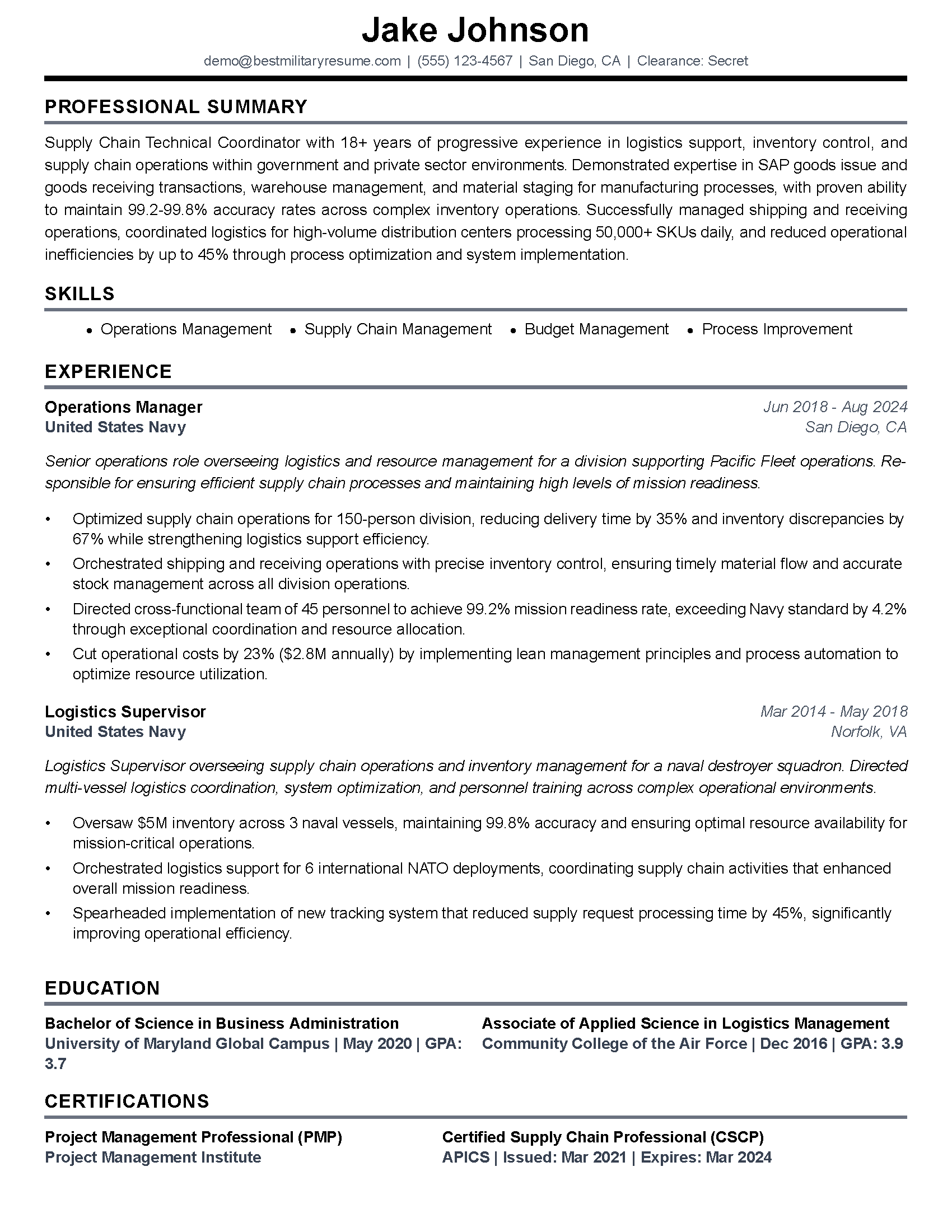
Placement matters as much as content. A hiring manager scanning your resume for six seconds will look at specific areas first. Your professional summary at the top gets read first. Then the first two bullets under each work experience entry. If your best achievements are buried on page two under a section called "Awards and Decorations," they are invisible.
Put your strongest quantified achievement in your professional summary. Not the award name, but the result. "Operations manager with a record of reducing maintenance costs by 22% across a 200-person organization" is a professional summary that earns a second look. "Navy veteran with multiple awards" is not.
Do Not Create a Separate Awards Section
Listing awards by name in their own section wastes space and buries the results. Instead, weave the achievement from each award into your work experience bullets where the accomplishment happened. The award name itself (NAM, ARCOM, etc.) adds nothing for a civilian reader. The result behind the award is what matters.
For each work experience entry, lead with your strongest achievement bullet. Do not start with job duties. "Supervised 12 personnel" is a duty. "Led 12-person maintenance team to achieve highest readiness rating in the battalion (98.7%), resulting in unit recognition from the commanding general" is an achievement. Duties tell employers what you were supposed to do. Achievements tell them what you actually accomplished.
If you have a skills section, keep it to hard skills and certifications. Do not put achievements there. Skills sections are for keywords that help your resume get past ATS filters. Achievements belong in the professional summary and work experience sections where they tell a complete story.
How Do You Translate Military Awards Into Civilian Language?
The award name itself is meaningless to civilian employers. "Navy and Marine Corps Achievement Medal" tells a hiring manager nothing. But the citation behind that medal contains the achievement you need. Your job is to extract the result and rewrite it without the military framing.
"Navy Achievement Medal — For superior performance while serving as Leading Petty Officer, Deck Department, USS Example. Petty Officer Smith expertly managed the preservation and maintenance of topside surfaces encompassing 14,000 square feet."
"Supervised 8-person facilities maintenance team responsible for 14,000 sq ft of infrastructure. Developed preventive maintenance schedule that reduced repair costs by 18% and earned organizational recognition for team performance."
Notice what changed. The award name disappeared. The military unit and ship name disappeared. The rank and "Leading Petty Officer" title became "supervised 8-person facilities maintenance team." The vague "superior performance" became a specific cost reduction. The result stayed, the military wrapper came off.
Do this for every achievement you want to include. Read the citation or evaluation bullet, identify the core result, and rewrite it using language from the job posting you are targeting. If the job posting mentions "cost reduction" and your award citation mentions saving money, use their exact phrasing. This is how you translate military experience effectively.
What Do Strong Before-and-After Achievement Bullets Look Like?
Here are four real examples of military achievements rewritten for civilian resumes. Study the pattern: strip the military context, add the numbers, and frame the result in business terms.
"Selected as Sailor of the Quarter. Managed arms locker and ordnance inventory for the command."
"Recognized as top performer out of 340 personnel for inventory management accuracy. Maintained $4.2M in controlled assets with zero discrepancies across 12 quarterly audits."
"ARCOM recipient. Served as NCOIC of the S-3 training section. Conducted pre-deployment training for the battalion."
"Directed training operations for 650-person organization, designing and executing a 90-day certification program that achieved 100% qualification rate. Recognized with achievement award for exceeding readiness standards."
The pattern is consistent across all four examples. Remove the award acronym. Remove the military unit designator. Add the scale (number of people, dollar value, time frame). Add the measurable result. Frame it as something a business would care about: cost savings, efficiency, compliance, team performance, or project completion.
One more pattern to notice: the civilian versions are longer than the military versions. That might seem backward since military writing is supposed to be concise. But military brevity assumes the reader knows the context. A civilian reader does not know what an S-3 section does, what a battalion-level pre-deployment training cycle involves, or why managing an arms locker matters. You need to add that context in civilian terms. Two sentences that explain the scope and result will always outperform one vague sentence that assumes shared military knowledge.
Also notice that none of the civilian versions mention the branch of service, the unit, or the deployment location. Those details are relevant to your military career but irrelevant to a hiring manager evaluating your qualifications. They want to know what you did, how well you did it, and how many people or dollars were involved. Keep the focus there and you will see better results from every application you submit.
How Can You Start Rewriting Your Achievements Today?
Gather your source documents first. Pull your evaluations (NCOERs, FITREPs, OERs, EPRs), award citations, and any after-action reports or command inspection results you have copies of. These are your raw material. Every number, percentage, and dollar amount in those documents is a potential resume bullet.
Go through each document and highlight every quantifiable result. Write each one down in a separate list. Do not worry about formatting yet. Just extract the raw achievements. You should end up with fifteen to twenty potential bullets from a typical four-year enlistment.
Next, rank them by relevance to the jobs you are targeting. If you are applying for project management roles, your training coordination and timeline management achievements go to the top. If you are targeting logistics positions, your supply chain and inventory achievements lead. The same military career produces different resumes depending on the target role. That is exactly why tailoring matters. BMR's Resume Builder handles this by letting you paste in a job posting and automatically restructuring your experience to match what that specific employer is looking for.
Key Takeaway
Your military achievements are not weak. They are just trapped in military language. Extract the numbers from your evaluations and citations, strip the military framing, and rewrite each accomplishment as a business result. Lead with your strongest achievement in every section of your resume.
Do not try to include every achievement on one resume. Pick the five to eight strongest ones that align with your target role and weave them into your work experience bullets and professional summary. Quality beats quantity. A resume with five powerful, quantified achievements will outperform one with fifteen vague duty descriptions every time. And if you need to plan your career transition, start with this achievement inventory. Knowing what you have accomplished is the foundation for knowing where to go next.
Frequently Asked Questions
QShould I list military awards by name on my civilian resume?
QHow do I quantify military achievements that seem hard to measure?
QWhere should achievements go on my resume?
QHow many achievements should I include on my resume?
QCan I use evaluation bullets as resume content?
QShould I include unit accomplishments on my resume?
QHow do I tailor achievements for different job applications?
QWhat military achievements should I leave off my resume?
About the Author
Brad Tachi is the CEO and founder of Best Military Resume and a 2025 Military Friendly Vetrepreneur of the Year award recipient for overseas excellence. A former U.S. Navy Diver with over 20 years of combined military, private sector, and federal government experience, Brad brings unparalleled expertise to help veterans and military service members successfully transition to rewarding civilian careers. Having personally navigated the military-to-civilian transition, Brad deeply understands the challenges veterans face and specializes in translating military experience into compelling resumes that capture the attention of civilian employers. Through Best Military Resume, Brad has helped thousands of service members land their dream jobs by providing expert resume writing, career coaching, and job search strategies tailored specifically for the veteran community.
View all articles by Brad TachiFound this helpful? Share it with fellow veterans:
