Best SkillBridge for Officers: O-3 to O-5 Programs 2026
Justin was hired during terminal leave. "The best resume I have ever seen."
Justin, E-7, Air Force, network engineering, named his number and got it
You ran a company. You signed for millions in gear. You briefed colonels and led people most folks could not find on a map. Now you are 12 to 24 months out. You are wondering if SkillBridge is the right move or just unpaid resume padding.
I get the doubt. I was a Navy Diver, not an O-4. But my own transition was a brutal stretch. No callbacks for what felt like forever. I had skills. I had a service record. I still got ghosted. The fear officers carry is the same fear I had. Just dressed up in a different uniform. The right SkillBridge can close that gap. The wrong one wastes your last 180 days on a slide deck nobody reads.
This guide is for O-3 to O-5 transitioning or retiring. Not pep talk. Just what works at the field grade level. What to avoid. And how to pick a program that actually converts.
Is SkillBridge Different for Officers?
The short answer is no. The rules are the same. The fit is different.
SkillBridge is governed by DoDI 1322.29. It runs in your last 180 days of service. The first O-6 in your chain of command holds final approval in most branches. Air Force and Space Force changed the rules on March 31, 2026. DAF moved to rank-based duration caps. O-5s cap at 90 days. O-6s need a special exception. Check your branch policy before you start the clock. You stay on active duty. You keep full military salary, BAH, and BAS. The host company does not pay you a wage. We covered the full SkillBridge pay rules and what hosts can and cannot cover in a separate guide. None of that changes because you wear oak leaves.
What changes is the kind of host that fits your rank, your title, and your scope. A captain off company command does not slot into the same program as an E-5 with trade experience. An O-5 leaving battalion command needs a host that respects what they ran. Eligibility is the same. Program selection is what changes. We cover the SkillBridge program guide in depth elsewhere. Read it once for the rules. Then come back here for the officer angle.
The Approval Reality for Officers
Your first O-6 in the chain of command signs off. For a major or lieutenant colonel that often means a direct conversation, not a routed packet. Read the O-6 final approval authority guide before you walk in.
What Makes a SkillBridge "Best" for an O-3 to O-5?
A good host at the field grade level does four things.
- Treats you like a hire, not an intern: You sit in real meetings. You own real work. Not coffee runs and a binder of FAQs.
- Pays a real offer at the end: The point is conversion. Ask the host for their conversion rate before you sign. If they cannot answer, that is the answer.
- Maps to a title that matches your scope: An O-4 with 14 years should not exit into an entry seat. Look for senior associate, manager, senior manager, director, or principal-track roles.
- Pays inside their normal band when they do convert: Some hosts use SkillBridge to backfill cheap. A good one slots you at market.
If a host cannot speak to those four things in plain English, move on. There are more programs than you think.

Best SkillBridge Tracks for Officers
Programs change names and slots every quarter. Tracks do not. Here is where O-3 to O-5 talent actually lands and why.
Consulting (Big 4, MBB, and Federal Practices)
Deloitte, Accenture Federal, Booz Allen, Guidehouse, KPMG, and EY all run SkillBridge or veteran fellowship pipelines. McKinsey, Bain, and BCG hire officers too. But their main pipelines are more selective and run on their own clocks.
Consulting loves officers because the job is the job. Run a workstream. Brief the client. Manage juniors. Hit a deadline. If you led a staff or commanded a unit, you have done a harder version of that. Federal-facing practices want clearances. A TS or TS/SCI clearance is a hard premium here.
Best fit for O-3 to O-5 with command or staff time, joint experience, or an MBA. Watch for "fellowship" labels that come with no offer at the end.
Defense Primes and Mid-Tier Integrators
Lockheed Martin, Raytheon (RTX), Northrop Grumman, General Dynamics, L3Harris, and BAE all run SkillBridge slots. So do mid-tiers like Leidos, CACI, SAIC, Peraton, and ManTech.
Primes know your world. Program management, capture, business development, systems engineering, and operations roles all fit field grade officers cleanly. If you ran an acquisition program, a prime can read your acquisition paperwork without a translator.
The trap here is grade drift. A prime will sometimes slot a former O-4 into a senior engineer or PM I role. The right band is often PM III or director. Negotiate the title before you start. Not after.
Federal Civilian (VEOA and Direct Hire)
The federal pipeline is the most underrated officer move. Most officers walk past it. A field grade officer leaving service often lines up clean against a GS-13 or GS-14 series. Through VEOA, agencies hire veterans for merit promotion jobs that are closed to outsiders. Direct-hire authority skips the standard USAJOBS competition for specific roles. Schedule A is a different authority for hires with disabilities, not a veteran pathway. The SkillBridge to federal career piece covers the mechanics. The short version: your SkillBridge can be at a federal agency. Many hire from that pipeline.
Why officers miss this: pay looks lower on paper than consulting. But locality pay, full federal benefits, TSP match, and a pension stack change the math fast. Running the retirement plus civilian pay math matters here. Retiring O-5s should not skip this step.
Big Tech and PE-Backed Mid-Market
Microsoft, Amazon, Google, and Salesforce run veteran SkillBridge tracks. So do PE-backed mid-market firms that need an operator who can run a function from day one.
Tech tracks split two ways. Technical roles (cloud, cyber, software, data). And operator roles (program management, chief of staff, sales ops, customer success). If you come out of a signals, cyber, or comms background, the technical track is wide open. We dig into the technical paths in best SkillBridge for tech careers.
Operator roles are where retiring O-4s and O-5s underprice themselves the most. A battalion XO who ran a 600-person org can run an ops team at a 200-person SaaS company. Pay matches scope. Not headcount.
Boutique and Veteran-Owned Firms
Huron Consulting Group runs SkillBridge cohorts. BreakLine is a separate veteran hiring program. It connects participants to full-time roles. It is not a SkillBridge internship. Worth researching on its own track. A handful of veteran-founded shops do too. We have a full write-up on the Huron Consulting Group SkillBridge if that is on your list.
The advantage at a boutique is access. You sit closer to partners and principals than you would at a Big 4. You see the deal flow. You build the network. The trade is brand recognition. If you plan to bounce in a year or two, a Deloitte name opens more doors. If you plan to stay and build equity, a boutique often pays out better long term.
Five Officer-Fit SkillBridge Tracks
Consulting (Big 4, MBB, Federal Practices)
Best for staff officers and command alumni. Clearances pay a premium.
Defense Primes and Mid-Tier Integrators
Fastest cultural fit. Watch for title and band drift.
Federal Civilian (GS-13, GS-14, VEOA)
Underrated by officers. Pension plus civilian pay changes the math.
Big Tech and PE-Backed Mid-Market
Operator roles fit retiring O-4 and O-5 scope. Tech roles fit cyber and signal backgrounds.
Boutique and Veteran-Founded Firms
Smaller brand. Better access. Higher long-term equity potential.
How Does Rank Match to Civilian Title?
This is the part that trips up most officers. You get a host offer. The title sounds wrong. You either talk yourself into it or you walk. Both reactions miss the point. The title is a negotiation.
Rough rank-to-title mapping for transition planning:
- O-3 (6 to 10 years): Senior associate, manager, program manager II, senior consultant, senior engineer. Federal: GS-12 or GS-13.
- O-4 (10 to 16 years): Manager, senior manager, program manager III, director of a small org, principal consultant. Federal: GS-13 or GS-14.
- O-5 (16 to 22 years): Senior manager, director, senior director, principal, partner-track. Federal: GS-14 or GS-15. SES feeder roles for retiring O-5s with policy or acquisition backgrounds.
This is the mapping. We go deeper in the military rank to civilian title mapping guide. Read it before you accept any host offer.
O-4 with 14 years takes a "program manager" slot at a defense prime. At offer time, the band turns out to be PM I at $95K. The host knew the right band was PM III at $135K. Nobody told the officer. The officer never asked.
Ask the host for the title, the band, and a sample job description. Compare to one or two LinkedIn searches in the same metro. If the band looks light, push back during SkillBridge. Not at offer time.
What About the Clearance Factor?
If you hold a TS or TS/SCI, you have an edge most candidates do not. Active clearances are expensive to recreate. A SkillBridge host that needs cleared work will pay a premium.
This matters most in:
- Federal-facing consulting: Accenture Federal, Booz Allen, Guidehouse, Deloitte Federal, KPMG Federal, EY Federal.
- Defense primes and integrators: All of them want cleared talent, fast.
- Cyber and intel-adjacent tech: Anduril and the cleared parts of AWS and Microsoft. Palantir runs a separate veteran fellowship outside SkillBridge. Research it on its own terms.
- Three-letter agencies: If you have polygraph plus TS/SCI, this opens up further.
A clearance does not change your SkillBridge eligibility. It does change which hosts will fight for you. Be direct about your clearance level when you apply. It is an edge. Use it.
SkillBridge vs Terminal Leave vs Straight Retirement
This decision matters more for retiring O-4 and O-5 than for separating O-3s. Three real options:
SkillBridge (Last 180 Days)
You stay on active duty. You keep pay, BAH, and BAS. You work full time at the host. Best when you have a target industry but not yet a target employer. Best when you need runway to interview, vet, and convert. Pairs well with retirement. You walk out with a job and a pension starting.
Terminal Leave (Last 30 to 60 Days)
You burn unused leave and can start a civilian job during it. You collect military pay and civilian salary at the same time. Best when you already have an offer in hand. Best for a clean break. We cover the play in terminal leave job search.
Straight Retirement (No SkillBridge, No Bridge Job)
You retire. Take 30 to 90 days of decompression. Then start looking. Best when you have lined up consulting, board work, or a known network move. For most retiring O-5s without a plan, this path bleeds the most months on the back end. Most retirees who skip the bridge wish they had not. Careers after military retirement is worth a read before you make the call.
Key Takeaway
For retiring O-4 and O-5 without a signed offer, SkillBridge is the safer bet. You keep pay and benefits while you interview, vet, and convert. Terminal leave wins if the offer is already in hand.
How to Apply Without Wasting Your 180 Days
The mistake most officers make is starting too late. The right start is 9 to 12 months out from terminal leave. Here is the rhythm that works.
12 Months Out: Pick Two Tracks
Pick a primary and a backup. Consulting and federal. Or primes and tech. Two tracks keeps you flexible. Five tracks is a path to nothing.
9 Months Out: Translate Your Resume
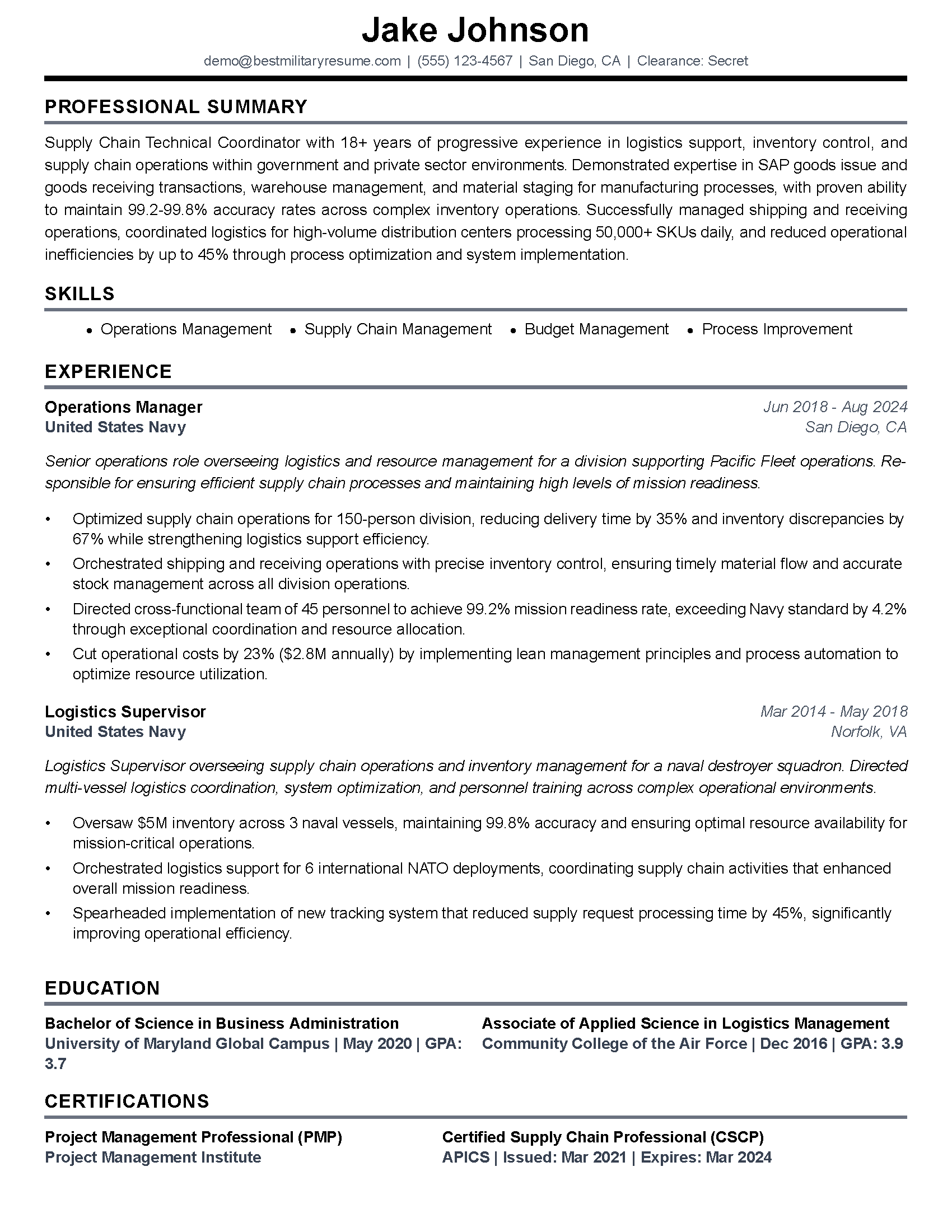
Rank, command time, and staff billets need to read like business titles and outcomes. Numbers, scope, budget, headcount.
6 to 9 Months Out: Apply Wide
Five to ten hosts per track. SkillBridge slots fill on rolling cycles, not one-shot windows.
5 Months Out: Get the O-6 Yes
Walk in with a host letter, a plan, and a release date. The O-6 wants confidence, not a packet to chase.
Start: Convert Before Day 120
Push for a real conversion talk by day 60. Get an offer in writing by day 120. The last 60 days are wind-down and onboarding paperwork.
When you apply, your host wants a civilian resume. One that translates rank, command, and staff time into language they can read. That is the whole point of the BMR builder. Paste your military background. Pick Federal or Private Sector. It tailors to the host's job description in minutes. Free tier covers two tailored resumes. That is enough to land your first host conversation.
The Traps Officers Walk Into
I have watched a lot of officers run this play. The same mistakes show up over and over.
- Taking a "fellowship" with no offer at the end: Real SkillBridge converts. If a host cannot tell you their hire rate, assume it is low.
- Negotiating the title at offer time: The host already wrote the requisition. Push title up during SkillBridge. Not after.
- Ignoring federal because pay looks low: Pension plus locality plus TSP match adds up. Run the real math.
- Picking by brand, not fit: McKinsey on the resume is great. McKinsey at the wrong life stage with the wrong scope is misery.
- Waiting until 6 months out to start: The good slots fill on a 9 to 12 month cycle. Late starts mean leftover slots.
- Skipping the resume rebuild: Your last fitness report is not a resume. Translate scope, budget, headcount, and outcomes.
For senior NCOs reading this from one rank south, the same patterns apply at a different scale. We have a sister piece on senior NCO SkillBridge programs if you want the E-7 plus version.
What If You Want the Federal Pipeline?
Retiring O-5s especially should not skip this. The federal pipeline lets you stack a military pension on a GS-14 or GS-15 paycheck. Add locality pay in DC, Norfolk, San Diego, or Honolulu. That combo beats most consulting offers on take-home. And beats all of them on stability.
The play is straightforward.
- Pick an agency that matches your career field: Acquisition officers fit DLA, Army Materiel Command, NAVAIR, AFLCMC. Logistics fits TRANSCOM and DLA. Intel fits NGA and DIA. Cyber fits CISA and NSA. Many agencies run SkillBridge slots and convert direct.
- Use VEOA and direct-hire authority: The Veterans Employment Opportunity Act lets you apply to merit promotion jobs that are closed to outsiders. Agency direct-hire authorities can shorten the queue further. Ask your target agency HR which authorities fit your series and grade.
- Translate to GS series and grade upfront: If you target a 1102 contracting role at GS-14, your resume needs to read 1102 GS-14. Officer career fields often map to several GS series. Pick the right one before you apply.
If you already work the federal world as a contractor, the move to federal employee runs the same lane. We cover that path in contractor to federal employee switch.
What to Do This Week
You do not need a perfect plan. You need a starting move.
- Block one hour: List the two tracks you would test if you only had two shots.
- Talk to three people: Find an O-4 or O-5 who finished SkillBridge in each of your two tracks last year. Ask what they would do differently.
- Update one document: Take your resume and rewrite the top two roles in civilian language. Numbers, scope, outcomes. No rank. No acronyms.
- Schedule one talk: Get on the phone with one host this month. Not all ten. One. Use it to learn how they actually run the program.
That is week one. The rest builds on it. SkillBridge for officers is not a magic ticket. Done well, it turns your last 180 days into the launch of the next 20 years. Done poorly, it is a paid sabbatical you regret. Pick the right track. Pick the right host. Walk in ready. That is the whole game.
Frequently Asked Questions
Is officer SkillBridge different from enlisted SkillBridge?
Do officers get paid during SkillBridge?
Can a retiring O-5 use SkillBridge?
Do consulting firms really hire officers from SkillBridge?
Does a TS or TS/SCI clearance change which SkillBridge programs to target?
What is the biggest mistake officers make with SkillBridge?
About the Author
Brad Tachi is the CEO and founder of Best Military Resume and a 2025 Military Friendly Vetrepreneur of the Year award recipient for overseas excellence. A former U.S. Navy Diver with over 20 years of combined military, private sector, and federal government experience, Brad brings unparalleled expertise to help veterans and military service members successfully transition to rewarding civilian careers. Having personally navigated the military-to-civilian transition, Brad deeply understands the challenges veterans face and specializes in translating military experience into compelling resumes that capture the attention of civilian employers. Through Best Military Resume, Brad has helped thousands of service members land their dream jobs by providing expert resume writing, career coaching, and job search strategies tailored specifically for the veteran community.
