Loading...
Loading...
The civilian and federal jobs that hire Air Force Mental Health Services — with real salaries and the resume that gets callbacks.
Every 4C0X1 has more options than a Google search will tell you. Below: career paths, BLS salary data, federal GS series, certifications by target career, and how to translate your experience without losing what made you valuable to the Air Force in the first place.
Free · No credit card · Tailored resume in under 5 minutes
After the Navy I got hired into 6 federal career fields and tech sales, and sat on federal hiring panels along the way. I spent the last 2 years rebuilding everything I learned into BMR, tuned for how AI actually screens resumes today. This is the system I wish I'd had on day one.
One page, built in our template, with your military experience translated into civilian terms hiring managers and ATS systems read. Use it as a reference for your own. Drop your email and we'll send you the download link.
Free. We'll also send occasional job-search tips. Unsubscribe anytime.
As a 4C0X1 Mental Health Service technician, you did the work that keeps a behavioral health clinic running. You conducted initial patient intakes and clinical interviews, administered standardized psychological screening tools, ran mental status exams, and supported licensed providers during individual and group therapy. You documented every encounter, managed treatment-plan paperwork, and instituted suicide-precaution and patient-safety measures when someone was in crisis. On deployments and exercises, you supported Combat and Operational Stress Control (COSC) and Disaster Mental Health teams, delivering psychological first aid to Airmen who had just been through the worst day of their lives.
The training pipeline runs through the Medical Education and Training Campus (METC) at Joint Base San Antonio-Fort Sam Houston, the joint-service school that also trains Army 68X and Navy behavioral health technicians. You earned the 3-skill level (4C031) after the resident course, then completed 5-level upgrade training and a Career Development Course at your first duty station. That shared schoolhouse is exactly why your background reads as a true cross-service equivalent to the Army 68X Behavioral Health Technician and the behavioral-health side of the Navy Hospital Corpsman rating.
Civilian behavioral health employers value this background because the entry-level clinical work translates almost directly. You already know how to take a clinical history, run a screening instrument, write a clean progress note, and de-escalate someone in acute distress without making the situation worse. Those are billable, in-demand skills in a field BLS projects to grow much faster than average. Use the military-to-civilian career crosswalk to see how your AFSC maps across the civilian and federal job market.
BMR has built more than 60,000 resumes across every branch, and the behavioral-health technicians I see translate fastest when they stop writing "assisted providers" and start naming the clinical work: intakes run, screening tools administered, crisis interventions documented. The skills are billable on day one. The resume is what makes a civilian clinic see that before they pass you over. — Brad Tachi, Navy Diver veteran & BMR founder
The number that matters when you're deciding what's next: how does civilian pay compare to what you make now?
Military comp is approximate (varies by location/dependents). Civilian is BLS median. Federal includes locality pay. Your real number depends on duty station, family status, GS step, and overtime.
The behavioral health field is one of the more stable civilian landing spots for a transitioning medical AFSC, and the demand is real. BLS projects employment of substance abuse, behavioral disorder, and mental health counselors to grow 17 percent from 2024 to 2034, much faster than the average for all occupations. The catch worth knowing up front: the licensed counselor and clinical social worker roles require a master's degree and state licensure, while the technician-level and assistant-level roles hire on your existing experience.
The most direct entry-level match is Psychiatric Technician (O*NET 29-2053.00), with a BLS median wage of $42,590 as of May 2024 and projected 16 percent growth. Social and Human Service Assistant (O*NET 21-1093.00) pays a median of $45,120 and is a common case-management on-ramp. Community Health Worker (O*NET 21-1094.00) runs a median of $51,030 and rewards your screening and patient-education experience.
If you pursue licensure on the GI Bill, Substance Abuse, Behavioral Disorder, and Mental Health Counselor (O*NET 21-1018.00) carries a median of $59,190, and Health Education Specialist (O*NET 21-1091.00) sits at $63,000. With supervisory experience, Social and Community Service Manager (O*NET 11-9151.00) reaches a median of $78,240. Be honest with yourself about geography: behavioral health jobs cluster around hospitals, community mental health centers, and VA facilities, so the strongest markets follow population density.
Many veterans coming out of medical AFSCs look at the broader healthcare-support market too. The 4N0X1 Aerospace Medical Technician and 4E0X1 Public Health pages cover adjacent paths if you want to compare. When you are ready to put this on paper, our military resume builder is built to translate clinical experience into civilian terms, or you can build your resume now.
| Civilian Job Title | Industry | BLS Median Salary | Outlook | Match |
|---|---|---|---|---|
Psychiatric Technician O*NET: 29-2053.00 | Behavioral Health | $42,590 | 16% (Much faster than average) | strong |
Social and Human Service Assistant O*NET: 21-1093.00 | Human Services | $45,120 | 6% (Faster than average) | strong |
Community Health Worker O*NET: 21-1094.00 | Public Health | $51,030 | 13% (Much faster than average) | strong |
Substance Abuse, Behavioral Disorder, and Mental Health Counselor O*NET: 21-1018.00 | Behavioral Health | $59,190 | 17% (Much faster than average) | moderate |
Health Education Specialist O*NET: 21-1091.00 | Public Health | $63,000 | 4% (As fast as average) | moderate |
Rehabilitation Counselor O*NET: 21-1015.00 | Behavioral Health | $46,110 | 1% (Slower than average) | moderate |
Behavioral Health Care Coordinator O*NET: 21-1099.00 | Behavioral Health | $57,530 | 7% (Faster than average) | moderate |
Social and Community Service Manager O*NET: 11-9151.00 | Human Services | $78,240 | 7% (Faster than average) | moderate |
BMR rewrites your 4C0X1 experience for any of the civilian roles above — keywords, achievements, and language hiring managers actually scan for.
Free · No credit card · 2 tailored resumes included
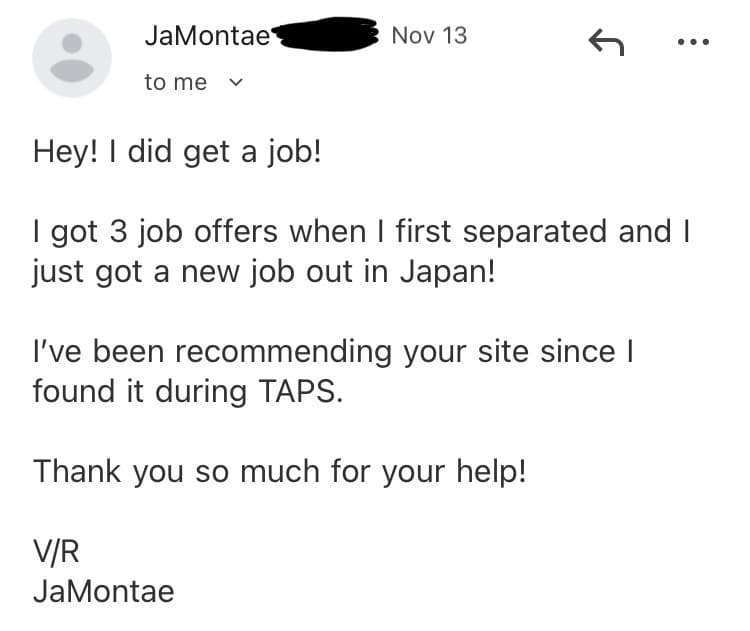
“Hey! I did get a job! I got 3 job offers when I first separated and I just got a new job out in Japan! I’ve been recommending your site since I found it during TAPS. Thank you so much for your help! V/R JaMontae ”
Federal service is one of the strongest paths for a 4C0X1, partly because the VA is the largest behavioral health employer in the country and partly because your clinical-support experience maps cleanly onto several GS series. Veterans' Preference adds 5 or 10 points to your competitive rating, and the VA also hires extensively through excepted-service authorities that move faster than the standard competitive process.
The closest entry-level match is the GS-0640 Health Aid and Technician series, which covers behavioral health technician and psychiatric technician roles inside VA and DoD facilities, typically advertised at the GS-4 through GS-7 range depending on your clinical hours. The GS-0186 Social Services Aid and Assistant series fits case-management and patient-coordination work at similar grades. As you add education, the GS-0101 Social Science series and the GS-0185 Social Work series open up, with GS-0185 requiring the qualifying social work degree and licensure for the full professional grades.
Two adjacent series are worth targeting: GS-0301 Miscellaneous Administration and Program for behavioral-health program-coordinator roles, and GS-0303 Miscellaneous Clerk and Assistant for clinical-documentation and health-records positions where your charting discipline is the qualifying experience. For federal application mechanics, our guide to specialized experience on federal resumes and the 2026 OPM federal resume format walk through exactly how to document clinical hours. You can also build a federal resume formatted to OPM standards, or start your federal resume here.
| GS Series | Federal Job Title | Typical Grades | Match | Explore |
|---|---|---|---|---|
| GS-0185 | Social Work | GS-9, GS-11, GS-12 | View Details → | |
| GS-0186 | Social Services Aid and Assistant | GS-4, GS-5, GS-6, GS-7 | View Details → | |
| GS-0640 | Health Aid and Technician | GS-4, GS-5, GS-6, GS-7 | View Details → | |
| GS-0101 | Social Science | GS-7, GS-9, GS-11 | View Details → | |
| GS-0301 | Miscellaneous Administration and Program | GS-5, GS-7, GS-9 | View Details → | |
| GS-0303 | Miscellaneous Clerk and Assistant | GS-3, GS-4, GS-5 | View Details → | |
| GS-0610 | Nurse | GS-9, GS-11 | View Details → |
Federal hiring uses keyword-matching and structured experience. BMR builds federal-format resumes (USAJobs-ready) with the right keywords, hours/week, and supervisor info — for any GS series above.
Free · No credit card · Federal + civilian resume formats included
Not everyone wants to stay in a related field. These career paths leverage your transferable skills — leadership, risk management, logistics, project planning — in completely different industries.
Employee relations runs on the exact skills behavioral health work builds: confidential interviewing, de-escalating tense conversations, and documenting sensitive cases cleanly. You already manage the hardest version of those conversations.
Running group therapy and psychoeducation sessions is structured-program delivery to a tough audience. Corporate training rewards facilitators who can read a room and adjust on the fly.
Correctional treatment work centers on assessing risk, building case plans, and managing people in difficult circumstances, the same assessment-and-intervention loop you ran in a clinic.
Talking someone through the worst moment of their day while staying calm and gathering critical information is exactly what you did on suicide-precaution and crisis calls. Dispatch needs that nervous system.
UX and qualitative research depend on structured interviewing, careful observation, and turning what people say into actionable findings, the clinical-interview skill set applied to product decisions.
Development work is built on empathetic, trust-first conversations and following through with people who care about a mission, the relational skills you used to build rapport with patients in distress.
The skills that made you a good Marine, Sailor, Airman, or Soldier transfer further than you think. BMR rewrites your bullets for any of the pivot careers above — without making you sound like you've never done the work.
Free · No credit card · Try unlimited career angles
If you are staying in behavioral health, your terminology already translates. Clinics, hospitals, and VA facilities use the same clinical vocabulary you learned at METC, so do not water down "mental status exam" or "psychological screening" for those employers. This section is for the careers OUTSIDE behavioral health, where a hiring manager has never read a CFETP and needs the civilian-business version of what you did.
The pattern that wins is naming the transferable competency, not the military setting. "Crisis intervention" becomes de-escalation and conflict resolution. "Clinical documentation" becomes case management and confidential records administration. "Group therapy facilitation" becomes group facilitation and structured-program delivery. Our glossary of 50 military terms translated to civilian language covers the broader vocabulary, and the guide to explaining military experience without jargon helps in the interview.
A few before-and-after examples for non-clinical roles. Before: "Conducted intake interviews and administered psychological screening tools for behavioral health clinic." After (for an HR or employee-relations role): "Conducted structured intake interviews and administered standardized assessments for 200+ individuals annually, maintaining strict confidentiality and accurate case records." Before: "Facilitated group therapy sessions." After (for a corporate training role): "Facilitated structured group sessions of 8 to 12 participants, adapting delivery to individual needs and tracking outcomes." Our resume builder handles this translation automatically, or you can get started here.
BMR turns your 4C0X1 duties and accomplishments into civilian bullets that match the job you're applying for — no manual translation, no rewriting.
Free · No credit card · Tailored to each job posting
Which certifications you need depends on where you're headed. Find your target career path below.
The wrong placement can sink an otherwise strong application. BMR knows where each cert ranks, what to call it, and how to frame it for ATS keyword matching and hiring manager attention.
Free · No credit card · Built around your real certs and clearance
Use these resources to move from AFSC to offer, split by whether you are staying in behavioral health or pivoting out.
Look at DoD SkillBridge internships with civilian hospital systems and community mental health organizations in your final 180 days. Professional associations worth joining: the National Board for Certified Counselors (NBCC) if you plan to pursue licensure, and the American Psychological Association's resources for psychiatric and behavioral health technicians. The American Association of Psychiatric Technicians (AAPT) offers a national certification that can credential your existing experience in states that recognize it. Your GI Bill is the lever for the master's degree that unlocks the licensed-counselor and clinical-social-worker grades.
For non-clinical pivots, American Corporate Partners (ACP) offers free veteran mentorship that pairs you with a corporate mentor in your target field. The Project Management Professional (PMP) and SHRM-CP credentials open doors in operations and HR respectively. Your clearance, if you held one, carries weight in federal and contractor hiring. For federal transition support, see our SFL-TAP transition resources.
Start with the military resume builder for private-sector roles or the federal resume builder for USAJOBS applications. Explore related paths through the career crosswalk tool, and when you are ready, build your resume now.
See also: Army 68X Behavioral Health Technician, Coast Guard HS Health Services Technician, and the Air Force 4N0X1 Aerospace Medical Technician career paths. For interview prep, read our guide to informational interviews for veterans.
Most veterans do this backwards — they wait until terminal leave to start, then panic. Here's the actual sequence that works.
Print this. Tape it to your monitor. Veterans who treat the transition like a 90-day op get hired faster than the ones who treat it like an emergency.
Stop rewriting from scratch every time you apply. BMR turns your military experience into civilian and federal resumes — tailored to each job.