Loading...
Loading...
The civilian and federal jobs that hire Air Force Histopathologys — with real salaries and the resume that gets callbacks.
Every 4T0X2 has more options than a Google search will tell you. Below: career paths, BLS salary data, federal GS series, certifications by target career, and how to translate your experience without losing what made you valuable to the Air Force in the first place.
Free · No credit card · Tailored resume in under 5 minutes
After the Navy I got hired into 6 federal career fields and tech sales, and sat on federal hiring panels along the way. I spent the last 2 years rebuilding everything I learned into BMR, tuned for how AI actually screens resumes today. This is the system I wish I'd had on day one.
Eighteen months of applications with nothing coming back is the kind of silence that makes you question the work itself. For a 4T0X2, that silence usually is not about the work. It is about a job title that hides what you actually did. As a Histopathology technician you stood at the bench between a surgeon's specimen and a pathologist's diagnosis. You grossed and accessioned surgical, cytology, and autopsy tissue, fixed and dehydrated it, embedded it in paraffin, and cut it on a microtome at four to five microns without tearing the section. You stained slides with hematoxylin and eosin, ran special stains and immunohistochemistry, cut frozen sections during surgery while an OR waited on the read, and kept the chain of custody on forensic and medicolegal specimens intact. That is exacting, irreversible work. Cut a block wrong and the tissue is gone. Most civilian hiring managers never see that level of precision described on a resume, because the resume says "lab tech" instead of what the hands did.
The pipeline is specific. After Basic Military Training you trained at the Medical Education and Training Campus (METC) at Fort Sam Houston in the Histopathology apprentice course, and award of the 4T052 craftsman level requires passing the American Society for Clinical Pathology (ASCP) Board of Certification Histotechnician (HT) examination. That HT credential is not a nice-to-have. On the civilian side it is the line between getting screened in and getting screened out, because it is the same certification a hospital histology lab requires of its own staff. From the 3-skill apprentice through the 7-skill craftsman, you moved from cutting and staining to validating new antibody panels, troubleshooting a stainer, and maintaining accreditation readiness under CAP and CLIA.
Civilian pathology labs value this background because histology does not forgive guesswork and the talent pool is thin. Hospital histology labs, dermatopathology and GI reference labs, and academic medical centers need people who can microtome cleanly, recognize a staining artifact before it reaches the pathologist, and document everything to an accreditation standard. The catch is translation. If you want to see where the specialty maps, start with our military-to-civilian career crosswalk. If you ran the broader clinical bench too, compare the 4T0X1 Medical Laboratory Specialist path, and if you cross-trained on patient care look at 4N0X1 Aerospace Medical Technician.
When I separated from the Navy I spent eighteen months applying with no callbacks, and the problem was never the experience. It was how it read on paper. A 4T0X2 carries that problem in a sharp form. "Histopathology technician" tells a civilian recruiter nothing, but "ASCP-certified histotechnician who cut frozen sections under OR time pressure and ran IHC panels under CAP accreditation" tells them everything. The translation is what costs the callbacks, not the work. — Brad Tachi, Navy Diver veteran & BMR founder
The number that matters when you're deciding what's next: how does civilian pay compare to what you make now?
Military comp is approximate (varies by location/dependents). Civilian is BLS median. Federal includes locality pay. Your real number depends on duty station, family status, GS step, and overtime.
The most direct civilian path keeps you at the microtome. Histotechnicians and histotechnologists sit inside the BLS group for Clinical Laboratory Technologists and Technicians, which reports a median wage of $61,890 (BLS OEWS, May 2024), with the lowest tenth under $38,020 and the top tenth above $97,990. The field is projected to grow about 5% through 2033. Where you land in that range depends on your ASCP category. A histotechnician (HT) sits lower than a histotechnologist (HTL), and HTL generally requires a bachelor's degree, so confirm which credential a posting names before you apply. O*NET tracks these roles distinctly: Histotechnologists under 29-2011.04 and Histologic Technicians under 29-2012.01.
The work splits by lab type. Hospital histology labs want a generalist who can gross, embed, microtome, and run routine H&E plus the common special stains, which is exactly how most Air Force histopath sections operate. Dermatopathology labs run enormous slide volume and prize a fast, clean microtome hand. GI and reference labs like those at large national pathology groups hire for immunohistochemistry and molecular preanalytics depth, where naming the antibody panels and the platforms you ran (for example a Ventana or Leica stainer) reads as a specialist rather than a generalist. Cytotechnology and grossing-room roles are adjacent moves that build on the same specimen-handling discipline.
Be honest about the market. Histology is stable and chronically short-staffed in many metros, which works in your favor, but pay varies sharply by region and employer type. Academic medical centers and large reference labs tend to pay more than small hospital labs, and night and weekend differentials are real money. If you want a higher ceiling, the same precision and staining chemistry moves into pharmaceutical and biotech tissue research, which the career-change section below covers. To translate bench detail into language a lab manager scans for, our military resume builder is built for it, and you can build your resume now once you know which lab type you are targeting. Army veterans who ran tissue work will find the 68K Medical Laboratory Specialist page useful for the shared civilian landscape, and there is a deeper look at the field in our military terms glossary.
| Civilian Job Title | Industry | BLS Median Salary | Outlook | Match |
|---|---|---|---|---|
Histotechnician (HT) O*NET: 29-2012.01 | Anatomic Pathology | $61,890 | 5% (Faster than average) | strong |
Histotechnologist (HTL) O*NET: 29-2011.04 | Anatomic Pathology | $61,890 | 5% (Faster than average) | strong |
Immunohistochemistry (IHC) Technician O*NET: 29-2011.04 | Reference & Specialty Pathology | $61,890 | 5% (Faster than average) | strong |
Grossing Technician (Pathology Assistant Support) O*NET: 29-2012.01 | Anatomic Pathology | $61,890 | 5% (Faster than average) | strong |
Cytotechnologist O*NET: 29-2011.04 | Anatomic Pathology | $61,890 | 5% (Faster than average) | moderate |
Histology Laboratory Supervisor O*NET: 29-2011.04 | Anatomic Pathology | $61,890 | 5% (Faster than average) | strong |
Anatomic Pathology Laboratory Technician O*NET: 29-2012.01 | Hospital & Academic Medical Centers | $61,890 | 5% (Faster than average) | strong |
BMR rewrites your 4T0X2 experience for any of the civilian roles above — keywords, achievements, and language hiring managers actually scan for.
Free · No credit card · 2 tailored resumes included
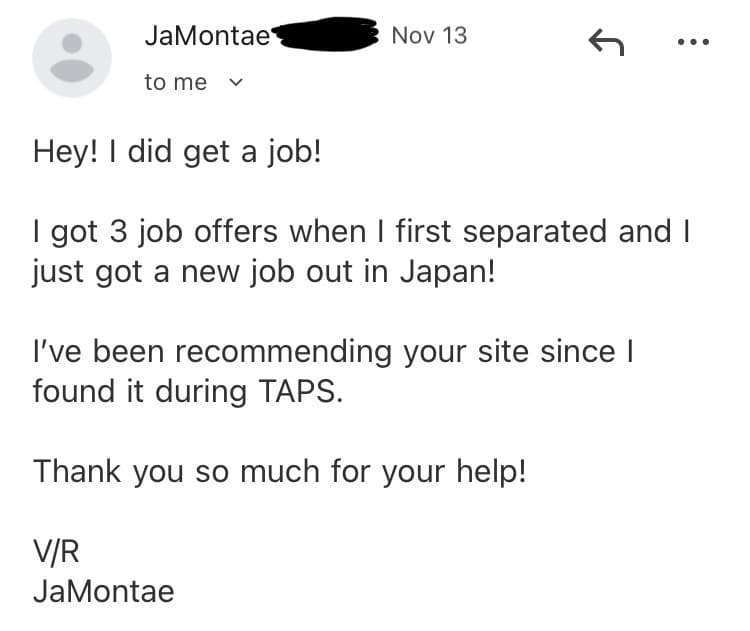
“Hey! I did get a job! I got 3 job offers when I first separated and I just got a new job out in Japan! I’ve been recommending your site since I found it during TAPS. Thank you so much for your help! V/R JaMontae ”
Federal pathology and research labs are among the strongest landing spots for a 4T0X2, because the histology bench inside a VA medical center or a military treatment facility is nearly identical to the one you already ran. The Department of Veterans Affairs operates the largest integrated health system in the country and staffs anatomic pathology and histology labs at most of its medical centers. The Defense Health Agency, the Armed Forces Medical Examiner System, the CDC, the FDA, and the National Institutes of Health all run histology and tissue-research labs. Veterans' Preference applies, and your METC training plus bench time counts as qualifying specialized experience.
The core series is GS-0644 Medical Technologist, which covers technologist-level histology and supervisory work and commonly runs GS-7 through GS-12 depending on your ASCP category and degree. GS-0645 Medical Technician covers technician-level histology roles at roughly GS-4 through GS-9, which is where many HT-certified histotechnicians enter. GS-0640 Health Aid and Technician picks up specimen-processing and accessioning roles. If you lean toward the chemistry of staining and tissue fixation, GS-1320 Chemistry opens at research labs, and GS-0601 General Health Science is the catch-all for hybrid bench-and-program positions. Histotechs supporting medicolegal autopsy work should look at GS-0644 and GS-0601 roles tied to the Armed Forces Medical Examiner System and VA pathology services, where frozen-section and autopsy support experience is specifically valued.
Grade placement turns on your ASCP credential and education, so list the HT or HTL category and any degree explicitly. A certified histotechnologist with a bachelor's qualifies for higher GS-0644 grades than a technician without one. The federal format is its own discipline, longer and more keyword-driven than a private resume. Our federal resume builder handles the USAJobs length and specialized-experience requirements, the specialized experience guide shows how to phrase your bench time so it qualifies, and you can start your federal resume when you are ready. Coast Guard health-services veterans chasing the same VA-lab path will find the HS Health Services Technician page useful for the shared series.
| GS Series | Federal Job Title | Typical Grades | Match | Explore |
|---|---|---|---|---|
| GS-0644 | Medical Technologist | GS-7, GS-9, GS-11 | View Details → | |
| GS-0645 | Medical Technician | GS-4, GS-5, GS-7, GS-9 | View Details → | |
| GS-0640 | Health Aid and Technician | GS-4, GS-5, GS-6 | View Details → | |
| GS-0601 | General Health Science | GS-7, GS-9, GS-11 | View Details → | |
| GS-1320 | Chemistry | GS-7, GS-9, GS-11 | View Details → |
Federal hiring uses keyword-matching and structured experience. BMR builds federal-format resumes (USAJobs-ready) with the right keywords, hours/week, and supervisor info — for any GS series above.
Free · No credit card · Federal + civilian resume formats included
Not everyone wants to stay in a related field. These career paths leverage your transferable skills — leadership, risk management, logistics, project planning — in completely different industries.
Your autopsy-support and medicolegal specimen work already runs on chain-of-custody discipline and microscopy. Forensic labs need exactly that documented, defensible sample handling.
Special-stain and tissue-fixation work is applied chemistry. Pharma and cosmetic QC labs run the same prepare-measure-document loop you ran on stainers and processors.
Preclinical CROs and biotech research labs need histology hands for tissue studies in drug development. Your processing, microtomy, and IHC skills transfer almost directly into a research setting.
Veterinary diagnostic labs run animal histopathology that mirrors human tissue work. Your processing and staining skills move over with minimal retraining on the veterinary side.
Food-safety labs use microscopy, staining, and sample-integrity discipline to test products and contaminants. Your bench precision and compliance habits map onto that QA environment.
Environmental labs process and analyze field samples under strict traceability and regulatory rules. Your specimen-handling, instrument, and documentation discipline transfers into that work.
The skills that made you a good Marine, Sailor, Airman, or Soldier transfer further than you think. BMR rewrites your bullets for any of the pivot careers above — without making you sound like you've never done the work.
Free · No credit card · Try unlimited career angles
If you are staying in histology or anatomic pathology, your terminology already matches the posting. A pathology lab manager knows what microtomy, H&E, IHC, and frozen sections are, so do not water those terms down. This section is for the 4T0X2 who wants to leave the pathology bench for a different industry, where a hiring manager has never seen "histopath" or "METC" and your value has to be spelled out in their language.
The move is to translate the underlying skill, not the medical context. Sectioning tissue at four microns on a microtome becomes precision sample preparation and microscopy specimen processing. Running a special-stain or IHC protocol becomes reagent chemistry and validated assay execution. Logging quality control on a stainer becomes instrument calibration and statistical process control. Keeping the chain of custody on a forensic specimen becomes documented sample integrity and traceability. Maintaining CAP and CLIA readiness becomes regulated-protocol compliance and audit readiness. Those are the phrases a pharmaceutical QC lab, a forensic lab, or a materials-science microscopy group scans for. For the wider pattern, our military terms glossary maps common histology jargon to plain business language, and the guide to explaining military experience without jargon shows how to say it out loud in the interview. When you are ready to rebuild the bullets, the resume builder structures them, and the table below shows the before-and-after pattern for non-pathology roles.
BMR turns your 4T0X2 duties and accomplishments into civilian bullets that match the job you're applying for — no manual translation, no rewriting.
Free · No credit card · Tailored to each job posting
Which certifications you need depends on where you're headed. Find your target career path below.
The wrong placement can sink an otherwise strong application. BMR knows where each cert ranks, what to call it, and how to frame it for ATS keyword matching and hiring manager attention.
Free · No credit card · Built around your real certs and clearance
SkillBridge can place you in a hospital histology lab or a national pathology group before you separate. Keep your ASCP Board of Certification HT or HTL current, because it is the single credential that opens the most civilian doors, and verify whether your target state requires separate clinical-laboratory personnel licensure, since California, New York, and Florida among others do. The National Society for Histotechnology (NSH) and the American Society for Clinical Pathology (ASCP) are the professional bodies worth joining for continuing education, proficiency resources, and job boards. See the SkillBridge guide for timing and command approval.
If you are pivoting into pharmaceutical or biotech tissue research, forensic science, food safety, or veterinary diagnostics, lean on American Corporate Partners (ACP) for veteran mentorship in those fields, and use your GI Bill toward a targeted credential rather than a second degree you may not need. Check the GI Bill certifications list for what your benefit funds toward a histology or science credential, and use SFL-TAP resources to lock down your transition timeline. To compare specialties side by side, use the career crosswalk tool.
Whatever direction you choose, the resume is the gate. Our military resume builder and federal resume builder are built for exactly this translation, and you can get started here in a few minutes.
See also: Air Force 4T0X1 Medical Laboratory Specialist, Army 68K Medical Laboratory Specialist, and Navy HM Hospital Corpsman career paths.
Most veterans do this backwards — they wait until terminal leave to start, then panic. Here's the actual sequence that works.
Print this. Tape it to your monitor. Veterans who treat the transition like a 90-day op get hired faster than the ones who treat it like an emergency.
Stop rewriting from scratch every time you apply. BMR turns your military experience into civilian and federal resumes — tailored to each job.