Loading...
Loading...
The civilian and federal jobs that hire Coast Guard Damage Controlmans — with real salaries and the resume that gets callbacks.
Every DC has more options than a Google search will tell you. Below: career paths, BLS salary data, federal GS series, certifications by target career, and how to translate your experience without losing what made you valuable to the Coast Guard in the first place.
Free · No credit card · Tailored resume in under 5 minutes
After the Navy I got hired into 6 federal career fields and tech sales, and sat on federal hiring panels along the way. I spent the last 2 years rebuilding everything I learned into BMR, tuned for how AI actually screens resumes today. This is the system I wish I'd had on day one.
One page, built in our template, with your military experience translated into civilian terms hiring managers and ATS systems read. Use it as a reference for your own. Drop your email and we'll send you the download link.
Free. We'll also send occasional job-search tips. Unsubscribe anytime.
Coast Guard Damage Controlmen (DC) are responsible for shipboard firefighting, flooding control, chemical/biological/radiological (CBR) defense, and hull maintenance on Coast Guard cutters. DCs maintain and operate firefighting systems, portable extinguishers, aqueous film-forming foam (AFFF) stations, damage control equipment, and CBR detection gear. They also perform welding, brazing, sheet metal fabrication, pipe fitting, and fiberglass repair to maintain the structural and watertight integrity of the vessel.
DCs complete 'A' School at Training Center Yorktown, Virginia — roughly 13 weeks covering shipboard firefighting tactics, damage control procedures, welding (stick, MIG, and oxy-fuel), pipe fitting, and HAZMAT response. Advanced DCs attend courses in advanced welding, Non-Destructive Testing (NDT), and HAZMAT Technician-level response. Some DCs also qualify as shipboard firefighting instructors at the CG Fire and Safety Test Detachment.
What makes DCs unique in the civilian job market is the combination of skilled trades (welding, fabrication, pipe fitting) with emergency response and safety management. Most civilian tradespeople have one or the other — DCs have both. They can weld a pipe, fight a fire that started from the weld, and then write the safety report afterward. That combination of hands-on technical skills with risk management and emergency response expertise is genuinely rare in the civilian workforce.
CG DCs translate to federal fire protection, NFPA-credentialed civilian roles, and federal facilities damage assessment positions. I've worked across federal engineering and the GS-0081 Fire Protection and GS-0019 Safety Tech series hire DCs when the resume actually frames the firefighting and damage control experience correctly. — Brad Tachi, Navy Diver veteran & BMR founder
The number that matters when you're deciding what's next: how does civilian pay compare to what you make now?
Military comp is approximate (varies by location/dependents). Civilian is BLS median. Federal includes locality pay. Your real number depends on duty station, family status, GS step, and overtime.
DCs carry a versatile skill set that maps to multiple civilian industries. The skilled trades side — welding, pipe fitting, sheet metal fabrication — puts DCs directly into construction, shipbuilding, industrial manufacturing, and maintenance. According to the Bureau of Labor Statistics, welders earn a median annual wage of $51,000 (May 2024, O*NET 51-4121.00), pipe fitters earn $63,700 (47-2152.00), and sheet metal workers earn $60,090 (47-2211.00). All three trades show stable or growing employment.
The emergency response and safety side opens doors to fire departments, industrial fire brigades, HAZMAT response teams, and occupational health and safety. Firefighters earn a median of $57,120 (33-2011.00) with 4% growth, while occupational health and safety specialists earn $83,910 (19-5011.00) with 12% growth.
DCs targeting higher-paying career tracks should consider the NDT (Non-Destructive Testing) field. NDT technicians — who inspect materials and structures without damaging them using ultrasound, radiography, and other methods — earn a median of $66,500 (17-3029.09 related). DCs with NDT qualifications from advanced training have a significant head start in this field.
| Civilian Job Title | Industry | BLS Median Salary | Outlook | Match |
|---|---|---|---|---|
Welder / Fabricator O*NET: 51-4121.00 | Construction / Manufacturing / Shipbuilding | $51,000 | About as fast as average (2%) | strong |
Plumber / Pipe Fitter / Steamfitter O*NET: 47-2152.00 | Construction / Industrial / Maritime | $63,700 | About as fast as average (2%) | strong |
Firefighter O*NET: 33-2011.00 | Fire Service / Government | $57,120 | About as fast as average (4%) | strong |
Occupational Health & Safety Specialist O*NET: 19-5011.00 | Government / Manufacturing / Construction | $83,910 | Faster than average (12%) | strong |
Sheet Metal Worker O*NET: 47-2211.00 | Construction / HVAC / Manufacturing | $60,090 | About as fast as average (4%) | strong |
HAZMAT Removal Worker O*NET: 47-4041.00 | Environmental Remediation / Industrial | $47,660 | About as fast as average (5%) | moderate |
Fire Inspector / Fire Investigator O*NET: 33-2021.00 | Government / Insurance | $68,180 | About as fast as average (4%) | moderate |
Emergency Management Director O*NET: 11-9161.00 | Government / Healthcare / Education | $83,960 | About as fast as average (3%) | moderate |
BMR rewrites your DC experience for any of the civilian roles above — keywords, achievements, and language hiring managers actually scan for.
Free · No credit card · 2 tailored resumes included
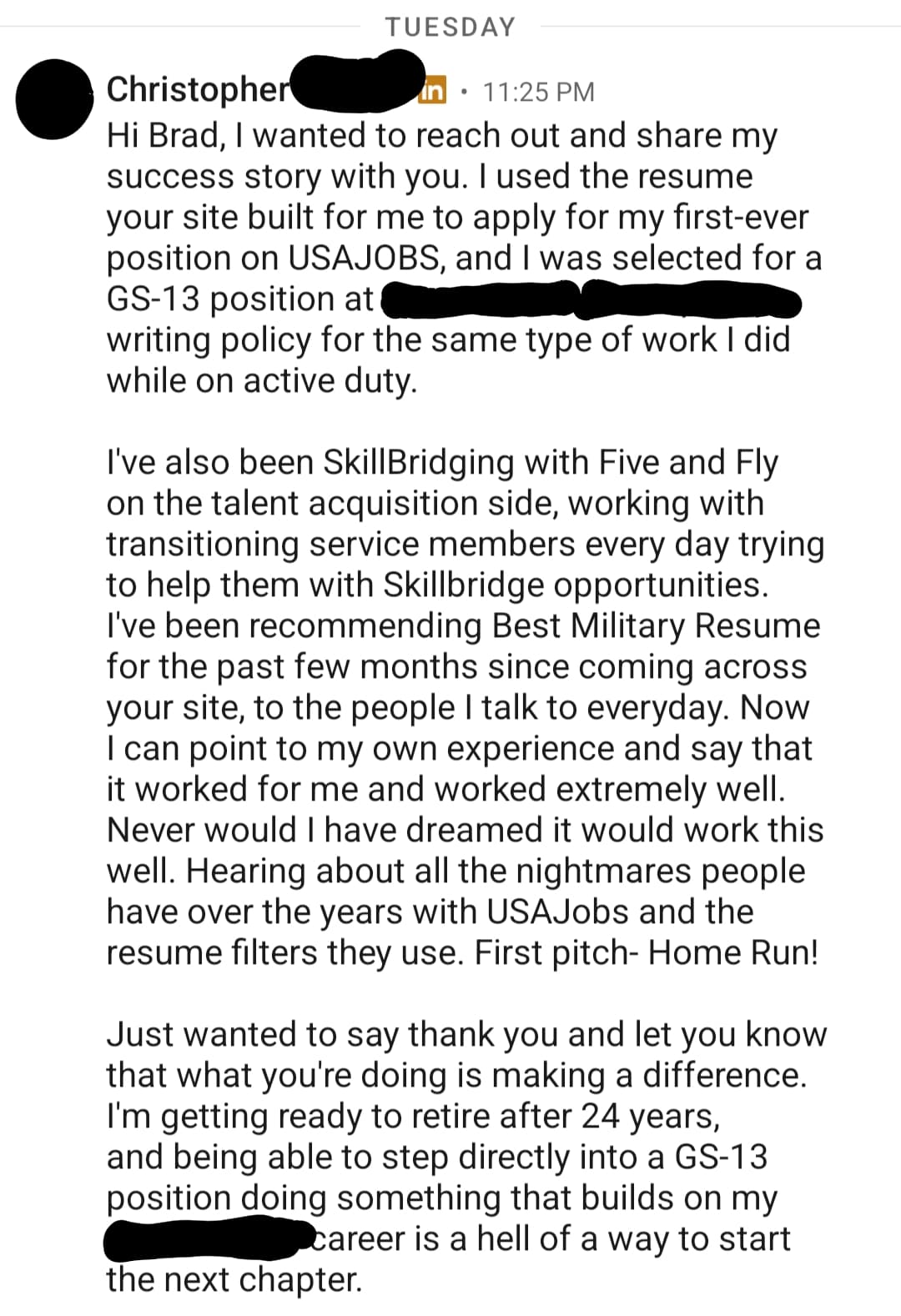
“I'm not working in the career field I want to be in. But the services provided has helped me land an interview with the Government. Now I wait to see if they select me for the position.”
DCs have an unusually wide range of federal career options because their skill set spans both trades and safety. On the trades side, Wage Grade positions for welders (WG-3703), pipe fitters (WG-4204), and sheet metal mechanics (WG-3806) are available at shipyards, military installations, and federal facilities nationwide. Naval shipyards in Norfolk, Puget Sound, Pearl Harbor, and Bath Iron Works employ hundreds of these tradespeople.
On the safety and emergency management side, Safety Management (GS-0018) and Safety Technician (GS-0019) positions are strong matches, especially at agencies with industrial operations, maritime facilities, or military installations. Fire Protection Engineer (GS-0804) positions align with DCs who have extensive firefighting instructor experience.
HAZMAT-qualified DCs should look at Environmental Protection Specialist (GS-0028) and General Physical Science (GS-1301) positions at EPA, Coast Guard, and DoD environmental cleanup programs. Emergency Management Specialist (GS-0089) roles at FEMA and DHS are strong matches for DCs with CBR defense and disaster response training.
For DCs who want to stay in the maritime world, Marine Cargo Inspector positions at Coast Guard Sector offices are civilian roles that directly leverage DC knowledge of ship systems, cargo safety, and HAZMAT regulations.
| GS Series | Federal Job Title | Typical Grades | Match | Explore |
|---|---|---|---|---|
| GS-0018 | Safety and Occupational Health Management | GS-9, GS-11, GS-12 | View Details → | |
| GS-0019 | Safety Technician | GS-7, GS-9, GS-11 | View Details → | |
| GS-0089 | Emergency Management | GS-9, GS-11, GS-12 | View Details → | |
| GS-0802 | Engineering Technician | GS-9, GS-11 | View Details → | |
| GS-1825 | Aviation Safety | GS-9, GS-11 | View Details → | |
| GS-0028 | Environmental Protection Specialist | GS-7, GS-9, GS-11 | View Details → | |
| GS-0301 | Miscellaneous Administration and Program | GS-7, GS-9 | View Details → | |
| GS-0801 | General Engineering | GS-9, GS-11 | View Details → | |
| GS-1301 | General Physical Science | GS-7, GS-9 | View Details → | |
| GS-0340 | Program Management | GS-11, GS-12, GS-13 | View Details → |
Federal hiring uses keyword-matching and structured experience. BMR builds federal-format resumes (USAJobs-ready) with the right keywords, hours/week, and supervisor info — for any GS series above.
Free · No credit card · Federal + civilian resume formats included
Not everyone wants to stay in a related field. These career paths leverage your transferable skills — leadership, risk management, logistics, project planning — in completely different industries.
DCs run and protect a ship's pressurized and damage-control systems, which is the same gauge-watching, alarm-response discipline a stationary engineer uses to keep a building's plant safe.
Flooding control means running pumps and valves to keep a space from going under, which is the exact instinct a treatment operator needs when flows surge and systems start to fail.
DCs isolate ruptures and rebuild valves and piping mid-casualty, so the precise valve and control-system work utilities depend on is already second nature.
Damage control is repair under the worst conditions, getting a flooded or burning space back into the fight, which is the same fast-diagnose-and-fix pressure a plant mechanic faces when a line goes down.
DCs handle CBR defense and atmosphere testing, taking readings and calling a space safe, which is the core of environmental technician work in a completely different industry.
A DC leads casualty-control teams, calling repairs while the clock runs, which is exactly how a maintenance supervisor directs crews keeping equipment and facilities running.
The skills that made you a good Marine, Sailor, Airman, or Soldier transfer further than you think. BMR rewrites your bullets for any of the pivot careers above — without making you sound like you've never done the work.
Free · No credit card · Try unlimited career angles
If you are applying to fire departments, shipyards, welding shops, or industrial safety firms, your terminology is already understood by the hiring manager. They know what AFFF is, they know what DC means in the context of damage control, and they know why CBR defense matters. This section is for DCs targeting careers outside of firefighting, trades, and maritime safety — project management, operations, corporate EHS, or any role where the hiring manager has never been aboard a ship.
BMR turns your DC duties and accomplishments into civilian bullets that match the job you're applying for — no manual translation, no rewriting.
Free · No credit card · Tailored to each job posting
Which certifications you need depends on where you're headed. Find your target career path below.
The wrong placement can sink an otherwise strong application. BMR knows where each cert ranks, what to call it, and how to frame it for ATS keyword matching and hiring manager attention.
Free · No credit card · Built around your real certs and clearance
Welding Certifications: The American Welding Society (AWS) administers civilian welding certifications. DCs with military welding qualifications may need to test to specific AWS codes (D1.1 Structural Steel, D1.6 Stainless Steel) for civilian employment. Test at an AWS Accredited Testing Facility — your CG welding experience reduces the learning curve significantly.
Fire Department Careers: Many fire departments give veterans' preference credit. The International Association of Fire Fighters (IAFF) can connect you with local union information. Your shipboard firefighting experience is real firefighting — emphasize structural fire attack, SCBA operations, and ventilation in applications.
NDT Certification: The American Society for Nondestructive Testing (ASNT) administers NDT certifications. DCs with military NDT qualifications have a head start. ASNT Level II certification opens doors to well-paying inspection positions in energy, aerospace, and infrastructure.
SkillBridge Programs: Search the SkillBridge database for welding, fire service, and safety employers. Some shipyards and industrial companies participate.
Safety & EHS: Start with OSHA 30-Hour (Maritime or General Industry, ~$150-300 online). For the career-level credential, target the CSP (Certified Safety Professional). DC safety and HAZMAT experience counts toward the experience requirement.
Project Management: PMP certification (PMI) — your DC damage control leadership and repair project coordination count toward the experience requirement. Cost: ~$555 (PMI member).
Federal Employment: Create your USAJobs profile. Key agencies: Coast Guard civilian, NAVFAC, NAVSEA shipyards, FEMA, EPA, Army Corps of Engineers. Federal resumes are 2 pages max. Build yours here.
Veteran Networking: American Corporate Partners (ACP) — free corporate mentorship for veterans.
Clearance Leverage: ClearanceJobs.com for cleared positions at defense contractors. Clearance stays active up to 24 months post-separation.
Coast Guard Resume Guide | Complete Military Resume Guide | Top Companies Hiring Veterans | Build Your Resume Free
Most veterans do this backwards — they wait until terminal leave to start, then panic. Here's the actual sequence that works.
Print this. Tape it to your monitor. Veterans who treat the transition like a 90-day op get hired faster than the ones who treat it like an emergency.
Stop rewriting from scratch every time you apply. BMR turns your military experience into civilian and federal resumes — tailored to each job.