Loading...
Loading...
The civilian and federal jobs that hire Coast Guard Cyber Mission Specialists — with real salaries and the resume that gets callbacks.
Every CMS has more options than a Google search will tell you. Below: career paths, BLS salary data, federal GS series, certifications by target career, and how to translate your experience without losing what made you valuable to the Coast Guard in the first place.
Free · No credit card · Tailored resume in under 5 minutes
After the Navy I got hired into 6 federal career fields and tech sales, and sat on federal hiring panels along the way. I spent the last 2 years rebuilding everything I learned into BMR, tuned for how AI actually screens resumes today. This is the system I wish I'd had on day one.
The Cyber Mission Specialist (CMS) is the Coast Guard's newest enlisted rating, approved by the Vice Commandant on 20 January 2022 and standing up its first billets in the 2023 assignment year. CMSs run full-spectrum cyberspace operations: defending Coast Guard networks, hunting adversary activity on Department of Homeland Security systems, and protecting the Marine Transportation System (the ports, vessels, and waterway infrastructure that move most of the nation's commerce). Most CMSs are assigned to dedicated cyber shore units under Coast Guard Cyber Command (CGCYBER) and its Cyber Protection Teams.
The training pipeline is the serious part. CMSs attend the Navy's 27-week Joint Cyber Analysis Course (JCAC) in Pensacola, Florida, the same foundational course that produces Navy Cryptologic Technician Networks and other joint cyber operators. From there, CMSs pick up advanced instruction in network traffic analysis, security threat analysis, blue-cell and red-cell operations, risk analysis, and cloud security. Because JCAC is a joint course, a CMS comes out the other side trained to the same baseline as cyber operators across the services, which is exactly why a hiring manager at a defense contractor or a federal SOC recognizes the qualification on sight.
Civilian employers value this background for two reasons that have nothing to do with patriotism. First, the work is real: a CMS has done incident detection, traffic analysis, and threat hunting on live government networks under operational pressure, not in a lab. Second, the security clearance. Cyber work in the Coast Guard requires a Top Secret clearance with SCI eligibility, and a cleared analyst who already knows the tooling is one of the most expensive and slow-to-produce hires in the private sector. You are walking out with both halves already done. If you want to see how that experience maps across the services, the Navy's Cryptologic Technician Networks (CTN) and the Coast Guard's own Information Systems Technician (IT) ratings share much of the same civilian map. For the broader picture of how cyber experience converts after service, see our guide on veterans breaking into InfoSec after the military.
I sat on the federal hiring side of the table after the Navy, and cleared cyber backgrounds were the rarest resumes that crossed my desk. A CMS who can write a JCAC-trained threat-hunting record into plain language is one of the easiest hires a federal SOC manager will make all year, because the clearance plus the live-network experience almost never come packaged together. The clearance opens the door. The way you describe the work is what lands the offer. — Brad Tachi, Navy Diver veteran & BMR founder
The number that matters when you're deciding what's next: how does civilian pay compare to what you make now?
Military comp is approximate (varies by location/dependents). Civilian is BLS median. Federal includes locality pay. Your real number depends on duty station, family status, GS step, and overtime.
Cyber is one of the few fields where the civilian market pays more than the government and is short on people, which works strongly in your favor. The numbers below are BLS Occupational Employment and Wage Statistics (OEWS), May 2024, national medians. Your geography matters: the highest concentrations of cleared cyber roles sit around Washington D.C., Northern Virginia, Maryland (Fort Meade), San Antonio, Tampa, and Colorado Springs, where the contractor and federal SOC density is highest.
The most direct translation is Information Security Analyst (O*NET 15-1212.00), with a BLS median of $124,910. This is the role most CMS threat-hunting and defensive operations experience maps to one-for-one. Closely related is the penetration tester / red-team side, which BLS also files under 15-1212.00; your JCAC red-cell training is the qualifying background. For people who leaned toward the network and traffic-analysis side, Computer Network Architect (15-1241.00, median $130,390) and Network and Computer Systems Administrator (15-1244.00, median $96,800) are strong fits. Analysts who enjoyed the requirements-and-systems side often land as Computer Systems Analysts (15-1211.00, median $103,790).
Be honest with yourself about seniority. A median is a midpoint, not a starting offer. A junior SOC analyst role may start below these figures, but cleared candidates compress that ramp fast, and contractors frequently pay a clearance premium on top of base. The cyber market also runs in hiring waves tied to federal contract cycles and budget timing, so a slow month is not a referendum on your resume. If you are weighing whether you even need a degree to make this jump, our breakdown of cybersecurity jobs veterans can land without a degree is the honest version. For the broader path map, see military cybersecurity to civilian careers.
Veterans from other branches compete for the same roles, so it helps to know your peers: the Army's 17C Cyber Operations Specialist, the Air Force's 1B4X1 Cyber Warfare Operations, and the Marine Corps' 0651 Cyber Network Operator all chase the same job titles. The candidate who translates the work best wins the interview. When you are ready to put your record into civilian language, a purpose-built military resume builder is the fastest way to handle exactly this translation.
| Civilian Job Title | Industry | BLS Median Salary | Outlook | Match |
|---|---|---|---|---|
Information Security Analyst O*NET: 15-1212.00 | Cybersecurity | $124,910 | 33% (Much faster than average) | strong |
SOC Analyst O*NET: 15-1212.00 | Cybersecurity | $124,910 | 33% (Much faster than average) | strong |
Penetration Tester O*NET: 15-1212.00 | Cybersecurity | $124,910 | 33% (Much faster than average) | strong |
Computer Network Architect O*NET: 15-1241.00 | IT & Networking | $130,390 | 13% (Faster than average) | strong |
Network and Computer Systems Administrator O*NET: 15-1244.00 | IT & Networking | $96,800 | 3% (As fast as average) | strong |
Computer Systems Analyst O*NET: 15-1211.00 | IT & Networking | $103,790 | 10% (Faster than average) | moderate |
Database Administrator O*NET: 15-1242.00 | IT & Networking | $104,620 | 9% (Faster than average) | moderate |
Computer Network Support Specialist O*NET: 15-1231.00 | IT & Networking | $73,340 | 7% (Faster than average) | moderate |
BMR rewrites your CMS experience for any of the civilian roles above — keywords, achievements, and language hiring managers actually scan for.
Free · No credit card · 2 tailored resumes included
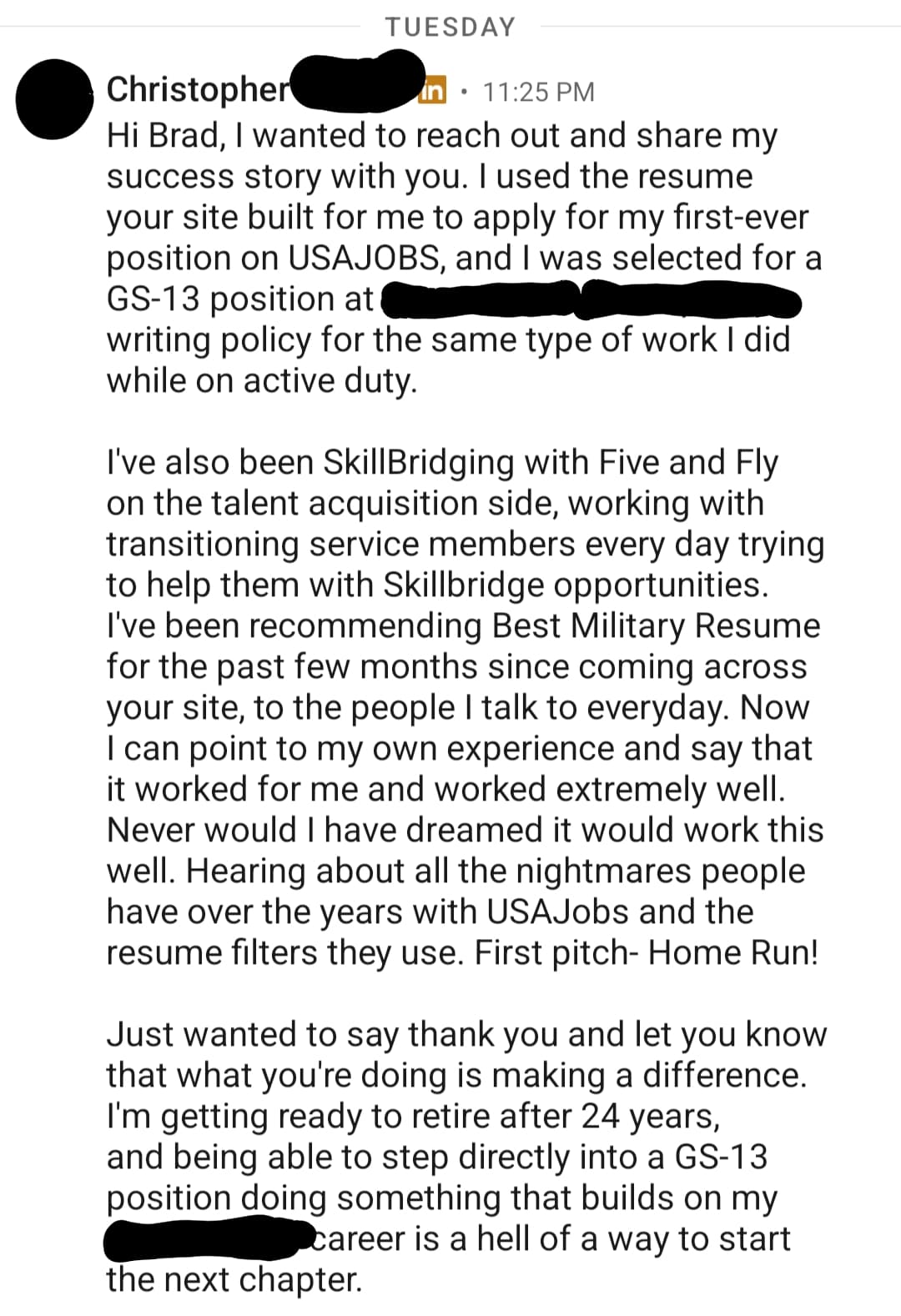
“I'm not working in the career field I want to be in. But the services provided has helped me land an interview with the Government. Now I wait to see if they select me for the position.”
The federal cyber path is the strongest single option a CMS has, and not for vague "stability" reasons. The federal government is the largest employer of cleared cyber talent in the country, your clearance is already current, and the qualification standards line up with what you actually did. The relevant series is GS-2210 Information Technology Management, which carries a Cybersecurity parenthetical specialty (INFOSEC) that exists precisely for backgrounds like yours. A CMS with a few years in typically qualifies for GS-9 through GS-12 depending on time-in-grade and scope, and the 2210 ladder commonly runs to GS-13 and beyond at agencies like CISA, the Coast Guard's own civilian cyber workforce, DHS components, and DoD.
Do not stop at 2210. Analysts who worked the intelligence side of cyber threat work qualify for GS-0132 Intelligence. Those who ran the security and compliance side map to GS-0080 Security Administration, which covers information security program management. Engineering-heavy CMSs who built or architected systems can compete for GS-0854 Computer Engineering or GS-1550 Computer Science when their record supports the academic requirement. The traffic-and-comms side translates to GS-0391 Telecommunications, and program-management roles sit under GS-0343 Management and Program Analyst or GS-0301 Miscellaneous Administration and Program.
Two things actually move a federal cyber application. First, Veterans' Preference (5 or 10 points) plus the VEOA pathway can get you into merit-promotion announcements normally closed to the public. Second, the federal resume is its own format and length, and a USAJOBS resume that reads like a private-sector one-pager gets passed over. Our GS-2210 IT Specialist federal resume guide walks the 2210 series specifically, and the 2026 OPM federal resume format guide covers the structure. A dedicated federal resume tool handles the hours-per-week and supervisor fields USAJOBS demands. The Air Force 1D7X1 Cyber Defense Operations page targets the same GS-2210 ladder if you want to compare notes.
| GS Series | Federal Job Title | Typical Grades | Match | Explore |
|---|---|---|---|---|
| GS-2210 | Information Technology Management | GS-11, GS-12, GS-13 | View Details → | |
| GS-0854 | Computer Engineering | GS-9, GS-11, GS-12 | View Details → | |
| GS-1550 | Computer Science | GS-9, GS-11, GS-12 | View Details → | |
| GS-0132 | Intelligence | GS-11, GS-12, GS-13 | View Details → | |
| GS-0391 | Telecommunications | GS-7, GS-9, GS-11 | View Details → | |
| GS-0343 | Management and Program Analyst | GS-9, GS-11, GS-12 | View Details → | |
| GS-0080 | Security Administration | GS-9, GS-11, GS-12 | View Details → |
Federal hiring uses keyword-matching and structured experience. BMR builds federal-format resumes (USAJobs-ready) with the right keywords, hours/week, and supervisor info — for any GS series above.
Free · No credit card · Federal + civilian resume formats included
Not everyone wants to stay in a related field. These career paths leverage your transferable skills — leadership, risk management, logistics, project planning — in completely different industries.
CMS watchstanding builds the exact discipline ATC demands: continuous monitoring of fast-moving data where a missed signal has real consequences, with structured shift handoffs.
Examining institutions for compliance is the same analytical loop as auditing a network against a security baseline: test against rules, find the deviation, document it, recommend the fix.
CMSs write incident reports and procedures that non-technical leadership has to act on. That skill, turning technical complexity into clear instructions, is exactly what technical writing pays for.
CMSs who trained junior watchstanders already teach technical material under pressure. CTE programs in cyber and IT are growing and actively want instructors with real operational experience.
A control room and a cyber operations center run on the same logic: watch the instruments, respond to alarms by procedure, document everything, hand off cleanly. The operational discipline transfers directly.
The procedural rigor and instrument-monitoring habits a CMS builds on watch are the same habits aviation rewards. The clearance-level reliability standard also signals well to operators.
A sales engineer sells technical products by being the person in the room who actually understands them. A CMS who has run the tools carries credibility a career salesperson cannot fake, especially selling security gear.
The skills that made you a good Marine, Sailor, Airman, or Soldier transfer further than you think. BMR rewrites your bullets for any of the pivot careers above — without making you sound like you've never done the work.
Free · No credit card · Try unlimited career angles
If you are applying to a cleared cyber role at a defense contractor or a federal SOC, your terminology already translates. Those hiring managers know what JCAC is, what a Cyber Protection Team does, and what threat hunting means. This section is for the CMS targeting a career OUTSIDE cyber and intelligence, where the reader has never heard your acronyms and will not Google them.
The pattern that gets you hired outside the field is the same every time: name the civilian-recognized skill, then show the scale and the outcome. Drop the unit jargon and keep the verb and the number.
The translation work is where most veterans lose callbacks, not the experience itself. Our glossary of 50 military terms translated to civilian language covers the common ones, and skills-based hiring explains why naming the skill plainly beats listing the billet. A good resume tool does this translation line by line so a non-technical recruiter understands what you did.
BMR turns your CMS duties and accomplishments into civilian bullets that match the job you're applying for — no manual translation, no rewriting.
Free · No credit card · Tailored to each job posting
Which certifications you need depends on where you're headed. Find your target career path below.
The wrong placement can sink an otherwise strong application. BMR knows where each cert ranks, what to call it, and how to frame it for ATS keyword matching and hiring manager attention.
Free · No credit card · Built around your real certs and clearance
If you are staying in the field, the fastest leverage is mapping your JCAC and on-the-job experience to the certifications hiring managers filter on, and getting your clearance status documented before you separate. The CompTIA Security+ and CySA+, the GIAC defensive and incident-response tracks, and the ISC2 credentials are the ones that show up in federal and contractor job postings under DoD 8140. SkillBridge is worth using if your command will release you: it places you with a civilian cyber employer for your last months of service. Our DoD 8140 certification guide shows which certs satisfy which work roles, and cybersecurity certifications for veterans (2026) ranks them by hiring impact.
If you are done with cyber entirely, your clearance and analytical training still travel. Document your clearance status early, because reactivation is far cheaper for an employer than a fresh investigation. Our guide on checking your clearance status after separation and what a clearance is worth in salary cover the money side. For mentorship, American Corporate Partners (ACP) pairs transitioning veterans with industry professionals at no cost.
Whatever direction you pick, the resume is the bottleneck. Start with the military resume builder for private-sector roles or the federal resume builder for GS positions, and explore adjacent paths through the career crosswalk. For transition timing and TAP resources, see SFL-TAP transition support. Ready to move? Build your resume now.
See also: Coast Guard ET Electronics Technician, Navy IT Information Systems Technician, and Army 25B Information Technology Specialist career paths.
Most veterans do this backwards — they wait until terminal leave to start, then panic. Here's the actual sequence that works.
Print this. Tape it to your monitor. Veterans who treat the transition like a 90-day op get hired faster than the ones who treat it like an emergency.
Stop rewriting from scratch every time you apply. BMR turns your military experience into civilian and federal resumes — tailored to each job.