Loading...
Loading...
The civilian and federal jobs that hire Navy Naval Aircrewman (Tactical Helicopter)s — with real salaries and the resume that gets callbacks.
Every AWR has more options than a Google search will tell you. Below: career paths, BLS salary data, federal GS series, certifications by target career, and how to translate your experience without losing what made you valuable to the Navy in the first place.
Free · No credit card · Tailored resume in under 5 minutes
After the Navy I got hired into 6 federal career fields and tech sales, and sat on federal hiring panels along the way. I spent the last 2 years rebuilding everything I learned into BMR, tuned for how AI actually screens resumes today. This is the system I wish I'd had on day one.
As a Naval Aircrewman (Tactical Helicopter), you flew as the enlisted sensor operator in the back of the MH-60R Seahawk, the Navy's primary anti-submarine and anti-surface helicopter. You were not a passenger. You ran the acoustic suite, dropping and monitoring sonobuoys to detect, classify, and track submerged contacts. You worked the APS-153 multi-mode radar, the FLIR electro-optical/infrared turret, and the ALQ-210 electronic support measures system to build a surface and air picture in real time, then fed targeting solutions to the aircraft commander and the parent ship over Link-16 and tactical voice.
The mission set went well beyond submarine hunting. You crewed the cabin-mounted GAU-21 or M240 for anti-surface and force-protection gunnery, ran search and rescue and combat search and rescue, conducted vertical replenishment and medical evacuation, and stood watch as a safety observer during shipboard landings on a pitching flight deck at night. ASW, ASUW, SAR, and EW all lived in the same cockpit, and you switched between them on a single sortie.
The pipeline that produced you was deliberately hard. Aircrew Candidate School and Rescue Swimmer School in Pensacola weeded heavily before anyone touched a sensor console. From there came the AWR "A" school and the MH-60R Fleet Replacement Squadron, where you earned your aircrew wings and the G11A sensor-operator qualification. Every flight afterward was a graded event with your aircraft commander and the ship counting on your call.
Civilian employers value this background once it is translated, because the underlying work is real-time interpretation of noisy multi-sensor data under time pressure, with a life-or-death decision riding on whether you read the signal correctly. That is rare. If you want to see how your rating maps across the civilian and federal job market, start with the military career crosswalk tool, then compare your path to the broader Naval Aircrewman (AW) overview and the sister sensor rating, Sonar Technician (Surface). For the language problem specifically, the hidden military skills civilians don't recognize guide is worth a read.
When I separated from the Navy I spent 18 months sending out resumes and getting nothing back. The work was never the problem. Specialty aircrew skills like yours are exactly the kind that read as "no civilian equivalent" to a recruiter who has never heard of a sonobuoy or an MH-60R, and that misread is what costs you the callback, not your actual ability. Translate the sensor-operator job into plain results and the door opens. — Brad Tachi, Navy Diver veteran & BMR founder
The number that matters when you're deciding what's next: how does civilian pay compare to what you make now?
Military comp is approximate (varies by location/dependents). Civilian is BLS median. Federal includes locality pay. Your real number depends on duty station, family status, GS step, and overtime.
Your most direct civilian matches sit in aviation operations, avionics, and sensor or instrumentation technical work. The figures below are BLS Occupational Employment and Wage Statistics medians from May 2024.
Airborne sensor and systems work translates cleanly into avionics technician roles (BLS median $81,390), where reading and maintaining radar, EO/IR, and electronic-warfare boxes is the daily job. Aircraft mechanics and service technicians (median $78,680) hire former aircrew who understand systems from the operator's seat. If you pursue your civilian flight ratings on the GI Bill, commercial pilot work carries a BLS median of $122,670, though that path requires hour-building and certificates that take time and money.
The sensor-discrimination core of your job also maps to electrical and electronics engineering technicians (median $77,180) and calibration technologists and technicians (median $65,040), both of which reward someone who can interpret instrument output and trust it under pressure. Defense primes and their sustainment contractors actively recruit MH-60R aircrew for mission-systems trainer, flight-test, and field-service positions, where having flown the platform is worth more than a classroom certificate.
Be honest with yourself about geography and cycle. Avionics and flight-test jobs cluster around naval air stations, manufacturer plants, and defense corridors in places like San Diego, Jacksonville, Norfolk, and the DFW and Seattle aerospace hubs. Pay is strong but openings move with defense budgets and airline hiring waves. For the playbook on turning sensor-operator experience into resume bullets a civilian hiring manager understands, the what your job is worth breakdown and the highest-paying civilian transitions guide are good starting points. Cross-branch, your skills overlap with the Air Force RPA Sensor Operator path. When you are ready to draft, the military resume builder structures it for you.
| Civilian Job Title | Industry | BLS Median Salary | Outlook | Match |
|---|---|---|---|---|
Avionics Technician O*NET: 49-2091.00 | Aviation & Aerospace | $81,390 | 4% (As fast as average) | strong |
Aircraft Mechanic and Service Technician O*NET: 49-3011.00 | Aviation & Aerospace | $78,680 | 5% (Faster than average) | strong |
Electrical and Electronics Engineering Technician O*NET: 17-3023.00 | Engineering & Technical | $77,180 | 2% (Slower than average) | strong |
Calibration Technologist and Technician O*NET: 17-3028.00 | Engineering & Technical | $65,040 | 5% (Faster than average) | moderate |
Commercial Pilot O*NET: 53-2012.00 | Aviation & Aerospace | $122,670 | 5% (Faster than average) | emerging |
Sound Engineering Technician O*NET: 27-4014.00 | Media & Technical | $66,430 | 2% (Slower than average) | moderate |
Quality Control Inspector O*NET: 51-9061.00 | Manufacturing | $47,460 | -3% (Decline) | moderate |
BMR rewrites your AWR experience for any of the civilian roles above — keywords, achievements, and language hiring managers actually scan for.
Free · No credit card · 2 tailored resumes included
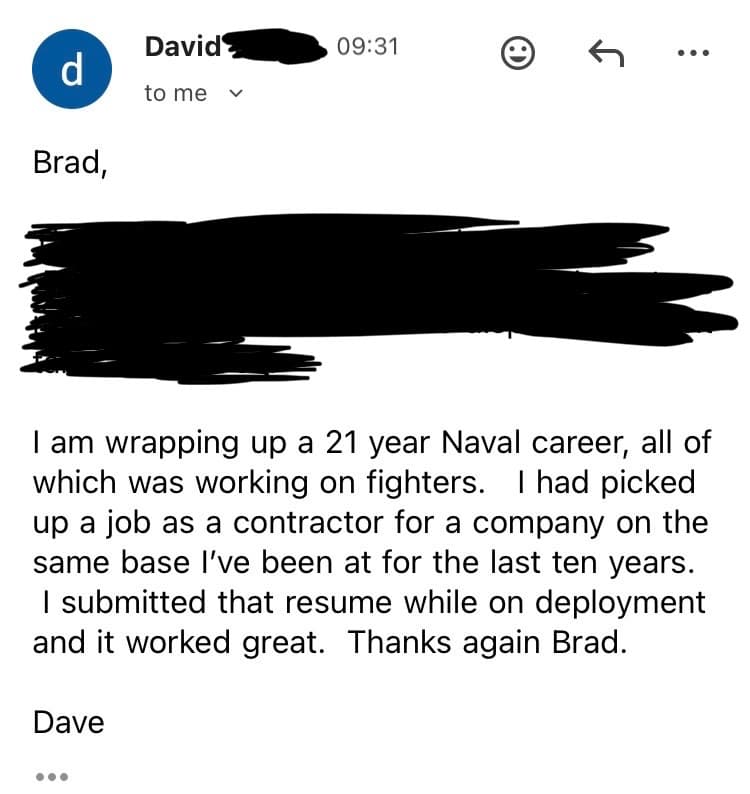
“I am wrapping up a 21 year Naval career, all of which was working on fighters. I had picked up a job as a contractor for a company on the same base I’ve been at for the last ten years. I submitted that resume while on deployment and it worked great. Thanks again Brad. Dave ”
Federal service rewards the exact combination most AWRs carry out of the fleet: an active security clearance, structured tactical-data analysis, and aviation-systems fluency. Veterans' Preference adds 5 or 10 points to your competitive rating, and a current clearance is a hiring shortcut that civilian-side candidates cannot replicate. The 5 vs 10 point Veterans' Preference guide explains where you fall.
The strongest direct fit is the GS-1825 Aviation Safety series with the FAA and the Navy, and the GS-1815 Air Safety Investigating series, where flight-deck and aircrew judgment is the qualification. The sensor-analysis side of your record supports the GS-0132 Intelligence series across DoD components and the GS-0391 Telecommunications and GS-0856 Electronics Technician series for the radar, ESM, and Link-16 work. Your maintenance-adjacent systems knowledge opens the GS-0802 Engineering Technician series.
Look past the obvious ones too. The GS-0018 Safety and Occupational Health Management series values aircrew who ran risk-management briefs on every sortie, the GS-0089 Emergency Management series wants your SAR and crisis-response background, and the GS-0080 Security Administration series fits a cleared veteran with physical and information-security exposure. Most AWRs qualify around the GS-7 to GS-11 band depending on rank and education, with technical series often starting a grade higher. Before you write anything, learn to read the announcement: the decode a USAJOBS announcement guide and the specialized experience guide tell you what the rating panel is scoring. The federal resume builder handles the OPM format.
| GS Series | Federal Job Title | Typical Grades | Match | Explore |
|---|---|---|---|---|
| GS-1825 | Aviation Safety | GS-9, GS-11, GS-12 | View Details → | |
| GS-0856 | Electronics Technician | GS-7, GS-9, GS-11 | View Details → | |
| GS-0802 | Engineering Technician | GS-7, GS-9, GS-11 | View Details → | |
| GS-0132 | Intelligence | GS-7, GS-9, GS-11 | View Details → | |
| GS-0391 | Telecommunications | GS-7, GS-9, GS-11 | View Details → | |
| GS-0089 | Emergency Management | GS-7, GS-9, GS-11 | View Details → | |
| GS-0018 | Safety and Occupational Health Management | GS-9, GS-11 | View Details → | |
| GS-0019 | Safety Technician | GS-5, GS-7, GS-9 | View Details → |
Federal hiring uses keyword-matching and structured experience. BMR builds federal-format resumes (USAJobs-ready) with the right keywords, hours/week, and supervisor info — for any GS series above.
Free · No credit card · Federal + civilian resume formats included
Not everyone wants to stay in a related field. These career paths leverage your transferable skills — leadership, risk management, logistics, project planning — in completely different industries.
Reading live acoustic and imaging output to identify and classify what you are seeing is the same cognitive skill you used on sonobuoy and FLIR runs, applied to patient care instead of contacts.
NDT is signal interpretation with a safety-of-life consequence, the same as classifying a faint subsurface contact. Ultrasonic testing in particular rewards an operator who reads acoustic returns for a living.
Using acoustic returns to build a picture of what is below the surface is exactly what sonobuoy operators do; the energy and geoscience industries do it with seismic data instead of sonar.
A 911 dispatcher does what you did in the cabin: take in multiple urgent inputs at once, triage them, and direct a response while lives hang on the call. The tempo and stakes are familiar.
Distinguishing a meaningful acoustic signal from background noise is the heart of sonobuoy work, and it is also the heart of live audio engineering. The ear and the discipline transfer.
Aircrew standardization instructors design training, deliver it, and certify others against hard standards. That is corporate training and development, minus the aircraft.
The skills that made you a good Marine, Sailor, Airman, or Soldier transfer further than you think. BMR rewrites your bullets for any of the pivot careers above — without making you sound like you've never done the work.
Free · No credit card · Try unlimited career angles
If you are staying in aviation, sensor systems, or avionics, your terminology already translates. Hiring managers in those fields know what a FLIR turret and a multi-mode radar are. This section is for AWRs targeting careers outside the cockpit, where "sonobuoy operator" on a resume reads as a dead end instead of the high-skill job it was.
The fix is to describe the underlying work, not the platform. The 50 military terms translated to civilian language glossary is a useful companion to the examples below.
Run every bullet through the lens of a manager who has never been near an aircraft. When you are ready, the military resume builder applies this translation automatically across your whole work history.
BMR turns your AWR duties and accomplishments into civilian bullets that match the job you're applying for — no manual translation, no rewriting.
Free · No credit card · Tailored to each job posting
Which certifications you need depends on where you're headed. Find your target career path below.
The wrong placement can sink an otherwise strong application. BMR knows where each cert ranks, what to call it, and how to frame it for ATS keyword matching and hiring manager attention.
Free · No credit card · Built around your real certs and clearance
Use these resources to move from the flight line to a civilian or federal offer. They are split by whether you are staying near aviation and sensors or leaving the field entirely.
See also: Sonar Technician (Surface) and the cross-branch Marine Helicopter Crew Chief path. When you are ready to put it on paper, build your resume now.
Most veterans do this backwards — they wait until terminal leave to start, then panic. Here's the actual sequence that works.
Print this. Tape it to your monitor. Veterans who treat the transition like a 90-day op get hired faster than the ones who treat it like an emergency.
Stop rewriting from scratch every time you apply. BMR turns your military experience into civilian and federal resumes — tailored to each job.