Loading...
Loading...
The civilian and federal jobs that hire Navy Robotics Warfare Specialists — with real salaries and the resume that gets callbacks.
Every RW has more options than a Google search will tell you. Below: career paths, BLS salary data, federal GS series, certifications by target career, and how to translate your experience without losing what made you valuable to the Navy in the first place.
Free · No credit card · Tailored resume in under 5 minutes
After the Navy I got hired into 6 federal career fields and tech sales, and sat on federal hiring panels along the way. I spent the last 2 years rebuilding everything I learned into BMR, tuned for how AI actually screens resumes today. This is the system I wish I'd had on day one.
The Robotics Warfare Specialist (RW) is the Navy's newest enlisted rating, established in 2024 by NAVADMIN 036/24. It is the first enlisted rating built specifically around unmanned and autonomous systems. If you converted into RW, you operate, maintain, and manage robotic and autonomous systems (RAS) across the air, surface, and subsurface domains. You are the subject-matter expert for computer vision, mission autonomy, navigation autonomy, data systems, and the artificial intelligence and machine learning that make those platforms work.
The rating was stood up to crew the Navy's hybrid fleet. The first RW Sailors converted from existing ratings who already held unmanned-systems billets and qualifying Navy Enlisted Classification (NEC) codes. Many came up through Electronics Technician A School, then C schools focused on robotic and AI-enabled warfare systems, sensor integration, and systems troubleshooting. Your day-to-day spans planning and controlling autonomous missions, managing the data and sensor payloads those platforms collect, and keeping the hardware and software stack running in environments where there is no operator on board to reach in and fix something.
That background is rare and getting more valuable. Civilian employers across defense, robotics, logistics automation, and energy are racing to field the same autonomous and AI-enabled systems the Navy is fielding, and they need people who have actually operated and sustained them, not just studied them. You can explore how that maps to civilian work with our military-to-civilian career crosswalk, and compare notes with adjacent Navy technical ratings like Electronics Technician (ET) and Information Systems Technician (IT), both of which feed the same autonomous-systems skill set.
There is one honest caveat worth saying out loud. RW is brand new, the population is still small, and there is no decade of veterans ahead of you who already made this jump. That is not a problem. It means the resume work matters more, not less, because you are translating cutting-edge experience that civilian recruiters have never seen on a resume before.
For a year and a half after the Navy I sent applications into a void with nothing coming back. The work was never the issue. It was that recruiters read my resume as "military" instead of "civilian." RW Sailors carry that problem at the extreme. You can have hands-on autonomous-systems and AI experience most civilian engineers would kill for, and a recruiter will still skim past it because "Robotics Warfare Specialist" reads as a Navy job title, not a robotics job. The translation is what earns the callback, not the experience. — Brad Tachi, Navy Diver veteran & BMR founder
The number that matters when you're deciding what's next: how does civilian pay compare to what you make now?
Military comp is approximate (varies by location/dependents). Civilian is BLS median. Federal includes locality pay. Your real number depends on duty station, family status, GS step, and overtime.
The civilian market for autonomous-systems talent is expanding fast, and RW experience lines up with several occupations that the U.S. Bureau of Labor Statistics (BLS) tracks. Salary figures below are BLS Occupational Employment and Wage Statistics (OEWS) national medians, May 2024.
Avionics and unmanned-platform technicians. If you worked the air side of the hybrid fleet, avionics technicians (BLS median $81,390) are the closest civilian analog. Commercial drone fleets, defense primes, and aerospace firms hire people who can keep autonomous airframes, sensors, and payloads mission-ready.
Electrical and electronics engineering technicians. At a BLS median of $77,180, this is the broadest landing spot for RW Sailors. Your work integrating sensors, controllers, and data systems on robotic platforms is exactly what these roles do in robotics, manufacturing automation, and R&D labs.
Electro-mechanical and mechatronics technicians. BLS median $70,760. Mechatronics sits at the intersection of mechanical hardware, electronics, and control software, which is the core of every robotic platform you sustained. This field is growing as factories and warehouses automate.
Robotics and field-service roles. Logistics-automation companies, warehouse-robotics fleets, and inspection-robot operators all need technicians who can deploy, calibrate, and recover autonomous units in the field. The honest read on this market is that it is geographically concentrated near defense hubs, tech corridors, and large distribution networks, so be ready to relocate or target remote-capable roles.
Veterans coming from the air side overlap heavily with civilian unmanned-aircraft career paths. If that is your route, the Army 15W Unmanned Aircraft Systems Operator and Air Force 1U0X1 RPA Sensor Operator pages cover the same civilian UAS market in depth. For broader salary context across ratings, our civilian salary data guide is a useful starting point, and you can line up specific roles against your experience with the resume builder built for veterans.
| Civilian Job Title | Industry | BLS Median Salary | Outlook | Match |
|---|---|---|---|---|
Avionics Technician O*NET: 49-2091.00 | Aerospace & Defense | $81,390 | 5% (Faster than average) | strong |
Electrical and Electronics Engineering Technician O*NET: 17-3023.00 | Robotics & Automation | $77,180 | 2% (Slower than average) | strong |
Electro-Mechanical and Mechatronics Technician O*NET: 17-3024.00 | Manufacturing Automation | $70,760 | 2% (Slower than average) | strong |
Computer Network Support Specialist O*NET: 15-1231.00 | Information Technology | $73,340 | 4% (As fast as average) | moderate |
Calibration Technologist and Technician O*NET: 17-3028.00 | Test & Measurement | $65,040 | 8% (Faster than average) | moderate |
Electronics Engineer O*NET: 17-2072.00 | Defense & R&D | $127,590 | 7% (Faster than average) | emerging |
Industrial Engineering Technician O*NET: 17-3026.00 | Logistics Automation | $64,790 | 6% (Faster than average) | moderate |
BMR rewrites your RW experience for any of the civilian roles above — keywords, achievements, and language hiring managers actually scan for.
Free · No credit card · 2 tailored resumes included
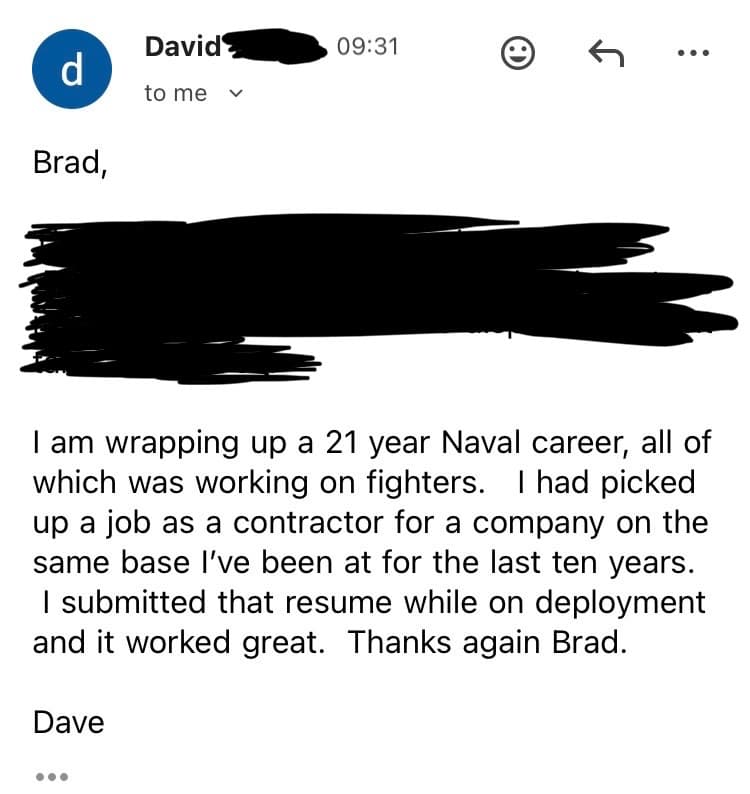
“I am wrapping up a 21 year Naval career, all of which was working on fighters. I had picked up a job as a contractor for a company on the same base I’ve been at for the last ten years. I submitted that resume while on deployment and it worked great. Thanks again Brad. Dave ”
Federal service is one of the strongest paths for RW Sailors, because the same agencies building autonomous and AI-enabled systems for defense are hiring for them directly. The federal General Schedule (GS) has several series that map cleanly to robotics, autonomy, and data work.
GS-0856 Electronics Technician. The most direct match. Your sensor-integration and electronics-troubleshooting work on robotic platforms qualifies you here, typically at GS-7 through GS-11 depending on experience and education. Navy warfare centers, NAVSEA, and NAVAIR hire heavily into this series.
GS-0802 Engineering Technician. For RW Sailors who worked across mechanical, electrical, and control systems, this series covers the multi-disciplinary technician work that supports engineering teams building unmanned platforms.
GS-2210 Information Technology Management. The data-systems and network side of autonomous operations maps here. RW work managing mission data, autonomy software, and sensor networks lines up with the cybersecurity and systems-administration tracks within this series.
GS-0855 Electronics Engineering and GS-0854 Computer Engineering. If you hold or are pursuing an engineering degree, these professional series open up. Veterans' Preference and a clearance make you competitive even at entry grades.
Speaking of clearance, most RW Sailors hold a security clearance, and that is a concrete federal hiring advantage that civilians cannot replicate quickly. Combined with Veterans' Preference, it moves your application up the stack. The catch is that USAJobs resumes follow rules that civilian resumes do not, and a private-sector resume will not survive the federal screening process. Our federal resume builder is built for exactly that format, and the career-paths-by-branch guide shows how technical ratings translate into GS work. Ratings that share these series include Cryptologic Technician Networks (CTN).
| GS Series | Federal Job Title | Typical Grades | Match | Explore |
|---|---|---|---|---|
| GS-0856 | Electronics Technician | GS-7, GS-9, GS-11 | View Details → | |
| GS-0802 | Engineering Technician | GS-7, GS-9, GS-11 | View Details → | |
| GS-2210 | Information Technology Management | GS-9, GS-11, GS-12 | View Details → | |
| GS-0854 | Computer Engineering | GS-7, GS-9, GS-11 | View Details → | |
| GS-0855 | Electronics Engineering | GS-7, GS-9, GS-11 | View Details → | |
| GS-1550 | Computer Science | GS-9, GS-11, GS-12 | View Details → |
Federal hiring uses keyword-matching and structured experience. BMR builds federal-format resumes (USAJobs-ready) with the right keywords, hours/week, and supervisor info — for any GS series above.
Free · No credit card · Federal + civilian resume formats included
Not everyone wants to stay in a related field. These career paths leverage your transferable skills — leadership, risk management, logistics, project planning — in completely different industries.
Hospitals run robotic surgical systems, automated diagnostics, and networked imaging that need the same sensor-and-electronics troubleshooting RW Sailors do on autonomous platforms.
Precision agriculture now runs on autonomous drones, sensor networks, and robotic field equipment. RW experience operating and sustaining uncrewed systems transfers directly to ag-tech operations.
Modern surveying relies on drone-mounted sensors and LiDAR to map sites. RW Sailors who managed sensor payloads and navigation autonomy already do the technical core of this work.
Broadcast and live-event production increasingly use remote-controlled cameras, automated rigs, and live data feeds. RW Sailors who ran remote sensor and camera payloads adapt quickly to this control-room work.
RW Sailors work alongside the AI and machine-learning that drive autonomous systems, giving them an applied head start most data-science entrants lack.
RW Sailors operate and troubleshoot the autonomy and mission software that controls robotic platforms, which is a natural on-ramp to building that software.
RW Sailors plan and sustain the lifecycle of high-value autonomous systems, which mirrors the planning and accountability logisticians manage for technical supply chains.
The skills that made you a good Marine, Sailor, Airman, or Soldier transfer further than you think. BMR rewrites your bullets for any of the pivot careers above — without making you sound like you've never done the work.
Free · No credit card · Try unlimited career angles
If you are staying in robotics, autonomy, or electronics, the people hiring you already speak your language. Sensor fusion, mission autonomy, and payload integration mean the same thing in a robotics lab as they do on a Navy unmanned platform. This section is for RW Sailors targeting careers OUTSIDE pure autonomous-systems work, where a hiring manager has never heard your rating and needs the experience translated into business language.
The core problem is that "Robotics Warfare Specialist" reads as a job title, not a skill set. A civilian recruiter does not know that RW means you ran AI-driven systems and recovered them when the autonomy failed. Translate the function, not the title.
| Military term | Civilian translation |
|---|---|
| Robotic and Autonomous Systems (RAS) | Autonomous systems / robotics platforms |
| Mission autonomy operator | Autonomous systems operations specialist |
| Sensor and payload management | Sensor integration and data acquisition |
| Computer vision / ML on platform | Applied machine learning and computer vision |
| Casualty troubleshooting | Root-cause failure analysis and diagnostics |
Before: "Served as RW mission autonomy operator for RAS platforms, conducted casualty troubleshooting on sensor payloads."
After: "Operated and recovered autonomous systems across air and surface domains, performing root-cause diagnostics on sensor and data-acquisition payloads to restore mission capability under operational deadlines."
That second version reads as a robotics-operations professional, which is what you are. For more on translating technical military language, see 50 military terms translated to civilian language and hidden military skills civilians do not know you have. When you are ready to rebuild your resume around the translation, the military resume builder handles the formatting so you can focus on the wording.
BMR turns your RW duties and accomplishments into civilian bullets that match the job you're applying for — no manual translation, no rewriting.
Free · No credit card · Tailored to each job posting
Which certifications you need depends on where you're headed. Find your target career path below.
The wrong placement can sink an otherwise strong application. BMR knows where each cert ranks, what to call it, and how to frame it for ATS keyword matching and hiring manager attention.
Free · No credit card · Built around your real certs and clearance
If you want to keep working with the platforms you already know, look at SkillBridge internships with defense robotics primes and autonomous-systems startups, which let you train with a civilian employer during your last months of service. Professional associations worth joining include the Association for Uncrewed Vehicle Systems International (AUVSI) for unmanned-systems networking and certifications, and IEEE for the broader robotics and AI engineering community. Stacking a recognized certification on top of your RW experience closes the credibility gap with civilian-trained candidates fast.
If you are pivoting into a different field, lean on the transferable side of the rating: systems thinking, data discipline, and the ability to run complex technical operations. American Corporate Partners (ACP) offers free veteran mentorship that pairs you with an industry professional, which is especially useful when you are entering a field with no obvious military pipeline. For federal roles, learn the USAJobs system early. Use your SFL-TAP transition resources to start the resume work before you separate, not after.
Whatever direction you choose, the resume is the bottleneck. Our military resume builder and federal resume builder translate RW experience into civilian and GS language, and the career crosswalk helps you explore options. When you are ready, you can build your resume now.
See also: Aviation Electronics Technician (AT), Air Force 1U1X1 RPA Pilot, and Marine 6469 UAS Operator for related autonomous-systems paths. For interview prep, read how to explain military experience in a civilian interview.
Most veterans do this backwards — they wait until terminal leave to start, then panic. Here's the actual sequence that works.
Print this. Tape it to your monitor. Veterans who treat the transition like a 90-day op get hired faster than the ones who treat it like an emergency.
Stop rewriting from scratch every time you apply. BMR turns your military experience into civilian and federal resumes — tailored to each job.