Military to Civilian Jobs by Branch: 12 Career Paths With Pay
Michael got only rejections. Then a $100K facilities manager role.
Michael, E-7, Navy, tried a ton of outside help before BMR
Military jobs match civilian work in operations, logistics, IT, cybersecurity, intelligence, HR, administration and healthcare. For 12 of them, 2025 median pay runs from $60,600 for paramedics to $129,180 for information security analysts.
Which Civilian Jobs Match Military Experience?
Each row is a civilian occupation from O*NET OnLine, the U.S. Department of Labor's job database. Pay is the national median, so half the people in that job earn more and half earn less. Your city and your level move it.
| Civilian career | Median pay (2025) | Outlook, 2025 to 2035 | Projected openings, 2025 to 2035 |
|---|---|---|---|
| Information security analysts (linked above) | $129,180 | Much faster than average (7% or higher) | 14,100 |
| Transportation, storage, and distribution managers | $107,230 | Faster than average (5% to 6%) | 18,300 |
| General and operations managers | $105,770 | Faster than average (5% to 6%) | 285,000 |
| Project management specialists | $102,320 | Much faster than average (7% or higher) | 76,500 |
| Management analysts | $101,860 | Much faster than average (7% or higher) | 94,100 |
| Network and computer systems administrators | $99,130 | Decline (-1% or lower) | 13,400 |
| Registered nurses | $97,550 | Faster than average (5% to 6%) | 180,800 |
| Intelligence analysts | $93,790 | Little or no change | 7,800 |
| Logisticians | $82,320 | Much faster than average (7% or higher) | 26,600 |
| Executive secretaries and executive administrative assistants | $76,590 | Little or no change | 43,300 |
| Human resources specialists | $75,940 | Faster than average (5% to 6%) | 73,700 |
| Paramedics (linked above) | $60,600 | Faster than average (5% to 6%) | 4,300 |
Each figure comes from the job's O*NET OnLine page. Those pages use Bureau of Labor Statistics (BLS) 2025 wage data. The outlook covers 2025 to 2035. Checked November 2026.
Two rows are worth a second look. Network and computer systems administrator pays $99,130, but O*NET projects the job to shrink. If you ran networks, look at the security analyst row too. It's projected to grow much faster than average.
Paramedic is the lowest-paid row. A medic who finishes nursing school and gets licensed moves to the registered nurse row. Its median is $97,550, with the same patient care background behind it.
Military to Civilian Jobs by Branch: Which Jobs Feed Each Career?
Each branch names its jobs differently. The Army and Marine Corps use MOS codes. The Navy and Coast Guard use ratings, and the Air Force uses AFSCs. The lists below are examples, not the only matches. What you actually did in the job decides the fit.
Army
- 11B Infantryman and 19D Cavalry Scout: general and operations manager
- 92A Automated Logistical Specialist and 92Y Unit Supply Specialist: logistician
- 88M Motor Transport Operator and 88N Transportation Management Coordinator: transportation, storage and distribution manager
- 42A Human Resources Specialist: human resources specialist
- 25B Information Technology Specialist: network and computer systems administrator
- 17C Cyber Operations Specialist and 25D Cyber Network Defender: information security analyst
- 35F Intelligence Analyst and 35G Geospatial Intelligence Imagery Analyst: intelligence analyst
- 68W Combat Medic Specialist: paramedic, or registered nurse after nursing school
For how to write each of these on a resume, see the Army MOS translation guide.
Navy
- BM Boatswain's Mate: general and operations manager
- LS Logistics Specialist: logistician
- PS Personnel Specialist and YN Yeoman: human resources specialist, or executive administrative assistant
- AZ Aviation Maintenance Administrationman: management analyst
- IT Information Systems Technician: network and computer systems administrator
- CTN Cryptologic Technician Networks and CWT Cyber Warfare Technician: information security analyst
- IS Intelligence Specialist: intelligence analyst
- HM Hospital Corpsman: paramedic, or registered nurse after nursing school
Rating codes and how to word them are in the Navy rating guide.
Air Force
- 3E6X1 Operations Management: general and operations manager
- 2G0X1 Logistics Plans: project management specialist
- 2R0X1 Maintenance Management Analysis and 3F3X1 Manpower: management analyst
- 2S0X1 Materiel Management: logistician
- 2T0X1 Traffic Management and 2T1X1 Ground Transportation: transportation, storage and distribution manager
- 3F0X1 Human Resources and Administration: human resources specialist
- 3F5X1 Administration: executive administrative assistant
- 3D1X2 Cyber Transport Systems and 1D7X1 IT Systems: network and computer systems administrator
- 1D7X5 Cybersecurity and 1B4X1 Cyber Warfare Operations: information security analyst
- 1N0X1 All Source Intelligence Analyst: intelligence analyst
- 4N0X1 Aerospace Medical Service: paramedic, or registered nurse after nursing school
The Air Force AFSC resume guide covers more codes.
Marine Corps
- 0311 Rifleman: general and operations manager
- 0511 MAGTF Planning Specialist: project management specialist
- 0411 Maintenance Management Specialist: management analyst
- 0431 Logistics/Embarkation Specialist and 3043 Supply Chain and Materiel Management Specialist: logistician
- 3112 Distribution Management Specialist and 3537 Motor Transport Operations Chief: transportation, storage and distribution manager
- 0111 Administrative Specialist and 0193 Personnel/Administrative Chief: human resources specialist, or executive administrative assistant
- 0631 Network Administrator: network and computer systems administrator
- 0681 Information Security Technician and 1721 Cyberspace Warfare Operator: information security analyst
- 0231 Intelligence Specialist: intelligence analyst
Medical care for Marines comes from Navy corpsmen, so the HM line above is the medical path. See the Marine Corps MOS guide for wording.
Coast Guard
- BM Boatswain's Mate: general and operations manager
- SK Storekeeper: logistician
- YN Yeoman: human resources specialist, or executive administrative assistant
- IT Information Systems Technician: network and computer systems administrator
- CMS Cyber Mission Specialist: information security analyst
- IS Intelligence Specialist: intelligence analyst
- HS Health Services Technician: paramedic, or registered nurse after nursing school
More ratings are in the Coast Guard ratings guide. Guardians have their own codes, covered in the Space Force resume guide.
Which Officer Paths Lead to Civilian Leadership Roles?
Four rows in the table ask for the planning and leading that officers do. They are general and operations manager, project management specialist, management analyst, and transportation, storage and distribution manager. All four have a 2025 median above $100,000.
BLS gives several officer examples in its Career Outlook article on military to civilian careers. One pairs the Navy's management analysis and control officer with civilian management analysts.
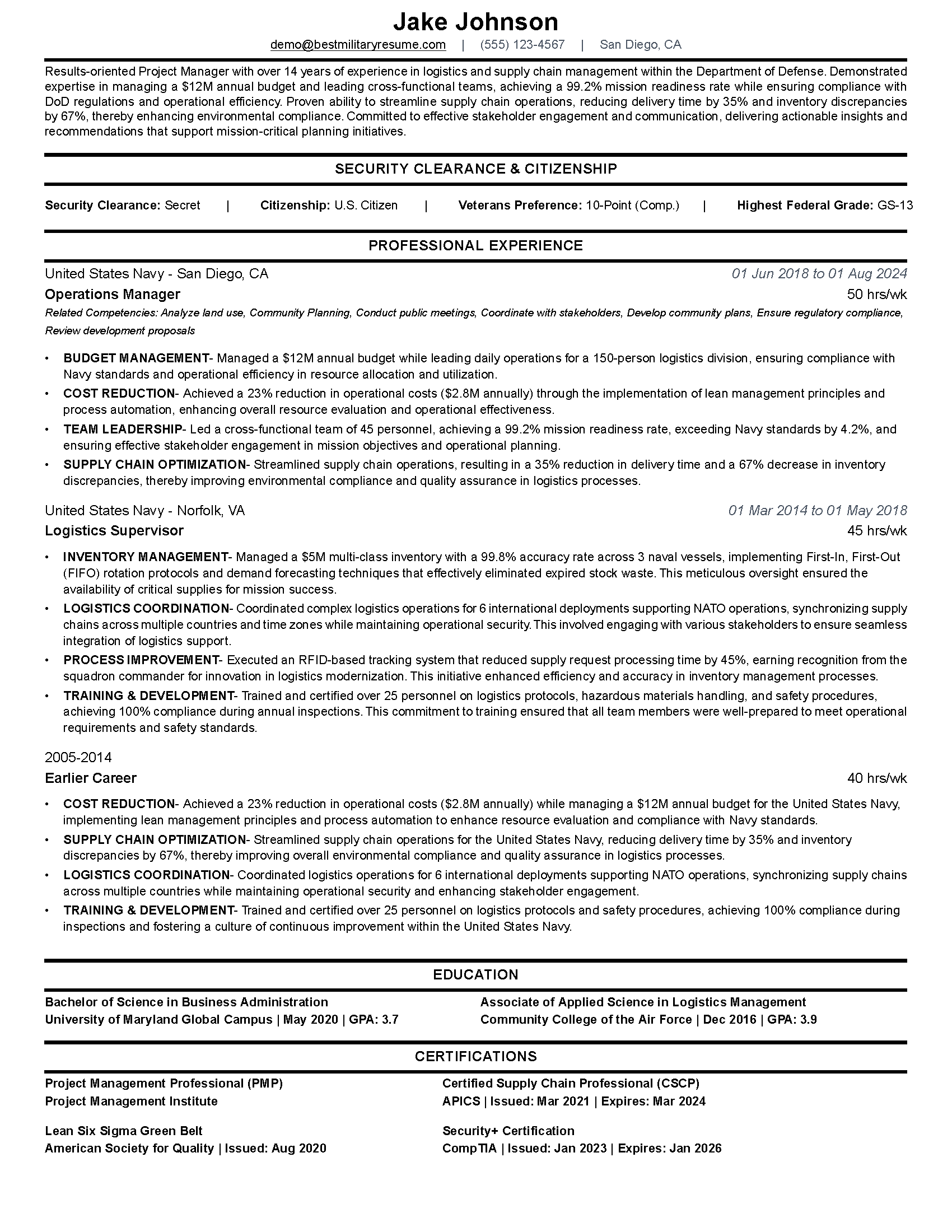
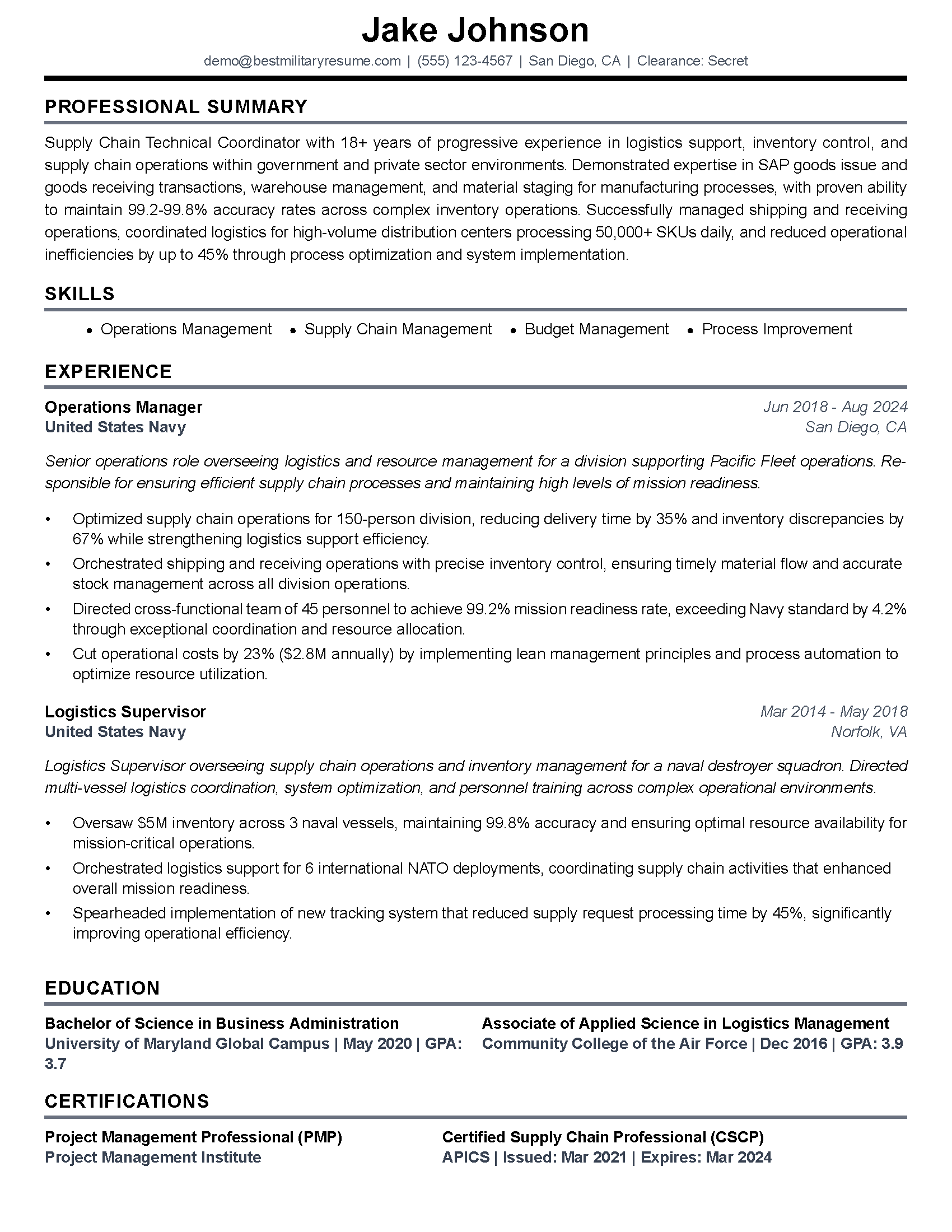
No officer path hands you a civilian title. Your level comes from scope: the people, gear and money you ran, and how far your decisions reached. Show those numbers and a reader can place your level. Leave it off and recruiters guess low. The officer resume guide shows how to write it.
What Does Each Path Ask For Beyond Your Military Job?
Operations and project management: Mission planning means setting objectives, moving resources, tracking timelines and adapting when the plan changes. That's project work. A PMP certification puts a civilian name on it, and you can start without one. See project management without a PMP.
Logistics and transportation: Hand receipts and moving equipment are the daily work of a logistician. APICS CSCP or CPIM certifications add civilian credibility. The logistics management career guide walks through the titles.
IT and cybersecurity: If you kept networks up or ran user accounts, you've done systems work. CCNA covers networking. CompTIA Security+ and CISSP cover security. The 25D and 17C cyber career guide shows the path.
Intelligence: Finding patterns and briefing leaders carry over to business intelligence, threat analysis, data analysis and competitive intelligence. The tools change to Tableau, Power BI, SQL and Python. The method stays. See the 35 series civilian careers guide.
HR and administration: Personnel actions, awards, evaluations and a commander's calendar are HR and executive support work. SHRM-CP certification bridges military HR to civilian standards. Read the military to HR career guide.
Healthcare: Paramedic and EMT work needs a state license, and many states use the NREMT exam. Registered nurse needs an approved nursing program, usually a degree, and a state license. The 68W and corpsman EMS guide covers the bridge programs.
Licensing Varies by State
Military medical training doesn't turn into a civilian license on its own. Each state sets its own rules for EMTs, paramedics and nurses. Look up your target state's rules well before you separate. Some states have faster routes for military medics, but the paperwork still takes time.
Which Other Civilian Jobs Fit Military Experience?
These paths fit too. Look up current pay for each one on O*NET.
- Law enforcement: Army 31B and Marine 5811 Military Police, and Navy MA Master-at-Arms. Add Air Force 3P0X1 Security Forces and Coast Guard ME Maritime Enforcement Specialist.
- Emergency management: Air Force 3E9X1 Emergency Management and Army 74D CBRN Specialist. Federal jobs in this field fall under GS-0089 in OPM's occupational handbook. See the emergency management resume guide.
- Paralegal: Army 27D Paralegal Specialist, Navy LN Legalman and Air Force 5J0X1 Paralegal.
- Contracting and procurement: Air Force 6C0X1 Contracting and Marine 3044 Operational Contract Support Specialist. Federal contract jobs are GS-1102.
- Finance: Army 36B Financial Management Technician, Air Force 6F0X1 Financial Management and Comptroller, and Marine 3432 Finance Technician.
- Training: Air Force 3F2X1 Education and Training, plus any NCO who ran ranges, schools or training plans.
Federal jobs in any of these fields can add veterans preference if you're eligible.
How Do You Pick One Path and Aim Your Resume at It?
Start with your own job. In BMR's Career Crosswalk Tool, pick your branch, then your MOS, rating or AFSC. It shows civilian titles and federal series. O*NET's free military crosswalk search gives a second view. Then pick one row from the table above as your target.
When I separated as a Navy Diver in 2015, I had specialized skills but zero clarity on which civilian careers made sense. I spent 18 months applying everywhere with no direction, getting zero callbacks. The moment I got specific about my target — picking a career lane and tailoring everything to it — I started getting interviews within weeks. That pattern has repeated across 25,926 veterans who have used BMR.
Once you have a title, put it at the top of your resume and use it in your summary. The job titles guide shows how to choose and word it. Then translate military terms in every bullet. Bring the scope with each one: how many people and how much gear and money.
Still torn between two fields? Picking a career field after the military works through that choice.
Key Takeaway
The right career depends on which skills you want to keep using and where you want to go. Pick your target career first. Then build your resume for that one path, with the posting's own words for work you've really done.
What's the Next Step After You Pick a Path?
Write a resume aimed at the one title you picked. One BMR success story: TJ, an Army Sergeant (E-5), ran federal and private searches at once. He landed a $143K private-sector program manager role, then a GS-14 within a month.
BMR's Resume Builder translates your military work into the words of the posting you paste in. Your first two tailored resumes are free.
For where people are landing, read where veterans are getting hired and the top companies hiring veterans. The complete military resume guide covers the whole resume, and the full list of military job pages goes branch by branch.
Frequently Asked Questions
Which military branch gives the best civilian job skills?
Can combat arms veterans get good civilian jobs?
Do I need a degree for these career paths?
Should I stay in my military field or switch careers?
How long does the military to civilian job search take?
Should I write one resume for every career path I'm considering?
About the author
Brad Tachi is the CEO and founder of Best Military Resume and a 2025 Military Friendly Vetrepreneur of the Year award recipient for overseas excellence. A former U.S. Navy Diver with over 20 years of combined military, private sector, and federal government experience, Brad brings unparalleled expertise to help veterans and military service members successfully transition to rewarding civilian careers. Having personally navigated the military-to-civilian transition, Brad deeply understands the challenges veterans face and specializes in translating military experience into compelling resumes that capture the attention of civilian employers. Through Best Military Resume, Brad has helped thousands of service members land their dream jobs by providing expert resume writing, career coaching, and job search strategies tailored specifically for the veteran community.