AWS Solutions Architect for Veterans: Is the Associate Cert Worth It After Cloud Practitioner?
Michael got only rejections. Then a $100K facilities manager role.
Michael, E-7, Navy, tried a ton of outside help before BMR
Yes, if you have some IT time behind you. AWS says "candidates with 1-3 years of IT experience have been able to prepare for and earn this certification as a starting point on their AWS Cloud learning and certification journey."
Your Cloud Practitioner also cuts the bill, because "once you earn one AWS Certification, you get 50% discount on your next AWS Certification exam."
You passed one AWS exam. Now you're asking if the next one is a stretch too far. This guide includes the exam facts in one table. It maps military work to the four exam domains. It also includes a resume block to copy.
Still deciding on your first cert? Start with why Cloud Practitioner comes first. This page picks up after you pass it.
79,061 resumes have been built on BMR so far.
How much AWS time does AWS want before you sit the exam?
It's a guide. The AWS Solutions Architect - Associate page calls it "the recommended experience prior to taking this exam." That line asks for "at least 1 year of hands-on experience designing cloud solutions that use AWS services."
The same AWS answer also makes room for IT people. That's the 1-3 years line at the top of this page. AWS also says the exam is "an ideal starting point for candidates with AWS Cloud or strong on-premises IT experience."
The page gives one more rule of thumb: "Candidates who do not have any IT work experience would benefit from first earning the AWS Certified Cloud Practitioner." You already did that part.
BMR advice: did you run a unit network or fix comm gear? Count that as on-premises IT time. If your job never touched IT, build lab time first. The free routes below give you that.
How big is the jump from Cloud Practitioner to Solutions Architect?
The question count stays the same. The clock, the price and the depth go up. The AWS Cloud Practitioner page says that exam checks a "foundational, high-level understanding of AWS Cloud."
| Item | Cloud Practitioner | Solutions Architect - Associate |
|---|---|---|
| Time | 90 minutes | 130 minutes |
| Questions | 65, multiple choice or multiple response | 65, multiple choice or multiple response |
| Cost | 100 USD | 150 USD, or half that with the 50% discount from your active Cloud Practitioner |
| Experience AWS names | "up to 6 months of exposure to AWS Cloud, but this is not required" | "at least 1 year of hands-on experience" |
| Valid for | 3 years | 3 years |
The SAA-C03 exam guide splits the scored questions into four domains:
| Domain | Share of scored content |
|---|---|
| Domain 1: Design Secure Architectures | 30% |
| Domain 2: Design Resilient Architectures | 26% |
| Domain 3: Design High-Performing Architectures | 24% |
| Domain 4: Design Cost-Optimized Architectures | 20% |
BMR advice: study in that order. Secure design carries the most weight, so it gets the most hours.
Where does your military work land in the four exam domains?
The guide's first task is "Design secure access to AWS resources." Its list includes "the principle of least privilege." Comm and cyber jobs can do that work on a unit network.
The map below is BMR advice. Use a row only if you did the work.
| If you did this in uniform | It lines up with | Build this in a lab |
|---|---|---|
| Set up user accounts and cut admin rights on a unit network | Domain 1: Secure | IAM roles with least-privilege policies |
| Kept backup comm paths ready when the main link went down | Domain 2: Resilient | An app spread across Availability Zones |
| Fixed slow links and tuned gear for more users | Domain 3: High-Performing | A load test, then instance and storage changes |
| Tracked gear and spend on a tight unit budget | Domain 4: Cost-Optimized | Budget alerts and right-sized instances |
IAM is AWS Identity and Access Management. The guide names it with IAM Identity Center under federated access.
Network and comm veterans can also read how a CCNA fits a network engineer resume.
Which free routes get you lab time before you book the exam?
The exam page points to "free, live webinars led by AWS-accredited instructors." It also lists "free Exam Readiness digital courses." An older, undated AWS blog post on veteran training named three more routes. Some have changed since, so here is what AWS's live pages say now:
- AWS Educate: the live page says you can build cloud skills "completely for free." It offers "free, self-paced online training" and hands-on tracks in storage, compute, networking, databases and cloud operations. It's "open to any individual, regardless of where they are in their education, technical experience, or career journey."
- AWS re/Start: the live page calls it "a cohort-based workforce development training program" with instructor-led sessions. "A technology background is not required to apply." "The program is free to the learner." Learners must be "18 years of age or older and unemployed or underemployed."
- Amazon Military SkillBridge: the post described it for members "separating within 180 days of service." Confirm the current terms with Amazon before you plan on it.
The Amazon Technical Apprenticeship page has a Solutions Architect path. "In this 14-week training course, you'll learn how to use our products and services in order to deliver the right solutions to our customers and drive future innovations." The page adds that these paid courses "are followed by up to 12 months of paid, on-the-job training."
BMR advice: pick one route that gives you hands-on lab time. That lab time is what turns study into the project on your resume. For the full program list, see free AWS training for veterans. To apply at Amazon, read how to apply to Amazon's veteran programs.
What happens on test day, and how long does the cert last?
You test at a "Pearson VUE testing center or online proctored exam," the exam page says. The exam guide sets the scoring rules:
- "The exam includes 50 questions that affect your score."
- "The exam includes 15 unscored questions that do not affect your score." You won't know which ones they are.
- "Unanswered questions are scored as incorrect; there is no penalty for guessing."
- Scores run from 100 to 1,000. "The minimum passing score is 720."
- "You need to pass only the overall exam." You don't have to pass each section.
BMR advice: answer every question. A blank counts as wrong, and a guess might be right.
The cert "is valid for 3 years." You can recertify "by passing the latest version of this exam, or by earning the AWS Certified Solutions Architect - Professional."
Where does the cert line go, and what project sits under it?
Put the cert in its own line. Then put a project right under it, so the reader sees what you built. Comparing clouds first? See which cloud cert to get first.
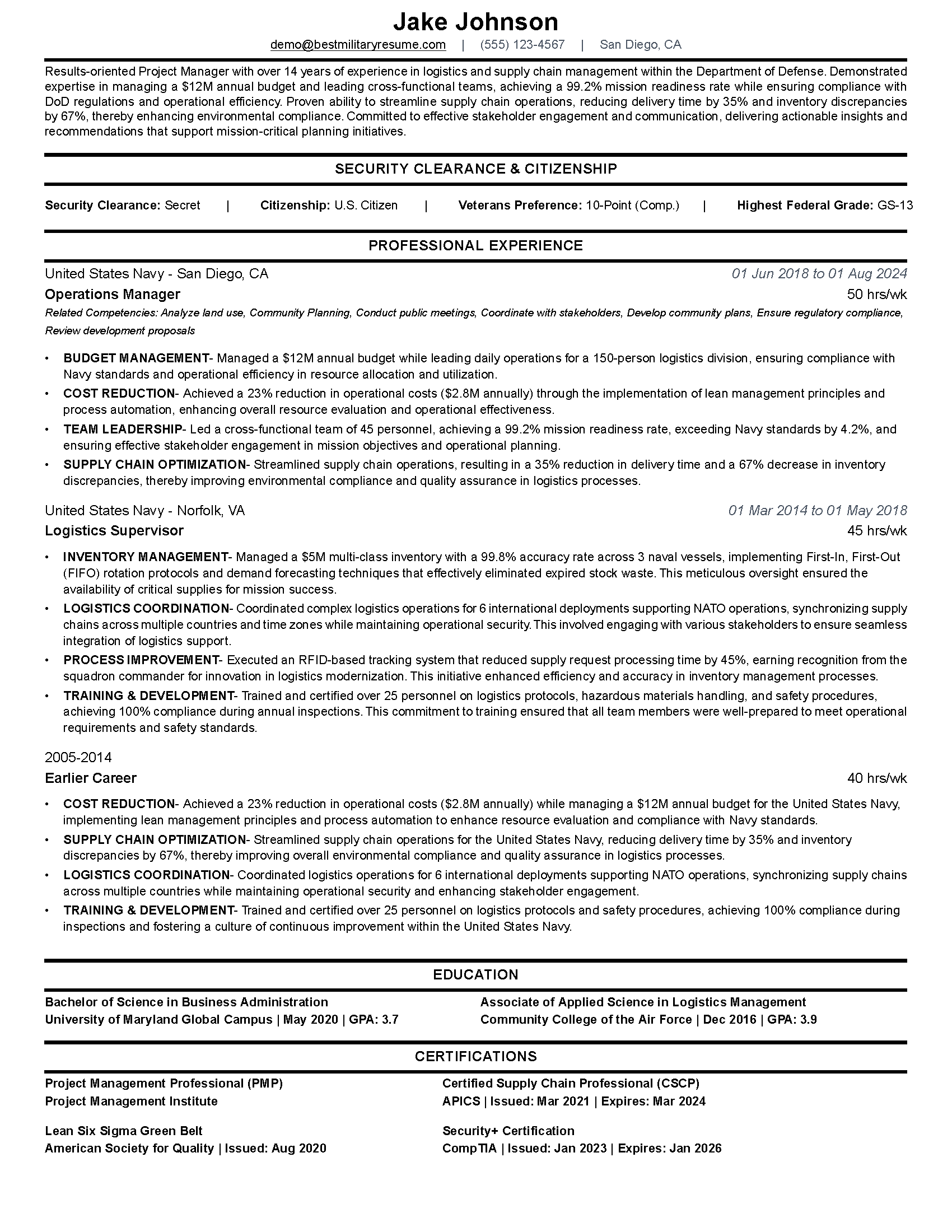
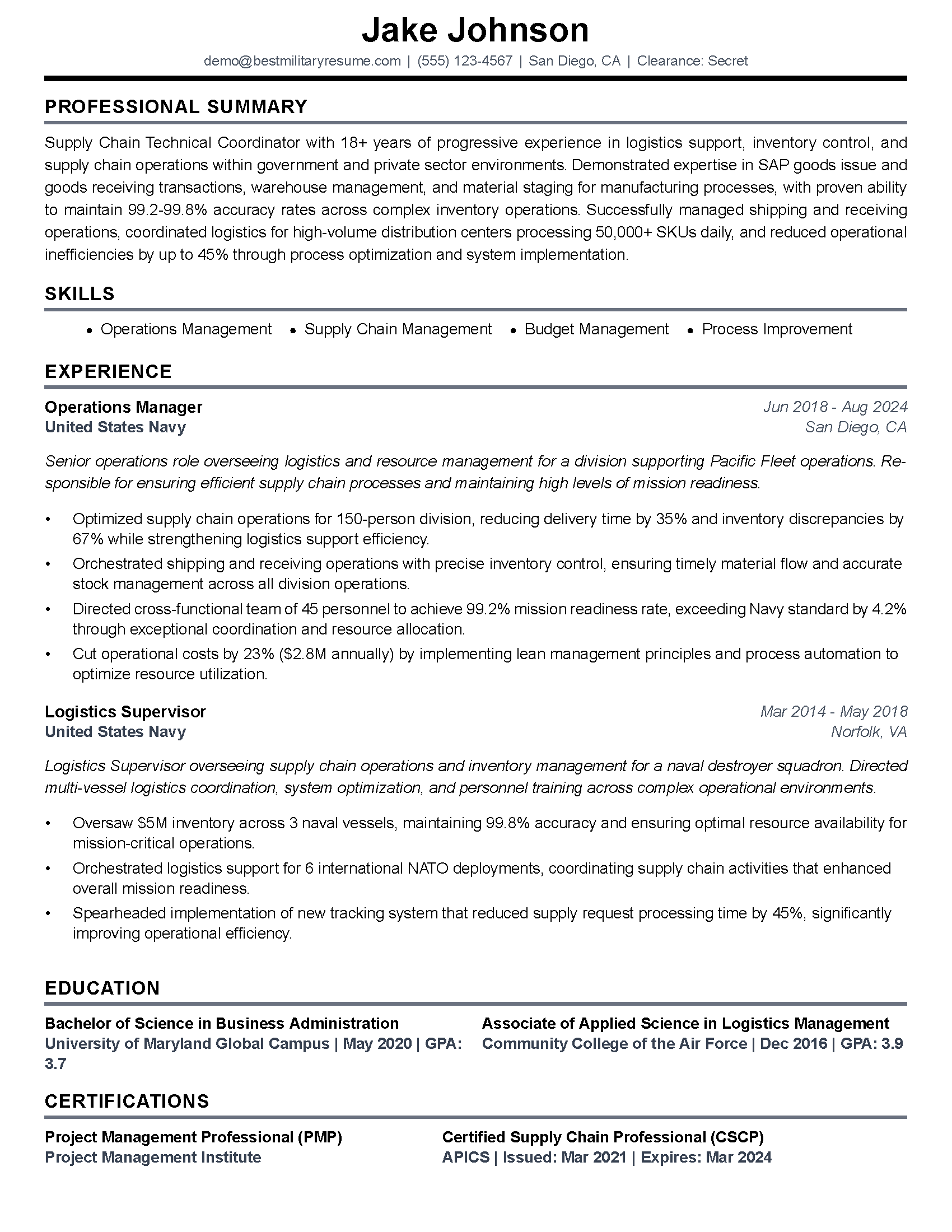
This is BMR's sample. Swap every [00] and bracket for your own numbers. If you can't back a number, cut it.
CERTIFICATIONS
AWS Certified Solutions Architect - Associate, MM/YYYY
PROJECTS
AWS Lab Build, [Personal project or program name]
MM/YYYY - MM/YYYY
- IDENTITY AND ACCESS - Built [00] IAM roles and least-privilege policies for [00] test users across [00] AWS accounts, cutting full-admin logins by [00]%.
- FAILOVER DESIGN - Restored the lab web app for [00] test users in [00] minutes during [00] failover drills by spreading it across [00] Availability Zones.
- LOAD TESTING - Raised the lab app's response speed by [00]% under [00] simulated users after [00] rounds of instance and storage changes.
- LAB COST CONTROL - Reduced the lab's monthly AWS bill by [00]% by resizing [00] instances and setting [00] budget alerts.
EXPERIENCE
[Job Title], [Branch], [Unit, Location]
MM/YYYY - MM/YYYY
- UNIT NETWORK ACCESS - Secured accounts for [00] users on a [00]-device unit network, closing [00] access findings and removing open admin rights by [00]%.
Which exam domain each bullet answers:
- Identity bullet: Domain 1, "Design secure access to AWS resources."
- Failover bullet: Domain 2, Design Resilient Architectures.
- Load test bullet: Domain 3, Design High-Performing Architectures.
- Cost bullet: Domain 4, Design Cost-Optimized Architectures.
- Unit network bullet: Domain 1 again, "the principle of least privilege."
Exam facts checked November 2026 against AWS's Solutions Architect and Cloud Practitioner pages and the exam guide.
What to Do Next
Write the project block first, even before you book the exam. Then add the cert line the day you pass.
Build it in the BMR resume builder.
Frequently Asked Questions
Does the AWS Solutions Architect - Associate exam require coding?
Will the Solutions Architect - Associate exam use short AWS service names?
What AWS cert comes after Solutions Architect - Associate?
About the author
Brad Tachi is the CEO and founder of Best Military Resume and a 2025 Military Friendly Vetrepreneur of the Year award recipient for overseas excellence. A former U.S. Navy Diver with over 20 years of combined military, private sector, and federal government experience, Brad brings unparalleled expertise to help veterans and military service members successfully transition to rewarding civilian careers. Having personally navigated the military-to-civilian transition, Brad deeply understands the challenges veterans face and specializes in translating military experience into compelling resumes that capture the attention of civilian employers. Through Best Military Resume, Brad has helped thousands of service members land their dream jobs by providing expert resume writing, career coaching, and job search strategies tailored specifically for the veteran community.
