Scrum Master Cert to First Job: The Veteran Pipeline
Michael got only rejections. Then a $100K facilities manager role.
Michael, E-7, Navy, tried a ton of outside help before BMR
You paid for the course. You sat the test. You passed. Now the certificate is a PDF on your desktop and nothing else has changed.
So you start applying. You type "Scrum Master" into the search bar. Forty applications in three weeks. Two auto-replies and a whole lot of nothing.
Then you read one of the postings closer. Down in the qualifications it wants two-plus years as a Scrum Master on a delivery team. The next one says three years. The one after that wants one to three years plus a tool you have never opened.
That is the gap almost nobody warns you about. The cert gets you past the box that asks if you have one. A hiring team still wants proof you can carry a team through a sprint without breaking it.
This article is about the part that comes after the cert. How to build real agile reps in the next 60 to 90 days. What your military work honestly maps to, and where that mapping falls apart under questioning. What a first agile resume shows. Which job titles to actually search, because most of the realistic ones are not called Scrum Master. What the interview probes. What the first 90 days look like.
By the end you will have a short list of titles to search this week. You will also have a plan for reps that a hiring team will believe.
Why does nobody call back after you get the cert?
Because a Scrum Master posting usually means a team is already in trouble. They are missing dates. Their retros have gone quiet. Two engineers are not speaking to each other.
A certificate does not fix any of that. They are hiring someone who has already sat in that room while it went sideways.
The Scrum Guide says the Scrum Master is accountable for establishing Scrum and for the Scrum Team's effectiveness. Read that word again. Effectiveness. That is an outcome word, and outcomes need a track record.
So the posting asks for one to three years. Recruiters screen on it. Your application ranks low against people who have it. Then it sinks in the stack. Nothing about that is personal. It is just how the ranking works.
More certs will not move it. Reps will. You need reps you can name out loud. Team size. Cadence. How long it ran. What got better.
The cert is the floor, not the proof.
Many Scrum Master postings ask for one to three years of running real sprints. A fresh cert with zero reps behind it usually ranks near the bottom of that pile. Reps move you up. More certs do not.
Which cert should you get, and can you stop shopping?
You could spend a month reading comparison threads. Skip it. Two certs carry most of the weight at the entry level, and either one clears the checkbox.
CSM from Scrum Alliance: you sit a 16-hour course taught by a Certified Scrum Trainer. Then you take a 50-question test and need 37 right to pass. Scrum Alliance does not set the course price. Individual trainers do, and the range is wide. The cert renews every two years, which costs $100 and 20 Scrum Education Units.
PSM I from Scrum.org: no course needed. The assessment costs $200. It is 80 questions in 60 minutes and you need 85% to pass. It does not expire and there is no renewal fee.
Pick on cash and calendar, not on prestige. If someone else is paying and you want a live classroom, take CSM. If you are paying yourself and you study fine alone, take PSM I. Then stop reading about certs and go get reps.
Leave PMI's agile cert for later. PMI-ACP now asks for 21 hours of formal agile training. It also asks for two years of agile experience in the past five years. There are shorter paths. One year of that same recent experience is enough if you already hold an outside agile cert. That cert has to be a year old. Your CSM or PSM I can fill that slot later. An active PMP clears the experience piece on its own. Most first-timers have none of that yet. That makes it a second-cert problem.
How do veterans pay for a scrum cert?
The GI Bill can pay you back for an approved licensing or certification test. The cap is $2,000 per test. You file VA Form 22-0803 to claim it. Check first that your specific test sits on VA's approved list. The benefit covers the test fee, not the certificate document itself.
If your target training is a high-tech program, VET TEC 2.0 is worth a look. It is funded through September 30, 2027 and capped at 4,000 paid participants per fiscal year. Still on active duty? Your branch credentialing office may cover the test. Our guide to using the GI Bill for certifications walks the paperwork. If you are also weighing project management credentials, the CAPM versus PMP breakdown covers that lane.

How do you get real sprint reps before anyone pays you?
This is the whole ballgame. You need one team, one backlog, and a few sprints you can talk about in specifics.
It does not have to be a software team. It does not have to be paid. It does have to be real, with other humans who have their own priorities.
1 Run one backlog end to end.
2 Volunteer with a small nonprofit.
3 Take one event off a working Scrum Master.
4 Use SkillBridge if you are still in.
5 Show up in agile user groups.
If you are still in uniform, start the placement hunt early. The SkillBridge industry provider list is the official directory. Our SkillBridge programs on the project management track post covers what those placements look like. Does the networking half feel foreign? Start with the build a network from zero guide.
What does your military work actually map to, and where does it break?
Some of the mapping is honest and strong. Some of it collapses the second an interviewer pushes.
Know the difference before you walk in. Pretending a platoon was a Scrum team is how veterans get caught.
- •Battle rhythm is cadence. You already know why a fixed schedule protects a team.
- •The after action review is a retrospective. Same purpose, softer room.
- •Pushing a stuck problem up the chain is impediment removal.
- •Blocking outside tasking so your people can work is protecting focus.
- •Running a brief without dominating it is a real facilitation skill.
- •You had authority. A Scrum Master has none over the team.
- •A daily brief reports status up. A Daily Scrum is developers planning their own day.
- •Mission stays fixed. Scope moves every sprint, on purpose.
- •Orders flow down. A backlog gets negotiated with a Product Owner.
- •You owned the technical work. A Scrum Master usually does not.
That second item on the right is the one that sinks interviews. A veteran says the daily brief was basically a standup. The interviewer asks who talked and in what order. The answer comes back top down. Now the interviewer knows you have not sat in a real Daily Scrum.
Say the honest version. The cadence work translates. The authority piece does not, and you have had to unlearn it. That answer builds more trust than a clean mapping ever will.
After my federal moves I pivoted into private-sector tech sales. I had no industry resume for that world at all. What got me through the door was learning how that field talks before I ever pitched my background. Agile is the same kind of problem. Learn the vocabulary first, then map your work into it.
What does a first agile resume actually show?
Start with what it does not do. Do not retitle a military role as Scrum Master. You did not hold that title. One follow-up question about sprint length can end the conversation.
A believable first agile resume carries five things.
- A summary that names the target: put the title you want in the first line. Then the cert. Then the closest real experience you have.
- The cert with its date: "Professional Scrum Master I, Scrum.org, March 2026." No more than one line.
- An agile experience block: the volunteer team, the internal project, the SkillBridge placement. Give team size, sprint length, how long it ran, and what got better.
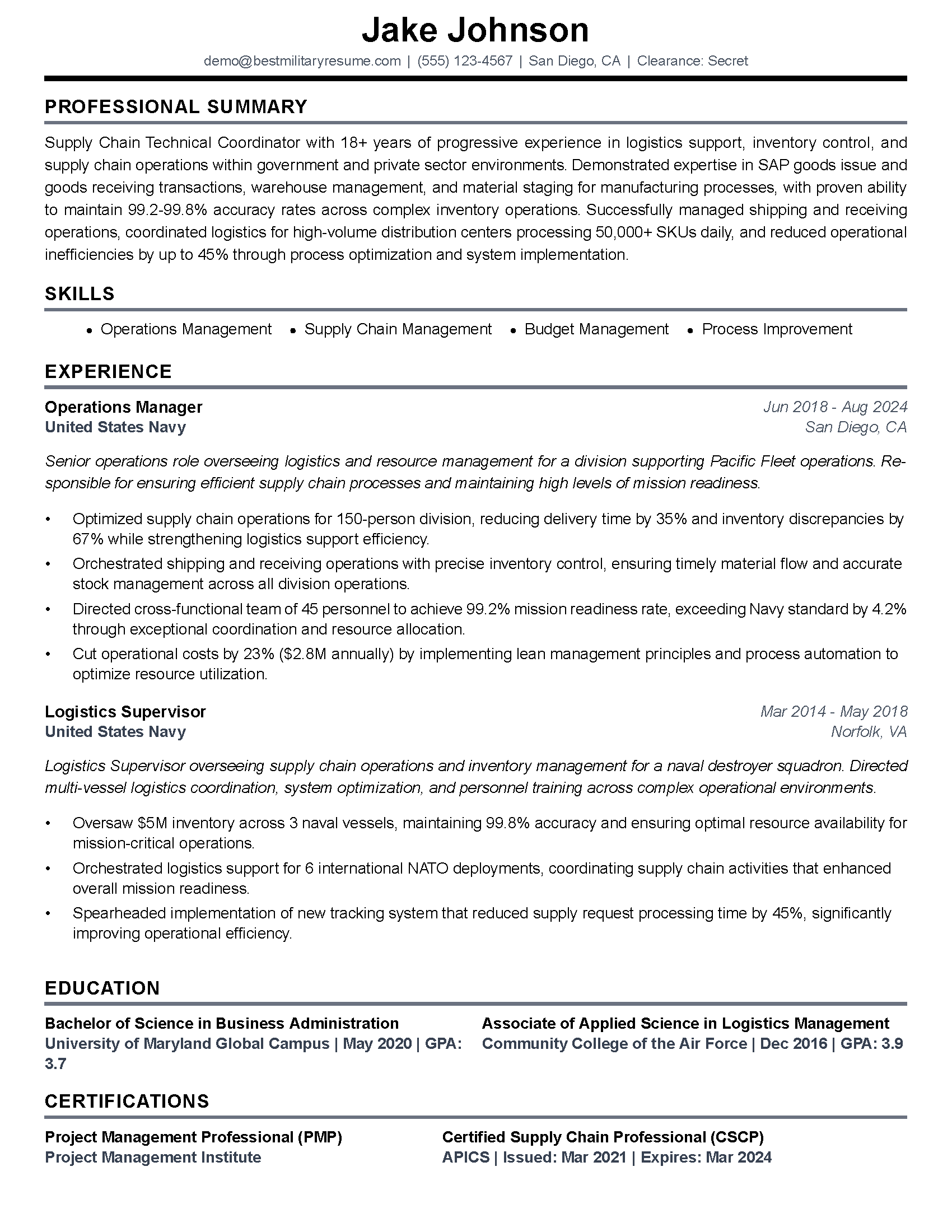
- Your real job history, described plainly: coordination, cadence, cross-team dependencies, stakeholder updates. Civilian words for work you actually did.
- Only the tools you have opened: Jira, Azure DevOps, Confluence, Miro. If you have not touched it, leave it off.
On keywords: pull them from the posting, not from a list you found online. Say the posting names backlog refinement, Kanban, velocity, and Definition of Done. Those exact phrases belong in your resume wherever they are true. Where they are not true, leave them out. Stuffing them in ranks you higher for one screen. Then it costs you the interview.
Our industry keyword guide covers how to pull them cleanly. If this is a full career change, the entry-level resume format for veterans is the right starting structure.
Which job titles should you search that are not "Scrum Master"?
This is the section that changes your week. Search one title only and you are fishing in the smallest pond available.
These are the realistic first stops, roughly in the order I would search them.
Search these titles this week.
Project Coordinator
Openings are steady, cert gatekeeping is low, and you sit next to delivery teams.
Business Analyst
You live in the backlog all day. Many Scrum Masters came through this door. Ask whether the team runs sprints before you accept.
Agile Delivery Coordinator
Fewer postings, but the closest title to the work. Often the support seat under a Scrum Master or delivery lead.
Agile PMO Analyst or Program Coordinator
You track metrics across many teams. Less facilitation, more visibility. A fine bridge if you can move onto a team later.
Associate or Junior Scrum Master
Real, but rare. Usually only at large companies with an internal academy. Worth a saved search alert, not your whole strategy.
Delivery Lead and RTE support roles
Be honest with yourself here. These usually want prior agile delivery years. Target them for job two, not job one.
One more path worth knowing. Staffing and consulting firms place Scrum Masters on client contracts. Their bar is sometimes lower than a direct hire, because they can coach you on the bench. The work can be short term. It also puts real sprints on your resume fast.
Broader project work may interest you too. Our military to project management without a PMP post covers those entry paths. That article is about project management generally. This one stays in the agile lane.
What does the interview actually probe?
Agile interviews go light on theory. Anyone can quote the Scrum Guide. They probe for whether you have been in the room.
The questions that keep showing up:
- Tell me about a conflict you helped two teammates work through. They want the moment, not your philosophy on conflict.
- Describe a sprint that slipped. What did you notice first? They are testing whether you watch flow or just watch dates.
- A Product Owner keeps adding scope mid-sprint. What do you do? The wrong answer is "I stop them." You have no authority to stop anyone.
- How do you run a retrospective when nobody talks? Very common. Have a real technique ready.
- Who owns your Definition of Done? A quick check on whether you have lived it or memorized it.
Answer from your reps, and name the scale honestly. "A team of five volunteers, two-week sprints, six sprints total" is a fine answer. It beats a vague answer that implies a bigger team than you had.
When something came from the course and not the job, say so. Tell them you have not hit it on a live team yet. Then say how you would open it. Then give the closest thing you have actually done. Interviewers respect that. Plenty of them have been burned by someone who oversold.
Build the stories before you need them. The STAR method guide for veterans is the right frame for these. The no-jargon interview guide keeps the military words out of your answers.
What do the first 90 days and the second job look like?
You land the coordinator role or the associate seat. Now the temptation is to fix everything by Friday.
Do not. A quick way to lose a new agile team is to redesign their process in week two. They have reasons for how they work, and you do not know those reasons yet.
A first 90 days that works looks like this. Weeks one to three, watch. Learn their real cadence, who actually decides things, and where work sits still. Weeks four to eight, fix one visible impediment all the way, and let the team notice. Weeks nine to twelve, ask the team what they want changed. Then change that one thing with them.
One fixed impediment beats five proposals. Our first 90 days in a civilian job guide goes deeper on that ramp.
The pay usually moves at job two, not job one. Get 12 to 18 months of real sprints on the resume. Now the postings that wanted one to three years are open to you. That is when the Scrum Master title stops bouncing you. Know your number before that conversation, because the first offer is rarely the last one.
Key Takeaway
Hiring teams buy sprints you have actually run. Get one real team and run a few sprints end to end. Then widen your search to coordinator and analyst titles as well as Scrum Master.
What should you do this week?
Four things, in order.
First, find one team. Ask a nonprofit, a coworker running a project, or a program manager. Ask a Scrum Master who might hand off a retrospective. You need one yes, not ten.
Second, set up saved searches for the first five titles above. Do it on one job board and on LinkedIn, and let them run daily.
Third, rewrite your resume for the coordinator or analyst title, not for Scrum Master. Pull the exact words from three real postings you would take.
Fourth, write down your reps as you get them. Team size, sprint length, one thing that got better. That short list becomes your interview answers in two months.
If the resume rewrite is where you stall, that is what we built BMR's resume builder for. Paste the agile posting you actually want. It tailors your resume to that exact role in civilian language. Veterans, military spouses, and dependents get two tailored resumes and two cover letters free. LinkedIn optimization and a job tracker come with it.
You already did the hard study part. Now go get one team and start counting sprints. Six of them and your next application reads different.
Frequently Asked Questions
Can you get a Scrum Master job with just a certification?
Which scrum certification is better for veterans, CSM or PSM I?
Does the GI Bill pay for a scrum master certification?
What job titles besides Scrum Master should veterans search?
Should I put Scrum Master on my resume for a military role?
How long does it take to land a first agile job after the cert?
Is a Scrum Master role technical?
About the Author
Brad Tachi is the CEO and founder of Best Military Resume and a 2025 Military Friendly Vetrepreneur of the Year award recipient for overseas excellence. A former U.S. Navy Diver with over 20 years of combined military, private sector, and federal government experience, Brad brings unparalleled expertise to help veterans and military service members successfully transition to rewarding civilian careers. Having personally navigated the military-to-civilian transition, Brad deeply understands the challenges veterans face and specializes in translating military experience into compelling resumes that capture the attention of civilian employers. Through Best Military Resume, Brad has helped thousands of service members land their dream jobs by providing expert resume writing, career coaching, and job search strategies tailored specifically for the veteran community.
