CCNA Network Engineer Resume: Turn the Cert Into Interviews
Taylor sent 200+ applications for 5 interviews. With BMR, 20 resumes all hit.
Taylor, E-7, Army, defense industry
You passed the CCNA. Or you're a few weeks out from the 200-301 exam. You spent nights on subnetting drills and OSPF labs after full duty days. That cert took real work.
Then you aimed it at network engineer jobs. And the calls didn't come. Maybe one recruiter asked if you'd take a help desk seat. Maybe nobody wrote back at all.
A lot of veterans in this spot ask the same thing. "I have the cert and years of network time. Why am I not getting interviews?" Often the answer sits on the page. The CCNA is listed, but the engineering work behind it isn't. A hiring team for a network role wants to see you build, change, and fix networks. They need proof of that on page one.
This guide shows you how to turn the CCNA into interview calls. The target is network administrator and network engineer roles. You'll get the exact spot for the cert and before-and-after bullets for military network work. You'll see lab proof that counts. And you'll learn what to say on the phone screen and in the technical interview. If you're still at the Network+ stage, start with turning Network+ into help desk and NOC interviews. This post picks up where that one stops.
Where does the CCNA go on a network engineer resume?
Put it where the first scan lands. That's the top third of page one, and it belongs in two places.
The first place is a short certifications line under your target title. Write it out in full, like this: Cisco Certified Network Associate (CCNA), 2026. Add the year you earned it. A current year tells the reader your skills are fresh.
The second place is your summary. Pair the cert with your years of hands-on work in one line. Something like this: Network administrator with a CCNA and six years running Cisco networks for military units. Now the cert and the experience land in the same glance.
Your target title goes at the very top, above both. Use the title in the posting. Two common ones are Network Administrator and Network Engineer. Leave your rank and job code off that line. The rank comes off the page, but the scope stays. How many users, sites, and devices you ran is what shows your level.
One more detail matters. The CCNA stays active for three years. To renew, pass the current CCNA or a higher Cisco exam. You can also earn 30 continuing education credits. That's per Cisco's own CCNA certification rules. If yours is close to its end date, renew it before you apply. A lapsed cert can raise a question you don't want in a phone screen.
Staff Sergeant, U.S. Army.
Signal NCO.
(CCNA listed on page two, under "Training.")
Network Administrator.
Cisco Certified Network Associate (CCNA), 2026.
Network administrator with a CCNA and six years running Cisco networks for 400 to 1,200 users.
Andreas, an Army 25B in one of our BMR success stories, had this exact problem. His Security+ and CCNA sat at the bottom of page two, right above his hobbies. Moving them to the top third of page one was one of the first fixes.
Which job titles should you aim the CCNA at?
Pick the rung that matches your hands-on time. The CCNA covers network basics, network access, IP connectivity, IP services, security basics, and automation. That's the core of junior and mid-level network work.
If you ran switches and routers in uniform for a few years, aim at these titles.
- Network Administrator: Keeps an existing network running, makes changes, and handles user and device issues.
- Network Engineer I or Junior Network Engineer: Builds and changes networks under a senior engineer.
- Network Technician: Installs, cables, and swaps gear, often across many sites.
- Systems and Network Administrator: Common at smaller shops, where one person covers servers and the network.
Read each posting before you apply. Some say "Network Engineer" but list five years of experience and a CCNP. Others say "Network Administrator" and ask for exactly what you have. The title alone often won't tell you the level. The required years and certs will.
The Bureau of Labor Statistics tracks pay for network and computer systems administrators. Their median wage was $99,130 in May 2025. That same BLS page projects the field to shrink 4 percent from 2025 to 2035. BLS still projects about 13,400 openings a year. All of them come from people moving to other jobs or retiring. In a shrinking field, each resume has to fit its posting closely. A general IT resume may not make the short list.
If you're looking ahead, the CCNP is the next Cisco step for engineers who want senior roles. That's a separate decision for another day. Right now the goal is interviews with the cert you hold.
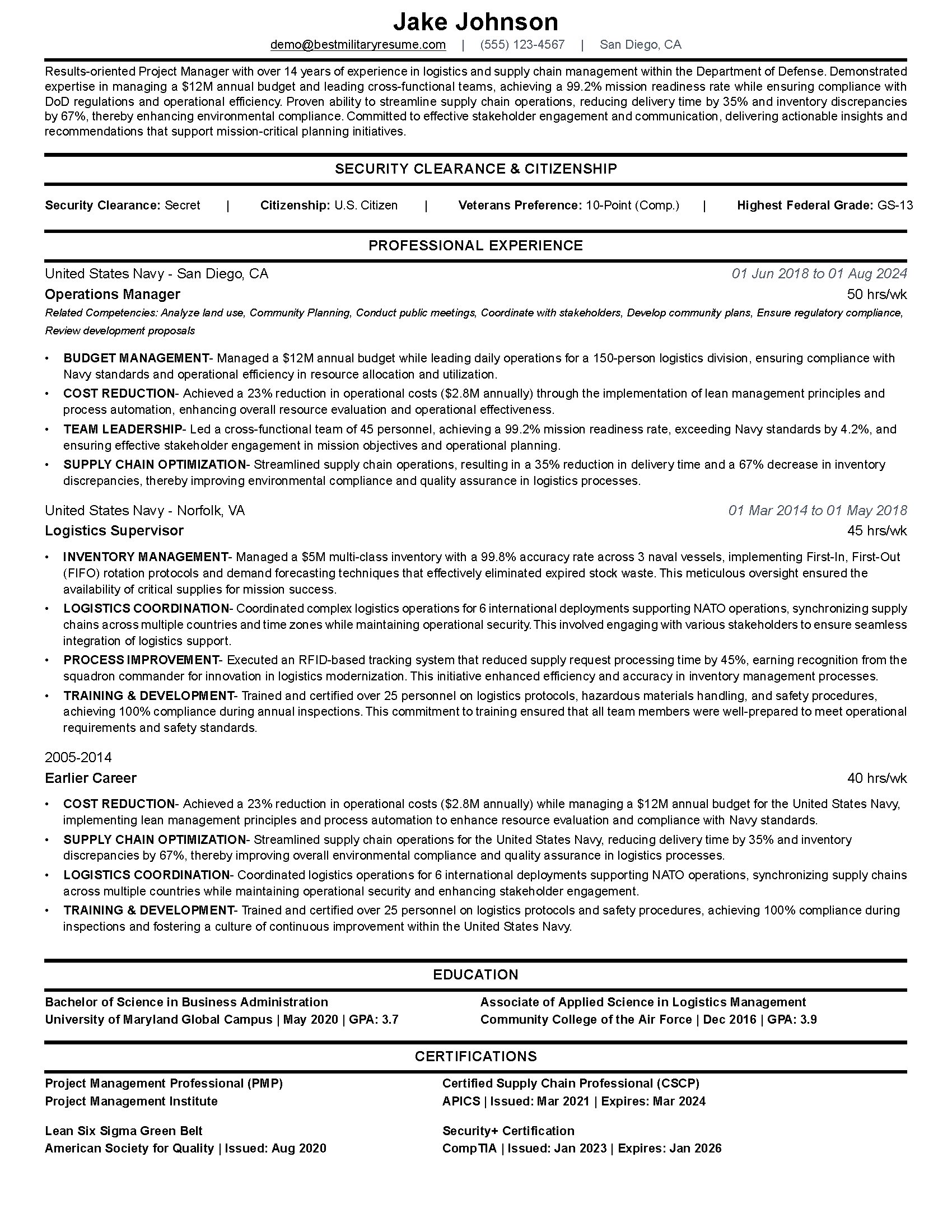
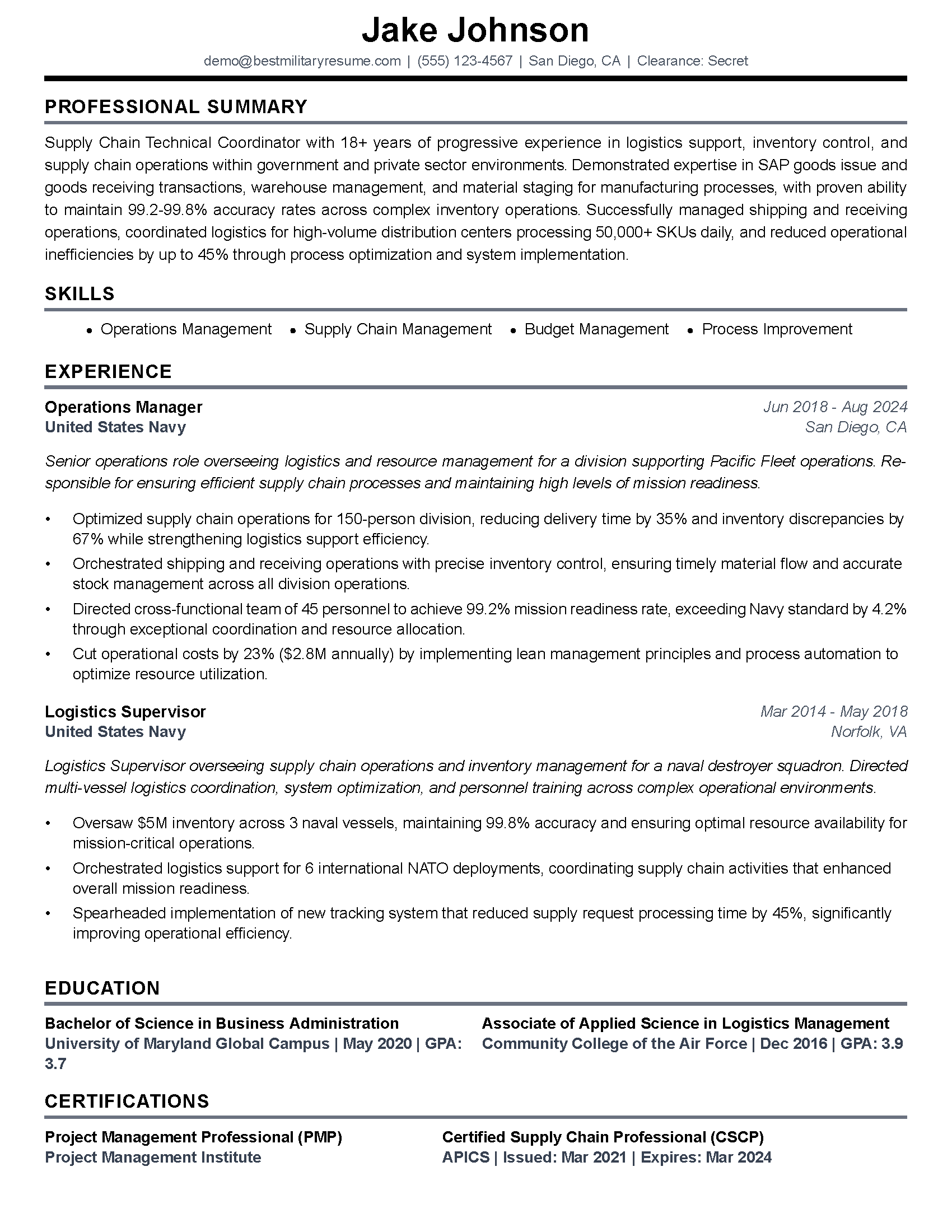
How do you turn military network work into engineer bullets?
This is where the interview is won or lost. You likely did real engineering work. But you wrote it in unit language, and the reader has to decode it.
Keep the tech words. A trunk port is a trunk port. OSPF is OSPF. A network hiring manager knows those terms, and the posting probably uses them. What you change is the military wrapper. Swap unit names, mission terms, and branch-only acronyms for plain words.
Use a four-part bullet
Each strong bullet answers four questions. What did you do? What gear or protocol did you use? How big was it? What changed because of you? If a bullet is missing scale or a result, it reads like a duty list.
The numbers in the examples below are for show. Use your own real numbers, from your evals, your awards, or your old logs.
Responsible for S6 network ops and NIPR/SIPR connectivity for the BDE TOC during field exercises.
Configured Cisco switches and routers for classified and unclassified networks serving 600 users. Set up 14 VLANs and OSPF routing across 3 sites in under 48 hours.
Look at what changed. The acronyms are gone. The gear, the protocols, the users, and the speed are all still there. A hiring manager can picture the job now.
More bullets you can adapt
- Changes: Planned and pushed config changes to 40 Cisco switches in set maintenance windows. No unplanned outages.
- Troubleshooting: Traced a spanning tree loop that took down a 200-user network. Restored service in 35 minutes.
- Security: Built and kept access control lists on edge routers to limit traffic between segments.
- Build: Stood up a full network from boxed gear for 150 users in 3 days.
- Training: Trained 6 junior techs on switch setup and basic troubleshooting.
Your old job's career page can help you find the right civilian words. Army readers can check the 25N career guide or the 25H career guide. Air Force readers can start with the 3D1X2 Cyber Transport Systems guide. Coast Guard IT techs have the Coast Guard IT career guide.
What if your military job wasn't networking?
Maybe you were a truck driver or a supply clerk, and you earned the CCNA to switch fields. You can still show proof. You just have to build it.
Cisco's own CCNA page points to two lab tools for practice: Cisco Packet Tracer and Cisco Modeling Labs. Packet Tracer lets you build a network in a simulator on your laptop. Modeling Labs runs virtual Cisco gear for more real-world practice. Either one gives you work you can describe.
Build a small project and finish it. Then write it up like a job. A good lab project has a goal, a design, and a result you can explain out loud.
Lab projects that show CCNA skills.
Build a three-site office network.
Use VLANs at each site and OSPF between them. Test that every site can reach every other site.
Lock down a guest network.
Write access lists so guests reach the internet but not the office servers.
Set up NAT and DHCP.
Hand out addresses inside the network and share one public address out to the internet.
Break it, then fix it.
Shut a link or change a setting on purpose. Find the fault with show commands and write down your steps.
Then add a "Projects" section under your work history. Keep each entry to one or two lines. A sample line might read like this. Built a three-site Packet Tracer network with 9 VLANs, OSPF, and guest access lists. That's honest. It's also specific enough to talk through in an interview.
Be clear that it's a lab. Don't dress a project up as a job. Interviewers often ask follow-up questions, and a lab you really built holds up under them.
How do you tailor the resume to each network job posting?
One resume won't fit every network posting. A hospital network admin and a junior engineer at a cleared contractor want different things on top.
Start from one master resume that holds everything. Keep every job, every bullet, and every cert there. Then cut a version for each posting you'd really take.
Read the posting line by line. Pull the exact words it uses for the work you've done. If it says LAN/WAN, use LAN/WAN. If it lists Cisco Catalyst switches and you ran them, say so in those words. Your keywords are the posting's own words for the work you've actually done. Only use a keyword you can back up in the interview.
Each posting uses different words, so one resume can't match them all. Our list of military resume keywords by industry can help you spot the IT terms to look for.
Tailoring checklist for each posting.
- ✓The target title at the top matches the posting's title.
- ✓The CCNA and any other certs it asks for sit in the top third.
- ✓Your first two bullets match the first two duties in the posting.
- ✓The gear and protocols named in the posting appear in your bullets, if you used them.
- ✓Every acronym is spelled out the first time it shows up.
- ✓Clearance status is near the top, if the posting asks for one.
You don't need a full rewrite each time. Most of the work is reordering. The bullets that match the posting move to the top. The rest stay below or get trimmed.
How do you talk about the CCNA in the phone screen?
The phone screen is often a recruiter, not an engineer. They have a short list of checks. Do you have the cert? Do you have the years? Can you explain your work in plain words?
So lead with what you can do, and let the cert back it up. Fill in a short answer like this one. "I've run Cisco networks for [years] in the [branch]. I earned my CCNA in [year] to back that up."
Then have four short stories ready. Each one should take about a minute.
- A build: A network you stood up, with the size and how long it took.
- A fix: An outage you tracked down, with the cause and the time to restore.
- A change: An upgrade or config change you planned and pushed without breaking things.
- A team moment: A time you trained someone or handed off work cleanly at shift change.
Expect a question about why you're leaving the military, too. Keep it short and pointed forward. "I'm separating in [month]. I want to grow as a network engineer in the private sector." Then stop talking. A short answer reads as confident.
If a recruiter offers you a help desk role, you can say no politely. "Thanks. I'm focused on network administrator and engineer roles." Then give one story that fits them. Sometimes that turns into a referral to the right team.
What will the technical interview test?
The technical round is usually with a network engineer or a team lead. They want to see how you think, not just what you memorized. Expect questions drawn from the same areas the CCNA covers.
Common topics include these:
- Subnetting: Splitting an address block on a whiteboard, by hand.
- VLANs and trunks: Why you'd split a network and how traffic moves between VLANs.
- Spanning tree: What it stops and what happens when it fails.
- Routing: How OSPF picks a path, and when you'd use a static route.
- NAT, DHCP, and ACLs: What each one does and where it sits in a design.
- Troubleshooting: A user can't reach a server, and you walk through how you'd fix it.
How to answer the troubleshooting question
This one shows up a lot, and it rewards a clear method. Start at the bottom and work up. Check the cable and the link light. Check the VLAN and the IP address. Check the gateway and the route. Check any access list in the path. Say each step out loud as you go.
Then tie it to a real story from your own time. Name the fault, how you found it, and the fix. Keep it to two or three sentences. A method plus a real story often beats a perfect textbook answer.
If you don't know something, say so. Then explain how you'd find out. Engineers tend to trust "I'd check the routing table first" more than a confident guess.
Key Takeaway.
The cert says you studied the topics. Your stories say you used them. Bring one real story for every topic on the CCNA list.
Where does a security clearance fit?
An active clearance can set you apart for network roles at defense contractors and federal sites. Many of those postings list a clearance level as a must-have.
Put it near the top of the resume, close to your name or in your summary. Write the level and the status plainly, such as Active Secret clearance. Never list anything about the work itself that's classified. Describe the network in general terms, like classified and unclassified networks.
In the interview, keep clearance talk short and factual. Our guide on how to talk about your clearance in an interview covers what to say.
Still need to fund the exam or your renewal? Per VA, the GI Bill can pay you back for certain licensing and certification tests. The guide to using the GI Bill for certifications walks through the options.
What to Do Next
The CCNA is done. Now make it work for you on the page. Move it to the top third. Rewrite your network bullets with gear, scale, and results. Add a lab project if your hands-on time is thin. Then tailor a version for every network posting you'd really take. Prep your stories for the phone screen and the technical round.
Start with one posting today. Pick the network administrator or engineer job you want most. Save the full text.
Then open the BMR Resume Builder and paste that posting in. BMR reads the posting and copies your base resume. Then it rewrites three things in the posting's own words: your summary, your work bullets, and your skills. Your base stays untouched, and the job lands in your tracker.
The free tier includes one private-sector tailored resume. Test it on your top network job first. Get that one right, send it, and then do the next posting.
Frequently Asked Questions
Is a CCNA enough to get a network engineer job?
Where should I put the CCNA on my resume?
How long is a CCNA valid?
What is the CCNA exam?
Can I list a homelab on a network engineer resume?
What do network engineer technical interviews ask about?
Should I put my security clearance on a network engineer resume?
About the Author
Brad Tachi is the CEO and founder of Best Military Resume and a 2025 Military Friendly Vetrepreneur of the Year award recipient for overseas excellence. A former U.S. Navy Diver with over 20 years of combined military, private sector, and federal government experience, Brad brings unparalleled expertise to help veterans and military service members successfully transition to rewarding civilian careers. Having personally navigated the military-to-civilian transition, Brad deeply understands the challenges veterans face and specializes in translating military experience into compelling resumes that capture the attention of civilian employers. Through Best Military Resume, Brad has helped thousands of service members land their dream jobs by providing expert resume writing, career coaching, and job search strategies tailored specifically for the veteran community.
