Career Stalled by Deployments? How Reservists Recover
Michael got only rejections. Then a $100K facilities manager role.
Michael, E-7, Navy, tried a ton of outside help before BMR
You came home from your third set of orders in five years. Your desk is still there. Your badge still works. But the people you trained are now your peers, and one of them is your boss.
I spent my Navy years as a diver, packing a bag for the next deployment. I didn't have a civilian boss waiting for me at home. Guard and Reserve members do, and repeated deployments can stall that civilian career. Often the damage comes in small pieces. A missed review here. A skipped raise there. A project that went to someone who stayed in the building.
This guide is for after the stall. Your career already took the hit. Want to plan both ladders before the next set of orders? Read how to balance a civilian career with Reserve promotion first.
Here you'll get the steps to recover. Add up what you lost. Check what the law may owe you, and ask for it in writing. Then rebuild your name at work and decide if you stay. Last, you'll turn those activations into proof on your resume.
What did the activations actually cost you?
HR needs a list it can act on. So write down every loss you can name, with dates. Pull your old reviews, pay stubs, and org charts. Put them next to your orders.
Most losses fall into a few buckets. Check each one.
- Review cycles: Did you miss an annual review? Did you get a blank one, or a rating marked "not enough time to rate"?
- Raises: Did your team get merit or cost-of-living raises while you were gone? Did yours land late, or not at all?
- Promotions: Did a role open that you were in line for? Who got it, and when?
- Projects: Which big projects started or finished without you? Those are the ones people talk about at review time.
- Skills and certs: Did the company roll out a new system, tool, or license while you were away? Did a cert you held lapse?
- Visibility: Does your new skip-level boss know your name? Do the decision makers know your work?
- Network: Who left the company while you were gone? Who joined and now holds sway?
Some of these losses may be legal claims. Others are just the cost of being gone, and only you can fix them. Sort your list into two piles. Pile one is pay, title, seniority, and benefits. Pile two is skills, projects, visibility, and network. The next few sections handle pile one. The rest of the guide handles pile two.
Build a simple timeline
Make a table with three columns. Column one is the date. Column two is what happened at work. Column three is where you were. A row might read: "March 2024. Team lead role posted and filled. On orders." That one line is worth more than a page of feelings. It's also the kind of record an HR rep or an ESGR ombudsman will want to see.
Does USERRA cover a promotion or raise you missed?
It may. USERRA is the federal law that protects civilian jobs for people who serve. It has a rule that a lot of reservists may not know about. It's called the escalator principle.
Picture a moving staircase. It kept moving while you were on orders. You get back on at the stair you would have reached by now. Under 38 USC 4313, you're generally owed the job you would have held with continuous employment. The Labor Department rule at 20 CFR 1002.191 names it the escalator position.
That rule also says the escalator can go down. Say your whole team got moved or laid off while you were gone. That may apply to you too. So this cuts both ways.
The test is "reasonable certainty"
The two words that matter most are reasonable certainty. The rules ask what you would have reached with reasonable certainty. A promotion that was likely but not sure is harder to claim than a team-wide raise.
- Raises: 20 CFR 1002.236 lists step, merit, and periodic increases. It says an employer may look at your own past raises. If you earned merit raises before, the missed one should usually count.
- Promotions by test: 20 CFR 1002.193 covers promotions tied to an exam. You should get time to adjust, then a makeup test. Pass it, and the promotion may date back to when you would have gotten it.
- Seniority: Under 38 USC 4316, you keep the seniority you had plus what you would have earned. Things like your vacation accrual rate and shift picks often ride on seniority. Vacation days for the time you were gone follow a different rule. The employer generally owes them only if it gives them to people on comparable leaves.
- Judgment calls: A promotion picked by a manager is harder. You'll need proof, like a posting you fit, past ratings, or a peer track you were on.
Know the limits before you ask
These rights generally depend on meeting USERRA's reemployment rules. Those include giving notice when you could, staying under the five-year service limit, and coming back on time.
Drill weekends, annual training, and most involuntary mobilizations don't count toward that five-year limit. Orders you volunteered for may count. Check the authority listed on each set of orders. And a dishonorable, bad-conduct, or other-than-honorable discharge can end these rights.
Federal workers have some different rules, set by OPM. They can still file with DOL VETS. VETS can refer the case to the Office of Special Counsel. Or they can go straight to the Merit Systems Protection Board (MSPB). Check your own agency's guidance.
One more fact helps a lot. Under 38 USC 4327(b), there's no time limit for filing a USERRA claim. So a raise you missed two years ago may not be too old to raise. That said, records fade and people leave. Sooner is still better.
This is general information, not legal advice. If real money or a firing is at stake, talk to a lawyer who handles USERRA cases.
How do you raise it with HR in writing?
Talk first if you like. But put the ask in writing within a day or two. An email gives you a date stamp and a record. It also keeps the tone calm. You're asking a fair question.
Keep it short. Name the gap and the dates. Cite the rule. Then ask for a review and a reply date. Here's a version you can paste and change:
- Subject: Request for USERRA pay and position review
- Line 1: I returned from military orders on [date]. I was on orders from [date] to [date].
- Line 2: During that time, my team received [merit raise / promotion / step increase] on [date].
- Line 3: I believe USERRA's escalator principle may apply. That rule is 20 CFR 1002.191 and 1002.236.
- Line 4: Please review my pay, title, seniority, and benefits as if I had worked through that period.
- Line 5: Can you reply by [date two weeks out]? I've attached a short timeline.
Attach your timeline from section one. Attach copies of your orders if HR doesn't already have them. Then save every reply in a folder outside your work email.
If HR says no or goes quiet
You have two outside routes. Both are free.
- ESGR: Employer Support of the Guard and Reserve is a DoD program. Its volunteer ombudsmen help you and your employer talk it out. They mediate. They don't enforce or punish.
- DOL VETS: The Labor Department's Veterans' Employment and Training Service takes formal USERRA complaints. Under 38 USC 4322, the complaint is in writing and VETS investigates it.
Many people try ESGR first, because it keeps things friendly. That matters if you plan to stay. If the stakes are high, VETS or a lawyer may be the better first call.
If you've just come off orders and still have demob tasks open, see the demobilizing reservist resources guide. It covers the paperwork and report-back windows, so this guide skips them.
What do you say to your manager when you're back?
The HR email fixes pay and title. The manager talk fixes your future. These are two different talks. Keep them apart, so your boss doesn't feel ambushed.
Ask for 30 minutes in your first two weeks back. Bring a one-page sheet. Lead with what you can do now. Then ask for a path.
Here's a simple order for the talk:
- Thank them for holding the job: Keep it short and real. One sentence is plenty.
- Ask what changed: New goals, new tools, new clients, new people. Take notes.
- Name what you want: "I want to be up for the next team lead role. What would you need to see from me?"
- Ask for one visible project: Something with a deadline in the next 90 days.
- Set the next check-in: Put a date on the calendar before you leave the room.
Don't open with a list of grievances. And don't apologize for serving. You did nothing wrong. You're asking for a fair shot at the next rung.
If your boss asks about the next activation
Your manager may ask if you'll be gone again. Be honest about what you know, and say when you'll know more. Under 38 USC 4311, an employer can't deny you a promotion because of your service. So the question shouldn't decide your path. But it helps to show you have a plan for coverage when you go.
How do you rebuild visibility and skills in 90 days?
Pile two is yours to fix. No rule hands you back your network. So treat the first 90 days like a work-up cycle with clear goals.
Days 1 to 30: catch up
- Learn every tool or system that changed while you were gone.
- Renew any cert that lapsed. Ask if the company pays for it.
- Meet one on one with each teammate. Ask what they're working on.
- Meet your boss's boss for 15 minutes. Just introduce yourself and your goals.
Days 31 to 60: deliver
- Ship the visible project you asked for. Hit the date.
- Send your boss a short weekly note. List what you finished and what's next.
- Offer to fix one problem your team keeps putting off. Those get remembered at review time.
Days 61 to 90: set up the next review
- Write down every result with a number. Hours saved, errors cut, dollars, people trained.
- Ask your boss for a mid-cycle check. "Am I on track for the next level?"
- Reconnect with a few people who left the company. They often know where the good jobs are.
- Ask HR for the date of your next formal review, if you don't have it yet.
Keep your 90-day results in one place. You'll use them at review time. You'll also use them on your resume, which is two sections from now.
Should you stay or leave?
Sometimes the fix works. You get the back pay, a real project, and a fair review. Sometimes it doesn't. The same pattern repeats after every set of orders. You can't fix a company that keeps you on the bench.
Ask yourself these questions once you've been back about 90 days:
- Did HR answer your written request, and was the answer fair?
- Did your boss give you a visible project and a real path?
- Have people with your record been promoted here after activations?
- Do you trust that the next set of orders won't reset you to zero?
- Would a new employer pay you more for the same work today?
Three or more "no" answers is a signal to start looking. You can look while you still have a paycheck. That puts you in a much better spot than looking after a bad review.
If you do look, a new employer may ask about future orders in an interview. The guide to restarting a job search after orders covers that search from the start. USERRA's anti-discrimination rule also reaches hiring, not just your current job.
If you stay and a role opens, apply like an outsider would. Write a real resume for it. The internal promotion resume guide shows how to write one. It helps when your boss thinks they already know you.
How do you turn the activations into resume proof?
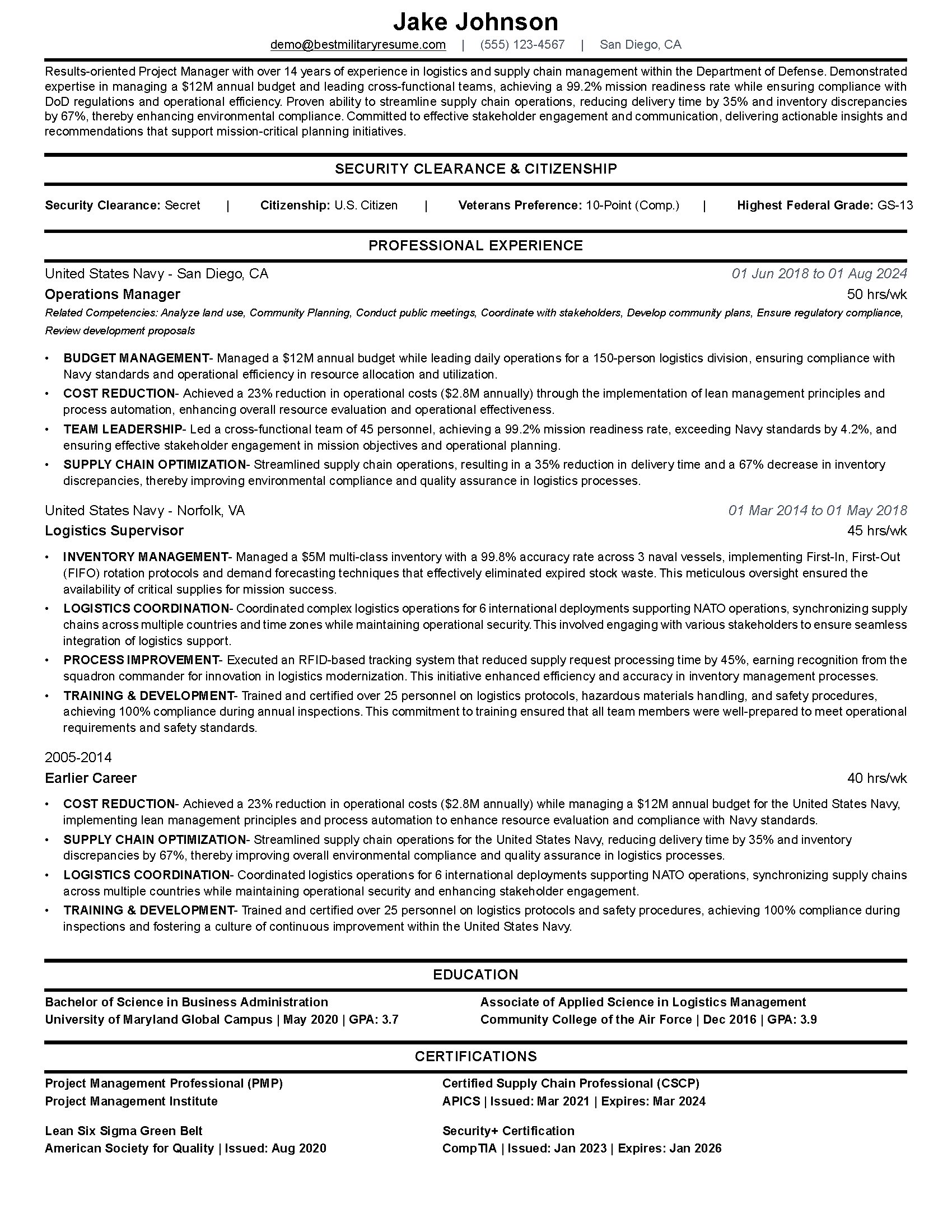
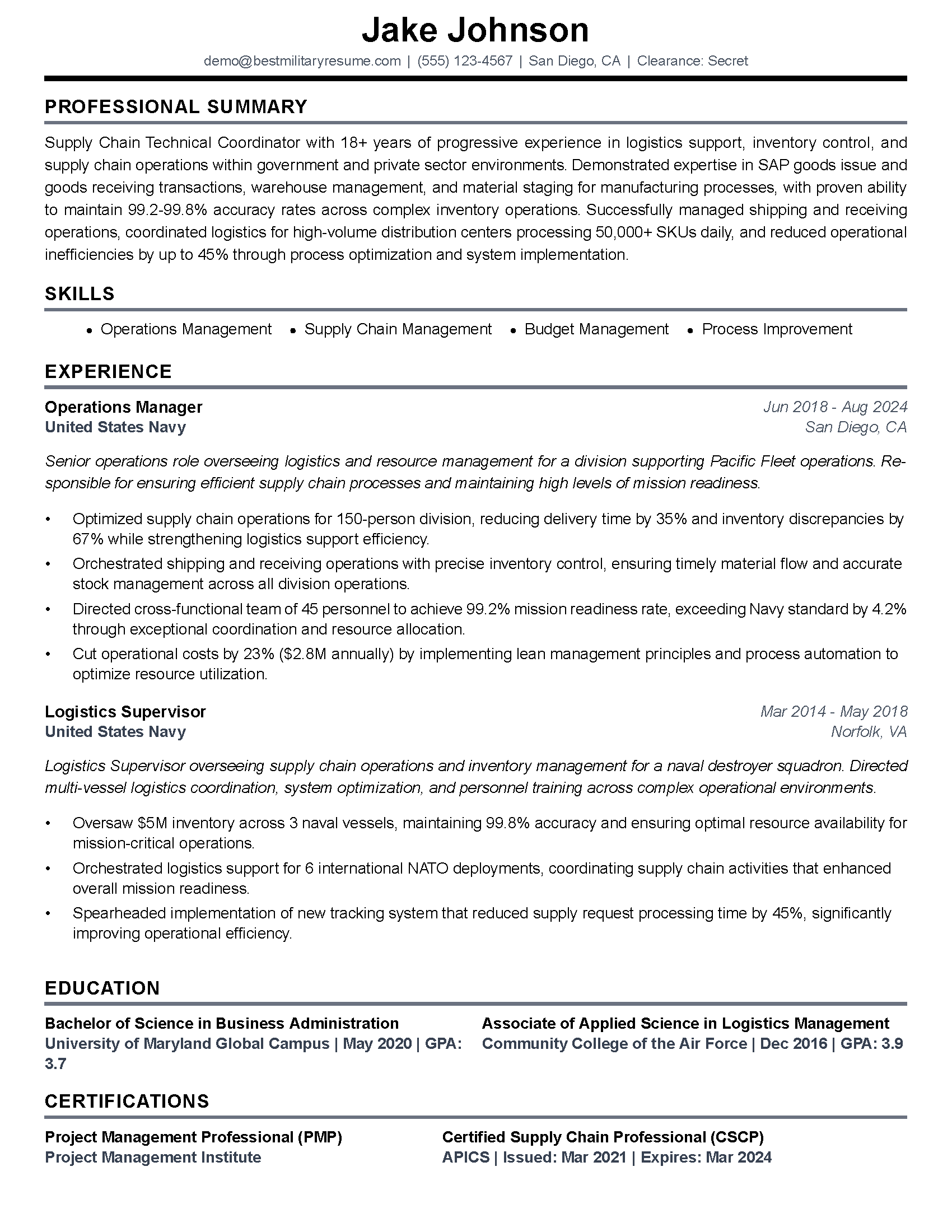
Your resume is where the stall can flip. Every activation you served is work you did. It may be the biggest scope you've ever held. A civilian resume that hides it looks like it has holes. A resume that shows it can set you apart.
Don't just write "Mobilized with the National Guard." Say what you ran. How many people? How much gear? How much money? How far did your calls reach? The rank comes off, but the scope stays. The size of what you ran tells a reader your level.
Here's a weak bullet many people write:
- Deployed to support operations overseas.
Here's the same work, with scope a hiring manager can read:
- Led a 22-person logistics team across two sites, tracking $4.1M in equipment with zero losses over nine months.
Those numbers are an example. Use your own, from your own records. If you don't have a number, write the size of the job in plain words.
Then do the same for your civilian job. Put your 90-day wins on the page with numbers. Now your resume shows growth on both ladders.
For layout, I won't repeat what other guides cover well. The reservist duty changes resume guide shows how to list several activations under one service entry. The guide on selling Reserve leadership to a civilian employer shows how to phrase that work for civilians.
Match it to the posting
One resume won't fit every job. Your keywords are the posting's own words for the work you've actually done. Every posting has a different set, which is why one resume can't cover them. So keep one master resume with everything on it. Then cut a version for each job you'd take.
What to Do Next
Start with the list from section one. Today, write down every review, raise, promotion, and project you missed, with dates. Tomorrow, send the HR email. Next week, book the manager talk.
Then fix your resume, because you need it either way. If you stay, it's your case for the next promotion. If you leave, it's your ticket out.
The BMR Resume Builder puts your civilian jobs and each activation in one base resume. It helps you say the military work in civilian terms. That base is the one place that holds every fact.
When you find a posting, inside your company or out, use tailoring. BMR reads the posting and copies your base. Then it rewrites your summary, work bullets, and skills in the posting's own words. Your base stays untouched, and the job lands in your tracker.
A free account lets you build your base. It also covers one tailored version for a private job and one for a federal job. Put your activations on the page today, so the next review reads them as growth.
Frequently Asked Questions
Does USERRA cover a promotion I missed while on orders?
Can I get back a raise I missed during an activation?
Is there a deadline to file a USERRA complaint?
Should I contact ESGR or DOL VETS first?
How do I bring up a missed raise with HR?
How do I show several activations on a civilian resume?
When should I leave a job after repeated deployments?
About the Author
Brad Tachi is the CEO and founder of Best Military Resume and a 2025 Military Friendly Vetrepreneur of the Year award recipient for overseas excellence. A former U.S. Navy Diver with over 20 years of combined military, private sector, and federal government experience, Brad brings unparalleled expertise to help veterans and military service members successfully transition to rewarding civilian careers. Having personally navigated the military-to-civilian transition, Brad deeply understands the challenges veterans face and specializes in translating military experience into compelling resumes that capture the attention of civilian employers. Through Best Military Resume, Brad has helped thousands of service members land their dream jobs by providing expert resume writing, career coaching, and job search strategies tailored specifically for the veteran community.
