Balancing a Civilian Career and Reserve Promotion Path
Michael got only rejections. Then a $100K facilities manager role.
Michael, E-7, Navy, tried a ton of outside help before BMR
I've been hired into six different federal career fields. Every move meant a new ladder. And a new set of people decided if I was ready for the next rung.
You're doing something harder. You're climbing two ladders at the same time. One has a civilian boss and a yearly review. The other has boards, school seats, drill weekends, and a billet at the next grade. They don't share a calendar, and usually nobody lines them up for you.
So the question shows up sooner or later. How do I leave for a resident course when my boss just made me project lead? Or the flip side. How do I take the civilian promotion when it means less time for the unit?
This guide covers your civilian career and reserve promotion path in the middle years, long after transition. These are real choices you'll face more than once. You'll get:
- A way to pick which ladder to push each year.
- A plan for PME and school seats.
- A script for the talk with your civilian boss.
- The USERRA lines that matter over a long reserve career.
- A way to make each ladder's wins feed the other.
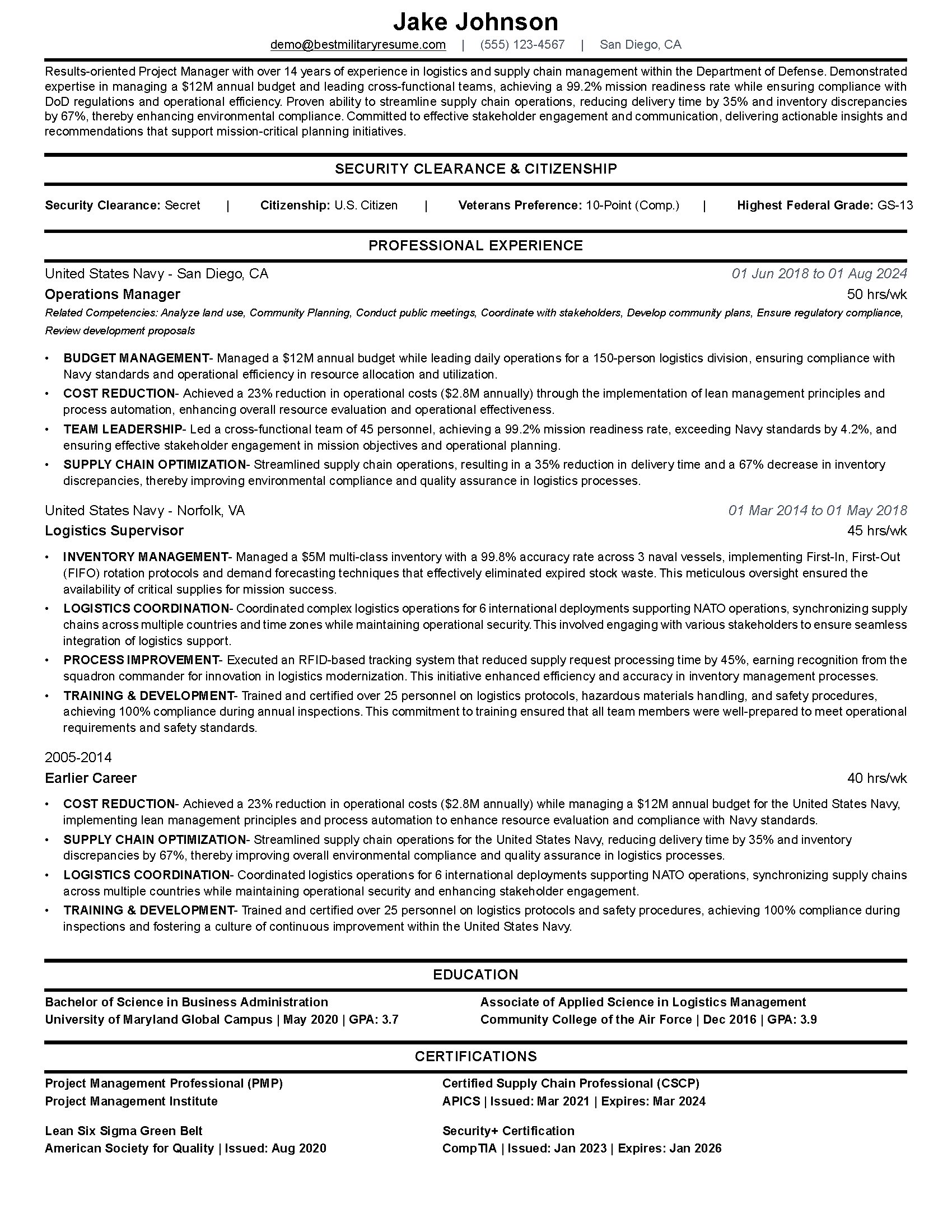
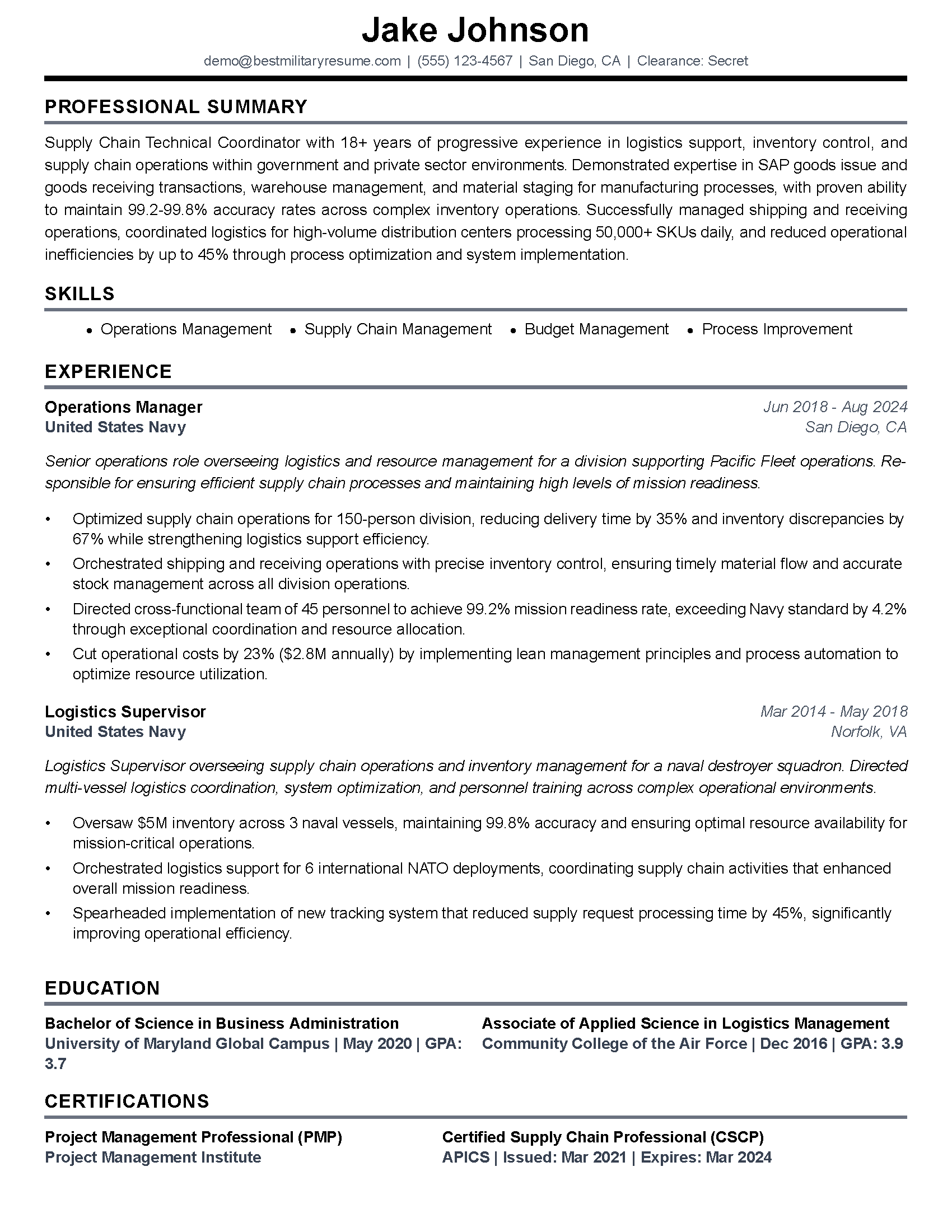
Need the resume layout for two careers? Read our guide on how to blend dual careers on a military reserve resume. This one is about the choices behind it.
Where do the civilian and reserve ladders usually collide?
The two ladders rarely clash every month. They clash at a few points you can see coming. Spot them early and you can plan around most of them.
School seats
Professional military education (PME) often means a resident phase away from home. The seat date usually comes from the school system, not from you. It can land in the middle of a product launch or your busiest sales quarter.
A bigger billet
A reserve promotion often brings a bigger job. A new platoon sergeant, first sergeant, or company commander may do a lot of work between drills. Think emails, training plans, counseling, and calls on a Tuesday night. A lot of that time may be unpaid. It comes out of the same evenings your civilian job already uses.
A civilian promotion
The civilian side can squeeze you too. A new manager role may bring on-call weeks or travel. Your new team may need you sharp on the Monday after a drill weekend. The job that pays the bills now wants more of the hours drill used to borrow.
Two review cycles
Your civilian review and your reserve evaluation run on different clocks. A board may look at your record in a year you spent buried at work. Your civilian review may land the month after a long school. Each side can see a gap the other side filled.
How do you choose which ladder to push this year?
You can't push both at full speed every year. Some years you can, for a while. But over a long career, taking turns is often easier to keep up than sprinting on both.
So pick one push ladder for the year. The other goes on hold. On hold, you still meet the standard and show up ready. You just don't chase the next rung this year.
- •You're eligible for the next board or school.
- •Your PME phase is scheduled or close.
- •Your civilian role is steady and you trust your backup.
- •A key billet opened that may not open again soon.
- •A promotion window or new role is open at work.
- •You just finished a big school and your record is current.
- •Your unit has a lighter training year ahead.
- •You're new at your job and still building trust.
Now put the year on one page. Drill dates, annual training, school windows, and your civilian review date all go on the same calendar. Then circle the months where both sides peak. Plan those first.
Look three years out, not one. Reserve promotions often hang on time in grade and finished schools. Strong evaluations and an open position at the next grade count too. If you'll be eligible in two years, you can push the civilian side now. Then you line up the school for later.
If the civilian side is your push ladder, give the year a shape. A 12-month promotion plan lays out what to do each quarter.
How do you plan around PME and resident school seats?
Schooling is where the ladders crash most often. In some branches, you can't pin on the next rank until the course is done.
The Army is a clear example. Its Select, Train, Educate, Promote (STEP) policy ties NCO promotion to school. In 2024, the Army suspended temporary NCO promotions and moved most promotion schools down one rank.
Sergeants now need the Basic Leader Course to make staff sergeant. The Advanced Leader Course now comes before sergeant first class. The 2024 change covers Guard and Reserve soldiers too. Rules shift, so check current guidance with your unit.
Other branches use their own mix of courses and boards. Officer boards in many components weigh PME too. The details change often. Treat your unit's current guidance as the authority, not a forum post from five years ago.
Knock out the part you control
Many PME courses have a distance learning phase and a resident phase. You control the distance phase. Do it early, in a push year, on your own schedule. Then the resident phase is the only piece left to fit around work.
Ask for the seat in your slow season
A lot of civilian jobs have a slow stretch. For a tax office it's summer. For retail it's often right after the holidays. Ask your unit's schools rep if you can request a class date in that window. You may not get it. But asking costs nothing.
Think twice before you turn down a seat.
Seats can be limited. The next one may land in a worse month. If you need to defer, ask what the next two class dates are before you say no.
What changes when a reserve promotion brings a bigger billet?
The pin-on takes one day. The billet can take the next two or three years.
A bigger job in the unit often means more work between drills. Before you say yes, ask the person leaving it one question. How many hours a week did this take outside of drill? Get a real number. Then look at your civilian calendar and find where those hours will come from.
Set a weekly limit and tell your leadership what it is. For example, you answer unit messages on Tuesday and Thursday nights, and you're fully on for drill. Leaders often respect a clear lane more than a vague promise to always be around.
Build a bench, too. A strong number two can carry routine work while you're tied up at your civilian job. That's good leadership on its own. It's also the skill a civilian employer wants to see in a manager.
And talk with the people at home before you take it. The hours come from somewhere. Often they come from evenings with your family.
How do you talk to your civilian boss about schools and orders?
The worst version of this talk happens two weeks before you leave. The best version happens the day the dates land.
The Department of Defense strongly recommends giving civilian employers at least 30 days' notice when it's feasible. The Labor Department quotes that line in its USERRA notice rule, 20 CFR 1002.85. Notice can be verbal or written. Earlier is almost always better for the relationship.
Hey, I've got a military school in two weeks. I'll be gone most of the month.
My resident course runs [dates]. I'm sending you the orders today. [Name] covers my accounts. I'll close the vendor review before I go, and I'm back on [date].
Bring four things to that talk. The dates, a coverage plan, what you'll finish before you go, and when you'll be back.
Then tell your boss about the year ahead, not just this trip. If a board or school is likely next year, say so now. A boss who sees the whole calendar can plan around it. A boss who gets surprised four times a year may start to resent it. That can happen even when the law protects you.
If your boss has a real problem with the timing, there's a lawful path for that. Under 20 CFR 1002.104, you don't have to fit your service around the employer's needs. But the employer can raise timing concerns with the military. Military authorities have to consider those requests. Offering to pass the concern up your chain often lowers the temperature.
If the talk goes badly, there's free help. Employer Support of the Guard and Reserve (ESGR) is a Defense Department program. Its volunteer ombudsmen offer free, neutral mediation between you and your employer. Reaching out early is usually smoother than waiting for a fight.
What does USERRA protect over a long reserve career?
The Uniformed Services Employment and Reemployment Rights Act (USERRA) protects your civilian job when you serve. Some parts of it matter more over 15 years of drilling than over one deployment.
- Promotion: 38 USC 4311 bars an employer from denying you a promotion because of your service. It also covers your obligation to serve and any benefit of employment.
- Vacation: Under 38 USC 4316(d), you may choose to use paid vacation during service. Your employer can't make you use it.
- The escalator: When you come back, you're generally entitled to the job you'd have reached with reasonable certainty. That means the job you'd hold if you hadn't left. The Labor Department calls this the escalator position in 20 CFR 1002.191.
- The five-year limit: Reemployment rights carry a five-year cumulative cap with each employer. But 38 USC 4312(c) leaves several kinds of service out of that count. Your normal drill weekends and annual training are among them. So is extra training your service certifies in writing as needed for professional development.
That last point matters for a long career. Years of drill and annual training generally don't eat into your five years. Some schools may not either, if they're certified that way. Check your orders, and ask ESGR when you're not sure.
What USERRA won't do is make the relationship easy. It sets the floor. It won't make your boss excited about a three-week absence. It won't earn you the stretch project. That part is on you, and it's mostly the calendar work above.
One more thing. These rights aren't a reason to skip notice. In most cases, giving notice is part of what keeps your reemployment rights in place. This isn't legal advice, so take your own case to ESGR or the Labor Department's veterans office.
Key Takeaway.
USERRA protects the job. Your calendar and your notice protect the relationship. Over a long reserve career, you need both.
How do you make each ladder's wins feed the other?
This is where the two careers stop competing and start helping. Each ladder makes proof the other one can use.
Reserve wins into civilian proof
Your evaluations are full of civilian-ready results once you pull the jargon out. Look for readiness rates, training you planned, people you led, and gear you signed for. Take the numbers and the scope and put them in civilian words. Our guide to turning an NCOER, OER, or FITREP into resume bullets walks through it line by line.
Say your evaluation notes you planned annual training for 120 soldiers and ran it with no safety incidents. A civilian bullet might read like this.
Planned and ran a two-week training event for 120 people, on schedule, with zero safety incidents.
The facts stay the same. Only the words change, and the scope comes with them. That bullet can also help your case for a civilian promotion. Aiming for a move inside your company? See how to build a resume for an internal promotion. To pitch it out loud, read how to sell reserve leadership to a civilian employer.
Civilian wins into your reserve record
It works the other way too. A civilian degree, a project management cert, or a trade license can matter on the reserve side. In many components, civilian education and certifications can go into your record. Ask your admin shop how. Then do it the month you earn them, not the month before a board.
Your civilian job can also shape your billet. A logistics manager often runs a sharp supply section. A nurse may bring real skills to a medical unit. Leaders may notice that when they fill key jobs.
Keep one record of both
The habit that makes this work is boring. After every drill weekend and every annual training, write two lines about what you did, with numbers. Do the same at the end of each civilian quarter. Five minutes then saves you a scramble before a board or a job posting.
Keep both careers in one master resume that holds everything. You cut shorter versions from it for each job. For the date layout, see how to list overlapping reserve and civilian dates.
When is it time to step back on one ladder?
Sometimes the right move is to slow one ladder down on purpose. That's a decision. It doesn't mean you failed.
Some signs it may be time:
- You've missed family events for months and it isn't getting better.
- Your civilian reviews are slipping because you're always tired or behind.
- You took the billet but can't do it the way your people deserve.
- You're dreading drill, or dreading Monday, most weeks.
If those hit close to home, take them seriously. Burnout can show up years into a career, not just in the first one.
Stepping back has more than one shape. You might ask for a lighter billet for a year or two. You might delay a school until a better season. You might hold your rank and skip the next board for now. Some people move to a unit closer to home.
Before you change your status, talk to your unit's career counselor or retention NCO. Ask what it does to your benefits and your points. A year that doesn't count toward your 20 qualifying years can push retirement back. Our guide to reserve retirement points shows how the numbers add up. See the cost before you decide.
The civilian side has its own version. You can pass on a promotion for now and say why. Tell your manager you have a big reserve year coming and you'd like a look next cycle. A good manager can work with that. Not every manager will, and that's useful to know too.
Some reservists also weigh a move to federal work. If that's on your list, read our guide to federal jobs while in the Guard or Reserve.
What to Do Next
Pick your push ladder for the next 12 months. Put drill, annual training, school windows, and your civilian review on one calendar. Then have the boss talk early, while it's still just a calendar talk.
Next, get both careers onto one resume while the details are fresh. Your reserve evaluations and promotions belong on your civilian resume. Your civilian wins belong in your reserve record. Keep one master resume with both careers on one timeline. Then you're ready when a board, a posting, or a promotion window opens.
That's the job of the BMR Resume Builder. Build your base resume once, with your reserve evaluations and your civilian work in it. When you tailor, BMR reads the posting. It rewrites your summary, work bullets, and skills in the posting's own words. It won't add work you never did.
The free tier includes one federal and one private tailored resume, so you can try both.
Two ladders take more planning than one. But each one can make you stronger on the other, if you write it down as you go.
Frequently Asked Questions
Can my civilian employer deny me a promotion because I'm in the Guard or Reserve?
How much notice do I have to give my employer before a military school or orders?
Can my employer make me use vacation days for annual training or a school?
Does military school count against my USERRA five-year limit?
Can my boss ask the military to move my drill or school dates?
How do I choose between a reserve school and a civilian promotion in the same year?
Should my reserve promotions go on my civilian resume?
About the Author
Brad Tachi is the CEO and founder of Best Military Resume and a 2025 Military Friendly Vetrepreneur of the Year award recipient for overseas excellence. A former U.S. Navy Diver with over 20 years of combined military, private sector, and federal government experience, Brad brings unparalleled expertise to help veterans and military service members successfully transition to rewarding civilian careers. Having personally navigated the military-to-civilian transition, Brad deeply understands the challenges veterans face and specializes in translating military experience into compelling resumes that capture the attention of civilian employers. Through Best Military Resume, Brad has helped thousands of service members land their dream jobs by providing expert resume writing, career coaching, and job search strategies tailored specifically for the veteran community.
