Class B CDL for Veterans: When It Beats Class A, and Which Endorsements to Add
Michael got only rejections. Then a $100K facilities manager role.
Michael, E-7, Navy, tried a ton of outside help before BMR
Under federal rule 49 CFR 383.91, a Class B commercial driver's license (CDL) covers "Any single vehicle with a GVWR of 11,794 kilograms or more (26,001 pounds or more), or any such vehicle towing a vehicle not in excess of 4,536 kilograms (10,000 pounds) GVWR."
For veterans, 49 CFR 383.77 lets a state waive the road test for a driver who "Is regularly employed or was regularly employed within the last year in a military position requiring operation of a CMV." Some states use a two-year window right now, so check yours.
CFR is the Code of Federal Regulations. GVWR means gross vehicle weight rating. CMV means commercial motor vehicle.
The rule also asks for two years in a like vehicle "immediately preceding separation from the military." The written knowledge tests usually still apply. Wisconsin's page says "You must still pass the commercial knowledge testing." A short list of job codes can skip those too.
You'll leave with your Class B or Class A call and the endorsements to add. You'll also know which waiver date to check in your state.
Should I get a Class B or go straight to Class A?
The rule draws the line at the trailer. Class A covers combinations where the towed unit is "in excess of 4,536 kilograms (10,000 pounds)." Class B covers the single truck or bus, plus a light trailer.
The two classes are not equal. Under 383.91(c), a Class A driver "may operate a heavy straight vehicle (Group B)" with the right endorsements. Going from B up to A means you "retake and pass all related tests."
| Your situation | The call | Why |
|---|---|---|
| You drove a single truck, bus or wrecker of 26,001 pounds GVWR or more in uniform. | Class B, through the waiver if you qualify. | At 26,001 pounds GVWR or more, it is Group B under 383.91. The waiver needs a vehicle "representative of the CMV type" you plan to drive. |
| You drove tractor-trailers or towed heavy trailers. | Class A. | A combination of 26,001 pounds or more, towing over 10,000 pounds GVWR, is Group A. A Class A also covers Group B. |
| You want school bus or transit work. | If the bus is 26,001 pounds or more: Class B with P. Add S for a school bus. | Endorsements are set in 383.93. The Bureau of Labor Statistics (BLS) says all bus drivers need the P endorsement. A bus under 26,001 pounds built for 16 or more people, driver included, is Group C. |
| You want dump, concrete mixer or trash truck work. | Class B, unless the job tows a heavy trailer. | A single truck over 26,000 pounds GVWR is Group B. A trailer over 10,000 pounds makes it Group A. |
| You want local routes and home most nights. | Class B, if the posting's trucks are single units. | BMR advice: read the truck type on the posting before you pick a school. |
| You're not sure yet and want the most options. | Class A. | It covers both classes. A later upgrade from B means new tests and, usually, new training. |
Can my military driving skip the road test?
It can, at the state's choice. The rule says "At the discretion of a State, the driving skills test ... may be waived." Its conditions include these:
- You hold a license now. The rule says "currently licensed at the time of his/her application."
- You drove a military CMV in your job within the last year.
- For at least 2 years right before separation, you drove a vehicle like the one you'll drive.
- For the 2 years before you apply, no license suspended, revoked or cancelled, and no at-fault crash.
- Also no more than one serious traffic conviction in those 2 years.
- In those 2 years, no more than one civilian license at a time.
- No conviction in those 2 years for a disqualifying offense under 49 CFR 383.51(b).
The class you get follows the vehicle you drove. New York's Department of Motor Vehicles (DMV) waiver page says "The class, endorsements, and restrictions on your CDL will depend upon the type of CMV you operated in the military." Drove a straight truck? That points to a Class B.
How long after I separate can I apply?
The sources do not agree right now, so check your own state. Each one sets its own window:
- The federal rule: employed in a CMV job "within the last year."
- New York's page says the federal government extended that "from one year to two years." It adds, "This waiver expires on January 29, 2027."
- Indiana's Bureau of Motor Vehicles page says you must apply "within two years of discharge." It gives no end date.
- Wisconsin's Department of Transportation page says "within one year after separation/retirement."
If you're near the one-year mark, call your state licensing office this week. Ask which window it uses today and when that ends.
Can I skip the written tests too?
The general knowledge test can be waived only for eight job codes. Some states call this "Even Exchange." The rule lists these:
- Army 88M Motor Transport Operator, 14T PATRIOT Launching Station Operator and 92F Fueler.
- Air Force 2T1 Vehicle Operator, 2F0 Fueler and 3E2 Pavement and Construction Equipment Operator.
- Marine Corps 3531 Motor Vehicle Operator.
- Navy EO Equipment Operator.
The rule checks the "1-year period immediately prior to the application." A state may grant this waiver, but it does not have to. For the full waiver story and free training, see our military to CDL guide.
Which endorsements belong on a Class B?
Four endorsements fit Class B work. Each one is a separate test, set out in 49 CFR 383.93.
| Endorsement | Test the rule requires | Can the military waiver cover it? |
|---|---|---|
| Passenger (P) | Knowledge and skills | Yes, knowledge and skills, if a state allows it. |
| School bus (S) | Knowledge and skills | No. 383.77 does not list it. |
| Tank vehicle (N) | Knowledge | Yes, the knowledge test, if a state allows it. |
| Hazardous materials (H) | Knowledge | Yes, the knowledge test, if a state allows it. |
Each endorsement waiver needs the matching work in the past year. That means a military job hauling passengers, driving a tank vehicle, or moving hazardous materials.
States can be stricter. Wisconsin's page says "This waiver does not cover the Hazardous Materials or School Bus endorsements." For H, the rule adds that "States must continue to meet the requirements for a hazardous materials endorsement." BLS's truck drivers page notes a background check for hazmat drivers.
Which ones should I add first?
BMR advice: add only what your target job uses.
- Bus or transit job: P.
- School bus job: P and S.
- Fuel or water truck job: N. Add H if the load is hazardous.
- Dump, mixer or box truck job: often none. Check the posting.
Fuelers have a head start. A 92F or 2F0 who drove tank vehicles may get the N knowledge test waived.
Do I need entry-level driver training first?
Most new drivers do, but waiver users may not. Entry-level driver training (ELDT) is set in 49 CFR 380.609. It says a first-time "Class A or Class B CDL" applicant "must complete driver training from a provider listed on the Training Provider Registry."
The same rule covers first-time "passenger (P), school bus (S), or hazardous materials (H)" endorsements. Tank vehicle (N) is not on that list.
The exemption is in 49 CFR 380.603. It excepts "Military personnel with military CMV experience who meet all the requirements and conditions of § 383.77." Miss one waiver condition, and you're back to ELDT.
The upgrade case matters too. The rule also covers anyone who "upgrades to a Class A or B CDL." So a Class B now and a Class A later usually means a second round of training.
Can my GI Bill cover the Class B costs?
CDL school and paid training
The Department of Veterans Affairs (VA) has a non-college programs page. It names "truck driving" as a program type. Your monthly rate depends on clock hours each week and your benefit. The page does not list CDL schools. Ask VA if the school is approved before you enroll.
Some employers train new drivers on the job. VA's on-the-job training page says "You'll most likely need to enter into a training contract for a set amount of time with an employer or union."
The CDL tests
VA can pay you back for a licensing test. Its test fees page caps each payback at "no more than $2,000 per test." The test must be for "a job that requires a license or certification." VA's page adds, "We’ll charge your entitlement based on the amount we paid back to you."
Three checks come first:
- Your benefit. It must be the Post-9/11 GI Bill, a Montgomery GI Bill or Chapter 35. Chapter 35 is the Survivors' and Dependents' Educational Assistance program.
- The test. VA covers "only tests approved for the GI Bill," and its page names no CDL test. Look up your state's CDL test in VA's search tool.
- The license card. VA says "We won't pay for fees or costs related to getting the actual license or certification document."
Wisconsin waives the license fee itself. Its page says "All issuance fees are waived" when you transfer a military CDL. That covers the CDL, not the permit. Fees may still apply for the S or H endorsement. Ask your state if it waives the fee too.
Which jobs need a Class B?
BLS names two job groups that fit. Its bus drivers page says all bus drivers must hold a CDL and a P endorsement. School bus drivers also need the S.
Delivery is less clear. The BLS delivery drivers page says "All delivery drivers need a driver's license." It does not mention a CDL. A delivery truck needs a Class B only at 26,001 pounds GVWR or more. BMR advice: check the truck's GVWR on the posting.
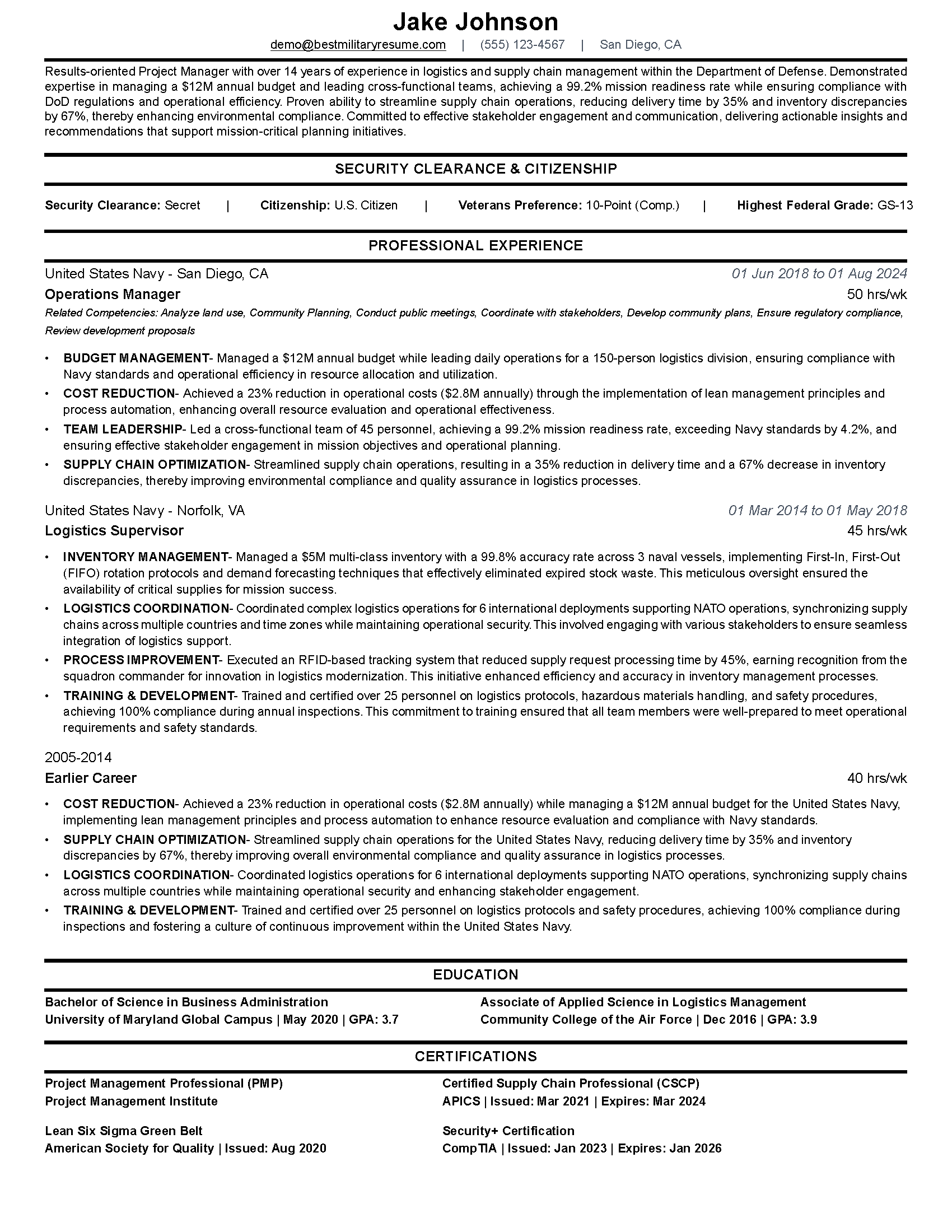
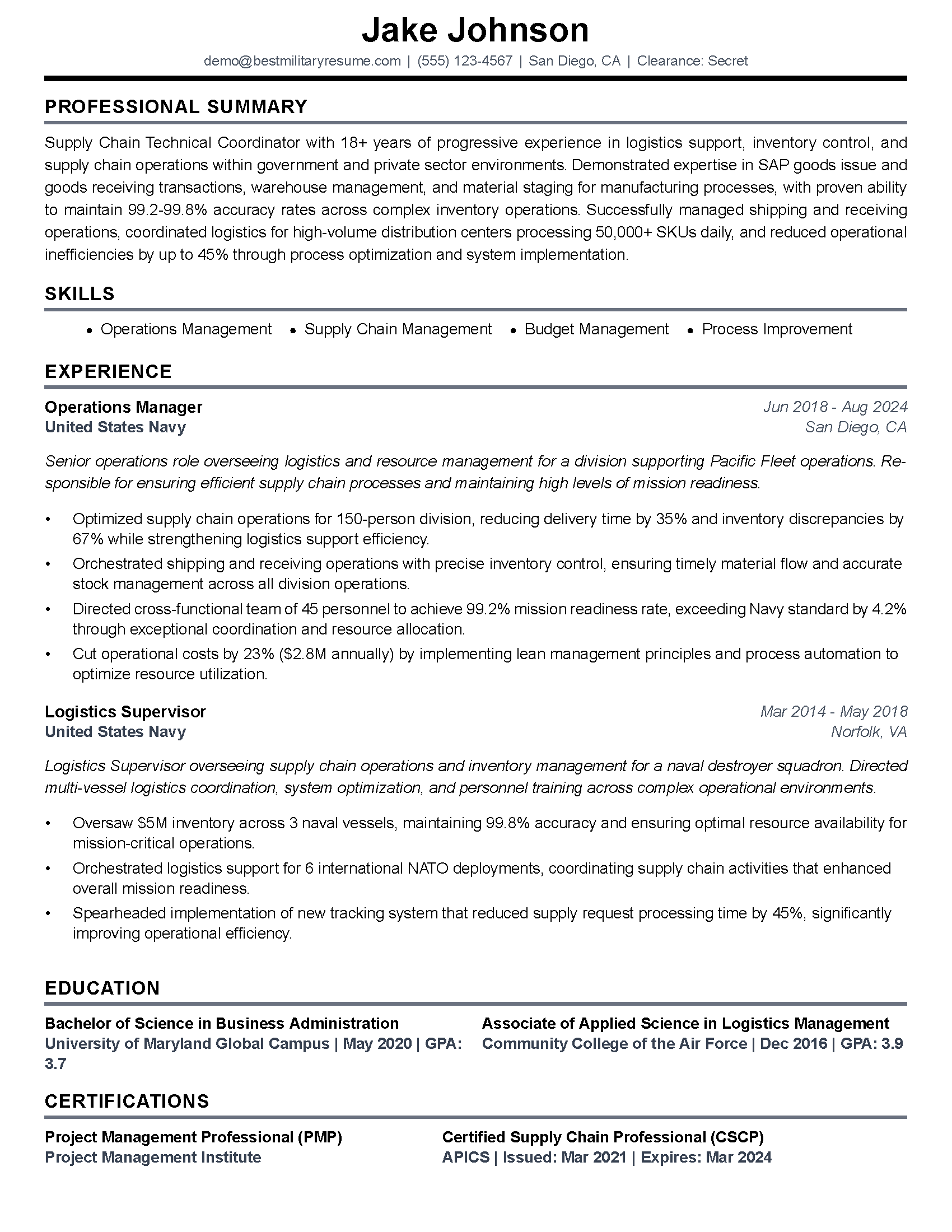
To put your license and driving record on a resume, use our 88M CDL resume guide. If you'd rather run the yard than drive, see our logistics resume guide.
Rules checked November 2026 at govinfo, 49 CFR parts 380 and 383, 2025 edition. State rules came from the New York, Wisconsin and Indiana licensing pages. Funding rules came from VA's pages.
What to Do Next
Find one Class B posting you would take, such as local delivery, transit, school bus or construction. Paste the whole posting into BMR's Resume Builder. BMR then rewrites your summary, work bullets and skills in that posting's own words.
Chris used BMR to land a civilian logistics job. He left the Army as a Lieutenant Colonel (O-5).
"Thanks to BMR, my resume effectively communicated the value of my leadership, operations, and logistics background in a way corporate recruiters understood. My resume landed me an interview, and ultimately a position as a Logistics Operations Manager."
Frequently Asked Questions
Can I add endorsements to a commercial learner's permit?
Does a Class B let me drive a smaller passenger vehicle?
Is there a time limit to finish CDL training?
Will the GI Bill pay me back if I fail the CDL test?
About the author
Brad Tachi is the CEO and founder of Best Military Resume and a 2025 Military Friendly Vetrepreneur of the Year award recipient for overseas excellence. A former U.S. Navy Diver with over 20 years of combined military, private sector, and federal government experience, Brad brings unparalleled expertise to help veterans and military service members successfully transition to rewarding civilian careers. Having personally navigated the military-to-civilian transition, Brad deeply understands the challenges veterans face and specializes in translating military experience into compelling resumes that capture the attention of civilian employers. Through Best Military Resume, Brad has helped thousands of service members land their dream jobs by providing expert resume writing, career coaching, and job search strategies tailored specifically for the veteran community.