Multiple Short Jobs on a Resume: A Veteran's Guide
Michael got only rejections. Then a $100K facilities manager role.
Michael, E-7, Navy, tried a ton of outside help before BMR
You separated three years ago. Your resume lists four employers. Not one of those jobs lasted a full year.
The first one paid rent while your savings ran dry. The second ended when the contract ended. The third was nothing like the recruiter described. The fourth you left for an offer that fell apart in month two.
Now someone opens your file. She sees four company names stacked in a short window. She does not read your reasons. She scrolls, pauses, and opens the next resume.
That pause is what this article fixes.
By the end you will know which short jobs to group and which ones to drop. You will also know how to word the ones you keep. And what to say when a hiring team asks about them.
Short stints are common and they are fixable. Your resume does not need to hide them. It needs to group them, label them, and give the reader a reason to keep going.
One boundary before we start. This article covers job churn you chose or absorbed yourself. If your moves were driven by a spouse's PCS orders, read the trailing spouse relocation resume guide instead. Orders are a different problem with a different fix.
Why Do So Many Veterans Rack Up Short Jobs After Separating?
Nobody plans a messy first three years. It happens one decision at a time.
The first civilian job is mostly a guess. You have never worked outside the military. You do not know how the work feels until you are in it. Some of those guesses miss badly. Our piece on culture shock in that first civilian job covers why.
Money speeds all of it up. Terminal leave runs out. The first VA payment takes a while. So you take the offer in front of you instead of the right one.
Then one short job tends to create the next. A bad fit makes you jump early. An early jump lands you somewhere you vetted in a hurry.
Six Reasons a Post-Service Resume Fills Up With Short Jobs
The bill-paying job
You took the first offer because savings ran out. The work never fit.
The layoff or contract end
Funding dried up or the site closed. You did nothing wrong.
Seasonal or temp work
The job had an end date printed on it from day one.
The oversold role
The recruiter sold a job that did not exist once you got there.
The chased offer
A better title showed up and you jumped. Then that one broke too.
The false start
You tried a new field, gave it eight months, and it was not for you.
All six leave the same mark on paper. A short date range next to a company name. The cause never shows up. That is the whole problem.
None of this makes you unusual. The Bureau of Labor Statistics has tracked the same group of Americans for decades. It does that in its National Longitudinal Surveys. People hold a lot of jobs across a working life. Yours are just bunched into a tight window.
My own path looks scattered on paper too. I was hired into six different federal career fields after the Navy. Environmental Management. Supply. Logistics. Property Management. Engineering. Contracting. Six fields reads like a guy who could not pick a lane. Every move was a step up. My resume had to say that out loud, because the job titles never did.
Is a Gap the Same Problem as a Pile of Short Jobs?
No. They look alike on the page. They are not the same problem.
A gap is empty time. Months with nothing listed at all. The reader wonders where you went.
Multiple short jobs are full time that looks unstable. Every month is covered. You were working the whole way through. The worry is different. The reader wonders how long you would stay.
So the fixes point in opposite directions. A gap gets filled in with what you were actually doing. Short stints get grouped, labeled, and explained. Empty months are a different fix. Our guide to employment gaps on a veteran resume handles that one.

When Should You Combine Short Jobs Into One Entry?
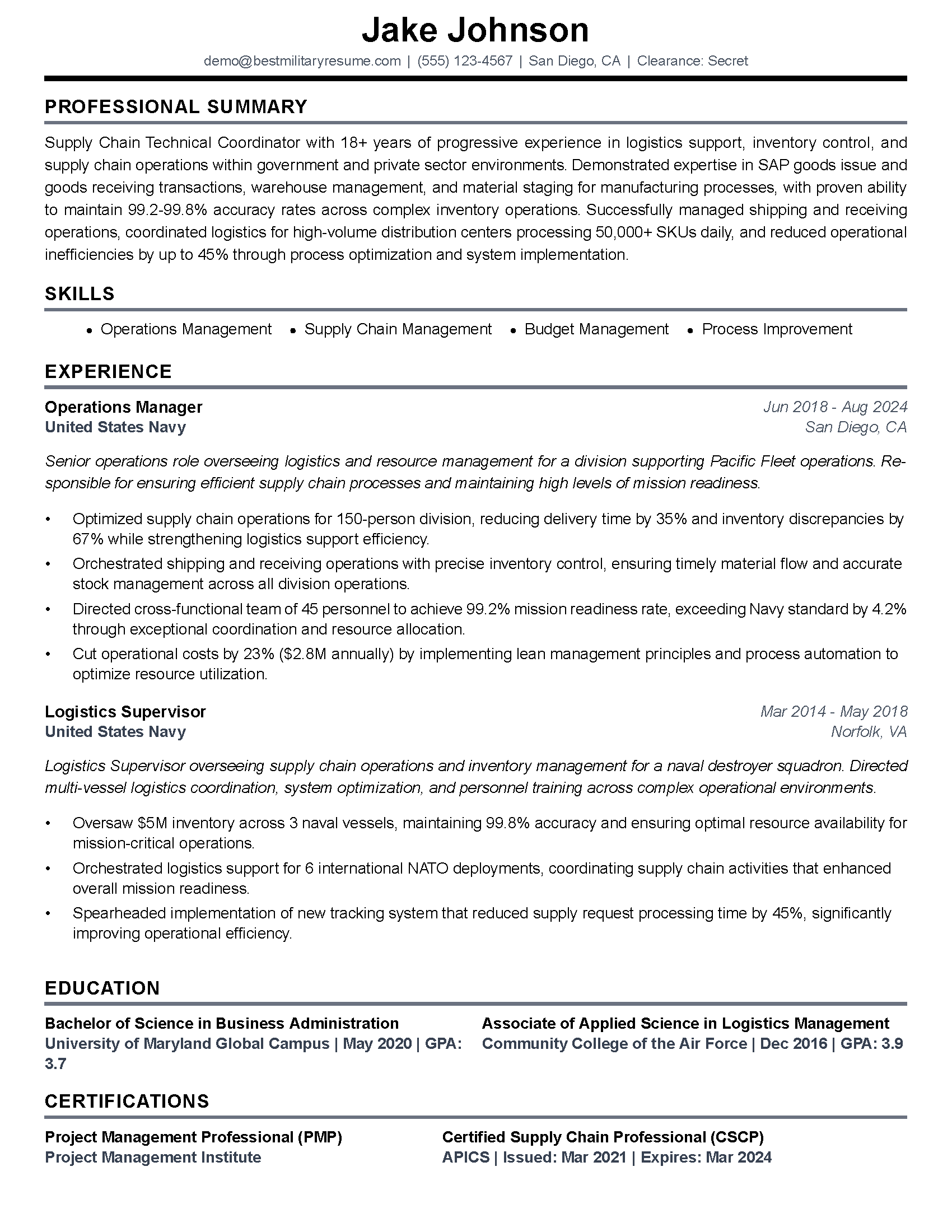
Combining is the biggest win available here. Four entries become one. The page calms down. The reader stops counting logos and starts reading work.
It only works when the grouping is true. You are not hiding anything. You are picking a better container for facts that stay the same.
What a combined entry looks like
The cleanest case is a staffing agency. If one agency placed you at four sites, the agency is usually your employer of record. It hires you, pays your wages, and usually withholds your taxes. The agency gets the date range. Each placement sits underneath as a bullet.
Warehouse Associate, Mar 2024 to Jul 2024. Inventory Clerk, Aug 2024 to Dec 2024. Shipping Lead, Jan 2025 to May 2025. Materials Handler, Jun 2025 to Oct 2025.
Warehouse and Inventory Contractor, Mar 2024 to Oct 2025. Four placements through a staffing agency across shipping, receiving, and cycle counts. Each assignment finished on schedule.
The second case is one function across different employers. Say you did warehouse and inventory work for three companies in two years. Group them under a heading that names the function and the full span. Then list each employer inside it.
Both versions keep every company name on the page. Nothing disappears. The dates still add up to the same months.
When combining is honest and when it is not
- Same employer of record, several roles: Usually combine. One entry with the roles listed inside it.
- Same staffing agency, several placements: Combine. The agency is your employer.
- Same function, different employers: Group only if you label the block clearly.
- Different functions, different employers: Leave them apart. A fake umbrella reads worse than the churn.
- Overlapping dates or a side gig: Keep it separate and label it. Merging those confuses the timeline.
One test settles most cases. Read the combined entry out loud to someone. If they can repeat your work history back correctly, the grouping is honest. If it makes four employers sound like one job, rewrite it.
Where you put all this matters too. A grouped entry still lives inside a reverse chronological work history. Our walkthrough of the work experience section shows the layout. If you are weighing formats, we compare the three resume formats for veterans side by side.
Which Short Jobs Can You Leave Off Your Resume?
Some short jobs cost you more than they add. Those can come off.
The common rule of thumb is three months. If a job ran under about 90 days and adds nothing to this application, it can go. Two weeks at a warehouse in 2023 reads as noise on the page.
Four conditions should hold before you cut it.
- It does not open a gap you cannot explain: Dropping a 10-week job between two others is fine. Dropping the only job in a 14-month stretch is not.
- It is not relevant to the role you want: A six-week contract using the exact software in the posting stays, even though it was short.
- It carries no title or skill you need: If it is the only place you supervised anyone, keep it.
- You are not filling out a form that asks for your work history: A resume is a summary. An application form is a signed statement.
Where the honesty limit sits
Trimming a short job off a resume is normal. Leaving it off a signed form is not. That covers employment applications, background check forms, and the SF-86 for a clearance. The SF-86 asks you to list every job for the last 10 years. It says you must cover the whole period with no breaks. You answer those forms completely.
That last point deserves attention. A resume is a marketing document. You choose what goes on it. A signed form is a different animal with different consequences.
Employment verification often runs through payroll data. A job you left off a resume can still show up there. On a resume that is fine. On a signed form it is a problem you do not want.
How Do You Explain a Layoff Without Sounding Bitter?
A layoff is the easiest short stint to explain. It is also the one veterans over-explain.
The instinct is to defend yourself. You want the reader to know it was not your performance. So you write three lines about restructuring and a new VP. That energy reads as grievance. Grievance is what sticks.
Keep it to a short factual label. On the resume, add a few words in parentheses after the date range. Something like "position eliminated in site closure" or "contract ended, program not renewed" does the job.
Then stop. No adjectives. No story about the VP.
Layoffs are ordinary and the government counts them every month. The Bureau of Labor Statistics counts hires, quits, layoffs, and discharges. It reports them in its Job Openings and Labor Turnover Survey.
If your whole site closed, you may have gotten written notice weeks ahead. Under the federal WARN Act, some employers owe 60 days of written notice. That 60-day rule sits in 29 U.S. Code 2102. The law usually covers employers with 100 or more employees. Notice usually kicks in when a site closing costs 50 or more workers their jobs. Some states set lower limits. California's version covers employers with 75 or more employees. A notice like that is a clean external fact. Naming it moves the reason off you and onto the business.
How Do You Make Temp and Contract Work Look Intentional?
Temp work is not a failure. It turns into one when the resume leaves it unlabeled.
An unlabeled five-month job looks like you got let go. A labeled five-month contract looks like you finished the job. The dates do not change. The label does all the work.
Put the word right in the title line, where the eye lands first.
- Inventory Analyst (6-month contract): Says the end date was planned.
- Maintenance Technician, placed through a staffing agency: Names the real employer of record.
- Seasonal Warehouse Lead (peak season): Explains a three-month run before anyone asks.
- Project Coordinator (contract to hire): Shows you were on a track, not drifting.
Then write the bullets like the work mattered, because it did. Contract work often hands you a narrow job with a clear number attached. That is easier to write well than a vague full-time role.
Finishing a contract on schedule is a good thing. Say so on the page. "Completed the full contract term" is a line hiring teams like to read.
Agencies are also a real road back to full time work. Our guide to staffing agencies and temp to full-time roles walks through how that pipeline runs.
What Do You Say When Someone Asks Why So Many Jobs?
The question is coming. Plan the answer instead of improvising it.
The version that hurts you rambles. It walks job by job through four employers and four grievances. By minute two you sound like the common thread in every bad workplace.
The version that works runs about 30 seconds and has four beats.
Name it first
Say your first years out had some short stops and that you will cover it fast. Beating them to it takes the charge out of the question.
Give the cause without blame
Two were contracts that ended. One was a fit you misread. Name the reason in a clause, not a paragraph.
Say what changed
Explain that you stopped taking the first offer. Now you screen the work itself before you sign.
Point at this job
Close on why this role fits the thread. Tie two things in the posting to work you already did well.
Practice it out loud until it is boring to you. Boring is the goal. A steady 30-second answer signals the churn is behind you.
I saw this from the hiring side of the desk on openings in my federal chain. A short stint never knocked anyone out by itself. What sank people was a package that left me guessing. Four unexplained employers made me invent a reason. The reason I invented was never generous.
Expect a follow-up question or two. Our list of the most common veteran interview questions covers the ones that usually come next.
What Should You Do This Week?
Open your resume and work in this order.
- List every job since separation with real start and end months. Get the timeline right before you touch wording.
- Mark each one as combinable, keepable, or cuttable using the rules above.
- Build your combined entries. Keep every employer name inside them.
- Label every contract, temp, and seasonal job in the title line.
- Write your 30-second answer and say it out loud four times.
Then tailor the whole thing to one specific posting. A grouped work history still needs the keywords from the job you actually want. Without that, it sinks in the rack-and-stack no matter how clean it looks.
Our Resume Builder does that part for you. Paste the posting, and it tailors your work history to that role. It is free for veterans, military spouses, and dependents, and it takes a few minutes.
One more thing worth hearing. A messy first few years out is not a verdict on your career. Our piece on how long a military to civilian transition really takes puts the timeline in perspective.
Key Takeaway
Short jobs do not sink a resume. Unexplained short jobs do. Group what belongs together. Label every contract and temp role. Then give a 30-second answer that ends on the job you want.
Frequently Asked Questions
Should I put a job I only had for two months on my resume?
Is it dishonest to leave a short job off my resume?
Can I combine several short jobs into one resume entry?
How do I list temp or contract work so it does not look like I was fired?
What do I say in an interview when they ask why I have so many jobs?
Do short jobs hurt me more than an employment gap?
How do I explain a layoff on a resume without sounding bitter?
Will multiple short jobs keep me out of federal work?
About the Author
Brad Tachi is the CEO and founder of Best Military Resume and a 2025 Military Friendly Vetrepreneur of the Year award recipient for overseas excellence. A former U.S. Navy Diver with over 20 years of combined military, private sector, and federal government experience, Brad brings unparalleled expertise to help veterans and military service members successfully transition to rewarding civilian careers. Having personally navigated the military-to-civilian transition, Brad deeply understands the challenges veterans face and specializes in translating military experience into compelling resumes that capture the attention of civilian employers. Through Best Military Resume, Brad has helped thousands of service members land their dream jobs by providing expert resume writing, career coaching, and job search strategies tailored specifically for the veteran community.
