Physical Job to Desk Job After Injury: Veteran Resume Plan
Michael got only rejections. Then a $100K facilities manager role.
Michael, E-7, Navy, tried a ton of outside help before BMR
BMR advice: lead your desk-job resume with planning, inventory and safety work, not lifting. Veteran Readiness and Employment (VR&E), a Department of Veterans Affairs (VA) program, can help you train for "a different field." Its "Employment Through Long-Term Services" track is that route, if a counselor finds you qualify.
To apply, VA asks for "a service-connected disability rating of at least 10% from VA" and no dishonorable discharge. The track also needs an employment barrier and VR&E enrollment.
For this career change, you get a skills table, three bullets, three desk roles and VA's route.
What desk skills did my physical job build?
BMR advice: the desk skill was inside the physical job all along. Each row pairs a task with the skill it proves and a desk role that uses it.
| What you did | Desk skill it proves | Desk role that uses it |
|---|---|---|
| Mechanic: ran the service schedule for a fleet | Maintenance planning | Logistician |
| Mechanic: ordered parts and chased late ones | Ordering and supplier follow-up | Purchasing agent |
| Mechanic: inspected vehicles and logged faults | Accurate records | Purchasing agent |
| Infantry leader: planned gear, food and timeline for a patrol | Planning and resource allocation | Logistician |
| Infantry leader: signed for and tracked unit equipment | Property records and accountability | Logistician |
| Warehouse: counted, stored and issued stock | Inventory control | Purchasing agent |
| Trades: figured materials and hours before a job | Estimating cost and time | Cost estimator |
| Any crew: ran safety briefs and hazard checks | Following rules and standards | Purchasing agent |
The logistician and purchasing agent rows come from job tasks the Occupational Information Network (O*NET) lists. The cost estimator row comes from the Bureau of Labor Statistics (BLS).
Logisticians "Plan, organize, and execute logistics support activities, such as maintenance planning, repair analysis, and test equipment recommendations." Purchasing agents "Maintain and review computerized or manual records of purchased items, costs, deliveries, product performance, and inventories." They also "Monitor and follow applicable laws and regulations."
What desk jobs use those skills?
O*NET shows how much of each workday is spent sitting.
- Logisticians: "54% responded 'More than half the time'" for time spent sitting.
- Purchasing agents: "65% responded 'Continually or almost continually'" for time spent sitting.
O*NET also lists a logistician task that reads like a motor pool job: "Direct availability and allocation of materials, supplies, and finished products." BLS says cost estimators "work mostly in office settings." BLS says purchasing staff "usually work in an office setting."
BLS 2025 median pay:
- Logisticians: "$82,320 per year."
- Purchasing managers, buyers and purchasing agents: "$81,670 per year."
- Cost estimators: "$78,740 per year."
A median is the middle of the range. Half earn more and half earn less. Your offer depends on place and level.
For these fields in depth, read our logistics and supply chain careers guide. Aiming at a federal desk job? Schedule A is its own hiring path, covered in our Schedule A guide.
How do I write the bullets?
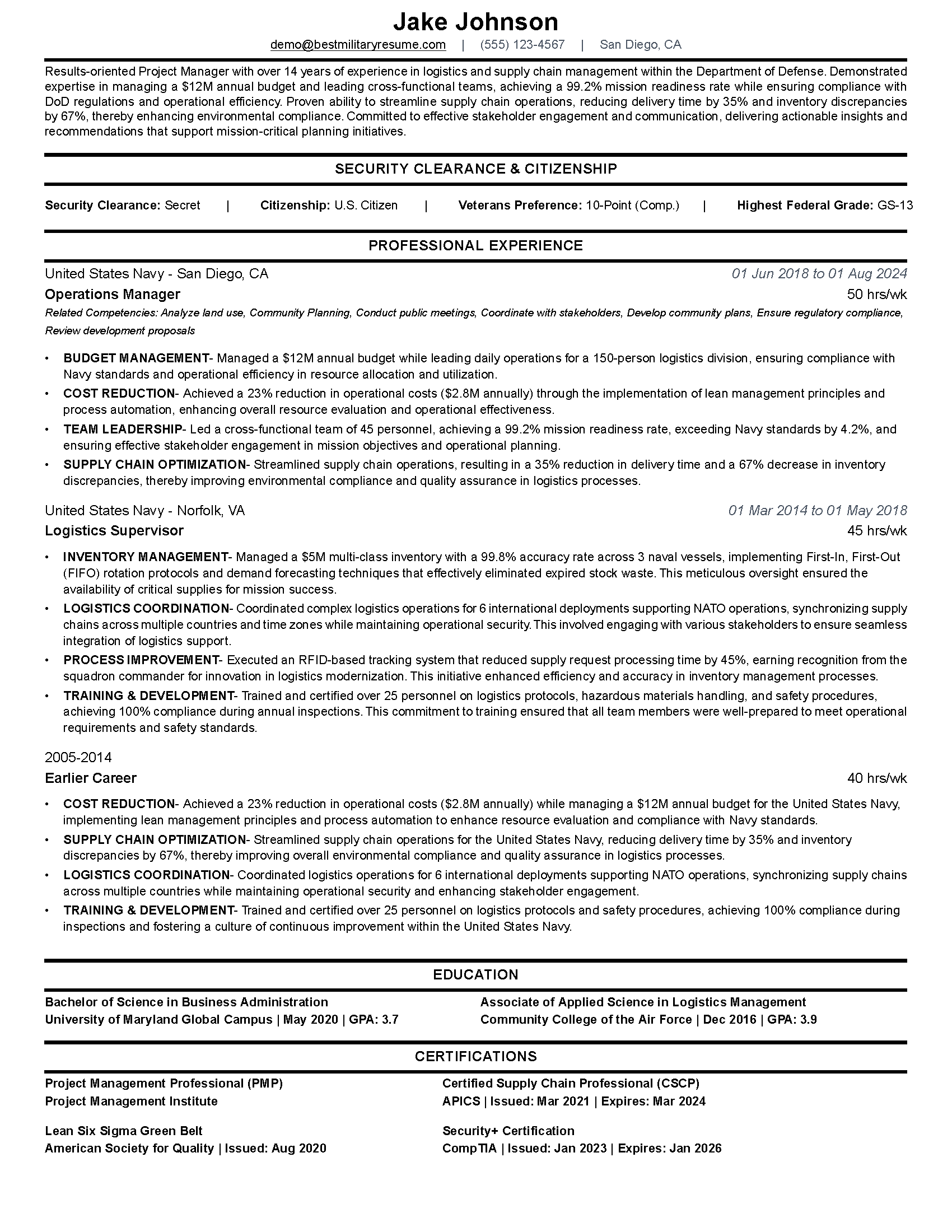
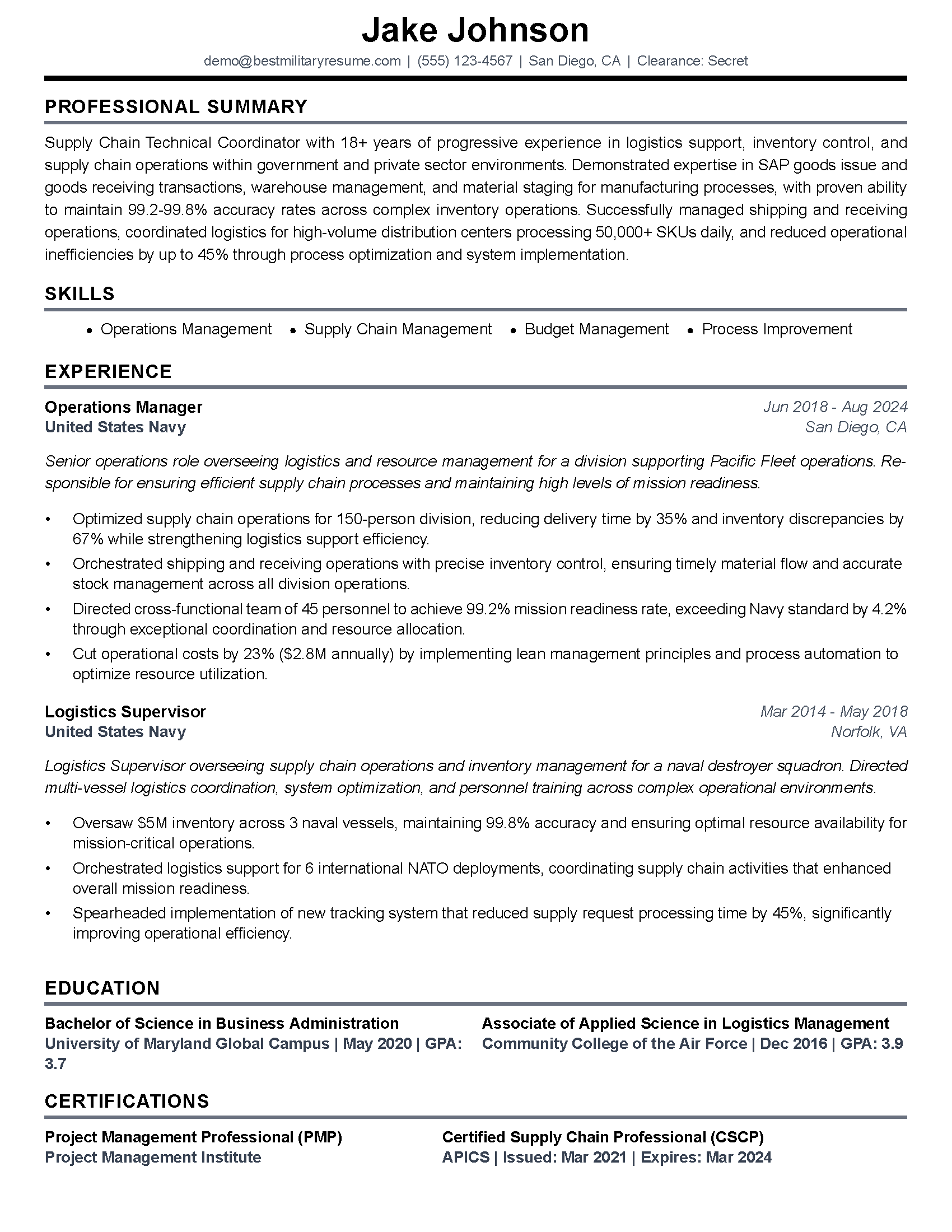
BMR advice: start each bullet with the desk skill, then the size, then the result. Keep the physical side out of the verb.
- Scheduled preventive maintenance for [00] vehicles, cutting missed services [00]% in [00] months.
- Tracked $[00]K in parts inventory across [00] shops, cutting back orders [00]% in [00] year.
- Delivered cost estimates for [00] building repairs worth $[00]K, finishing [00]% under budget.
Put your own figure where each bracket sits. If records are thin, use a number you can defend.
Whether to name the injury is a separate choice. Our disability disclosure guide covers it. If recovery left a gap in your work history, see the employment gaps guide.
Is a degree the gate for these roles?
Often, yes. BLS lists a "Bachelor's degree" as the typical entry education for all three roles.
BLS also lists "None" for prior related work for logisticians and cost estimators. So the degree, not years on the job, is the usual gate. O*NET puts logisticians in "Job Zone Four." It says "Most of these occupations require a four-year bachelor's degree, but some do not." That "some do not" is your way in.
BMR advice: read five real postings for your target role before you enroll. If most ask for a degree, plan the training. If some accept experience, apply now while you train.
Will VR&E retrain me for a desk field?
VA names five VR&E tracks. They are Reemployment, Rapid Access to Employment, Self-Employment, Employment Through Long-Term Services and Independent Living. Two fit a move to a desk.
Rapid Access to Employment is for an "employment path that uses your existing skill set." You must have an employment barrier, be enrolled in VR&E and "already have experience, education, or training in your field of interest." Its benefits include "Help with writing your resume and preparing for interviews." See VA's VR&E page for the Rapid Access track.
Employment Through Long-Term Services is the track for a new field. VA lists these benefits:
- "A complete skills assessment"
- "Career guidance"
- "Job market evaluation"
- "Education and training for a professional or vocational field that's a good fit for you"
VA defines the goal as suitable employment: "a job that doesn't make your disability worse, is stable, and matches your abilities, aptitudes, and interests." VA's VR&E page has the full rules.
VA also notes: "You may be eligible for both VR&E training and GI Bill benefits. You'll need to decide which benefit you want to use." Our VR&E vs. GI Bill guide walks through that choice. For how the training plan works, read our VR&E career training guide.
Easing back with fewer hours first? Our part-time return guide covers that path.
Sources checked November 2026: VA's VR&E pages, O*NET and BLS.
What to Do Next
Put a number on each desk skill from the table, then list those skills first. Bring one logistics, purchasing or estimating posting to BMR's Resume Builder next. That posting's wording then carries into your summary, work bullets and skills. Work you never did stays out, and the job lands in your tracker.
"I spent 6 months spinning my wheels, but once I put good data into your site, the results spoke for themselves. I had 4 companies want interviews, all four went into 2nd and 3rd round, and I have an offer that is equivalent to a 50K raise."
Brent, Master Sergeant (E-8), Marines
Frequently Asked Questions
Can VR&E set up on-the-job training in a desk field?
Who helps me find a job after VR&E training?
How exact do purchasing agents have to be?
Can I get work experience in my new field while I train?
About the author
Brad Tachi is the CEO and founder of Best Military Resume and a 2025 Military Friendly Vetrepreneur of the Year award recipient for overseas excellence. A former U.S. Navy Diver with over 20 years of combined military, private sector, and federal government experience, Brad brings unparalleled expertise to help veterans and military service members successfully transition to rewarding civilian careers. Having personally navigated the military-to-civilian transition, Brad deeply understands the challenges veterans face and specializes in translating military experience into compelling resumes that capture the attention of civilian employers. Through Best Military Resume, Brad has helped thousands of service members land their dream jobs by providing expert resume writing, career coaching, and job search strategies tailored specifically for the veteran community.