How to Answer "Biggest Achievement" When Your Work Is Classified
Taylor sent 200+ applications for 5 interviews. With BMR, 20 resumes all hit.
Taylor, E-7, Army, defense industry
When your biggest achievement is classified, keep the skill, the scale and the result in your answer. Drop the target, source, method, location and program, or pick an unclassified win instead.
That rule fixes the answer that shrinks to "I supported operations." That answer tells the interviewer nothing. Yet the work behind it is often the best of your career. Many cleared folks back so far off the line that they take their whole story with them.
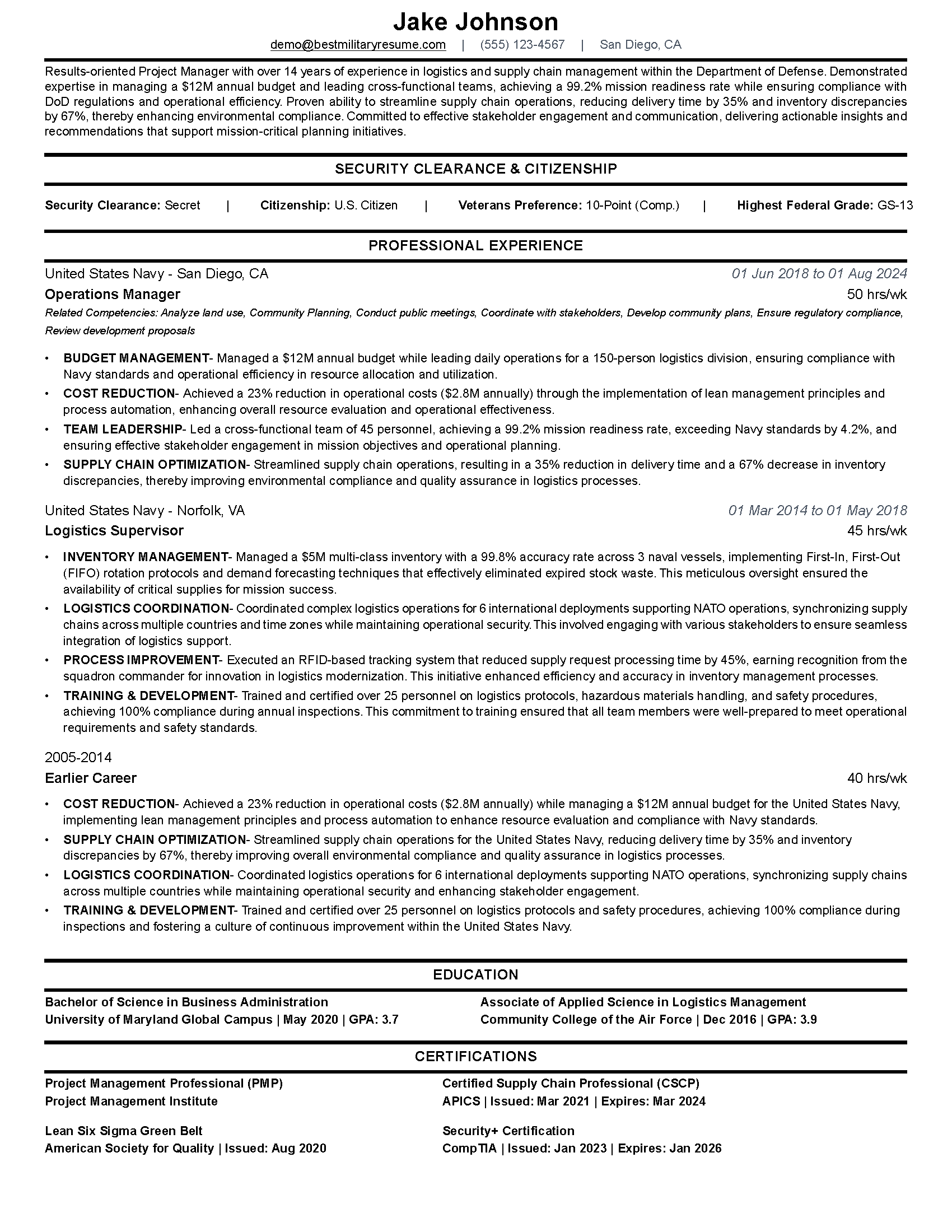
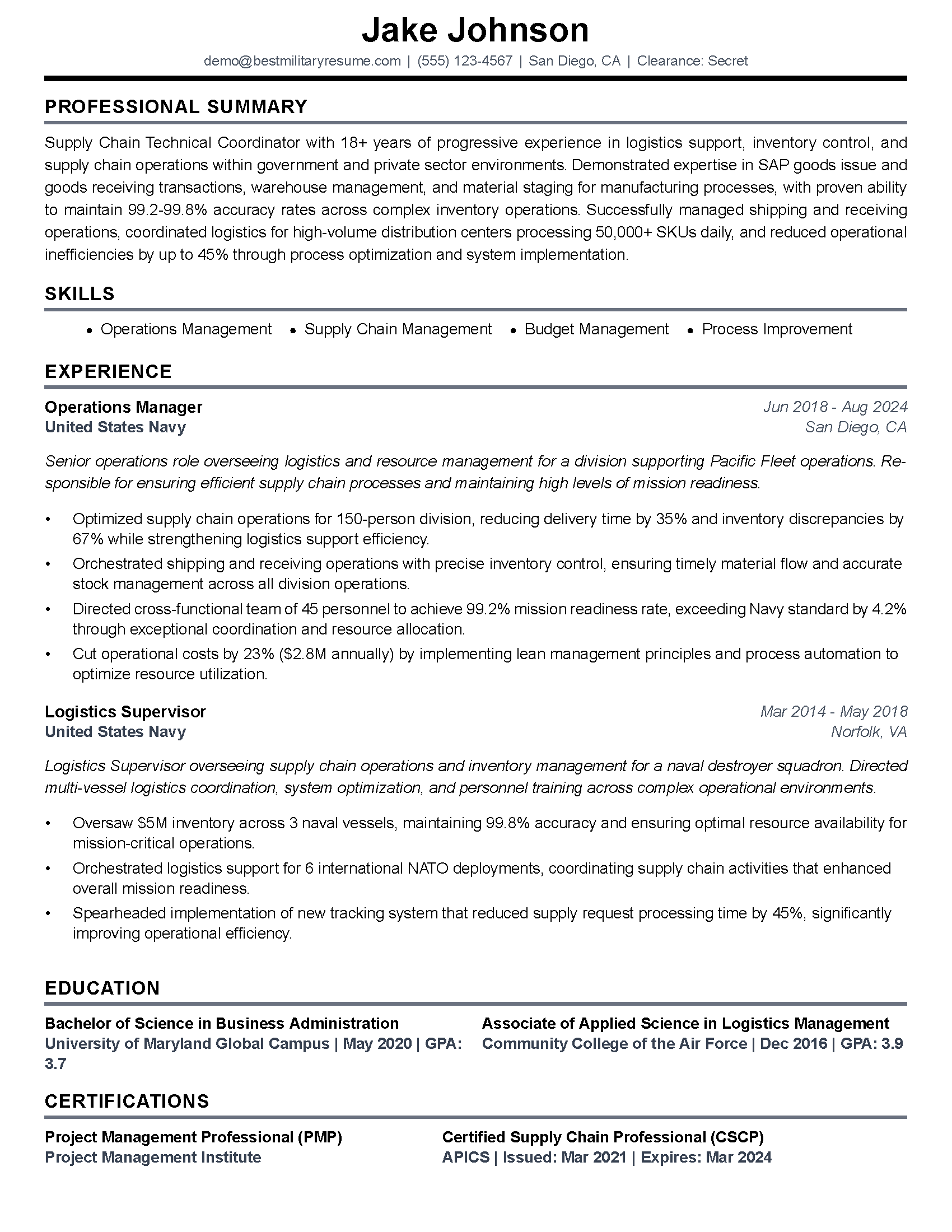
Your resume has to make the same cut on paper before you ever get this question. 79,689 resumes have been built on BMR, a resume builder for veterans.
This isn't legal or security advice. Your Security Classification Guide (SCG) has the final word on what you can say. So do your SSO and PSO.
What does a safe biggest achievement answer sound like?
These three are made-up samples that show the method. They aren't real people, and the numbers in them are sample numbers. Each one is said out loud, in the first person, the way you'd answer in the room.
Sample 1: an intelligence analyst
"My biggest achievement was fixing how my team handed off work between shifts. I was a senior analyst on a team that ran around the clock. Reports were getting dropped at shift change, so leaders got late answers. I built a short handoff checklist and trained every analyst on it. I also added a 15-minute overlap so each shift talked to the next one face to face. Within two months, we stopped missing deadlines. My boss made the checklist the standard for the whole section. I'd bring that same habit to your team."
It keeps the skill, the round-the-clock scale and the result. It never says what the team watched or where.
Sample 2: a network defense technician
"The work I'm proudest of is cutting the time it took my team to patch our network. I led five technicians who kept a secure network running for a large unit. Each patch cycle took about three weeks, and that left gaps open too long. I mapped every step and cut the ones that added nothing. Then I wrote a test plan we could run at night. We got the cycle down to one week, with no outages from a patch. That's the kind of work your security team does, and it's why this role caught my eye."
Here the tools and the timeline carry the weight. The answer names no system, no base and no mission.
Sample 3: an aircraft maintenance supervisor
"My biggest achievement was getting a crew ready for an inspection on short notice. I ran a crew of 14 aircraft mechanics. Our last inspection had found gaps in our records. I set up a daily records check and paired each new mechanic with a senior one. I also tracked every open item on one board, so nothing sat for long. We passed the next inspection with no major findings. I learned how to raise a crew's standard fast, and I'd bring that to your shop floor."
Notice what's missing. There's no aircraft type, no program name and no location. The result still lands.
How do you take your own achievement down the ladder?
I wrote the method in my ClearanceJobs article on classified work: "Climb the abstraction ladder. Keep the skill, the scale, and the outcome. Drop the target, source, method, location, and program."
Work it in this order, in your head, not on paper:
- Pick the win: choose one result you drove yourself. Say "I," not "we."
- Name the skill: say it the way a civilian job posting would. "Led analysts" works. A unit nickname doesn't.
- Name the scale: team size, hours, budget or people trained. My article lists "your team size, the tempo you held, and the budget you touched" as usually unclassified.
- Name the result: faster, fewer errors, a passed inspection, a standard others adopted.
- Run the drop list: take out the target, source, method, location and program. If a detail fits one of those five, it goes.
- Say it out loud: keep it short and plain. Then check it against the next section.
Can safe details add up to a classified answer?
Yes, and this is the trap that catches sharp people. Executive Order 13526, section 1.7(e), says compilations of individually unclassified items "may be classified" in some cases. That applies when the combination reveals a classifiable association that no single item shows.
Each piece of your answer can be fine alone. Your dates are unclassified. So are your base, your unit and your skill. But put all four in one answer, and they may point at something nobody cleared for release.
In an interview, the stacking often happens in the small talk. The interviewer asks, "Where were you stationed then?" Then, "What years?" Then, "What did your team focus on?" Each question feels harmless. Together they can rebuild the thing you left out.
So run one check before the interview. Read your answer, then add the follow-ups you expect. Would the answer plus the follow-ups name a place, a time and a mission? Then cut one of them.
What do you say when the interviewer pushes for more?
Some interviewers will push. Hold the line in a calm voice, then hand them something real.
Here's a short script you can adapt:
- The first push: "The mission itself is classified, so I'll keep that part general. I can go deeper in the appropriate setting. What I can tell you is how I ran the team and what changed because of it."
- A second push: "I'd rather not guess where the line is in an interview. My security officer draws that line, not me. Happy to walk you through how I built the process, step by step."
- A question about place or dates: "I'll keep the location and timing general. The skill is the part that carries over to this job."
Then stop talking about what you can't say. Go back to your skill, your scale and your result.
The key line is "I can go deeper in the appropriate setting." In my article, the candidate who stays inside the SCG and says it "sends a signal." "It says they can be trusted with the thing they're being hired to be trusted with."
When should you pick an unclassified achievement instead?
Some wins can't climb the ladder. If the result itself is classified, no wording fixes that. The same goes for a program whose very existence is protected. In those cases, pick another win.
Good stand-ins are often right next to the classified work:
- A training result: the new people you brought up to speed, and how fast.
- A process fix: a checklist, a handoff or a schedule that saved time.
- A people win: a struggling teammate you coached to a promotion.
- An inspection or audit: a passed review you prepared the team for.
Not sure if a win is safe? Ask before the interview, not during it. As I wrote, nothing outranks "your Security Classification Guide, your SSO, or your program security officer." A recruiter or interviewer can't clear a detail for you.
The written side has its own steps. If you worked for NSA, even as a contractor, its Prepublication Review page covers resumes and cover letters. It also says "NSA/CSS Policy 1-30 allows up to 30 business days to complete a review." Plan for that before you send anything in writing.
What about your clearance and your resume?
Those are their own questions, and each has its own guide. For the clearance question itself, see how to talk about your clearance in a civilian interview. To clean up deployment details on paper, read combat deployment resume OPSEC.
If you want a frame for the story, the STAR method for veterans fits the ladder well. For more questions like this one, try our behavioral questions with sample answers. And to turn unit words into plain ones, see explaining military experience without jargon.
Sources: Executive Order 13526, NSA's Prepublication Review page, my ClearanceJobs article and BMR's mock interview scoring rules. We checked them in November 2026.
What to Do Next
Pick your win tonight. Run it down the ladder, then run the stacking check. Say it out loud until it sounds like you.
Practice in the BMR mock interview before the real one. Type only the version you'd say to a stranger. It scores your answer and flags any "we" that hides your part. Then it writes a stronger version from your own background. You can start with a free account.
Frequently Asked Questions
Can I say which agency I worked for in an interview?
What if the interviewer is cleared too?
Should I mention my clearance level in my biggest achievement answer?
Can I name the aircraft or system I worked on?
About the author
Brad Tachi is the CEO and founder of Best Military Resume and a 2025 Military Friendly Vetrepreneur of the Year award recipient for overseas excellence. A former U.S. Navy Diver with over 20 years of combined military, private sector, and federal government experience, Brad brings unparalleled expertise to help veterans and military service members successfully transition to rewarding civilian careers. Having personally navigated the military-to-civilian transition, Brad deeply understands the challenges veterans face and specializes in translating military experience into compelling resumes that capture the attention of civilian employers. Through Best Military Resume, Brad has helped thousands of service members land their dream jobs by providing expert resume writing, career coaching, and job search strategies tailored specifically for the veteran community.