Air Force 3P0X1 Security Forces: Civilian Careers
Desiree landed a $135K hybrid senior financial consultant role.
Desiree, E-5, Army National Guard, the interviewer loved the resume from the top down
Air Force Security Forces veterans leave the service with law enforcement training, weapons qualification, access control experience, and force protection expertise that civilian employers in security, law enforcement, and protective services actively seek. The 3P0X1 AFSC covers a wide range of duties — from base entry point access control to combat arms training, K-9 handling, executive protection, and law enforcement investigations — and each of these specializations maps to specific civilian career paths that pay well and offer long-term stability.
The translation challenge for Security Forces is not a lack of transferable skills. It is that civilian employers often do not realize how much training and responsibility comes with the SF badge. A civilian HR manager reading "Security Forces" on your resume may picture a gate guard, when in reality you may have conducted criminal investigations, managed armories, led response teams, or coordinated force protection for an entire installation. Your resume needs to bridge that perception gap and communicate the full scope of what you actually did — not just the title the Air Force gave you.
Having served in the military myself and then transitioning to civilian careers, I know that the biggest obstacle is not your qualifications — it is how you present them. SF veterans who learn to translate their experience into civilian security and law enforcement language consistently land roles that match their actual skill level rather than being underemployed in entry-level positions that do not reflect their training and responsibility.
What Civilian Careers Match Air Force Security Forces Experience?
Security Forces experience opens doors to several distinct career paths. The right one depends on your rank, specialization, and what kind of work environment you want after the military:
Federal law enforcement. FBI, DEA, ATF, CBP (Customs and Border Protection), Secret Service, U.S. Marshals, Federal Protective Service, and ICE all recruit veterans with law enforcement backgrounds. Your military law enforcement training, weapons qualification, and security clearance give you a significant advantage over civilian applicants. Many federal agencies specifically value SF experience because you already understand use of force continuum, rules of engagement, report writing, and evidence handling. Federal law enforcement salaries start at $50K-$60K (GS-5/7) but climb rapidly to $90K-$130K+ at GS-12/13 levels, with excellent benefits, retirement, and law enforcement availability pay (LEAP) that adds 25% to your base salary at many agencies. When you factor in LEAP, locality pay, and federal benefits, total compensation at the GS-12/13 level often exceeds what comparable civilian roles pay in the private sector — plus you get the federal pension and TSP matching that civilian employers rarely offer.
State and local police departments. Many police departments give veterans preference in hiring and waive portions of their academy training for candidates with military law enforcement experience. Some states (Texas, Florida, Virginia) have expedited certification paths for military police and Security Forces veterans. Starting salaries range from $45K-$65K depending on department and location, with most officers earning $70K-$90K+ within 5-7 years including overtime and specialty pay. The advantage of local LE is speed — many departments are hiring aggressively right now, and a Security Forces veteran with clean records and a willingness to attend their academy can be on the job within months of separation. Some departments in Texas, Arizona, and Florida have even created direct-hire pathways for military LE veterans that compress the hiring timeline significantly.
Corporate security management. Fortune 500 companies, financial institutions, hospitals, and tech campuses all employ security managers and directors who oversee physical security, access control, emergency response, and threat assessment. These roles pay $65K-$120K+ depending on company size and responsibility scope. Your experience managing entry control points, developing security plans, coordinating emergency response, and briefing leadership on security posture translates directly to corporate security management — often at higher pay and significantly better work-life balance than traditional law enforcement. Corporate security managers typically work standard business hours, earn competitive salaries with full benefits, and avoid the physical risks and shift work that come with patrol-based LE positions. For SF veterans who enjoyed the planning and management aspects of the career more than the patrol and response aspects, corporate security is often the ideal fit.
Defense contracting and government security. Companies like Allied Universal, Securitas, and specialized defense contractors hire SF veterans for force protection, executive protection, and security consulting roles. If you have experience with base defense, anti-terrorism programs, or FPCON implementation, defense contractor roles at military installations pay $55K-$85K and offer a familiar working environment during your transition. These roles let you use your SF skills immediately while you figure out your long-term career direction — many veterans use defense contractor security as a 1-2 year bridge before moving to federal LE or corporate security management.
Protective services and executive protection. SF veterans with Raven or Phoenix Raven training, close protection experience, or VIP security backgrounds can target executive protection roles in the private sector. These positions pay $70K-$150K+ depending on the client and travel requirements, and the demand for trained protective agents continues to grow as high-net-worth individuals, executives, and public figures face increasing security concerns. SF veterans with any level of close protection training have a foundation that civilian EP training programs can build on quickly, and the combination of military discipline and protective skills makes you highly competitive in this niche but lucrative field.
Security Forces Career Path Comparison
Federal Law Enforcement (FBI, CBP, USSS)
Highest long-term earning potential with federal benefits and retirement. Competitive hiring process but SF experience + clearance gives strong advantage. Start: GS-5/7 ($50K-$65K), senior: GS-13+ ($100K-$130K).
State / Local Police
Fastest hiring timeline. Many departments offer academy credit for SF training. Strong union protections and overtime potential. Start: $45K-$65K, with OT: $70K-$100K+.
Corporate Security Management
Best work-life balance. Growing demand at Fortune 500 companies, hospitals, and tech campuses. No shift work at senior levels. Salary: $65K-$120K+.
How Should Security Forces Veterans Translate Their Resume?
The biggest resume mistake SF veterans make is listing duties in Air Force terminology that civilians do not understand. "Maintained FPCON Bravo measures at installation entry control points" tells a civilian hiring manager nothing. It sounds like a foreign language to someone who has never worked in a military environment. But the experience behind that sentence — implementing heightened security protocols across a facility, managing vehicle and personnel screening procedures, and coordinating with multiple security teams to maintain a specific threat posture — is exactly what civilian security directors do at corporate campuses, government buildings, and critical infrastructure sites. "Managed physical security access control for a 10,000-person facility, implementing tiered security protocols based on threat assessment levels" communicates the same experience in language they can evaluate.
Here are the critical translations for your resume:
Entry Control Point (ECP) duty becomes "physical security access control and visitor management for a facility with X daily visitors." Flight chief / flight sergeant becomes "shift supervisor managing X security personnel across X posts." BDOC (Base Defense Operations Center) becomes "security operations center monitoring and emergency dispatch coordination." FPCON measures become "threat-based security protocol implementation and escalation procedures."
Quantify everything on your resume. Instead of "managed entry control point," write "managed access control for installation with 10,000+ personnel, processing an average of 3,000 daily vehicle and pedestrian entries while maintaining zero unauthorized access incidents over 18 months." Numbers give civilian hiring managers concrete data to evaluate your experience against their requirements.
For law enforcement experience, translate SF blotter entries to "law enforcement incident reports." SFMIS (Security Forces Management Information System) becomes "law enforcement records management system." Use of force reports stay largely the same — civilian LE understands this terminology. SABC (Self Aid Buddy Care) becomes "tactical emergency medical training" or "first responder certified."
"Performed ECP operations at FPCON Bravo. Supervised 4-person fire team during 12-hour shifts. Wrote SF blotter entries and maintained SFMIS records. Qualified on M4, M9, and M240B."
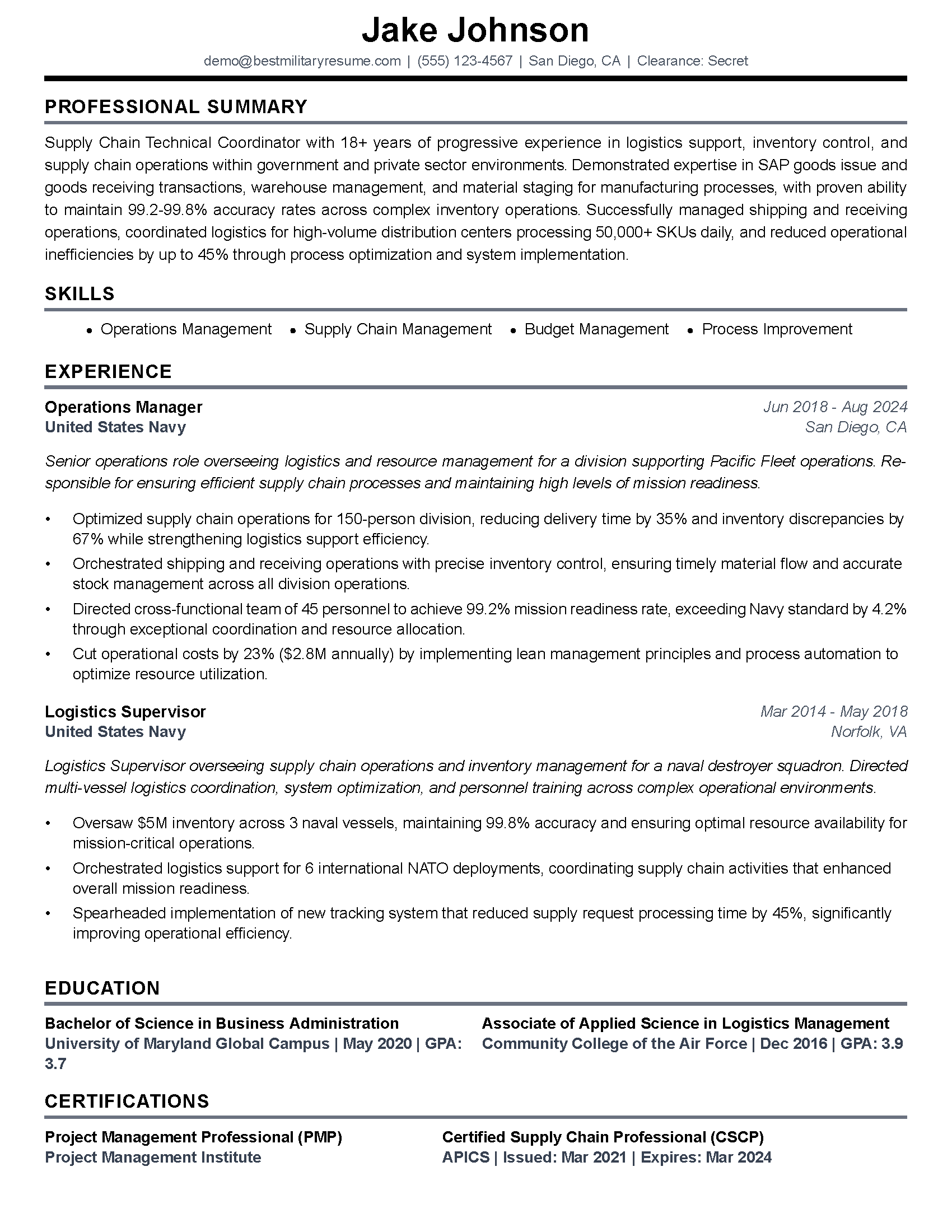
"Supervised 4-person security team providing 24/7 access control for a 10,000-person installation processing 3,000+ daily visitors. Implemented elevated threat security protocols. Maintained law enforcement incident documentation in records management system with 100% compliance."

What Certifications Help Security Forces Veterans Get Hired Faster?
Certifications significantly impact hiring timelines and salary offers for SF veterans transitioning to civilian security and law enforcement careers:
For law enforcement: Your state's Peace Officer Standards and Training (POST) certification is the most important credential. Some states grant partial or full POST equivalency for military police and Security Forces training — check your target state's requirements early. Additionally, FEMA ICS (Incident Command System) certifications (ICS-100, ICS-200, ICS-300) are valued by federal agencies and demonstrate your emergency management capabilities.
For corporate security: Certified Protection Professional (CPP) from ASIS International is the gold standard for security management. Physical Security Professional (PSP) certification demonstrates expertise in physical security systems — access control, CCTV, alarm systems — that your SF experience directly supports. These certifications position you for security director roles at $90K-$120K+.
For executive protection: Executive Protection Institute (EPI) certification or similar accredited programs validate your close protection skills for the private sector. Combined with any Raven or Phoenix Raven training documentation you can provide, these credentials open doors to high-paying protective service roles.
For investigations: If you worked in the SF investigations section (S2I), consider credentials like Certified Fraud Examiner (CFE) for corporate investigations or Professional Certified Investigator (PCI) from ASIS. These translate your military investigative experience into recognized civilian qualifications that corporate employers, law firms, and insurance companies value for their internal investigation teams.
Regardless of which path you choose, make sure your resume clearly lists all relevant training and certifications you completed during your SF career. Combat arms training and maintenance, law enforcement patrol certification, defensive tactics instructor qualifications, any specialized schools (K-9, CATM, investigations, Raven) — all of these carry weight with civilian employers when properly translated. Use BMR's resume builder to create tailored versions for each career path you are targeting, because a resume for federal LE should look very different from one targeting corporate security management.
Start certification research early — at least 6-12 months before separation. State POST requirements vary significantly, and some require additional academy time regardless of military experience. Check your target state's specific requirements before you commit to a location so you are not surprised by additional training timelines after separation.
How Do Veterans Preference and Federal Hiring Help SF Veterans?
Veterans preference is a significant advantage for SF veterans targeting federal law enforcement. With 5 or 10 point preference (depending on disability rating), you receive a meaningful boost in the federal hiring process. For competitive service positions, this can be the difference between making the referral list and being passed over.
Federal agencies with law enforcement positions use specific hiring authorities that benefit veterans. The Direct Hire Authority for certain CBP and Border Patrol positions streamlines the process considerably. The FBI, DEA, and Secret Service also have veteran-focused recruitment programs that recognize military law enforcement as qualifying experience for their special agent positions.
For federal resume formatting, security and law enforcement positions require detailed descriptions of your duties, including hours per week, supervisor information, and specific law enforcement competencies. Use the USAJOBS resume format and include your DD-214, SF-15 (if claiming 10-point preference), and any law enforcement training certificates with your application package. Federal LE applications are thorough — expect background investigations, polygraphs, physical fitness tests, and structured interviews. Start the application process 6-12 months before your target start date because federal hiring timelines are notoriously slow, and having applications in the pipeline well before separation prevents gaps in employment. Use BMR's federal resume builder to create a properly formatted federal law enforcement resume that includes all required elements.
Related: The complete military resume guide for 2026 and how to list military experience on a resume.
Frequently Asked Questions
Can Security Forces veterans become police officers?
What is the best civilian career for Security Forces veterans?
Do I need a degree for federal law enforcement after Security Forces?
How does my Security Forces training transfer to civilian certifications?
What salary can Security Forces veterans expect?
Should Security Forces veterans target law enforcement or corporate security?
How do I translate BDOC experience for civilian employers?
Is executive protection realistic for Security Forces veterans?
About the Author
Brad Tachi is the CEO and founder of Best Military Resume and a 2025 Military Friendly Vetrepreneur of the Year award recipient for overseas excellence. A former U.S. Navy Diver with over 20 years of combined military, private sector, and federal government experience, Brad brings unparalleled expertise to help veterans and military service members successfully transition to rewarding civilian careers. Having personally navigated the military-to-civilian transition, Brad deeply understands the challenges veterans face and specializes in translating military experience into compelling resumes that capture the attention of civilian employers. Through Best Military Resume, Brad has helped thousands of service members land their dream jobs by providing expert resume writing, career coaching, and job search strategies tailored specifically for the veteran community.
