National Guard Resume With No Work Experience: How to Write Your First One
Desiree landed a $135K hybrid senior financial consultant role.
Desiree, E-5, Army National Guard, the interviewer loved the resume from the top down
Your Guard or Reserve job is real work experience, and it goes on your resume as a job. Under 38 U.S.C. 4311, a member of a uniformed service "shall not be denied initial employment" by an employer "on the basis of that membership."
So you don't hide drill. You list it like any other job.
That's hard to believe when your whole record is basic, AIT and a few drill weekends. A National Guard resume with no work experience can feel like a blank page.
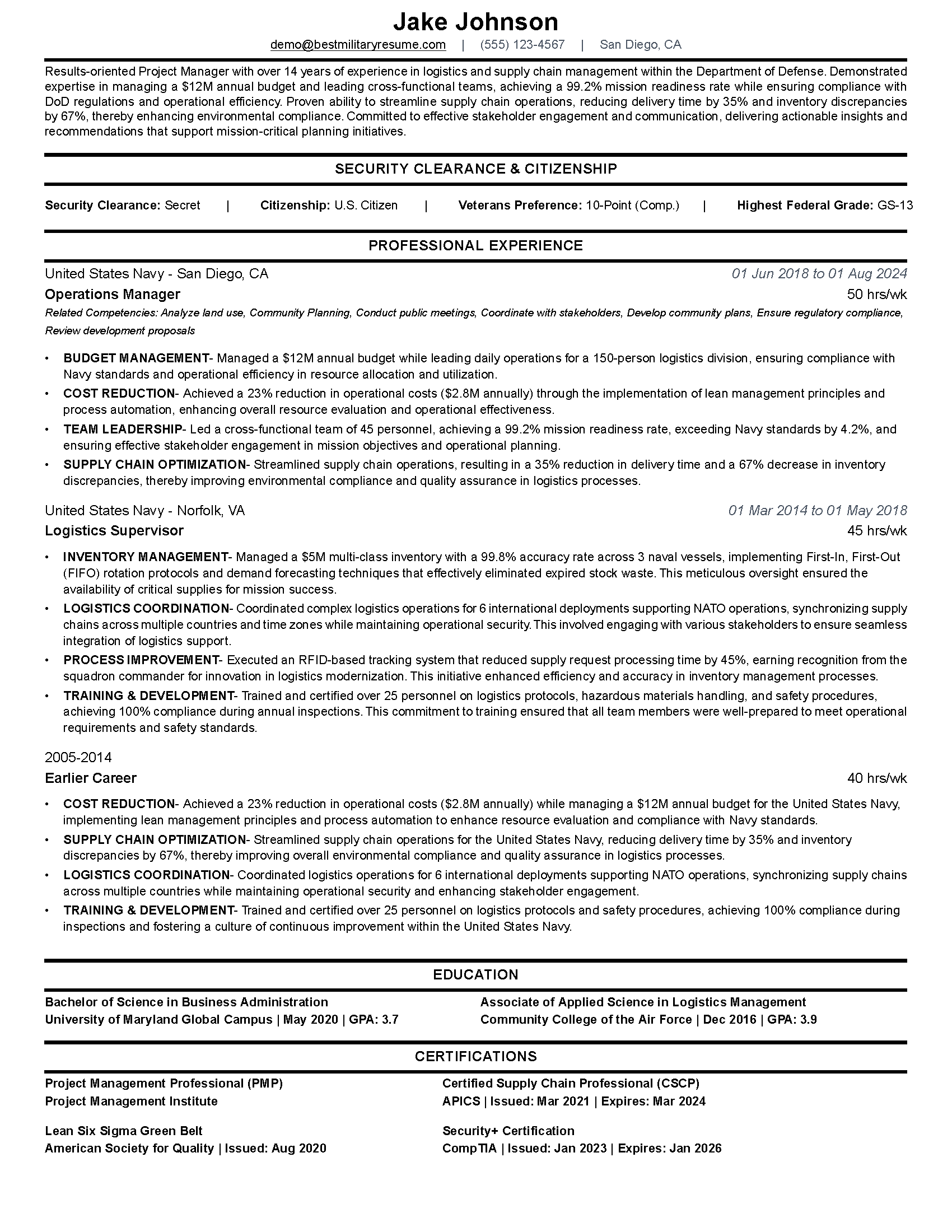
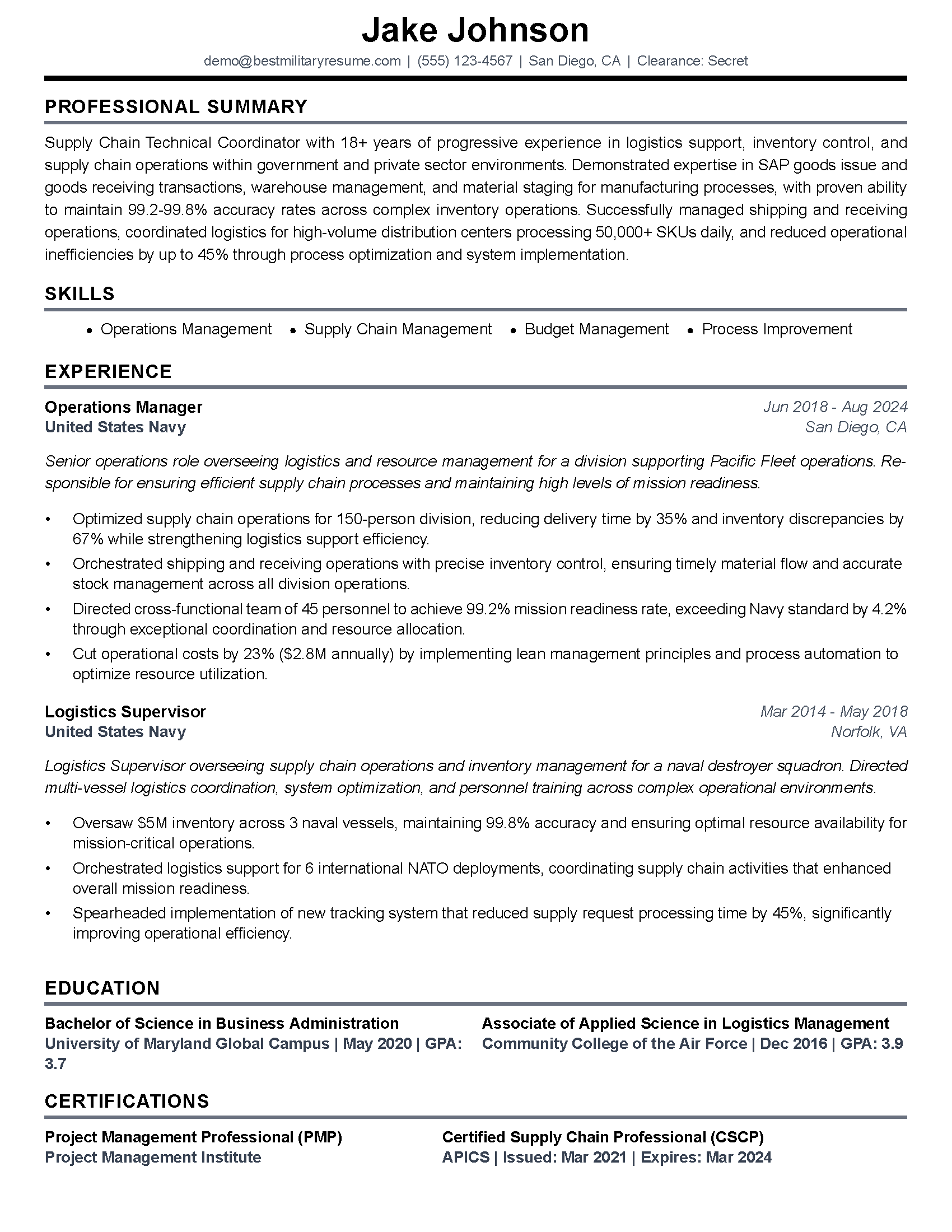
This guide takes you through a first resume in the order you'll build it. It includes a full Guard job entry you can copy and fill in.
Already have civilian jobs to blend with your service? See how to put Guard service on a civilian resume. This guide is for the first one.
What counts as work experience when drill is most of it?
Everything you did in uniform counts. That includes drill weekends, annual training and the school that taught you the job.
BMR advice: put your unit at the top of your experience section. Give it a job title, your unit, the place and your start date. Then write what you did on those weekends.
The hours are part time, but the work counts. You signed for gear, checked vehicles, followed safety rules and trained next to people with years on you.
One line from a Military.com guide for young job seekers fits here. It says, "What you lack in experience, you make up for in passion, desire and motivation to succeed."
BMR advice: show that drive with real tasks, not with the word "motivated."
How do you turn your MOS, AFSC or rating duties into civilian words?
A hiring manager at a warehouse or a store won't know your job code. They know tasks. So you write the task.
BMR advice: list five things you did at your last three drills. Then rewrite each one the way a civilian boss would say it.
| What you'd say in your unit | What a civilian employer reads |
|---|---|
| Motor pool day | Inspected and serviced [00] vehicles against a checklist |
| Signed a hand receipt | Tracked and signed for $[00] in equipment |
| Ran a detail | Led a crew of [00] on [task] and finished in [00] hours |
| Taught a class at drill | Trained [00] team members on [skill] |
| Pulled a shift at the front desk | Monitored building access and logged visitors |
This works the same for an Air Force AFSC or a Navy rating. Name the task, the count and what it fixed.
The Military.com guide also says to "Review job ads and employers' websites for industry terms and lingo you can incorporate into your resume."
BMR advice: copy two or three task words from the ad you want. Use them where they're true for you.
Stuck on a term? Try the military jargon decoder.
A full Guard entry to copy
This is BMR's sample for a drilling truck driver. Swap every [00] and bracket for your own facts. If you can't back a number, cut the line.
MOTOR TRANSPORT OPERATOR, [State] Army National Guard, [City, State]
MM/YYYY - Present | [00] drill weekends and [00] days of annual training a year
- VEHICLE INSPECTIONS - Cut breakdowns on [00] unit trucks by [00]% by inspecting each vehicle before use on [00] drill weekends a year.
- LOAD PLANS - Delivered [00] tons of unit gear over [00] miles by building [00] load plans and securing cargo on [00] trucks.
- CONVOY DRIVING - Drove [00] convoy runs over [00] miles during [00] days of annual training, cutting late arrivals by [00]%.
- PEER TRAINING - Trained [00] new soldiers on vehicle checks and cargo tie-down over [00] months, raising first-time pass rates by [00]%.
- EQUIPMENT RECORDS - Reduced open repair requests by [00]% for [00] trucks by updating [00] vehicle and equipment records within [00] days.
What each part answers:
- The title line lists drill as a job. That's safe to do: 4311 bars an employer from denying you "initial employment" because of that membership.
- The schedule line answers the drill question before anyone asks it.
- The inspection and records bullets show what Military.com calls proof that you're "reliable and trustworthy."
- The load plan and convoy bullets use the task words a logistics job ad would use.
- The training bullet covers "experience training new employees," which Military.com lists as proof of responsibility.
Where do basic training and AIT go on the page?
BMR advice: put them under a heading called Training, below Education. They're schools, not jobs.
For each one, write the course name, the place and the dates. Add one line on what you learned to do. Write it as a skill, like "operated and loaded tactical trucks."
BMR's sample format:
TRAINING
[Your AIT or tech school course name], [Installation, State], MM/YYYY - MM/YYYY
Learned to [task], [task] and [task] in [00] weeks of hands-on training.
Basic training, [Installation, State], MM/YYYY - MM/YYYY
BMR advice: don't repeat the same tasks in your job entry and your training entry. Put the work you did at the unit. Put what you were taught at the school.
What fills the rest of a first resume?
Your unit job won't fill a page alone, and it doesn't have to. Military.com says proof can come from "work experience, volunteer activities, school projects, internships, hobbies and sports."
BMR advice: add these in this order, and only what's true.
- Education: your school, your diploma or degree, and an expected date if you're still in.
- Part-time jobs: food service, retail, lifeguarding or anything else. Write them with tasks and counts too.
- Volunteer work: name the group, what you did and how often.
- Sports: list a captain role or a season you kept up while in school.
- Certifications: list one only if you hold it now and can show the card.
Don't list a certification you're "working on." A hiring manager may ask to see it.
For a skills list that matches the ad, see what skills to put on a resume.
How do you tell an employer about drill and annual training?
You tell them plainly, and you don't apologize. The Army Benefits USERRA page says "an employer may not deny initial employment" based on "an employee's military service."
USERRA is the Uniformed Services Employment and Reemployment Rights Act. Once you're hired, it comes with a duty on your side. The Army Benefits page lists five criteria for getting your job back after service. One is to "Give advance notice of service to the employer."
BMR advice: once you get the offer, hand your boss your drill dates early. That makes the notice easy and keeps the trust.
The Military.com guide says to "Write a list of objections that employers might have about hiring you." Drill weekends will be on that list. BMR advice: answer it with your schedule and one line on how you'll cover your shifts.
Trouble with a boss over drill? Call the Employer Support of the Guard and Reserve (ESGR). The Army page calls it "a Department of Defense office created to assist in the resolution of conflicts arising from an employee's military commitment."
If ESGR can't fix it, it will help hand the case to DOL VETS. That's the Department of Labor's Veterans' Employment and Training Service. It investigates USERRA complaints.
For the cover letter line, see where the drill line goes in a reservist cover letter.
What should stay off your first resume?
BMR advice: cut anything a civilian boss can't read or doesn't need.
- Your unit's full number and battalion chain. The state and branch are enough.
- Job codes with no task words next to them.
- Your fitness test scores and weapons qualification scores, unless the job is in security.
- Your Social Security number, DoD ID or date of birth.
- Guesses about a future deployment. Nobody can plan around a guess.
- Filler words like "hardworking" and "team player." Your bullets prove those.
Got a civilian job to stack next to drill? See how to blend a Reserve career with a civilian one.
Rules checked November 2026 against 38 U.S.C. 4311 on govinfo and the Army Benefits USERRA page.
What to Do Next
Pull up your last three drill weekends. Write one bullet for each, like the sample above.
Then build the whole page in the BMR resume builder. 79,061 resumes have been built on BMR.
Frequently Asked Questions
Does USERRA protect me if I'm still applying to join the Guard or Reserve?
Does USERRA apply to small businesses, or only big companies?
If I get the job and then get called up, can I keep my health plan?
About the author
Brad Tachi is the CEO and founder of Best Military Resume and a 2025 Military Friendly Vetrepreneur of the Year award recipient for overseas excellence. A former U.S. Navy Diver with over 20 years of combined military, private sector, and federal government experience, Brad brings unparalleled expertise to help veterans and military service members successfully transition to rewarding civilian careers. Having personally navigated the military-to-civilian transition, Brad deeply understands the challenges veterans face and specializes in translating military experience into compelling resumes that capture the attention of civilian employers. Through Best Military Resume, Brad has helped thousands of service members land their dream jobs by providing expert resume writing, career coaching, and job search strategies tailored specifically for the veteran community.