Veteran-Owned Resume Writing Services: Why It Matters
Desiree landed a $135K hybrid senior financial consultant role.
Desiree, E-5, Army National Guard, the interviewer loved the resume from the top down
I spent 1.5 years after separating from the Navy submitting applications into what felt like a black hole. Zero callbacks. Zero interviews. I had the experience, the clearance, the work ethic. What I did not have was a resume that translated any of it into language a civilian hiring manager could actually read.
During that stretch, I tried two different resume writing services. Neither was veteran-owned. Both produced resumes that looked polished on the surface but missed the mark completely. One writer asked me what an E-5 was. The other listed my Navy Diver qualifications as "underwater maintenance technician." That is not a real job title in any branch of the military.
That experience taught me something I now tell every veteran who asks: the person writing your resume needs to understand where you are coming from. Not conceptually. Not because they read a blog post about military acronyms. Because they lived it. This article breaks down why veteran-owned resume services exist, what actually makes them different, and how to tell which ones are worth your money.
What Makes a Resume Service "Veteran-Owned"?
The term gets thrown around loosely, so let me be specific. A veteran-owned resume writing service means the founder or primary operator served in the U.S. military. They went through basic training, held an MOS or rating, did the job, and eventually separated or retired. Some went on to federal careers. Some went private sector. Some did both.
This matters because the gap between military experience and a civilian resume is not just a vocabulary problem. It is a framing problem. When you served as an Operations Specialist running a combat information center, you managed real-time data feeds, coordinated with multiple departments, and made decisions under pressure that affected hundreds of people. A civilian resume needs to show that. But it also needs to show it in a way that maps to specific job requirements for a logistics coordinator, project manager, or operations analyst role.
A writer who served understands the weight of what you did because they did similar work. They know that "supervised 12 personnel" in a military context means something very different than supervising 12 people at a retail store. They do not need you to explain what a deployment tempo looks like or why you changed duty stations every two years. That baseline understanding saves hours of back-and-forth and produces a resume that actually represents your experience accurately.
"The resume writer who called my dive qualifications 'underwater maintenance' lost me as a client in one sentence. If you do not understand the experience, you cannot translate it."
Why Does Military Experience in a Resume Writer Change the Output?
The difference shows up in four specific areas that directly affect whether your resume gets you interviews.
Accurate Translation of Military Roles
A veteran writer knows that an Army 88M (Motor Transport Operator) is not just a "truck driver." They managed vehicle maintenance schedules, conducted pre-combat inspections, operated in convoy security operations, and were responsible for millions of dollars in equipment. A non-veteran writer will Google the MOS, read the first result, and give you a watered-down version. A veteran writer knows which details map to fleet management, logistics coordination, and DOT compliance roles in the civilian sector because they have seen the crossover firsthand.
Understanding Chain of Command Context
Military leadership does not map neatly to corporate org charts. An E-6 in a 200-person unit has more direct leadership responsibility than many civilian managers with the same number of reports. A veteran resume writer understands how to frame that scope accurately. They know the difference between NCOIC responsibilities and OIC responsibilities. They understand that "acting platoon sergeant" means something specific about trust and capability.
Handling Gaps and Transitions Correctly
PCS moves, deployment cycles, terminal leave, separation processing. These create employment timelines that look messy on paper if you do not know how to handle them. A veteran writer has dealt with their own version of this. They know that a two-year gap between your ETS date and your first civilian job might include terminal leave, a cross-country move, and 90 days of job searching. They frame it correctly without making you look unemployed.
Knowing Which Details Actually Matter
Some military accomplishments translate directly. Some need context. Some are better left off the resume entirely. A veteran writer knows that your Expert Marksman badge does not belong on a resume for a GS-0343 Program Analyst position. They also know that your experience managing a $4.2M annual budget as an E-7 absolutely does belong there, even if it was not your primary duty. That judgment call comes from experience, not from a style guide.
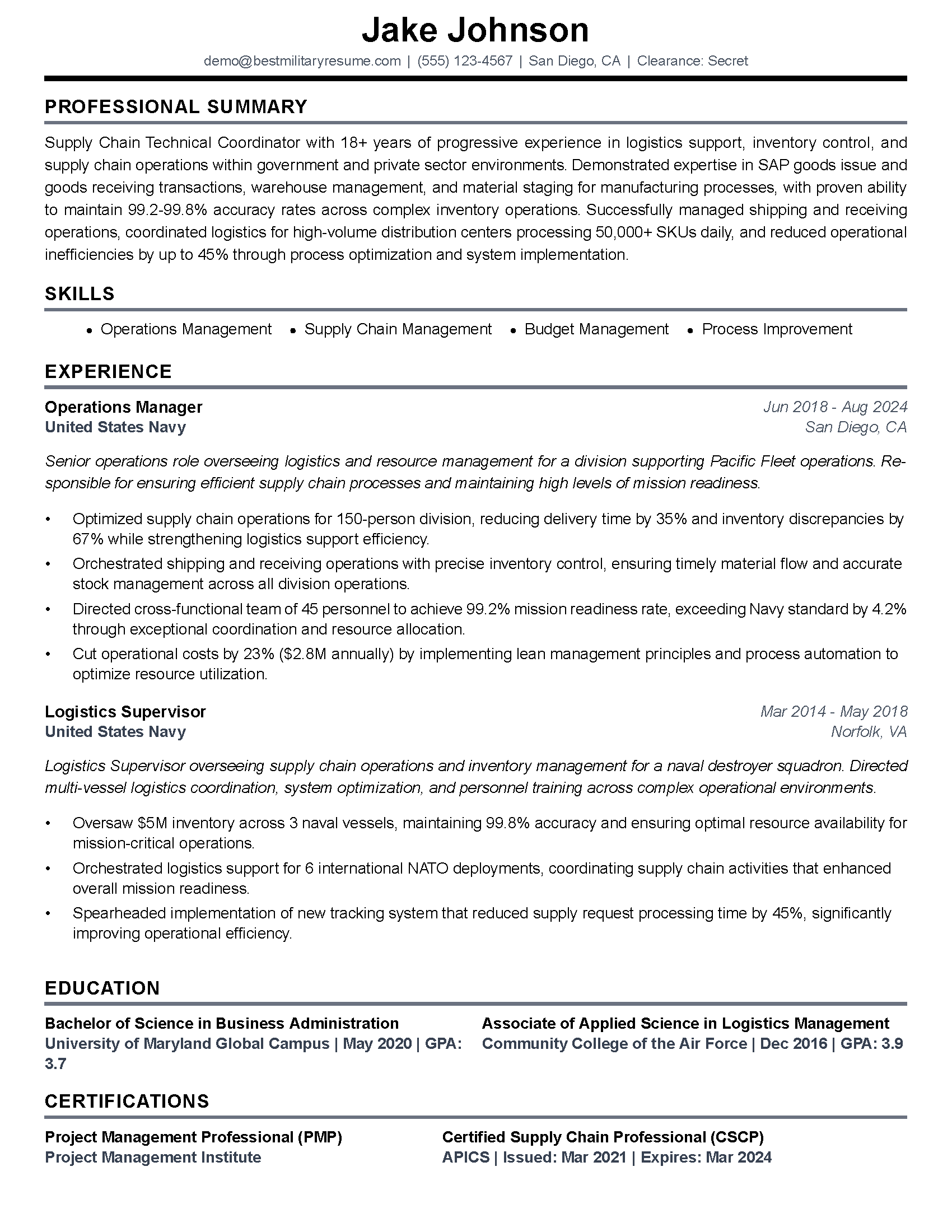
"Performed maintenance duties on underwater equipment. Supervised team members in various operations. Maintained safety protocols."
"Led 8-person dive team executing underwater ship husbandry, salvage, and construction operations. Managed $1.8M equipment inventory with zero loss across 4 deployment cycles. Maintained 100% team safety record over 1,200+ logged dives."

How Do You Verify a Service Is Actually Veteran-Owned?
Claiming "veteran-owned" is easy. Proving it takes a little digging. Here is what to look for when you are evaluating a resume service.
First, check if the company is registered as a Veteran-Owned Small Business (VOSB) or Service-Disabled Veteran-Owned Small Business (SDVOSB) through the SBA. The SBA VOSB certification database is public and searchable. If a company claims veteran-owned status but is not in the database, that does not automatically mean they are lying. Not every small business goes through the certification process. But it is a strong signal if they have it.
Second, look at the founder or team page. Does the owner name their branch, their MOS or rating, their years of service? Vague claims like "our team has military experience" without specifics are a yellow flag. At BMR, I tell people exactly who I am: Navy Diver, separated in 2015, hired into six different federal career fields, worked in tech sales, and built this platform after my own 1.5-year struggle with zero callbacks.
Third, read the questions you should ask any resume writer before paying. A veteran-owned service should be able to answer every one of them without hesitation. If they get vague about their process for translating military experience or cannot explain how they handle federal vs. private sector resumes, walk away.
1 Check SBA VOSB Database
2 Read the Founder Bio
3 Ask About Their Translation Process
4 Review Sample Resumes
5 Check for Federal Resume Capability
Should You Choose a Veteran-Owned Service Over a Cheaper Alternative?
Price is real. I get it. When you are separating from the military, your budget is tight. You are looking at moving costs, maybe a gap between your last military paycheck and your first civilian one, and someone is asking you to spend $300-800 on a resume. That is a real decision.
But here is what I have seen after helping 24,538 veterans through BMR: the cost of a bad resume is always higher than the cost of a good one. A resume that sits at the bottom of an ATS ranking for six months costs you six months of salary. If you are targeting a GS-12 position paying $86,000, six months of job searching with a weak resume means roughly $43,000 in lost income. That math is not theoretical. I lived it during my own 1.5-year stretch of zero callbacks.
The question is not whether you should pay for resume help. The question is whether the person you are paying actually understands your background well enough to represent it accurately. Some non-veteran writers are excellent at their craft. But they are working uphill when it comes to military translation because they are learning your world from scratch with every client.
If budget is the primary concern, there are solid free options. Free veteran resume help with expert feedback covers your options. And BMR itself offers two free tailored resumes to every veteran, military spouse, and dependent who signs up. You paste a job posting, the tool translates your military experience into language that matches that specific role. No charge for the first two.
What Are the Red Flags in Veteran Resume Writing Services?
Veteran-owned does not automatically mean good. I have seen veteran-owned services that produce mediocre work and non-veteran services that do excellent military translation. The "veteran-owned" label is a strong starting indicator, but you still need to evaluate the actual product.
Watch for these warning signs, regardless of who owns the company:
- One-size-fits-all resumes. If the service gives you the same template and format whether you are targeting a GS-0201 HR Specialist position or a private sector project management role, they are cutting corners. Federal and private sector resumes have different requirements, different lengths, and different formatting standards.
- No intake call or questionnaire. A quality resume service needs to understand your full military background, your target roles, and your career goals before writing a single word. If they just ask you to email your old resume and they will "fix it up," that is a content mill, not a writing service.
- Turnaround under 48 hours. A thorough military-to-civilian resume takes time. The writer needs to research your target roles, map your experience to specific job requirements, and draft content that accurately represents what you did. Same-day delivery means they are using templates.
- No revisions included. Any service worth paying for includes at least one round of revisions. Military experience is complex and even a good writer will sometimes miss context that matters to you.
I wrote a full breakdown of veteran resume writer red flags that goes deeper into what to avoid. Read that before you hand anyone your credit card.
Watch Out for "Military Discount" Bait
Some services advertise military discounts to attract veteran clients but have zero military resume expertise on staff. A 20% discount on a resume that does not translate your experience is still a waste of money. Ask about their military translation process before asking about pricing.
How Does a Veteran-Owned Resume Builder Compare to a Veteran Resume Writer?
This is a distinction that matters more than people realize. A resume writer is a person who writes your resume for you. A resume builder is a tool that helps you write it yourself, usually with templates, AI assistance, and structured guidance.
Both can be veteran-owned. Both can produce good results. But they work differently and fit different situations.
A veteran resume writer is a good fit if you want someone else to do the heavy lifting. You provide your military background, your target roles, and your career goals. They produce a finished resume. The cost is typically $300-800 for a single resume, sometimes more for federal-specific work. The downside is that you get one resume, maybe two with revisions, and then you are on your own for every future application.
A veteran resume builder like BMR's military resume builder gives you the ability to tailor your resume to every single job you apply to. You paste the job posting, the tool analyzes the requirements, and it translates your military experience into language that matches that specific role. You can do this as many times as you need. The first two are free.
I covered this comparison in detail in resume builder vs. resume writer. The short version: if you are applying to one or two specific roles, a writer might be the right call. If you are applying broadly across multiple industries or GS series, a builder that lets you tailor each time will serve you better.
Can a Non-Veteran Write a Good Military Resume?
Yes. I am not going to pretend otherwise. There are non-veteran resume writers who have spent years specializing in military-to-civilian transitions. They have worked with enough veterans to understand the terminology, the culture, and the translation challenges. Some of them produce excellent work.
The difference is in the floor, not the ceiling. A skilled non-veteran writer can produce a great military resume. But when a non-veteran writer is average, they produce a resume full of generic translations and missed context. When a veteran writer is average, they at least get the military experience right, even if the formatting or structure needs work.
If you go with a non-veteran service, here is what to screen for:
- Ask them to explain what a NCOER or OER is and how they use evaluation reports in resume writing
- Ask how they handle the difference between a federal resume and a private sector resume
- Ask for samples from veteran clients specifically, not just general professional resumes
- Ask whether they tailor each resume to a specific job posting or produce a single "master resume"
- Ask how many veteran resumes they have written in the past year
If they stumble on any of those, you are probably better off with a veteran-owned service or a resume builder designed specifically for veterans.
What Should a Veteran Resume Service Include for Federal Jobs?
Federal resumes are a different animal. They require specific information that private sector resumes do not: hours per week, supervisor name and phone number, detailed duty descriptions with measurable outcomes, and all of it needs to fit within 2 pages under current OPM guidelines.
Many resume writers, including some veteran-owned ones, still produce 4-6 page federal resumes based on outdated guidance. That format was standard for years, and my own federal resumes used to run 16+ pages. But OPM updated the requirements, and the current standard is 2 pages max. Any service that tells you a federal resume needs to be 4-6 pages is working from old information.
A quality veteran-owned service for federal jobs should cover these specifics:
- Proper USAJOBS formatting with all required fields (hours/week, supervisor info, salary, dates in MM/YYYY format)
- Keyword alignment with the specific job announcement, not generic federal language
- Accurate GS-level targeting based on your military rank and experience
- Understanding of how USA Staffing ranks applications so your resume surfaces to the top of the list
If you are targeting federal positions specifically, check out best military to civilian resume writing services for a full comparison, or use BMR's federal resume builder to generate a properly formatted federal resume yourself.
Key Takeaway
Federal resumes are 2 pages max under current OPM guidelines. If a resume service is producing 4-6 page federal resumes, they are working from outdated standards. This applies whether the service is veteran-owned or not.
Is a DIY Approach Better Than Paying for a Veteran Resume Service?
Depends on where you are in the process and how much time you have. If you are six months out from your ETS date and have time to learn resume writing, research your target industry, and iterate on drafts, DIY can absolutely work. The information is out there. TAP gives you a starting point. BMR gives you two free tailored resumes. You can build a solid resume on your own if you put the work in.
If you are three weeks from separation, already stressed about the move, and have not started your resume, paying a veteran writer to handle it makes more sense. Time is the variable. The closer you are to needing the resume, the more valuable it is to have someone else do the translation work.
I wrote a full breakdown of DIY vs. hiring a military resume writer that walks through the cost, time, and quality tradeoffs. If you are on the fence, start there.
The middle ground that works for many veterans: use a builder tool like BMR to create your first tailored resume for free. See how the translation looks. If you are happy with the output, keep using the tool. If you want a human to take it further, you will at least have a solid draft to hand a writer, which cuts down on the time and cost of their work.
What to Do Next
If you are shopping for a veteran-owned resume service, do your due diligence first. Check the SBA database, read the founder bio, and ask the right questions before you pay. Know the red flags to watch for so you do not waste money on a service that cannot deliver.
If you want to try the builder approach first, BMR's resume builder gives you two free tailored resumes. Paste a job posting, get a resume that translates your military experience into language that matches that specific role. No charge to start. See how the output compares to what you have been using.
And if you have already worked with a resume service, whether veteran-owned or not, and the result did not land you interviews, check out our reviews of specific resume tools and service reviews to see how the options stack up.
Frequently Asked Questions
What does veteran-owned mean for a resume writing service?
How do I verify if a resume service is actually veteran-owned?
Is a veteran-owned resume service always better than a non-veteran one?
How much do veteran resume writing services typically cost?
Should I use a veteran resume writer or a resume builder tool?
What should a veteran resume service include for federal jobs?
Can I get a good military resume for free?
About the Author
Brad Tachi is the CEO and founder of Best Military Resume and a 2025 Military Friendly Vetrepreneur of the Year award recipient for overseas excellence. A former U.S. Navy Diver with over 20 years of combined military, private sector, and federal government experience, Brad brings unparalleled expertise to help veterans and military service members successfully transition to rewarding civilian careers. Having personally navigated the military-to-civilian transition, Brad deeply understands the challenges veterans face and specializes in translating military experience into compelling resumes that capture the attention of civilian employers. Through Best Military Resume, Brad has helped thousands of service members land their dream jobs by providing expert resume writing, career coaching, and job search strategies tailored specifically for the veteran community.
