Veteran Resume Help: Where to Get Free Expert Feedback
Michael got only rejections. Then a $100K facilities manager role.
Michael, E-7, Navy, tried a ton of outside help before BMR
You finished your resume. Maybe TAP gave you a template. Maybe you pulled something together on your own at 2 AM the week before terminal leave. Either way, you look at it and something feels off, but you cannot pinpoint what.
So you ask your spouse. They say it looks fine. You send it to a buddy who separated last year. They say it looks good. You post it in a Facebook group and get fourteen different opinions, half of which contradict each other.
None of that is resume help. That is people being polite. What you need is someone who actually hires people -- or who has built hundreds of resumes for veterans -- to look at yours and tell you specifically what is working, what is not, and what to fix. The good news: that kind of feedback exists, and a lot of it is free. You just have to know where to look.
Why General Feedback Does Not Help
I spent 1.5 years applying for government jobs after I separated from the Navy as a diver. Zero callbacks. My resume was not terrible -- it was just not written for the people reading it. Nobody told me that. Everyone said it looked professional. That word, "professional," cost me 18 months.
General feedback fails because the person giving it does not know what hiring managers and HR specialists actually screen for. Your neighbor who works in accounting has no idea how USA Staffing ranks federal applications. Your former platoon sergeant might be a great leader, but if they have never sat on a hiring panel, their resume advice is based on what they have heard, not what they have seen work.
Useful resume feedback is specific. It sounds like: "Your second bullet under your last position is too vague -- what was the dollar value of the equipment you managed?" or "This summary does not mention supply chain at all, and that is the job you are applying for." If the feedback you are getting does not reference specific lines, specific jobs, or specific keywords, it is not moving your resume forward.
That is why you need to be intentional about where you get help. Free does not mean low quality -- it means you have to find the right sources.
TAP Resume Workshops: A Starting Point, Not the Finish Line
The Transition Assistance Program gives every separating service member a resume workshop. The instructors are often veterans themselves, and many of them genuinely want to help you land on your feet. The program gets a lot of criticism, and some of it is fair, but the people running it are trying.
What TAP does well: it forces you to sit down and actually write a resume before you separate. For many service members, this is the first time they have ever written one. That matters. Having something on paper -- even a rough draft -- is better than staring at a blank page three weeks after your ETS date.
Where TAP falls short is customization. The program produces one generic resume. One. And because there is no standardized curriculum across installations, the quality of feedback you get depends entirely on which base you are at, which instructor you draw, and which contractor is running the program that quarter. Some classes are solid. Others are a checkbox exercise. You will not know which one you got until you are sitting in it.
The core issue is that TAP does not teach you to tailor. You walk out with a single resume that is supposed to work for every job you apply to, and that is not how hiring works in 2026. A logistics manager resume and a project coordinator resume need different keywords, different emphasis, different summaries -- even if the underlying experience is the same. If you went through TAP and got a decent draft, great. Use it as your foundation. But do not stop there.
For a detailed breakdown of the TAP timeline and what to expect at each stage, check out our SFL-TAP Army timeline guide.

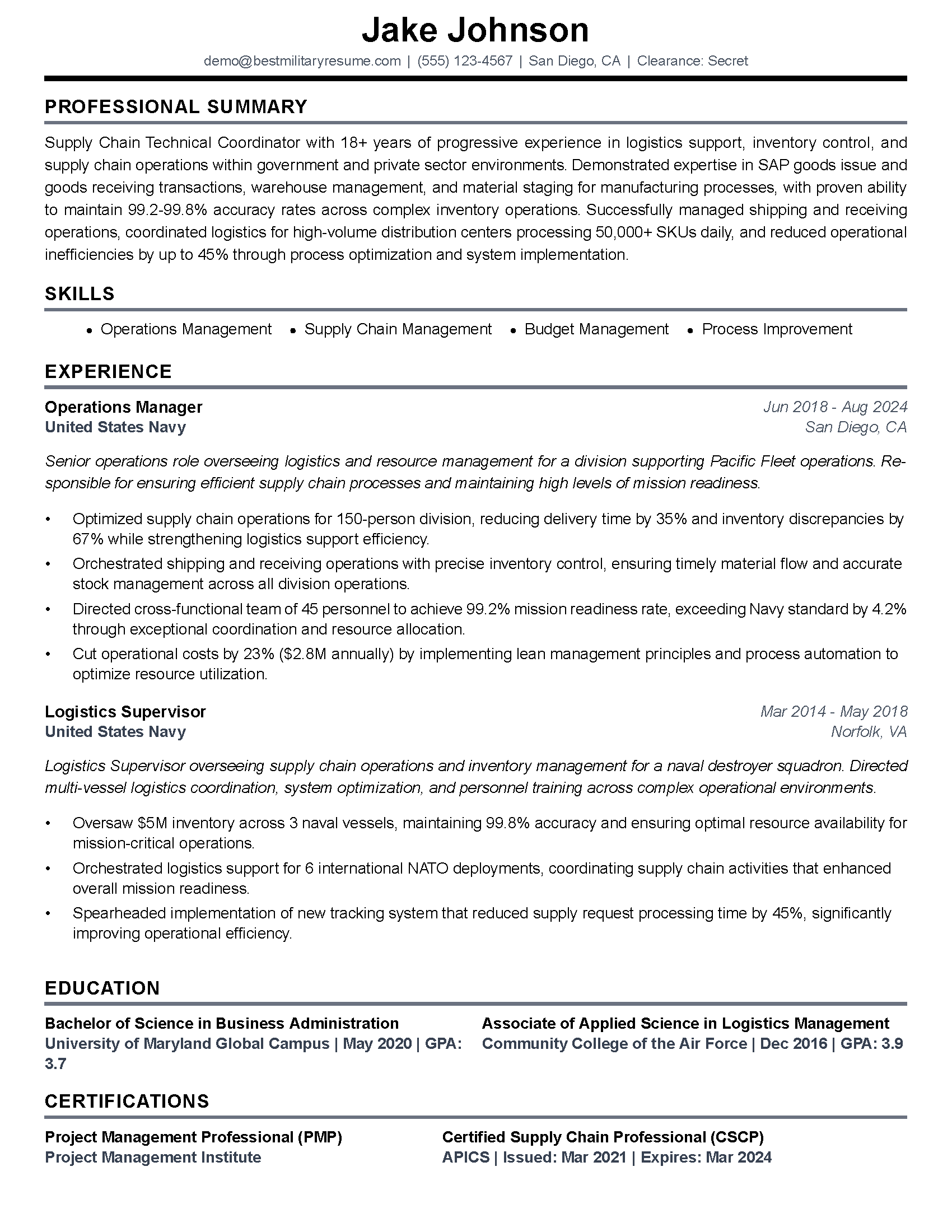
VSO Resume Help: AMVETS, DAV, VFW, and American Legion
Veteran Service Organizations are one of the most underused free resources for resume help. AMVETS, Disabled American Veterans (DAV), the VFW, and the American Legion all offer employment assistance programs, and many of them include one-on-one resume reviews.
AMVETS runs career centers in several states and partners with the Department of Labor for resume workshops. Their career counselors can review your resume and help you translate military experience into civilian language. The availability depends on your location, but if there is an AMVETS career center near you, walk in and ask. The service is free for all veterans.
DAV offers employment resources through their local chapters and their online career portal. They connect veterans with career coaches who can review resumes, prep for interviews, and help with job placement. DAV is particularly strong if you have a service-connected disability and need to navigate accommodations language on your resume.
VFW provides employment assistance through their service officers and local posts. The quality varies by chapter -- some posts have dedicated employment coordinators, while others focus more on benefits claims. Call your local VFW before showing up and ask specifically if they offer resume review services.
American Legion has a network of trained service officers and partners with organizations that provide career coaching. Their career fairs are also solid places to get informal resume feedback from actual recruiters who hire veterans regularly.
The pattern across all VSOs is the same: the national organization offers programs, but execution happens locally. Call ahead, ask what employment services they provide, and be specific about what you need. "I need someone to look at my resume and tell me what to fix" is a better ask than "I need career help."
Hiring Our Heroes and American Corporate Partners
The U.S. Chamber of Commerce Foundation runs Hiring Our Heroes (HOH), which is one of the more structured free programs available. Their resume workshops and career events are specifically built for transitioning service members, veterans, and military spouses.
HOH runs in-person events at military installations and virtual workshops throughout the year. They also have a resume engine tool that helps you build a resume from scratch. We did a full review of the Hiring Our Heroes resume builder -- it is a decent starting point, though it has limitations when it comes to tailoring for specific job postings.
Where HOH really shines is their fellowship programs and networking events. If you attend a Hiring Our Heroes career summit, you can often get face-to-face time with hiring managers from companies that actively recruit veterans. That kind of direct feedback -- "here is what I look for when I review a veteran resume" -- is worth more than any template.
American Corporate Partners (ACP) takes a different approach. They pair transitioning service members and veterans with corporate mentors for a full year of one-on-one mentoring. Your mentor can review your resume, coach you on interviews, and help you understand what civilian employers in your target industry actually want to see. ACP mentors are volunteers from companies like JPMorgan Chase, Amazon, Deloitte, and hundreds of others. The program is free and the waitlist moves faster than you would expect.
Both of these programs work best if you come prepared. Do not show up empty-handed. Bring a draft resume, a target job posting, and specific questions. "Is my resume good?" will get you a polite nod. "Does my experience section show enough project management for a PMP-track role at a defense contractor?" will get you a real answer.
Free Resume Builders With Built-In Feedback
Some tools go beyond just formatting your resume -- they actually help you evaluate and improve it. This is where technology has caught up to the problem.
Best Military Resume (BMR) offers a free tier that includes 2 tailored resumes, 2 cover letters, LinkedIn optimization, elevator pitches, an email signature generator, 2 company reports, an open-to-work post generator, and a job tracker. The tailoring piece matters here: BMR does not just format your resume, it helps you match your experience to specific job postings. That means the feedback is baked into the tool -- you paste in a job description, and the builder shows you what to emphasize and what keywords you are missing.
I built BMR after my own 18-month stretch of silence from federal applications. The free tier exists because I know what it is like to be separating with no budget for a $400 resume writer and no idea what you are doing wrong. Two tailored resumes is enough to see the difference between a generic resume and one built for a specific posting.
For a deeper look at other options, we compared several platforms in our free resume builder for veterans guide. That article breaks down what each tool does well and where they fall short.
The key thing to look for in any resume builder is whether it helps you tailor. A tool that produces one generic resume is not much better than a Word template. You need something that takes a job posting and shows you where your resume aligns and where it does not. That is the kind of feedback that actually moves the needle.
How to Get Useful Feedback From Any Source
Whether you are sitting across from a VSO career counselor, attending a Hiring Our Heroes workshop, or asking a mentor through ACP, the quality of feedback you get depends heavily on how you ask for it. Here is what works.
Bring a target job posting. A resume does not exist in a vacuum. It exists to get you a specific job. If you hand someone your resume without a job description, the best they can do is comment on formatting and grammar. Hand them your resume AND the posting for the GS-11 Contract Specialist position you want, and now they can tell you whether your experience actually maps to the requirements.
Ask about specific sections. "What do you think of my professional summary?" is a better question than "What do you think of my resume?" Break it into parts. Summary, experience bullets, skills section, education. Section-by-section feedback catches things that a general read-through misses.
Ask what is missing, not just what is wrong. Many veterans write resumes that are technically correct but incomplete. They leave out quantifiable results, dollar values, team sizes, and the scope of their responsibilities. A good reviewer will catch those gaps. Ask them: "What would you want to see here that I did not include?"
Get feedback from someone in your target industry. A general resume reviewer can help with structure and clarity. But someone who hires in your target field can tell you whether your resume speaks the language of that industry. If you are aiming for logistics roles, find someone who has hired logistics managers. If you want federal employment, find someone who has served on a federal hiring panel. Industry-specific feedback is the highest-value feedback you can get.
Our veteran resume walkthrough covers every section of a military-to-civilian resume with real examples, which gives you a reference point before you ask for outside feedback.
Federal Resume Help: A Different Animal
If you are applying for federal jobs through USAJOBS, the resume rules change. Federal resumes require more detail than private-sector resumes -- hours per week, supervisor contact information, detailed duty descriptions, start and end dates for every position. The format is different, the expectations are different, and the system that processes your application (USA Staffing) ranks candidates based on how closely their resume matches the job announcement.
That means the feedback you need for a federal resume is different too. A civilian career coach who has never navigated USAJOBS will give you advice that sounds logical but does not work in the federal hiring system. You need someone who understands how federal HR specialists review applications.
Federal resumes should still target 2 pages. That surprises many veterans because the internet is full of advice saying federal resumes should be 4-6 pages. I have been hired into 6 different federal career fields -- Environmental Management, Supply, Logistics, Property Management, Engineering, and Contracting -- and every resume I submitted was targeted and concise. The 4-6 page advice is outdated. Federal resumes were historically long (my early ones were 16+ pages), but the modern best practice is 2 pages with more detail per line than a civilian resume.
For free federal resume help specifically, look at:
- USAJOBS resume builder -- the built-in tool on USAJOBS.gov walks you through the required fields. It is not fancy, but it ensures you do not miss mandatory information. We wrote a complete USAJOBS resume builder walkthrough that explains every field.
- Your installation's Civilian Personnel Advisory Center (CPAC) -- if you are still on active duty, CPAC staff can sometimes review federal resumes. They deal with federal hiring every day.
- BMR's federal resume builder -- the federal resume builder is specifically designed for the federal format and helps you match your experience to federal job announcements.
If you want to understand the difference between good and bad federal resume practices, our guide on federal resume writing services for veterans covers what to look for in any federal resume resource, free or paid.
Other Free Resources Worth Knowing About
Department of Labor Veterans Employment and Training Service (VETS) -- DOL runs the VETS program, which funds employment services at American Job Centers (formerly One-Stop Career Centers) nationwide. These centers offer free resume reviews, job search assistance, and interview prep. Many have staff specifically trained to work with veterans. Find your nearest center at CareerOneStop.org.
State workforce agencies -- Every state has a workforce development office, and many have dedicated veteran employment representatives. In Texas it is the Texas Workforce Commission. In Virginia it is the Virginia Employment Commission. These offices can review your resume, connect you with local employers, and sometimes fund additional training or certifications.
University veteran centers -- If you are using the GI Bill, your school likely has a veteran services office. Many of these offices offer career services specifically for student veterans, including resume reviews, mock interviews, and connections to employers who recruit on campus. Do not sleep on this resource -- university career centers often have strong employer relationships that you will not find anywhere else.
LinkedIn veteran programs -- LinkedIn offers free Premium subscriptions to veterans for one year. That includes access to LinkedIn Learning courses on resume writing and the ability to message recruiters directly through InMail. We covered the details in our guide on getting free LinkedIn Premium as a veteran.
For connecting with other veterans who have already made the transition and can share what worked for them, read our guide on building a professional network from zero.
What to Do After You Get Feedback
Getting feedback is step one. Acting on it is where many veterans stall out. Here is how to turn feedback into a better resume without spinning your wheels.
Prioritize the structural feedback over the cosmetic. If someone tells you to change your font AND to rewrite your experience bullets to include measurable results, do the bullets first. Formatting tweaks are easy. Rewriting your experience section to show the dollar value of the contracts you managed or the number of personnel you supervised -- that is the work that actually changes whether you get called back.
Do not try to implement every piece of feedback at once. If you got input from three different sources, you will have conflicting advice. That is normal. Weight the feedback based on who gave it. A hiring manager in your target industry carries more weight than a general career coach. A federal HR specialist carries more weight than your cousin who "knows a guy at the VA."
Tailor after you revise. Once you have incorporated the best feedback, tailor your resume for specific positions before submitting. A revised but still generic resume will rank lower than a tailored one that matches the job posting keywords. This is where tools like the BMR resume builder save you time -- paste in the job description, and the tool shows you where your resume aligns and where it does not.
Get a second round of feedback after revising. Your resume is not a one-and-done document. After you make changes, get one more set of eyes on it. This does not have to be the same person who reviewed it the first time. Fresh eyes catch different things.
If you want to see what the feedback process looks like in practice, our military resume before and after rewrites article shows 10 real examples with commentary on what changed and why.
And if you are still figuring out what belongs on your resume in the first place, start with our military skills translation list to identify the civilian equivalents of what you did in uniform. Once you know the language, getting feedback becomes a conversation about refinement rather than starting from scratch.
If you are weighing whether to do this yourself or pay someone, our DIY vs. hire a resume writer comparison breaks down the real costs. And if you do decide to hire a writer, read the 10 questions to ask before you pay so you do not waste money on a bad service. Free veteran resume help is out there. The challenge is not finding it -- it is knowing which sources will give you feedback specific enough to actually improve your resume. Start with one resource from this list, bring a target job posting, ask specific questions, and build from there. You do not need to spend $400 on a resume writer to get a resume that lands interviews. You need the right feedback from the right people, and then the discipline to act on it.
Frequently Asked Questions
Is veteran resume help actually free?
What is the best free resource for veteran resume feedback?
Does TAP provide good resume help?
How do I get useful feedback on my veteran resume?
Should I pay for a veteran resume writing service?
What free tools help veterans tailor their resumes?
Can VSOs like AMVETS and DAV help with my resume?
About the Author
Brad Tachi is the CEO and founder of Best Military Resume and a 2025 Military Friendly Vetrepreneur of the Year award recipient for overseas excellence. A former U.S. Navy Diver with over 20 years of combined military, private sector, and federal government experience, Brad brings unparalleled expertise to help veterans and military service members successfully transition to rewarding civilian careers. Having personally navigated the military-to-civilian transition, Brad deeply understands the challenges veterans face and specializes in translating military experience into compelling resumes that capture the attention of civilian employers. Through Best Military Resume, Brad has helped thousands of service members land their dream jobs by providing expert resume writing, career coaching, and job search strategies tailored specifically for the veteran community.
