Why Veterans Make Great Employees: A Hiring Manager View

I have sat on both sides of the hiring desk. I spent years as a federal hiring manager reviewing resumes and interviewing candidates for contracting and logistics positions. Before that, I was the veteran trying to get hired. And after both of those experiences, I moved into tech sales, where I watched veteran colleagues outperform people with twice as much industry experience.
So when someone asks "why do veterans make great employees?" I do not give the standard answer about discipline and leadership. Those words are true but meaningless without specifics. What actually makes veteran employees stand out, and what trips them up, is more nuanced than any motivational poster suggests.
This article is for two audiences. If you are a hiring manager or employer, this is what you should actually know about veteran candidates beyond the talking points. If you are a veteran, this is what hiring managers are really looking for and what you might be doing wrong on your resume or in interviews without realizing it.
What Specifically Makes Veterans Stand Out in the Hiring Process?
When I reviewed resumes for federal contracting positions, certain patterns jumped out from veteran candidates that I rarely saw from civilian applicants. These were not soft skills on a resume. They were measurable behaviors that showed up in the work.
Accountability without supervision. Most veteran candidates I interviewed could describe situations where they owned a problem, fixed it, and reported the outcome without being asked. In civilian workplaces, this is surprisingly rare. Many employees wait for direction, escalate problems upward, or deflect responsibility when things go sideways. Veterans default to ownership. When you have been responsible for equipment worth millions or for the safety of your team, accountability becomes automatic.
Adaptability to new environments. Veterans change jobs, locations, teams, and entire skill sets every 2-4 years throughout their military careers. By the time they separate, they have proven they can walk into an unfamiliar environment and become productive fast. I have seen this repeatedly. A veteran hire who has zero industry experience will often outpace a civilian hire with two years in the field within 6 months because the veteran already knows how to learn a new system from scratch.
"When I moved into tech sales with zero SaaS experience, my manager told me later that he almost did not hire me. My resume looked completely unrelated. But within my first quarter, I hit 118% of quota. He said the other new hires were still figuring out the CRM while I was already closing deals. That is what military adaptability looks like in practice."
Mission focus over ego. In most military units, the mission comes before personal preferences, comfort, or credit. This translates directly to workplace performance. Veteran employees tend to focus on the team outcome rather than personal visibility. They will do the unglamorous work that needs doing without being asked and without complaining about it. In a corporate environment where everyone is positioning for the next promotion, this stands out.
Performance under pressure and ambiguity. Every employer says they want people who "thrive under pressure." Veterans have actually been tested under real pressure with real consequences. They have made decisions with incomplete information on tight timelines. This does not mean every veteran handles corporate stress perfectly, but the baseline resilience is genuinely higher. When a project deadline moves up or a client escalates, veteran employees tend to stay focused while others spiral.
What Turns Hiring Managers Off About Veteran Resumes?
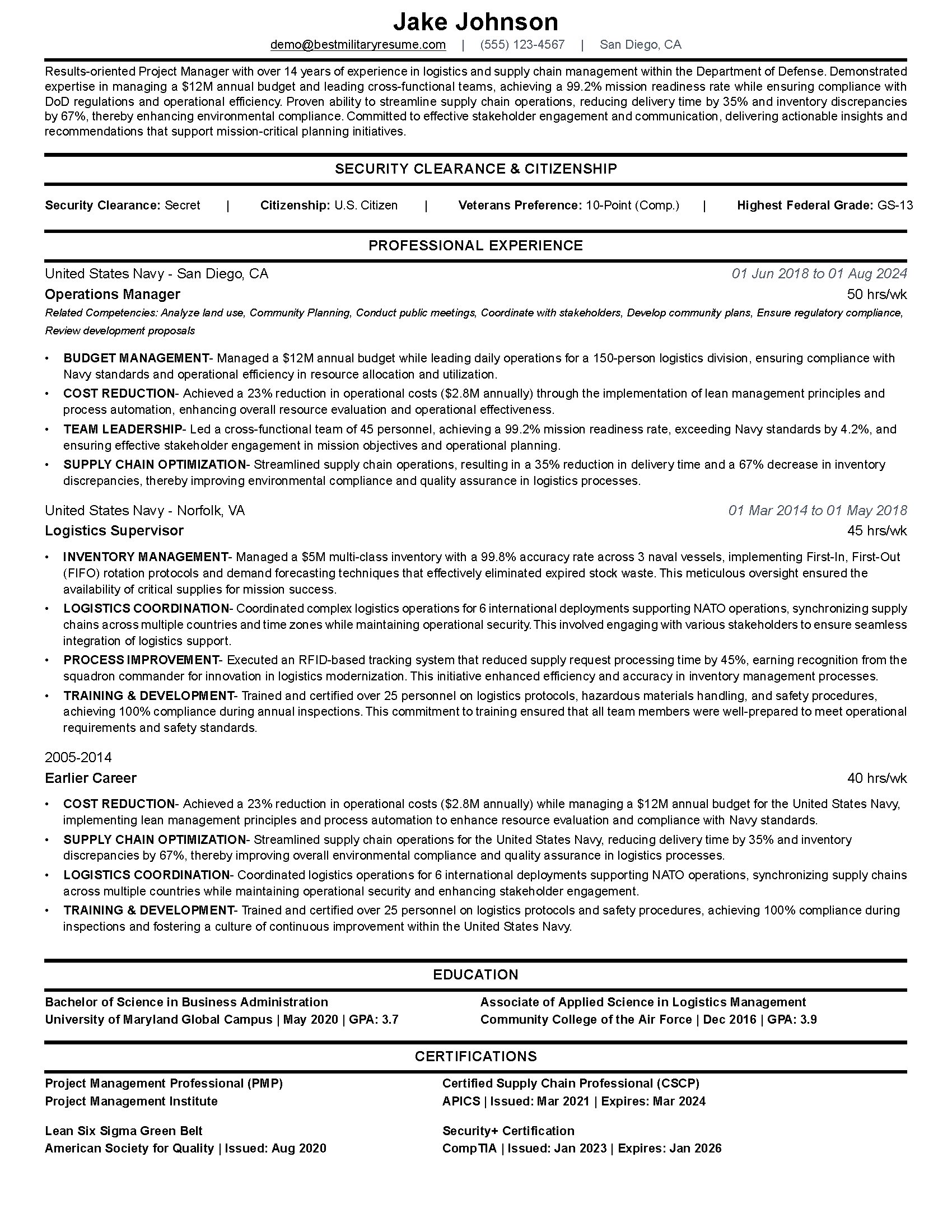
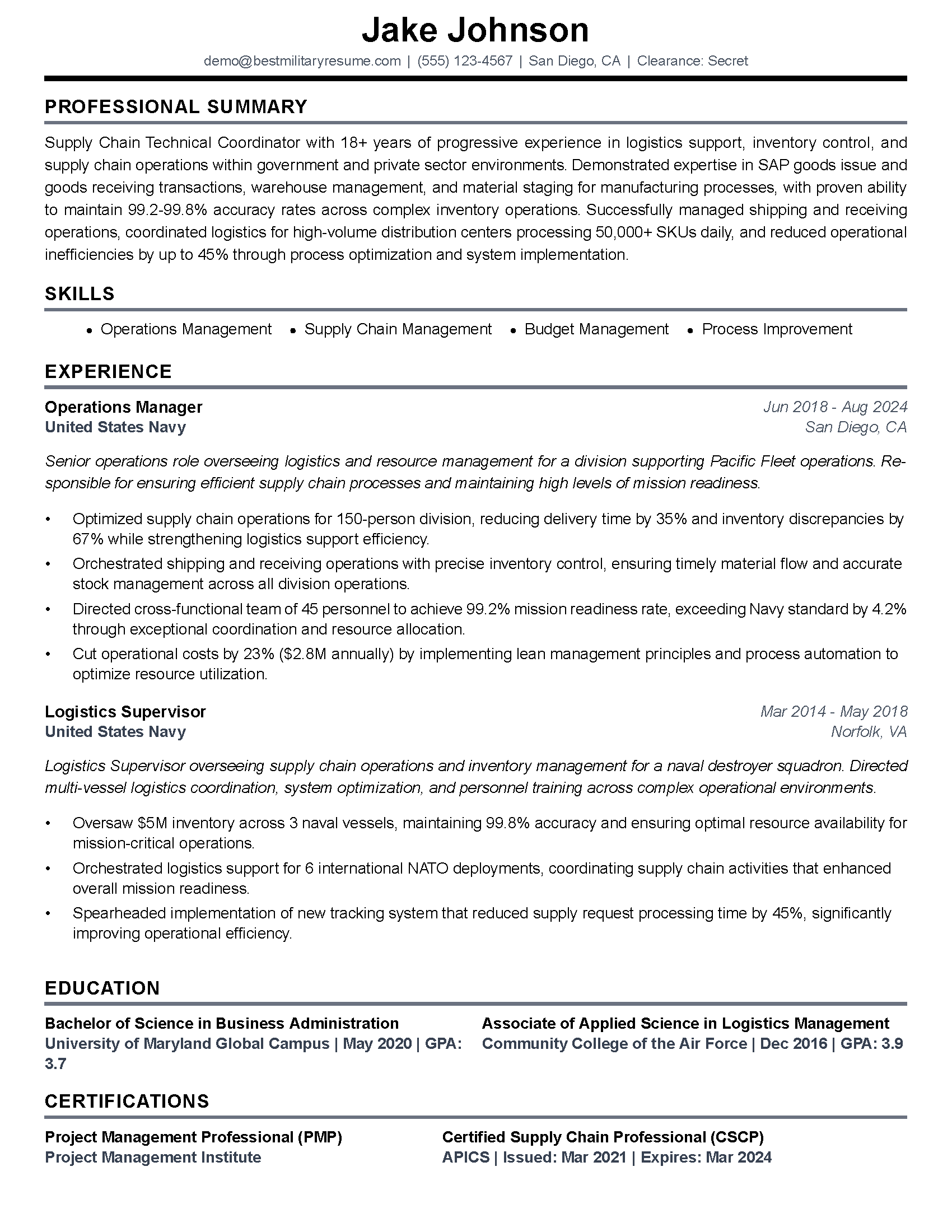
Here is the other side. As much as I valued veteran candidates, some of the resumes I reviewed made it nearly impossible to see their strengths. And these were not bad candidates. They were qualified people with poorly built resumes.
Military jargon that forces the reader to guess. The number one problem I saw was resumes full of acronyms, unit designations, and military-specific terminology that meant nothing outside the DoD. When a hiring manager has 50 resumes to review and yours requires a decoder ring, it goes to the bottom of the pile. This is not about the hiring manager being lazy. It is about the 6-second scan reality. You have roughly 6 seconds before a reviewer decides to keep reading or move on. Jargon wastes those seconds.
"Served as LPO for COMNAVSPECWARCOM det, managed COMSEC material and PQS qualifications for 18 personnel across 4 PLTs. Maintained 100% accountability on all SI/SCI material during OCONUS deployments."
"Led an 18-person team across 4 operational units, managing classified communications security and personnel training qualifications. Maintained 100% accountability of sensitive materials during international operations valued at $1.2M."
Duty descriptions instead of accomplishments. Military evaluations train you to list what you did. Civilian resumes need to show what you achieved. "Responsible for maintenance of 12 vehicles" tells me nothing. "Reduced vehicle downtime by 30% through a preventive maintenance schedule that saved $45K in annual repair costs" tells me you solve problems and save money. The shift from duties to results is the single biggest resume improvement most veterans can make.
Resumes that do not match the job posting. Many veteran candidates send the same resume to every job. This is a critical mistake because ATS systems scan for keywords from the job posting. A generic veteran resume, no matter how impressive, will rank lower than a weaker resume that matches the specific skills and qualifications the employer listed. Every application needs a tailored resume.
Underselling or overselling rank. Some veterans downplay their military leadership because they think civilian employers will not understand E-7 or O-3. Others lead with their rank as if it automatically qualifies them for management. Neither works. What works is translating the scope of your responsibility: team size, budget authority, decision-making level, and the complexity of what you managed. A hiring manager does not need to know you were a Staff Sergeant. They need to know you managed a team of 18 across 4 locations with a $2M operating budget.
Which Veteran Strengths Do Employers Undervalue?
Some of the most valuable things veterans bring to a workplace are invisible on resumes and rarely discussed in interviews. Employers miss them because they do not know to look for them.
Cross-functional collaboration. In the military, you work with people from completely different specialties every day. An operations officer coordinates with intel, logistics, communications, and medical simultaneously. This cross-functional muscle is exactly what companies need but rarely find in candidates who have spent their entire career in one department. Veterans switch contexts constantly and know how to communicate across disciplines.
Documentation and process discipline. Military operations run on standard operating procedures, checklists, and after-action reviews. Veterans naturally document processes, create repeatable systems, and conduct post-project reviews. In civilian companies where institutional knowledge lives in one person's head and processes break when that person leaves, this habit is worth its weight in gold.
Veteran Strengths Employers Often Miss
Cross-Functional Collaboration
Veterans coordinate across specialties daily, a skill most civilian candidates build over decades
Process Documentation
SOPs, checklists, and after-action reviews are second nature, reducing knowledge loss
Risk Assessment Instinct
Identifying what could go wrong and planning contingencies before they are needed
Training and Mentoring
Most veterans have formally trained junior personnel, a skill that improves entire teams
Security Clearance Value
An active clearance saves employers $5K-$15K and months of investigation time
Risk assessment instinct. Military training builds a constant awareness of what could go wrong and how to mitigate it. Veterans identify risks in projects, operations, and decisions that civilian colleagues overlook because they have never operated in an environment where missed risks had serious consequences. In project management, compliance, operations, and any role involving safety, this instinct is incredibly valuable.
Training and mentoring ability. Most veterans above E-4 or O-2 have formally trained and mentored junior personnel. They have written training plans, evaluated performance, given corrective feedback, and developed people. This is a skill that many civilian managers never formally learn. A veteran hire who can train new team members effectively multiplies the value of the entire team.
What Do Veterans Get Wrong About Selling Themselves?
Veterans are often their own worst enemies in the job search. Not because they lack qualifications, but because they present those qualifications in ways that do not connect with civilian hiring managers.
Assuming the military experience speaks for itself. It does not. A hiring manager who has never served does not automatically understand that an E-7 with 15 years of experience managed complex operations with real consequences. You have to spell it out in civilian terms with specific numbers. "Led a 22-person maintenance division responsible for $8.5M in equipment across 4 operational sites" communicates scope. "Served as Maintenance Chief" communicates nothing.
Translate Scope, Not Just Titles
Every military position has a civilian equivalent in terms of responsibility scope. An E-5 team leader managing 8 people and a $500K budget is a first-line supervisor. An O-4 running a department of 120 is a director-level executive. Use the civilian equivalent scope, not the military rank, to communicate your level.
Talking about duties instead of impact in interviews. When asked "tell me about a time you solved a problem," many veterans describe what they were responsible for rather than what they accomplished. The STAR method (Situation, Task, Action, Result) exists for a reason. Lead with the result. "I reduced equipment downtime by 40%" is more compelling than "I was responsible for maintaining 45 vehicles." The first gets you hired. The second gets a polite nod.
Not tailoring the professional summary to each role. Your resume summary should change for every job you apply to. The version you send to a project management role should emphasize coordination, timelines, and budget management. The version you send to an operations role should emphasize process improvement, team leadership, and efficiency metrics. Same experience, different framing. BMR's Resume Builder handles this tailoring automatically, but if you are building your own resume, plan to rewrite your summary for each application.
Undervaluing "soft" accomplishments. Veterans often skip things like mentoring programs they created, process improvements they implemented, or cross-training initiatives they led because those feel less impressive than operational achievements. But in civilian workplaces, those are exactly the work experience items that differentiate a good candidate from a great one. If you built a training program that reduced onboarding time by 2 weeks, that belongs on your resume.
How Should Employers Actually Evaluate Veteran Candidates?
If you are a hiring manager reading this, here is how to get past the surface-level confusion that military resumes sometimes create.
Look at scope, not titles. Military job titles are meaningless to most civilians. Instead, look for indicators of scope: how many people did they manage, what was the budget or asset value they were responsible for, how many locations or projects were they running simultaneously? A veteran whose resume shows they managed a team of 30 across 4 sites with a $5M budget is a mid-level manager regardless of what their military title was.
Ask about learning speed, not industry experience. The best interview question for a veteran candidate is "Tell me about a time you had to learn something completely new in a short timeframe." Every veteran has this story, and it directly predicts how fast they will get up to speed in your organization. Industry experience matters less than learning velocity for most roles below senior leadership.
Key Takeaway
The best predictor of veteran employee success is not how closely their military job matches the civilian role. It is how fast they learned new roles throughout their career. A veteran who changed specialties, locations, and teams every 2-4 years has proven adaptability that no civilian career path can match.
Check for common resume mistakes that hide strong candidates. If a veteran resume is heavy on jargon but the scope indicators are strong, do not dismiss it. That candidate likely has the skills but not the resume-writing experience. Many of the best veteran employees I hired had the weakest initial resumes. The military does not teach resume writing, and TAP gives veterans a starting point but not a polished product. Look past the format to the substance.
Value the security clearance. If your organization handles any government contracts or sensitive data, an active security clearance is a tangible financial asset. Sponsoring a new clearance investigation costs $5,000-$15,000 and takes 6-18 months. A veteran who already holds one saves you that time and money immediately.
The Bottom Line for Both Sides
Veterans make excellent employees not because of vague qualities like "discipline" and "leadership" but because of specific, measurable capabilities: accountability without supervision, rapid learning in new environments, cross-functional collaboration, process discipline, and performance under pressure. These are not military talking points. They are workplace behaviors that directly impact business outcomes.
But those strengths only matter if they make it onto the resume and into the interview in language the hiring manager understands. The gap between veteran capability and veteran employability is almost always a communication problem, not a qualification problem.
For veterans: your job is to translate your experience into the language of the role you want. Be specific. Use numbers. Drop the jargon. Tailor every application. For employers: your job is to look past unfamiliar terminology and evaluate the scope and impact of what the candidate actually accomplished. The veteran who managed a 30-person team with a $5M budget in a combat zone can absolutely manage your department of 15 with a $2M budget in an air-conditioned office.
The companies that figure out how to evaluate and hire veteran talent consistently outperform those that do not. And the veterans who figure out how to communicate their value in civilian terms consistently land better roles faster. Both sides just need to meet in the middle.
Frequently Asked Questions
QWhat makes veterans better employees than other candidates?
QHow should I evaluate a veteran resume if I do not understand military terms?
QWhat are the biggest resume mistakes veterans make?
QDo veterans really adapt faster than civilian hires?
QShould I mention my military rank on a civilian resume?
QWhat veteran strengths do most employers overlook?
QIs a security clearance valuable to civilian employers?
QHow can employers better interview veteran candidates?
About the Author
Brad Tachi is the CEO and founder of Best Military Resume and a 2025 Military Friendly Vetrepreneur of the Year award recipient for overseas excellence. A former U.S. Navy Diver with over 20 years of combined military, private sector, and federal government experience, Brad brings unparalleled expertise to help veterans and military service members successfully transition to rewarding civilian careers. Having personally navigated the military-to-civilian transition, Brad deeply understands the challenges veterans face and specializes in translating military experience into compelling resumes that capture the attention of civilian employers. Through Best Military Resume, Brad has helped thousands of service members land their dream jobs by providing expert resume writing, career coaching, and job search strategies tailored specifically for the veteran community.
View all articles by Brad TachiFound this helpful? Share it with fellow veterans:
