Loading...
Loading...
The civilian and federal jobs that hire Air Force Pest Managements — with real salaries and the resume that gets callbacks.
Every 3E4X3 has more options than a Google search will tell you. Below: career paths, BLS salary data, federal GS series, certifications by target career, and how to translate your experience without losing what made you valuable to the Air Force in the first place.
Free · No credit card · Tailored resume in under 5 minutes
After the Navy I got hired into 6 federal career fields and tech sales, and sat on federal hiring panels along the way. I spent the last 2 years rebuilding everything I learned into BMR, tuned for how AI actually screens resumes today. This is the system I wish I'd had on day one.
Pest Management is not "the bug guy on base," whatever the squadron jokes say. It is applied entomology and environmental-health protection inside the civil engineer squadron, where you run an integrated pest management (IPM) program that protects flightlines, dorms, dining facilities, munitions storage, and the health of everyone on the installation. If you held this AFSC, you already did regulated chemical-application work under federal and state law, and that compliance signature is what civilian environmental and public-health employers actually pay for.
The 3E4X3 mission, per the Air Force, is to manage, evaluate, and execute pest management techniques and the environmental compliance that surrounds them. In practice that means conducting pest and disease-vector surveys, identifying plant and animal pests, choosing the least-toxic effective control method, applying restricted-use pesticides and herbicides as a certified applicator, and documenting every application. You handled structural pest control inside facilities, grounds and turf management outside, vegetation and noxious-weed control along flightlines and fence lines, and disease-vector surveillance for mosquitoes, ticks, rodents, and other public-health pests. You also inspected facilities, advised building managers on prevention, and performed quality assurance on contracted pest management work.
The training pipeline runs through the Civil Engineer School at Sheppard AFB, Texas, with operational entomology coursework available through the U.S. Air Force School of Aerospace Medicine (USAFSAM) for higher-level vector-surveillance and program-management positions. The Department of Defense pesticide applicator certification you earned is the credential that maps you straight into regulated civilian work. Employers value this background because you already understand label law, re-entry intervals, personal protective equipment, hazardous-material handling, and how to defend an application decision in a records audit. That regulatory fluency is rare in entry-level hires and it is the reason this AFSC translates cleanly into environmental, agricultural, and public-health careers.
If you are weighing where the experience can take you, start with the military-to-civilian career crosswalk. Within the Air Force, your civil-engineer peers in 3E4X1 Water and Fuel Systems Maintenance and the preventive-medicine side in 4E0X1 Public Health share much of your regulatory and environmental-health world. For the resume language that turns an application log into a hiring-manager-ready bullet, our military terms glossary is a good first stop.
I spent years in federal environmental and engineering work after the Navy, and I can tell you the 3E4X3 skill set is undervalued by the people who hold it. You ran a regulated chemical-application program and signed your name to the compliance record. Say that plainly on a resume and you stop competing for entry-level pest tech jobs and start competing for environmental specialist and program roles. — Brad Tachi, Navy Diver veteran & BMR founder
The number that matters when you're deciding what's next: how does civilian pay compare to what you make now?
Military comp is approximate (varies by location/dependents). Civilian is BLS median. Federal includes locality pay. Your real number depends on duty station, family status, GS step, and overtime.
The most direct civilian path uses your IPM and certified-applicator background straight away. According to BLS Occupational Employment and Wage Statistics (May 2024), pest control workers earn a median of $44,730 per year, and first-line supervisor and commercial/structural account-manager roles at national firms pay well above that. Companies like Rentokil-Terminix, Rollins (Orkin), and Ecolab hire certified applicators and value the documentation discipline you already carry. This is a stable, year-round industry, though base-level field work is physical and outdoor, and pay climbs fastest when you move into supervision, commercial accounts, or fumigation specialties.
The higher-leverage move is into environmental and agricultural technical roles. BLS (May 2024) reports environmental science and protection technicians earn a median of $49,490, and agricultural technicians earn $46,790. These roles sample, monitor, and document field conditions, which is the survey-and-record half of what you already did. From there the ladder runs to agricultural inspectors at a $50,990 median (BLS May 2024), where your label-law and regulatory-compliance fluency is a direct asset, and on to environmental scientists and specialists at an $80,060 median (BLS May 2024) with a degree. Government, consulting firms, and large agricultural operations are the main employers, and the work is less cyclical than construction trades.
A third lane is grounds, turf, and vegetation management at the supervisory level. Golf courses, sports complexes, universities, municipalities, and large facility operators all run herbicide and turf-pest programs that legally require certified applicators. Your combined structural, turf, and vegetation-control experience is broader than a typical civilian hire who only did one. If you came up on the flightline-vegetation and noxious-weed side, that maps cleanly onto right-of-way and roadside vegetation programs run by transportation departments and utilities.
Veterans coming from Navy and Marine civil-engineer ratings share several of these civilian paths. The Navy's Utilitiesman (UT) and Engineering Aide community, and the Coast Guard's Marine Science Technician (MST) rating, both feed the same environmental and inspection employers. For a deeper look at the field, our LinkedIn guide for transitioning service members covers how to surface in front of these recruiters. When you are ready to put it on paper, the military resume builder will translate the application records into civilian bullets, or you can build your resume now.
| Civilian Job Title | Industry | BLS Median Salary | Outlook | Match |
|---|---|---|---|---|
Pest Control Worker O*NET: 37-2021.00 | Pest Management | $44,730 | Faster than average | strong |
Environmental Science and Protection Technician O*NET: 19-4042.00 | Environmental Services | $49,490 | Faster than average | strong |
Agricultural Technician O*NET: 19-4012.00 | Agriculture | $46,790 | Average | strong |
Agricultural Inspector O*NET: 45-2011.00 | Agriculture & Regulatory | $50,990 | Little or no change | strong |
First-Line Supervisor of Landscaping, Lawn Service, and Groundskeeping Workers O*NET: 37-1012.00 | Grounds & Turf Management | — | Average | moderate |
Environmental Scientist and Specialist O*NET: 19-2041.00 | Environmental Services | $80,060 | Faster than average | moderate |
Conservation Scientist O*NET: 19-1031.00 | Natural Resources | $67,950 | Average | moderate |
BMR rewrites your 3E4X3 experience for any of the civilian roles above — keywords, achievements, and language hiring managers actually scan for.
Free · No credit card · 2 tailored resumes included
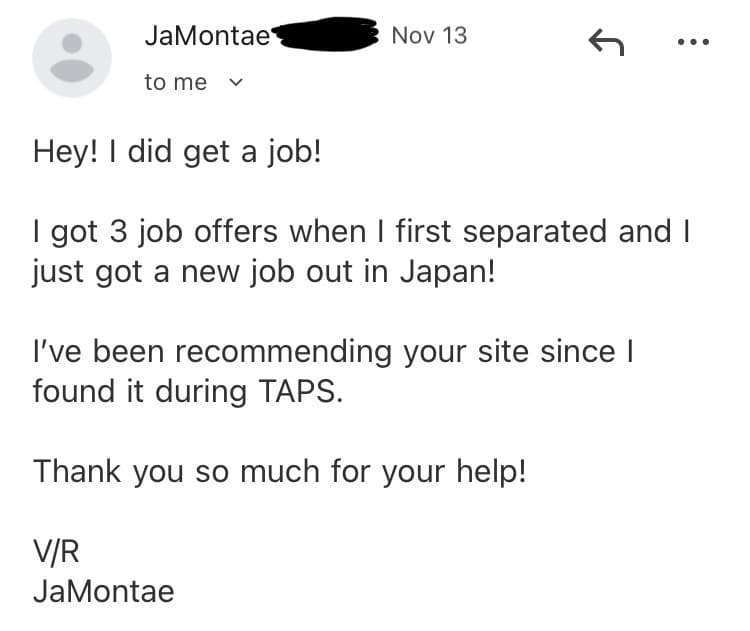
“Hey! I did get a job! I got 3 job offers when I first separated and I just got a new job out in Japan! I’ve been recommending your site since I found it during TAPS. Thank you so much for your help! V/R JaMontae ”
Federal service is where a 3E4X3 background pays off fastest, because the government runs the exact regulated pest and environmental programs you already worked inside. The clearest fit is the WG-5026 Pest Controlling trade series, the federal blue-collar equivalent of your certified-applicator work on installations, in the VA, the Bureau of Prisons, DoD facilities, and the National Park Service. From there the white-collar ladder opens up with your records and survey experience.
The GS-0028 Environmental Protection Specialist series is the strongest professional target. Your compliance documentation, label-law knowledge, and program QA experience line up with how these positions are graded, and veterans often qualify at the GS-7 or GS-9 entry with the right resume. The GS-0401 General Biological Science series covers entomology and vector-surveillance work, and is the home series for many DoD and USDA pest-program positions. The GS-0690 Industrial Hygiene and GS-0018 Safety and Occupational Health Management series both value your chemical-exposure, PPE, and hazardous-material handling background.
Two land-management series round out the list for anyone who came up on the vegetation, grounds, and noxious-weed side: GS-0454 Rangeland Management and GS-0457 Soil Conservation, both heavily used by USDA, the Bureau of Land Management, and the Natural Resources Conservation Service. The federal crosswalk table on this page maps each series to a relevance score and a likely starting grade.
Veterans' Preference (5 or 10 points) and special hiring authorities like VEOA give you a real edge in these competitions, but only if the resume mirrors the announcement's language. Federal resumes are longer and more detailed than private-sector ones, and the qualification statement does the work. Start with how OPM grades military experience into GS levels, learn to decode a USAJOBS announcement, and when you are ready, the federal resume builder formats it to OPM standards. You can also start your federal resume here.
| GS Series | Federal Job Title | Typical Grades | Match | Explore |
|---|---|---|---|---|
| GS-5026 | Pest Controlling | WG-5, WG-7, WG-8 | View Details → | |
| GS-0401 | General Biological Science | GS-5, GS-7, GS-9 | View Details → | |
| GS-0690 | Industrial Hygiene | GS-7, GS-9, GS-11 | View Details → | |
| GS-0457 | Soil Conservation | GS-5, GS-7, GS-9 | View Details → | |
| GS-0454 | Rangeland Management | GS-5, GS-7, GS-9 | View Details → | |
| GS-0028 | Environmental Protection Specialist | GS-5, GS-7, GS-9 | View Details → | |
| GS-0018 | Safety and Occupational Health Management | GS-7, GS-9, GS-11 | View Details → |
Federal hiring uses keyword-matching and structured experience. BMR builds federal-format resumes (USAJobs-ready) with the right keywords, hours/week, and supervisor info — for any GS series above.
Free · No credit card · Federal + civilian resume formats included
Not everyone wants to stay in a related field. These career paths leverage your transferable skills — leadership, risk management, logistics, project planning — in completely different industries.
Food plants live or die on pest exclusion, sanitation, and documented regulatory compliance, which is precisely the program you already ran.
Your certified-applicator habits, PPE discipline, and chemical-handling judgment transfer straight into remediation and abatement work.
A 3E4X3 spends every duty day mixing chemicals to exact concentrations, documenting application data, and handling restricted-use compounds under EPA and label law. That same precision with measurement, sampling, and regulated handling is the core of a chemical technician role in a manufacturing or pharmaceutical lab, an industry most pest managers never picture themselves in.
Vector surveillance is applied field epidemiology; you already tracked disease carriers and reported population-level risk.
Designing controls around chemical and biological hazards is the engineering version of the exposure-control work you did every day.
You enforced label law and survived application audits; reading regulations and proving conformance is the core of compliance work.
The skills that made you a good Marine, Sailor, Airman, or Soldier transfer further than you think. BMR rewrites your bullets for any of the pivot careers above — without making you sound like you've never done the work.
Free · No credit card · Try unlimited career angles
If you are staying in pest control, environmental health, or agriculture, your terminology already translates. Inspectors, applicators, and program managers in those fields know what IPM and a re-entry interval are. This section is for 3E4X3 veterans targeting careers OUTSIDE the pest and environmental specialty, where a hiring manager has never heard your job language and needs the business meaning spelled out.
The core move is to describe outcomes and regulated processes, not Air Force task names. A "pest management survey" becomes "field assessment and risk-based inspection." A "certified applicator" credential becomes "regulated hazardous-material handling under federal and state law." A "QAE on a contracted function" becomes "contract quality assurance and vendor performance oversight." These translations open doors in quality assurance, compliance, facilities, and operations roles that would otherwise screen you out for using military-specific terms.
| Air Force term | Civilian translation |
|---|---|
| Integrated Pest Management (IPM) program | Risk-based program management with documented, least-toxic intervention standards |
| Certified pesticide applicator | Licensed handler of regulated chemicals under federal and state compliance law |
| Disease-vector surveillance | Field sampling, monitoring, and public-health risk reporting |
| Quality Assurance Evaluator (QAE) on contracts | Contract quality assurance and vendor performance oversight |
| Application records and historical database | Regulatory recordkeeping and compliance audit documentation |
Here is the before-and-after that matters most. Before: "Performed IPM surveys and applied restricted-use pesticides per label." After: "Conducted risk-based facility inspections across a 4,000-acre site, selected and applied regulated chemical treatments in full compliance with federal label law, and maintained the audit-ready application record for a zero-discrepancy annual review." The second version is the one a quality, compliance, or operations manager can score.
For more translation patterns, work through the 50 military terms translated to civilian language guide and the breakdown of turning evaluations into resume bullets. The military resume builder applies these translations automatically, or build your resume now and see your bullets rewritten.
BMR turns your 3E4X3 duties and accomplishments into civilian bullets that match the job you're applying for — no manual translation, no rewriting.
Free · No credit card · Tailored to each job posting
Which certifications you need depends on where you're headed. Find your target career path below.
The wrong placement can sink an otherwise strong application. BMR knows where each cert ranks, what to call it, and how to frame it for ATS keyword matching and hiring manager attention.
Free · No credit card · Built around your real certs and clearance
Your DoD applicator certification is a strong starting point, but state licensing is what civilian employers require, and it does not transfer automatically. Contact your state department of agriculture early to convert your experience toward a commercial applicator license. The Entomological Society of America (entsoc.org) offers the Associate Certified Entomologist (ACE) credential, which is the recognized professional mark in structural pest control. The National Pest Management Association (npmapestworld.org) runs training and connects you to commercial and government employers.
SkillBridge is worth using before you separate. Pest control, environmental services, and facilities firms regularly host fellowships. Start with our SkillBridge guide and the programs list by industry. The SFL-TAP transition resources hub covers timeline and benefits.
If you are pivoting into broader environmental, safety, or operations work, three credentials carry weight: the OSHA 30-Hour and the Board of Certified Safety Professionals (bcsp.org) credentials for safety roles, and PMP from PMI (pmi.org) for program-management roles. Use your GI Bill strategically toward an associate or bachelor degree in environmental science or biology, which unlocks the GS-0028 and GS-0401 federal series and the environmental scientist track. For veteran networking and mentorship, American Corporate Partners (acp-usa.org) pairs you with an industry mentor at no cost.
See also related civil-engineer and environmental paths: Air Force 3E4X1 Water and Fuel Systems Maintenance, Navy Utilitiesman (UT), and the Coast Guard Marine Science Technician (MST). To explore every option side by side, use the career crosswalk tool. When you are ready to apply, the federal resume builder handles USAJOBS formatting, or just get started here.
Most veterans do this backwards — they wait until terminal leave to start, then panic. Here's the actual sequence that works.
Print this. Tape it to your monitor. Veterans who treat the transition like a 90-day op get hired faster than the ones who treat it like an emergency.
Stop rewriting from scratch every time you apply. BMR turns your military experience into civilian and federal resumes — tailored to each job.