Loading...
Loading...
The civilian and federal jobs that hire Air Force Medical Materiels — with real salaries and the resume that gets callbacks.
Every 4A1X1 has more options than a Google search will tell you. Below: career paths, BLS salary data, federal GS series, certifications by target career, and how to translate your experience without losing what made you valuable to the Air Force in the first place.
Free · No credit card · Tailored resume in under 5 minutes
After the Navy I got hired into 6 federal career fields and tech sales, and sat on federal hiring panels along the way. I spent the last 2 years rebuilding everything I learned into BMR, tuned for how AI actually screens resumes today. This is the system I wish I'd had on day one.
One page, built in our template, with your military experience translated into civilian terms hiring managers and ATS systems read. Use it as a reference for your own. Drop your email and we'll send you the download link.
Free. We'll also send occasional job-search tips. Unsubscribe anytime.
Air Force Medical Materiel specialists (4A1X1) run the supply chain that keeps military treatment facilities stocked, sterile, and audit-ready. You order, receive, store, and issue everything a hospital or clinic consumes: pharmaceuticals, surgical instruments, implants, reagents, vaccines, and high-value biomedical equipment. The work runs on the Defense Medical Logistics Standard Support (DMLSS) system and its successor LogiCole/DMLSS modules, which track every line item, lot number, and expiration date across the Defense Health Agency network.
The job is not generic warehousing. You manage cold-chain integrity for vaccines and biologics that fail if temperature drifts a few degrees. You quarantine and process recalled lots so a defective implant never reaches an operating room. You handle controlled substances under chain-of-custody rules, reconcile high-dollar equipment accounts, and keep the facility ready for Joint Commission and DHA inspections. Training starts at the Medical Education and Training Campus (METC) at JBSA-Fort Sam Houston, Texas, where the pipeline covers medical logistics, DMLSS operations, biomedical equipment accountability, and regulatory compliance before you report to a Medical Logistics flight at a base like Travis, Wright-Patterson, Ramstein, or Keesler.
Civilian employers value 4A1X1 veterans because you sit at the intersection of three skill sets that rarely show up in one resume: regulated inventory control, life-safety accountability, and procurement under audit. A hospital materials manager, a pharmaceutical distributor, and a medical-device manufacturer all need exactly that combination. If you want to see how your AFSC maps to the broader supply field, the military-to-civilian career crosswalk lines up adjacent roles, and the related 2S0X1 Materiel Management and 4A0X1 Health Services Management pages cover the supply and healthcare-admin sides of your world.
When I separated from the Navy I spent 18 months applying with no callbacks. The problem was never the experience. It was that "medical materiel" and "DMLSS" read like another language to a civilian recruiter, so the resume got passed over before anyone understood what you actually ran. Translate the cold-chain control and the audit accountability into hospital and pharma language and the same background that got ignored starts getting interviews. — Brad Tachi, Navy Diver veteran & BMR founder
The number that matters when you're deciding what's next: how does civilian pay compare to what you make now?
Military comp is approximate (varies by location/dependents). Civilian is BLS median. Federal includes locality pay. Your real number depends on duty station, family status, GS step, and overtime.
The clearest civilian path for a 4A1X1 is healthcare supply chain. Hospitals, surgery centers, and large clinic networks run central supply and pharmacy logistics operations that mirror a Medical Logistics flight almost line for line. Pay reflects the regulated, high-stakes nature of the work.
Per BLS Occupational Employment and Wage Statistics (May 2024), purchasing agents (O*NET 13-1023.00) earned a median of $75,410, and purchasing managers (O*NET 11-3061.00) earned a median of $136,380. Logisticians (O*NET 13-1081.00) posted a median of $80,880 with employment projected to grow faster than average. Storage and distribution managers and transportation/distribution managers (O*NET 11-3071.00) earned a median of $102,010. These are the roles where your DMLSS and inventory-control experience reads as immediate qualification rather than something a hiring manager has to interpret.
Two market realities are worth naming. First, healthcare supply chain is geographically concentrated near hospital systems and distribution hubs, so the strongest job density sits around metro medical centers and the regional warehouses of distributors like McKesson and Cardinal Health. Second, the medical-device and pharmaceutical side pays well but screens hard for regulatory familiarity, which is exactly the FDA and chain-of-custody background you already carry. For a wider view of where logistics experience travels, the veterans in logistics and supply chain careers guide maps adjacent fields, and veterans coming from sister-service supply ratings such as Navy Logistics Specialist (LS) and Army 92A Automated Logistical Specialist compete for the same civilian roles. When you are ready to put this on paper, the military resume builder structures the bullets for you, or you can build your resume now.
| Civilian Job Title | Industry | BLS Median Salary | Outlook | Match |
|---|---|---|---|---|
Logistician O*NET: 13-1081.00 | Healthcare Supply Chain | $80,880 | 19% (Much faster than average) | strong |
Healthcare Purchasing Agent O*NET: 13-1023.00 | Healthcare Supply Chain | $75,410 | 7% (Faster than average) | strong |
Storage and Distribution Manager O*NET: 11-3071.00 | Warehousing & Distribution | $102,010 | 8% (Faster than average) | strong |
Purchasing Manager O*NET: 11-3061.00 | Healthcare Supply Chain | $136,380 | 8% (Faster than average) | moderate |
Medical and Health Services Manager O*NET: 11-9111.00 | Healthcare Administration | $117,960 | 29% (Much faster than average) | moderate |
Inventory Control Specialist O*NET: 43-5061.00 | Healthcare Supply Chain | $49,490 | 4% (As fast as average) | strong |
Procurement Clerk O*NET: 43-3061.00 | Healthcare Supply Chain | $45,620 | -5% (Decline) | moderate |
Supply Chain Manager O*NET: 11-3071.04 | Healthcare Supply Chain | $99,200 | 8% (Faster than average) | moderate |
BMR rewrites your 4A1X1 experience for any of the civilian roles above — keywords, achievements, and language hiring managers actually scan for.
Free · No credit card · 2 tailored resumes included
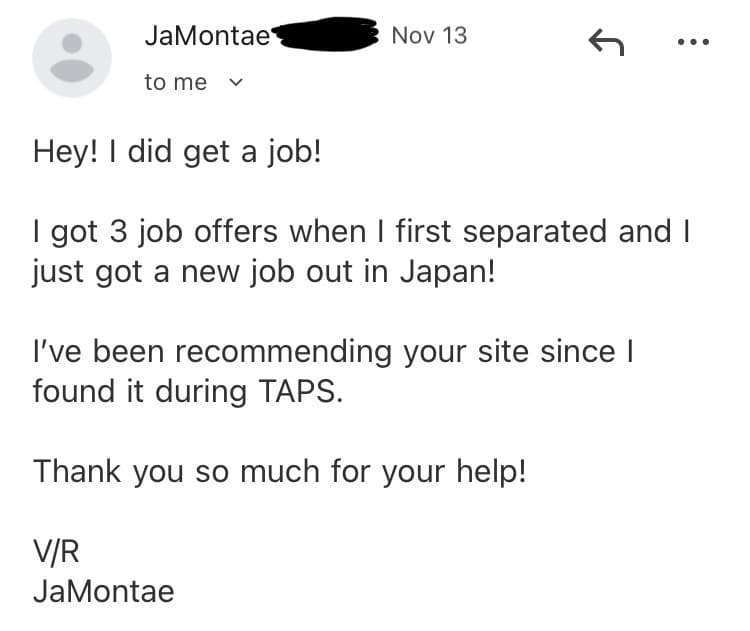
“Hey! I did get a job! I got 3 job offers when I first separated and I just got a new job out in Japan! I’ve been recommending your site since I found it during TAPS. Thank you so much for your help! V/R JaMontae ”
Federal service is one of the most natural moves for a 4A1X1 because the Defense Health Agency, the VA, and military treatment facilities employ civilians who do the exact work you did in uniform. The GS series below qualify on the strength of your medical logistics record.
The GS-2003 Supply Program Management and GS-2010 Inventory Management series are the core targets. Both routinely sit at the GS-7 through GS-11 range for transitioning specialists with hands-on DMLSS and account-management experience, and your record of managing high-dollar medical equipment accounts is the specialized experience that qualifies you. GS-2001 General Supply and GS-2030 Distribution Facilities and Storage Management cover the warehouse-operations and storage-control side. For the procurement angle, GS-1102 Contracting values medical-materiel purchasing experience, and GS-0346 Logistics Management is the management-track series as you take on planning and program responsibility.
Veterans preference applies across all of these, and the VA in particular weights medical-logistics experience heavily for its supply chain workforce. Qualifying turns on the wording: a federal resume has to show months, hours per week, and the specialized experience that matches the series, which is a different format from a civilian one-pager. The 2026 OPM federal resume format guide walks the structure, and the match-your-MOS-to-federal-series guide shows how to line the experience up. The 6C0X1 Contracting page shares the GS-1102 target if procurement is where you want to land. To start the federal version, use the federal resume builder or get started here.
| GS Series | Federal Job Title | Typical Grades | Match | Explore |
|---|---|---|---|---|
| GS-2010 | Inventory Management | GS-7, GS-9, GS-11 | View Details → | |
| GS-2001 | General Supply | GS-5, GS-7, GS-9 | View Details → | |
| GS-2003 | Supply Program Management | GS-5, GS-7, GS-9 | View Details → | |
| GS-2030 | Distribution Facilities and Storage Management | GS-7, GS-9, GS-11 | View Details → | |
| GS-1102 | Contracting | GS-7, GS-9, GS-11 | View Details → | |
| GS-1910 | Quality Assurance | GS-7, GS-9, GS-11 | View Details → | |
| GS-0346 | Logistics Management | GS-9, GS-11, GS-12 | View Details → |
Federal hiring uses keyword-matching and structured experience. BMR builds federal-format resumes (USAJobs-ready) with the right keywords, hours/week, and supervisor info — for any GS series above.
Free · No credit card · Federal + civilian resume formats included
Not everyone wants to stay in a related field. These career paths leverage your transferable skills — leadership, risk management, logistics, project planning — in completely different industries.
Vaccine and biologic cold-chain work is the same discipline a food plant needs to keep perishable product safe and traceable.
Processing medical-device recalls and FDA notices is the core of regulatory affairs, just on the documentation and submissions side.
Clearing regulated, high-value goods through compliance rules mirrors managing controlled medical materiel through DHA and FDA requirements.
Medical materiel work runs on forecasting consumption, pricing high-dollar equipment, and reconciling spend against budget. That cost-analysis discipline is the core of construction and manufacturing estimating, just applied to a different category of goods.
The forensic, audit-the-record discipline of reconciling accounts and processing recalls transfers cleanly to examining claims against policy rules.
Keeping a facility continuously inspection-ready for Joint Commission and DHA is exactly what corporate compliance officers do for their regulators.
Catching a defective lot before it reaches a patient is the same judgment a manufacturing quality inspector uses to pull nonconforming product off the line. Your recall, quarantine, and documentation habits transfer directly into industrial quality control.
The skills that made you a good Marine, Sailor, Airman, or Soldier transfer further than you think. BMR rewrites your bullets for any of the pivot careers above — without making you sound like you've never done the work.
Free · No credit card · Try unlimited career angles
If you are staying in medical logistics or hospital supply chain, your terminology already translates. Recruiters at hospitals, distributors, and device makers know what DMLSS and cold chain mean. This section is for the veteran targeting a role OUTSIDE medical supply, where a civilian hiring manager has never heard your AFSC language and will pass over a resume written in it.
The fix is to describe the function and the scale, not the system name. "Managed DMLSS accounts" tells a non-medical recruiter nothing. "Administered an enterprise inventory system controlling 4,000 line items valued at $6M with 99.7 percent accuracy" tells them you can run their warehouse. The 50 military terms translated to civilian language glossary and the Air Force-specific EPR/OPR to civilian resume guide cover the same translation work for your performance reports.
A few before-and-after examples for non-medical roles:
Once your bullets read in civilian language, the military resume builder formats them for the role you are targeting.
BMR turns your 4A1X1 duties and accomplishments into civilian bullets that match the job you're applying for — no manual translation, no rewriting.
Free · No credit card · Tailored to each job posting
Which certifications you need depends on where you're headed. Find your target career path below.
The wrong placement can sink an otherwise strong application. BMR knows where each cert ranks, what to call it, and how to frame it for ATS keyword matching and hiring manager attention.
Free · No credit card · Built around your real certs and clearance
Staying in Medical Logistics and Healthcare Supply Chain. SkillBridge is the highest-leverage move in your last six months: medical distributors and hospital systems host internships that convert to offers, and you keep your pay while you train. Industry associations worth joining are the Association for Health Care Resource and Materials Management (AHRMM) and the Association for Supply Chain Management (ASCM, formerly APICS), both of which run certifications that signal civilian readiness. For sister-service peers competing for the same healthcare supply roles, the Navy LS Logistics Specialist and Army 92Y Unit Supply Specialist pages are worth a look, and the 4P0X1 Pharmacy Technician page covers the adjacent pharmacy track.
For Careers Outside Medical Supply. If you are leaving the field, American Corporate Partners (ACP) pairs you with a corporate mentor for a year at no cost, which is the single best networking lever for a clean industry switch. The GI Bill covers degree completion or a certificate such as Project Management or Six Sigma if you are repositioning into operations or quality. SFL-TAP and the broader transition resources cover the timeline and benefits side. The military to logistics management career guide is a useful next read if you want to move up rather than out.
Build the resume. Start with the military resume builder for private-sector roles or the federal resume builder for GS jobs. Explore adjacent fields through the career crosswalk, and when you are ready to commit, build your resume now.
Most veterans do this backwards — they wait until terminal leave to start, then panic. Here's the actual sequence that works.
Print this. Tape it to your monitor. Veterans who treat the transition like a 90-day op get hired faster than the ones who treat it like an emergency.
Stop rewriting from scratch every time you apply. BMR turns your military experience into civilian and federal resumes — tailored to each job.