Air ForceAFSC: 6C0X1

Contracting

The civilian and federal jobs that hire Air Force Contractings — with real salaries and the resume that gets callbacks.

Every 6C0X1 has more options than a Google search will tell you. Below: career paths, BLS salary data, federal GS series, certifications by target career, and how to translate your experience without losing what made you valuable to the Air Force in the first place.

Free to start · Tailored resume in under 5 minutes

$56K–$136K
Salary Range
BLS-verified median salaries
14
Career Paths
12
Companies Hiring
8
Resume Examples
10
Federal GS Series
7
Certification Paths
10
FAQs Answered
BT
Brad Tachi
Navy Diver · BMR Founder

After the Navy I got hired into 6 federal career fields and tech sales, and sat on federal hiring panels along the way. I spent the last 2 years rebuilding everything I learned into BMR, tuned for how AI actually screens resumes today. This is the system I wish I'd had on day one.

65,000+ resumes built·Success stories every week
Free Sample · Emailed to You

Get a free 6C0X1 Contracting sample resume

One page, built in our template, with your military experience translated into civilian terms hiring managers and ATS systems read. Use it as a reference for your own. Drop your email and we'll send you the download link.

Free. We'll also send occasional job-search tips. Unsubscribe anytime.

Military Role Overview

Air Force Contracting specialists (6C0X1) are the service's acquisition professionals — they negotiate, award, and administer contracts for everything the Air Force buys, from office supplies and IT services to weapon systems and base operating support. 6C0X1s execute the full spectrum of federal acquisition, working within the Federal Acquisition Regulation (FAR), Defense Federal Acquisition Regulation Supplement (DFARS), and Air Force Federal Acquisition Regulation Supplement (AFFARS) to ensure the government gets best value while maintaining legal compliance.

The training pipeline starts at the 338th Training Squadron, Joint Base San Antonio-Fort Sam Houston, Texas, where Airmen complete approximately 8 weeks of contracting fundamentals covering simplified acquisition procedures (SAP), source selection, contract types (Firm-Fixed-Price, Cost-Plus-Fixed-Fee, Cost-Plus-Award-Fee, Indefinite Delivery/Indefinite Quantity, Blanket Purchase Agreements), and market research. From there, contracting Airmen work in base contracting offices at installations worldwide, progressing through increasingly complex acquisitions as they gain experience and earn Defense Acquisition Workforce Improvement Act (DAWIA) certifications under the Back to Basics framework.

What makes 6C0X1 one of the most directly transferable AFSCs in the Air Force is simple: federal acquisition is a skill set with massive demand across government agencies, defense contractors, and the private sector. A 6C0X1 who separates with a DAWIA Professional certification and experience running source selections or managing contract portfolios is walking into a job market that actively recruits people with exactly that background. The systems (CON-IT, FPDS-NG, SAM.gov, Wide Area Workflow), the regulations (FAR Parts 8, 12, 13, 15, 16), and the processes (market research, solicitation development, proposal evaluation, contract administration) are the same whether you work for the Air Force or for a civilian agency — or advise companies competing for those contracts.

Federal contracting was one of the federal career fields I worked in after the Navy — and 6C0s have one of the most direct civilian translations of any AFSC. The GS-1102 Contract Specialist series exists exactly for this background, and the FAR/DFARS knowledge plus clearance is the combination federal contracting offices need. — Brad Tachi, Navy Diver veteran & BMR founder

Security ClearanceSecret (minimum); some billets require TS/SCI
ASVAB RequirementG-72
TrainingContracting Apprentice Course (~8 weeks, 338th TRS, JBSA-Fort Sam Houston, TX). Progression through 5-level (Journeyman) and 7-level (Craftsman) via on-the-job training, CDC completion, and DAWIA/Back to Basics certification milestones. Warrant authority (unlimited contracting officer authority) available at senior levels.
Certs Earned in ServiceDAWIA Back to Basics Contracting Professional certification, Government Purchase Card (GPC) training, Contracting Officer Representative (COR) certification, SAM.gov administration, FPDS-NG reporting

Pay Reality Check

The number that matters when you're deciding what's next: how does civilian pay compare to what you make now?

Air Force mid-career
$58K–$82K
E-5 to E-7 total comp (base + BAH + BAS + tax advantage)
Civilian Contracting
$68K–$136K
BLS median across direct-match civilian roles
Federal (GS-9 to GS-13)
$58K–$120K
10 matching GS series + locality pay + step increases
+39% on average
Civilian roles for Contractings pay ~$28K more than mid-career enlisted total comp.

Military comp is approximate (varies by location/dependents). Civilian is BLS median. Federal includes locality pay. Your real number depends on duty station, family status, GS step, and overtime.

Private Sector Career Paths

The federal acquisition skill set that 6C0X1s develop translates into two distinct career tracks in the private sector: procurement/supply chain roles within corporations, and business development/capture management roles within companies that sell to the government.

According to the Bureau of Labor Statistics (May 2024), the median annual wage for Purchasing Managers is $136,380 (O*NET 11-3061.00), making it one of the highest-compensated paths for experienced contracting professionals. Purchasing Agents earn a median of $67,620 (13-1023.00), while the broader Management Analyst category — which captures many of the consulting roles former 6C0X1s land — has a median of $101,190 (13-1111.00).

Defense contractors are the most aggressive recruiters of separating 6C0X1s. Companies like Lockheed Martin, Raytheon, Northrop Grumman, and Booz Allen Hamilton hire former contracting specialists for proposal management, contract administration, pricing strategy, and compliance roles. These employers value the fact that a former 6C0X1 already knows how the government evaluates proposals, what FAR clauses mean operationally, and how to navigate the source selection process — from the other side of the table.

Beyond defense, corporate procurement departments at Fortune 500 companies hire for strategic sourcing, vendor management, and supply chain optimization. The analytical rigor of federal contracting — cost/price analysis, market research, competitive range determinations — maps directly to corporate procurement methodology. The gap is mainly in terminology, not capability.

Civilian Job Title Translations

Contract Specialist
Government / Defense
strong
$67,620median
About as fast as average
O*NET: 13-1023.00
Procurement Analyst
Defense / Consulting
strong
$67,620median
About as fast as average
O*NET: 13-1023.00
Contracting Officer
Government
strong
$136,380median
About as fast as average
O*NET: 11-3061.00
Purchasing Manager
Multiple Industries
strong
$136,380median
About as fast as average
O*NET: 11-3061.00
Supply Chain Manager
Manufacturing / Retail / Defense
moderate
$80,880median
Much faster than average (17%)
O*NET: 13-1081.00
Compliance Specialist
Government / Financial / Healthcare
moderate
$78,420median
Faster than average
O*NET: 13-1041.00
Cost Analyst
Defense / Consulting / Manufacturing
moderate
$77,070median
About as fast as average
O*NET: 17-2112.00
Business Development Manager
Defense / Technology
moderate
$136,380median
About as fast as average
O*NET: 11-3061.00

Companies That Hire This Background

Federal procurement and acquisition management. Military contracting experience with FAR/DFARS directly qualifies for GS-1102 positions.
Contract administration and oversight. AF contracting experience is a direct match for DCMA contract specialists and administrative contracting officers.
Procurement and supply chain contracting for DoD. Military contracting experience directly applicable to DLA acquisition positions.
Government consulting including acquisition advisory, procurement strategy, and contract management. Military contracting experience valued in public sector practice.
Acquisition management, contract support, and procurement advisory services. Active SkillBridge partner with veteran hiring programs.
Acquisition support, contract management, and procurement analysis positions supporting DoD programs.
Procurement, subcontract management, and supply chain positions. Military contracting experience valued for government program support.
Contracts management, pricing, and procurement roles. Understanding of government contracting from the buyer side is a competitive advantage.
Contracts, subcontracts, and procurement positions across Collins Aerospace and Raytheon divisions. FAR knowledge is essential.
Contracts management, pricing analysts, and procurement specialists. Military contracting officers understand the government buyer perspective.
Procurement, vendor management, and supply chain roles. Military contracting negotiation skills transfer to commercial procurement.
Contracting specialists and procurement analysts for national laboratories and energy programs. GS-1102 positions with competitive pay.

See a salary you want? Build a resume targeting it.

BMR rewrites your 6C0X1 experience for any of the civilian roles above — keywords, achievements, and language hiring managers actually scan for.

Free to start · 2 tailored resumes included

Build My Resume Free
Real Air Force success story
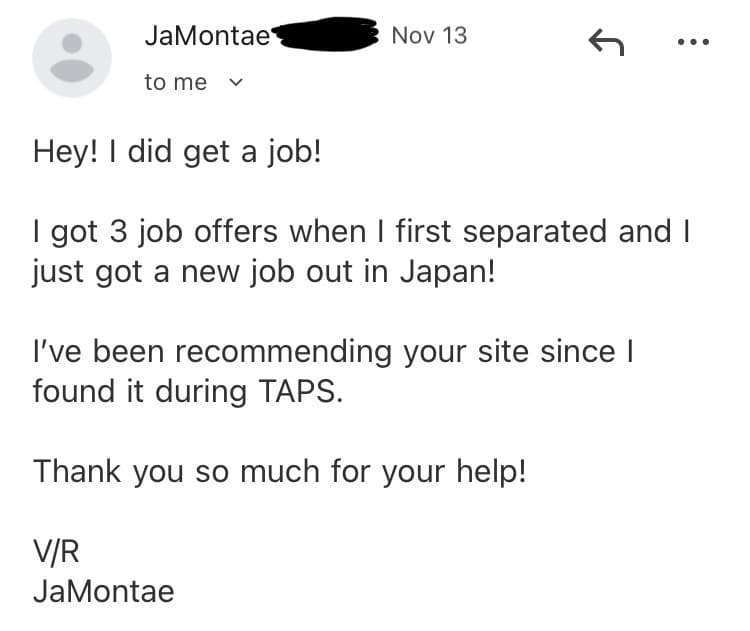
Hey! I did get a job! I got 3 job offers when I first separated and I just got a new job out in Japan! I’ve been recommending your site since I found it during TAPS. Thank you so much for your help! V/R JaMontae
JaMontae· Staff Sergeant (E-5)· Air Force
Information Technology and Computer Science
Read the full story

Federal Career Paths

Transitioning from 6C0X1 into federal civilian service is one of the smoothest paths in the entire military. The GS-1102 (Contracting) series is the direct match, and agencies across the federal government are chronically short-staffed in acquisition. DoD, DHS, NASA, VA, HHS, DOE, and GSA all hire contract specialists, and your DAWIA certification carries over directly.

The critical advantage for separating 6C0X1s: your DAWIA Back to Basics certification satisfies the Federal Acquisition Certification in Contracting (FAC-C) requirements at civilian agencies. This means you skip the training pipeline that civilian new-hires must complete. Combined with Veterans' Preference, this makes you a highly competitive candidate for GS-1102 positions at the GS-07 through GS-12 level, depending on your experience and education.

Beyond 1102, several related series are strong fits. The GS-1101 (General Business and Industry) series covers procurement-adjacent roles in industrial property management and business advisory positions. GS-0343 (Management and Program Analyst) positions leverage your analytical skills — cost analysis, program evaluation, and organizational efficiency work. GS-0560 (Budget Analyst) roles are a natural fit for 6C0X1s who handled funding documents, obligation tracking, and financial management as part of contract execution.

GS-0301 (Miscellaneous Administration) and GS-0501 (Financial Administration and Program) positions round out the options for 6C0X1s who want to move into broader program management or financial oversight roles within agencies. The key to federal hiring: apply early. Federal hiring timelines run 60-120 days, so start submitting USAJobs applications at least 6 months before your separation date.

GS Series & Position Matches

GS-1102
Contracting
Typical grades: GS-9, GS-11, GS-12, GS-13
View Details
GS-0343
Management and Program Analyst
Typical grades: GS-9, GS-11, GS-12, GS-13
View Details
GS-0560
Budget Analysis
Typical grades: GS-9, GS-11, GS-12
View Details
GS-1101
General Business and Industry
Typical grades: GS-7, GS-9, GS-11, GS-12
View Details
GS-1801
General Inspection, Investigation, Enforcement
Typical grades: GS-7, GS-9, GS-11
View Details
GS-0201
Human Resources Management
Typical grades: GS-7, GS-9, GS-11
View Details
GS-2010
Inventory Management
Typical grades: GS-5, GS-7, GS-9
View Details
GS-0301
Miscellaneous Administration and Program
Typical grades: GS-7, GS-9, GS-11
View Details
GS-0346
Logistics Management
Typical grades: GS-7, GS-9, GS-11
View Details
GS-1160
Financial Analysis
Typical grades: GS-9, GS-11, GS-12
View Details

Federal resumes follow different rules. We know them.

Federal hiring uses keyword-matching and structured experience. BMR builds federal-format resumes (USAJobs-ready) with the right keywords, hours/week, and supervisor info — for any GS series above.

Free to start · Federal + civilian resume formats included

Build My Federal Resume Free

Want to Change Careers Entirely?

Not everyone wants to stay in a related field. These career paths leverage your transferable skills — leadership, risk management, logistics, project planning — in completely different industries.

Arbitrator, Mediator, and Conciliator

$67,710
Dispute Resolution(O*NET: 23-1022.00)BLS OEWS May 2024Average (3% to 4%)
High-stakes negotiation between opposing partiesInterpreting contract terms and obligationsDriving parties to a documented agreementStaying neutral while controlling the process

Closing a contract means getting two sides with different interests to a signed deal. Mediators do the same thing for disputes, using the negotiation and agreement-drafting instincts a contracting career builds daily.

How to get there: Most enter through a 30 to 40 hour basic mediation training and court-roster certification, which varies by state. A law degree helps for high-dollar commercial work but is not required.

Real Estate Sales Agent

$56,320
Real Estate(O*NET: 41-9022.00)BLS OEWS May 2024Average (3% to 4%)
Negotiating price and terms to a closePreparing and reviewing purchase contractsReading market and comparable pricingGuiding clients through a complex transaction

A property deal is a negotiated contract with money, terms, and contingencies, which is exactly the document a contracting professional lives in. The selling is new; reading and closing the contract is not.

How to get there: A state real estate license requires a short pre-licensing course and exam (typically 60 to 120 hours). Income is commission-based, so most start part-time or with a brokerage that mentors new agents.

Insurance Sales Agent

$60,370
Insurance(O*NET: 41-3021.00)BLS OEWS May 2024Average (3% to 4%)
Pricing and explaining risk-based termsMatching coverage to a client's exposureNegotiating policy structureBuilding a book of repeat business

Contracting trains you to weigh risk and price terms accordingly. Insurance agents do the same for clients, translating exposure into the right coverage and terms, which makes the jump natural for a contracts background.

How to get there: A state insurance license (life, health, or property and casualty) requires a short course and exam. Carriers and agencies hire and train new agents; the role is commission-driven.

Loan Officer

$74,180
Banking and Lending(O*NET: 13-2072.00)BLS OEWS May 2024Slower than average (1% to 2%)
Evaluating financial terms and riskStructuring deals against written guidelinesNegotiating rates and conditionsDocumenting decisions to an audit standard

Approving a loan is the same judgment as approving a contract: assess the numbers, weigh the risk, and structure terms that protect the institution. Banks hire that disciplined deal-evaluation skill directly.

How to get there: No specific degree is required for most consumer lending. Mortgage loan officers need the NMLS license (a national exam plus background check); banks train new commercial officers on the job.

Sales Engineer

$121,520
Technology Sales(O*NET: 41-9031.00)BLS OEWS May 2024Faster than average (5% to 6%)
Structuring and negotiating high-dollar dealsTranslating technical requirements into termsBuilding trust with procurement-side buyersClosing complex, multi-stakeholder agreements

You have sat on the buying side of major technical purchases and know exactly how those deals get scoped and closed. That insider view makes you formidable on the sell side, where vendors compete for the contracts you used to award.

How to get there: No engineering degree is strictly required if you have the technical and deal credibility. Many enter through a sales development or solutions-consultant role and move up on closed revenue.

Paralegal and Legal Assistant

$61,010
Legal(O*NET: 23-2011.00)BLS OEWS May 2024Little or no change (-1% to 1%)
Interpreting contract clauses and the FARDrafting and reviewing legal documentsResearching regulations and precedentSpotting risk and ambiguity in agreements

Reading a contract against the Federal Acquisition Regulation is paralegal work without the law-firm letterhead. The clause-by-clause interpretation and document drafting transfer straight into a legal-support role.

How to get there: A paralegal certificate (a few months to a year) is the common entry credential, and many employers accept relevant experience plus the cert. Government contract-law backgrounds are valued by firms with federal practices.

Pivoting industries? You don't need to start from scratch.

The skills that made you a good Marine, Sailor, Airman, or Soldier transfer further than you think. BMR rewrites your bullets for any of the pivot careers above — without making you sound like you've never done the work.

Free to start · Try as many career angles as you want

Tailor My Resume to a New Career

Skills Translation Guide

If you are applying to defense contractors or federal civilian contracting positions, this section is not for you — those employers know exactly what a contracting officer does, what FAR Part 15 source selection means, and what DAWIA certification represents. The terminology is identical.

This section is for 6C0X1s targeting careers outside of procurement and government contracting — positions in corporate finance, management consulting, operations, real estate, or other fields where the hiring manager has never heard of the FAR and does not know what a 'sole source justification' is. The translations below reframe your acquisition experience into language that resonates in those industries.

Resume Bullet Examples

Before (Military)
Served as Contracting Officer with $5M warrant authority, executing 200+ contract actions annually across simplified acquisition and formal source selection
After (Civilian)
Served as procurement manager with $5M purchasing authority, executing 200+ procurement actions annually across direct purchase and competitive bidding processes
Before (Military)
Led 3 formal source selections evaluating technical proposals, past performance, and cost/price across $20M+ acquisitions
After (Civilian)
Led 3 competitive vendor evaluations assessing technical capability, track record, and pricing across $20M+ procurement programs
Before (Military)
Ensured FAR/DFARS compliance across all contract actions, passing 100% of quality assurance reviews during annual inspection
After (Civilian)
Ensured procurement policy compliance across all purchasing actions, passing 100% of quality audits during annual review cycle
Before (Military)
Developed IGCEs for 50+ requirements using market research, historical pricing, and cost modeling to establish fair and reasonable pricing
After (Civilian)
Developed cost estimates for 50+ projects using market research, historical data, and financial modeling to establish budget baselines
Before (Military)
Administered 30 active contracts valued at $50M, conducting monthly surveillance and managing COR oversight programs
After (Civilian)
Managed 30 active vendor relationships valued at $50M, conducting monthly performance reviews and maintaining quality standards
Before (Military)
Conducted market research for 100+ requirements using SAM.gov, industry days, and RFI responses to identify capable sources
After (Civilian)
Conducted market analysis for 100+ procurement needs using industry databases, trade events, and information requests to identify qualified suppliers
Before (Military)
Processed 75 contract modifications including scope changes, funding adjustments, and period of performance extensions
After (Civilian)
Processed 75 contract amendments including scope changes, budget adjustments, and timeline extensions, maintaining documentation and audit trails
Before (Military)
Managed unit GPC program with $250K annual spend, maintaining 100% compliance with monthly reconciliation and approving official reviews
After (Civilian)
Managed corporate purchasing card program with $250K annual spend, maintaining 100% compliance with monthly reconciliation and management reviews

Get bullets like these auto-generated for your resume.

BMR turns your 6C0X1 duties and accomplishments into civilian bullets that match the job you're applying for — no manual translation, no rewriting.

Free to start · Tailored to each job posting

Generate My Resume Bullets

Certifications by Career Path

Which certifications you need depends on where you're headed. Find your target career path below.

Accounting & Finance

Certified Government Financial Manager (CGFM)
Credential for government financial management positions
Association of Government Accountants
Cost: $300-$500Time: 6-12 monthsGI Bill Eligible
Contracting officers manage significant financial obligations. Budget tracking and fiscal compliance experience provides foundation for government financial management.

Compliance & Regulatory

Certified Fraud Examiner (CFE)
Valued for contract fraud investigation and compliance careers
Association of Certified Fraud Examiners
Cost: $450-$550Time: 6-12 monthsGI Bill Eligible
Contracting officers develop skills in identifying irregularities, evaluating vendor claims, and ensuring compliance. These skills transfer to fraud examination and audit roles.

Federal Employment

Federal Resume Certification (USAJOBS)
Understanding federal resume format is critical for GS-1102 positions
OPM / Self-Study
Cost: FreeTime: 1-2 weeks self-study
GS-1102 Contracting series is one of the most common federal hiring paths for 6C0X1. Understanding KSAs and specialized experience documentation is essential.

Logistics & Supply Chain

Certified Supply Chain Professional (CSCP)
Supply chain management credential for logistics and procurement transition
APICS
Cost: $1,500-$2,500 (course + exam)Time: 3-6 monthsGI Bill Eligible
Military procurement and vendor management experience provides foundation. CSCP broadens career options beyond contracting into supply chain management.

Operations Management

Lean Six Sigma Green Belt
Process improvement credential valued for operations and management consulting
ASQ / IASSC
Cost: $200-$500Time: 2-4 monthsGI Bill Eligible
Contract process improvement, cycle time reduction, and efficiency analysis from acquisition provide strong foundation. Valued for consulting transitions.

Procurement & Contracting

DAWIA (Defense Acquisition Workforce Improvement Act) Certification
Required credential for DoD acquisition workforce. Some 6C0X1 earn Level I or II during service.
Defense Acquisition University
Cost: Free (government)Time: Earned during service through DAU courses
DAU contracting certifications transfer directly to civilian DoD acquisition positions. Levels I-III correspond to GS grade requirements. Check if your certification is current.
Certified Federal Contracts Manager (CFCM)
Industry-standard credential for federal contracting professionals
National Contract Management Association (NCMA)
Cost: $300-$500 exam feeTime: 3-6 months preparationGI Bill Eligible
Validates FAR knowledge and contract management skills. Military contracting experience provides strong foundation. Valued by both government and contractor employers.
Certified Professional Contracts Manager (CPCM)
Advanced credential for senior contracting professionals
National Contract Management Association (NCMA)
Cost: $400-$600 exam feeTime: 6-12 months preparationGI Bill Eligible
Senior-level credential covering both government and commercial contracting. Requires experience beyond CFCM. Significant differentiator for senior roles.
Certified Purchasing Professional (CPP)
Credential for commercial procurement and purchasing management
American Purchasing Society
Cost: $250-$400Time: 3-6 monthsGI Bill Eligible
Validates procurement skills for commercial sector roles. Military contracting negotiation and vendor management experience provides foundation.

Project Management

Project Management Professional (PMP)
Industry-standard PM credential for acquisition program management
Project Management Institute (PMI)
Cost: $400-$555 exam feeTime: 3-6 months preparationGI Bill Eligible
Contract lifecycle management, source selection coordination, and multi-stakeholder requirements management count toward PM experience hours.

Got a cert? Don't bury it. List it the right way.

The wrong placement can sink an otherwise strong application. BMR knows where each cert ranks, what to call it, and how to frame it for ATS keyword matching and hiring manager attention.

Free to start · Built around your real certs and clearance

Build My Resume the Right Way

Transition Resources

For Staying in Procurement & Acquisition

SkillBridge Programs: Several defense contractors and consulting firms participate in DOD SkillBridge, allowing 6C0X1s to work in procurement, capture management, or contract administration roles during their last 180 days of service. Search the SkillBridge database for current openings. Booz Allen Hamilton, SAIC, and Leidos have historically participated.

DAWIA/Back to Basics Certification Transfer: Your DAWIA contracting certification transfers to civilian federal service. Ensure you download your certification documentation from the Defense Acquisition University (DAU) portal before losing .mil network access. Print copies of your Acquisition Career Record Brief (ACRB) and all training transcripts.

NCMA Membership: The National Contract Management Association (NCMA) is the premier professional association for contract management professionals. Their Certified Federal Contracts Manager (CFCM) and Certified Commercial Contracts Manager (CCCM) designations are widely recognized. Attend local chapter events — this is where federal and defense contractor hiring managers network.

Industry Certifications: The Certified Professional Contracts Manager (CPCM) from NCMA is the gold standard civilian certification. If targeting corporate procurement, consider the Certified Professional in Supply Management (CPSM) from the Institute for Supply Management (ISM).

For Careers Outside of Procurement

Management Consulting: Former 6C0X1s with strong analytical skills transition well into consulting. The analytical rigor of cost/price analysis and market research maps to consulting methodology. Consider PMP certification (PMI) to complement your acquisition background — your contract management experience likely qualifies for the project hours requirement.

Financial Analysis: If you excelled at cost/price analysis and financial management, the CFA (Chartered Financial Analyst) or financial modeling certifications open doors. Your experience with should-cost models, price reasonableness determinations, and budget execution translates to financial analysis roles.

Federal Employment (USAJobs): Create your USAJobs profile immediately. Use the "Veterans" filter. Key agencies for 6C0X1s: GSA, DHS, NASA, VA, DOE, and any agency with an acquisition workforce. Federal resumes are 2 pages max — not the 4-6 page myth you see online. Build yours here.

Veteran Networking: American Corporate Partners (ACP) provides free mentorship from corporate executives — you can be paired with someone in procurement, finance, consulting, or any target industry. ACP is legitimate and completely free for veterans.

Education Benefits: GI Bill covers MBA programs, which pair exceptionally well with acquisition experience for consulting and corporate procurement leadership roles. Many certification exam fees and prep courses are also covered. Use the GI Bill Comparison Tool to verify program approval.

Clearance Leverage: If you have an active Secret or TS/SCI, that has real market value — defense contractors will pay a premium for cleared acquisition professionals. Sites like ClearanceJobs.com list positions that require active clearances. Your clearance stays active for up to 24 months after separation if not renewed, so start your job search before it lapses.

BMR Career Resources

Air Force Resume Guide: AFSC Translation | Complete Military Resume Guide | Top Companies Hiring Veterans | Build Your Resume Free
Your 30 / 60 / 90-Day Transition Plan

Most people do this backwards. They wait until terminal leave to start, then panic. Here's the sequence that works. Already out? Same plan, start at day one today.

1Days 0–30

Set the foundation

  • Pull your DD-214 (request from Milconnect if separated)
  • List your top 3 civilian roles AND top 3 GS series
  • Build your tailored 6C0X1 resume — BMR does it free
  • Write 1 strong LinkedIn headline (not "veteran seeking opportunities")
  • Pull together your evals/performance reports for accomplishments
Build my resume free
2Days 30–60

Apply with intent

  • Apply to 5–10 jobs/week — quality over quantity
  • Tailor every resume to the job description (BMR auto-tailors)
  • Connect with 5 people/week on LinkedIn (not a spray)
  • Set up a USAJobs profile and a saved-search alert for your GS series
  • Practice translating your military bullets out loud — explain to a civilian friend
Tailor my next resume
3Days 60–90

Close the offer

  • Track every application — date, status, contact, notes
  • Follow up 7–10 days after each application
  • Prep for behavioral interviews using the STAR method
  • Negotiate salary — don't take the first offer (BLS median is your floor)
  • Stay applying even after one offer — leverage = options
Track my applications

Print this. Tape it to your monitor. Veterans who treat the job search like a 90-day op get hired faster than the ones who treat it like an emergency.

Frequently Asked Questions

How valuable is my DAWIA certification in the civilian world?
Extremely valuable for federal careers. Your DAWIA Back to Basics contracting certification satisfies the Federal Acquisition Certification in Contracting (FAC-C) requirements at civilian agencies, meaning you skip the training pipeline civilian new-hires must complete. For defense contractor roles, DAWIA certification signals that you understand the acquisition framework from the government side — employers pay a premium for that perspective. For purely private sector (non-government) procurement roles, DAWIA is less directly recognized, but the analytical and regulatory compliance skills it represents are understood.
What is the salary range for former 6C0X1s in civilian roles?
It depends on which career path you pursue. According to BLS May 2024 data: Purchasing Managers earn a median of $136,380 (O*NET 11-3061.00), Management Analysts earn $101,190 (13-1111.00), Purchasing Agents earn $67,620 (13-1023.00), Compliance Officers earn $78,420 (13-1041.00), and Budget Analysts earn $88,280 (13-2031.00). Defense contractor contract specialist roles typically fall between the Purchasing Agent and Management Analyst ranges, depending on experience and clearance level. Federal GS-1102 positions at GS-09 to GS-12 range from approximately $61,000 to $105,000 depending on locality pay.
Should I stay in government contracting or go private sector?
Both paths are strong — it depends on what you value. Staying in federal acquisition (GS-1102) offers stability, retirement benefits, your DAWIA certification carries over, and Veterans Preference gives you a hiring advantage. Defense contractors typically pay 15-30% more than equivalent GS positions but with less job security and benefits variability. Corporate procurement (non-government) pays well and offers career growth outside the defense ecosystem, but you will need to translate your FAR knowledge into commercial procurement language. Many 6C0X1s do a stint with a defense contractor first, then move to corporate procurement or consulting once they have both government and industry experience.
What if I want to leave procurement entirely?
6C0X1s have strong transferable skills that apply beyond procurement. Your cost/price analysis experience translates to financial analysis (BLS median $101,350, O*NET 13-2051.00). Your negotiation and vendor management skills apply to sales and business development. Your analytical methodology — market research, competitive analysis, best-value determinations — maps to management consulting (BLS median $101,190, O*NET 13-1111.00). Project management (BLS median $100,750, O*NET 13-1082.00) is another strong path, since contract management is fundamentally project management with a regulatory framework. See the Career Change Paths section above for specific entry paths and certifications.
Do I need additional certifications after separating?
It depends on your target career. For federal contracting: your DAWIA certification is sufficient — just make sure you download and save all documentation before losing .mil access. For defense contractor roles: NCMA certifications (CFCM or CPCM) strengthen your resume but are not required — your experience and DAWIA cert usually suffice. For corporate procurement: the Certified Professional in Supply Management (CPSM) from ISM is the industry standard. For management consulting or financial analysis: PMP, CFA, or MBA programs add credibility in those fields. Bottom line — get the cert that matches your target career, not every cert available.
Is my security clearance valuable outside the military?
Yes — significantly. An active Secret clearance saves employers $5,000-15,000+ and months of processing time. For defense contractor contracting roles, a Secret or TS/SCI clearance is often a hard requirement. This gives cleared 6C0X1s a major competitive advantage over civilian candidates who would need to be sponsored. Sites like ClearanceJobs.com list positions specifically. Important: your clearance stays active for up to 24 months after separation if not renewed, so start your job search before it lapses.
How does Veterans Preference work for GS-1102 positions?
Veterans Preference gives you 5 or 10 extra points on federal hiring assessments. Disabled veterans get 10 points. For GS-1102 (Contracting) positions specifically, you have an additional advantage: Direct Hire Authority is frequently used for acquisition workforce positions because agencies cannot fill these roles fast enough through normal competitive hiring. This means some 1102 positions bypass the standard rating/ranking process entirely. Start applying 6 months before separation — federal hiring timelines run 60-120 days. Build your federal resume at bestmilitaryresume.com — federal resumes follow different formatting rules than private sector resumes.
How do I explain contracting experience in a non-procurement job interview?
Focus on the transferable skills, not the acquisition jargon. Instead of 'I conducted source selections per FAR Part 15,' say 'I managed competitive vendor evaluations worth $5-50M, developing scoring criteria, leading evaluation panels, and making award recommendations to senior leadership.' Instead of 'I administered IDIQ contracts,' say 'I managed a portfolio of long-term service agreements totaling $20M annually, monitoring vendor performance against defined metrics and resolving disputes.' Quantify everything — dollar values of contracts managed, number of vendors in your portfolio, savings achieved through negotiation, timeline improvements. The contracting process is interesting context, but the analytical and leadership skills are what get you hired outside procurement.
Where are the best job markets for former 6C0X1s?
The DC Metro area (Northern Virginia, Maryland, DC) dominates for defense contractor and federal acquisition roles — this is where the money is. Huntsville, AL (Army Materiel Command, Missile Defense Agency), Colorado Springs, CO (Space Force), and Dayton, OH (Wright-Patterson AFB/AFLCMC) are secondary defense hubs. For corporate procurement roles outside defense: any major metro works, but cities with large corporate headquarters clusters (Dallas, Atlanta, Chicago, New York) offer the most opportunities. Remote work has expanded significantly in procurement and contract management — many defense contractors now offer hybrid or fully remote positions for experienced professionals.
Can I start job searching while still on active duty?
Yes — and you should. Start 12 months before your DOS/separation date. At 180 days out, you may be eligible for DOD SkillBridge to work full-time at a civilian company (defense contractor, consulting firm, or corporate procurement department) while still receiving military pay. At minimum: download your DAWIA certifications and training records 6 months out, build your resume 6 months out, start networking on LinkedIn 6 months out, and apply to federal positions 6 months out (federal hiring is slow). Use terminal leave strategically — it is your transition runway. NCMA chapter events are excellent for networking with hiring managers in the acquisition community.
Free for every veteran

Translate your 6C0X1 Contracting experience into a resume that gets callbacks

Stop rewriting from scratch every time you apply. BMR turns your military experience into civilian and federal resumes — tailored to each job.

What you get — all free:
2
Tailored resumes
AI-rewritten for each job posting
2
Cover letters
Matched to the role
LinkedIn optimization
Profile rewrite for civilian recruiters
Elevator pitch generator
For interviews and networking
2
Company research reports
Know who you're applying to
Job tracker
Manage every application in one place
Start My Free Resume
Free to start · 90 seconds to sign upBuilt by a Navy Diver veteran. More than 65,000 resumes built for the military community.