Loading...
Loading...
The civilian and federal jobs that hire Marines Small Unmanned Aircraft System (sUAS) Specialists — with real salaries and the resume that gets callbacks.
Every 7316 has more options than a Google search will tell you. Below: career paths, BLS salary data, federal GS series, certifications by target career, and how to translate your experience without losing what made you valuable to the Marines in the first place.
Free · No credit card · Tailored resume in under 5 minutes
After the Navy I got hired into 6 federal career fields and tech sales, and sat on federal hiring panels along the way. I spent the last 2 years rebuilding everything I learned into BMR, tuned for how AI actually screens resumes today. This is the system I wish I'd had on day one.
As a 7316, you were the small-drone subject-matter expert for your unit. You planned, launched, and recovered hand-carried Group 1 to Group 3 systems like the RQ-20 Puma, the Stalker, and the Skyraider, then fed the electro-optical and infrared feed straight to the squad or platoon that needed eyes over the next ridgeline. The aircraft fits in a pack, launches from your hands or a bungee, and the whole point of the job is organic, short-range reconnaissance that a small unit controls itself instead of waiting on a higher-echelon asset.
That is a different job than flying a large remotely piloted aircraft from a ground-control station, and the civilian market treats it differently too. 7316 is a lateral-move MOS, so most of you came in already seasoned from another field and added drone work on top. You learned airspace deconfliction, mission planning, sensor employment, battery and payload management, and how to read a live ISR feed under time pressure, all on a system one person can carry. That portable, field-deployable skill set maps almost perfectly onto the fastest-growing corner of the civilian drone economy: commercial Part 107 operations.
Civilian employers value this background because you already do the hard part. You understand controlled and uncontrolled airspace, pre-flight planning, weather limits, and how to keep an aircraft and a sensor working in a dusty, wet, or cold field. A new commercial drone hire usually has a Part 107 card and zero field hours. You have hundreds of launches in conditions most operators never see. If you want to compare the larger ground-station path, the Marine 7314 UAS Operator and the 6469 Unmanned Aircraft System Operator pages cover the bigger platforms. To see how every MOS lines up against civilian work, start with our military-to-civilian career crosswalk, and if you want the language side first, the hidden military skills civilians do not know you have breakdown is a good warm-up.
When I got out of the Navy I undersold myself for months, because I could not put a civilian price tag on what I actually knew. The commercial drone field is exactly that kind of opening for a 7316. You already fly the aircraft, read the sensor, and plan the airspace. The Part 107 card is a weekend. The field reps you carry into your first inspection or mapping job is the part nobody else has, and that is what gets you hired. — Brad Tachi, Navy Diver veteran & BMR founder
The number that matters when you're deciding what's next: how does civilian pay compare to what you make now?
Military comp is approximate (varies by location/dependents). Civilian is BLS median. Federal includes locality pay. Your real number depends on duty station, family status, GS step, and overtime.
The commercial small-UAS field is one of the few areas where your military skill translates almost without a gap, because the civilian sector flies the same class of aircraft you did. The civilian pay you will see depends heavily on the niche you pick and whether you bring add-on skills like mapping software or thermal analysis.
Direct paths and what BLS reports (OEWS, May 2024 medians):
Be honest with yourself about the market. The commercial drone industry is real and growing, but it is also fragmented, project-based, and regional. Steady salaried roles cluster around utilities, survey and engineering firms, public-safety agencies, and agriculture, while pure freelance flying is feast-or-famine. The operators who do best add a second skill on top of flying: mapping software, thermal inspection, or program management. Marines from related drone fields hit the same job market, so the Army 15W UAS Operator and Air Force 1U0X1 RPA Sensor Operator pages are worth a look for how they frame the imagery side. For the broader tech-without-a-degree angle, see best tech careers for veterans with no degree, and when you are ready to put it on paper, the military resume builder turns flight logs into bullets a hiring manager reads.
| Civilian Job Title | Industry | BLS Median Salary | Outlook | Match |
|---|---|---|---|---|
Commercial Drone / sUAS Pilot O*NET: 53-2012.00 | Drone Services | $122,670 | Faster than average (BLS pilots category) | strong |
Aerial Survey & Mapping Drone Operator O*NET: 17-3031.00 | Surveying & Mapping | $51,940 | 6% (Faster than average) | strong |
Public-Safety / Inspection Drone Operator O*NET: 27-4021.00 | Infrastructure & Public Safety | $42,510 | Faster than average | strong |
Drone Services Technician / UAS Maintainer O*NET: 49-3011.00 | Aviation Maintenance | $78,680 | 5% (Faster than average) | strong |
Avionics / UAS Systems Technician O*NET: 49-2091.00 | Aviation Maintenance | $81,390 | 4% (Average) | moderate |
Geographer / GIS-Linked Aerial Analyst O*NET: 19-3092.00 | Geospatial | $97,200 | 3% (Average) | moderate |
Surveying & Mapping Technician (Ground + Air) O*NET: 17-3031.00 | Surveying & Engineering | $51,940 | 6% (Faster than average) | moderate |
BMR rewrites your 7316 experience for any of the civilian roles above — keywords, achievements, and language hiring managers actually scan for.
Free · No credit card · 2 tailored resumes included
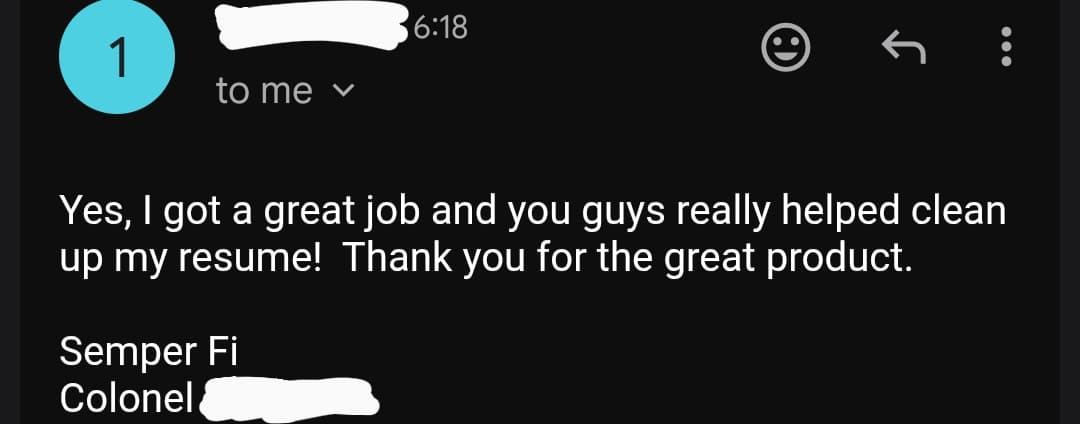
“Hey Brad, Just wanted to send out a quick thank you. You've created something amazing with BMR and your continued advocacy for transitioning service members does not go unnoticed. It was the most effective resource I used in my transition and I know it played a key role in landing a six figure…”
Federal agencies fly small UAS for a growing list of missions: land survey, wildfire mapping, infrastructure inspection, border and coastal patrol, and scientific data collection. A 7316 background lines up with several GS series, and the aviation-category crosswalk below names the strongest matches with grade ranges. The key is that federal hiring rewards the planning and airspace side of your job, not just the stick time.
GS series where a 7316 competes well:
Veterans Preference applies across all of these. Your 5 or 10 points move you up within the category-rating group, and a small-UAS skill set is specialized enough that fewer applicants compete head-to-head with you. For the mechanics of building a USAJobs application that survives the rack-and-stack, read the 2026 OPM federal resume format guide and 10 federal job series every veteran should search. Other aviation-adjacent Marines aim at overlapping series, so the Air Force 1U1X1 RPA Pilot page covers the larger-platform federal angle. When the announcement is in front of you, the federal resume builder keeps the formatting OPM-compliant.
| GS Series | Federal Job Title | Typical Grades | Match | Explore |
|---|---|---|---|---|
| GS-1825 | Aviation Safety | GS-9, GS-11, GS-12 | View Details → | |
| GS-2101 | Transportation Specialist | GS-7, GS-9, GS-11 | View Details → | |
| GS-1370 | Cartography | GS-7, GS-9, GS-11 | View Details → | |
| GS-1373 | Land Surveying | GS-5, GS-7, GS-9 | View Details → | |
| GS-0150 | Geography | GS-7, GS-9, GS-11 | View Details → | |
| GS-2152 | Air Traffic Control | GS-9, GS-11, GS-12 | View Details → |
Federal hiring uses keyword-matching and structured experience. BMR builds federal-format resumes (USAJobs-ready) with the right keywords, hours/week, and supervisor info — for any GS series above.
Free · No credit card · Federal + civilian resume formats included
Not everyone wants to stay in a related field. These career paths leverage your transferable skills — leadership, risk management, logistics, project planning — in completely different industries.
Your habit of reading imagery for fine detail and documenting it cleanly transfers directly to appraising damage from photos and on-site inspections.
You collected and reported field data under demanding conditions. Environmental monitoring is the same disciplined field-collection loop applied to air, water, and soil.
You read terrain and mapped areas of interest from the air. Conservation work uses that same spatial and field-survey skill for land and resource management.
Running a live ISR feed under pressure is close cousin to running live broadcast equipment: both demand flawless real-time operation with no second take.
You executed exacting procedures where a mistake had real consequences. The operating room rewards that same precision and procedural discipline.
Agencies now use small drones to map wildfire spread, and your aerial-recon and live-reporting skills slot directly into that growing role.
As unit sUAS SME you planned missions, managed assets, and directed execution. That coordination experience maps to running operations in a civilian organization.
The skills that made you a good Marine, Sailor, Airman, or Soldier transfer further than you think. BMR rewrites your bullets for any of the pivot careers above — without making you sound like you've never done the work.
Free · No credit card · Try unlimited career angles
If you are staying in the drone world, you do not need this section. A survey firm, a public-safety drone unit, or an inspection company already knows what a Puma is and what an ISR feed means. This section is for the 7316 who wants out of aviation entirely and into a field where nobody has heard of an sUAS, so the resume has to speak their language instead of yours.
The trick is to lead with the underlying skill, not the platform. You ran a sensor-to-decision loop under time pressure, managed risk in a regulated airspace, kept technical equipment running in the field, and briefed the people who acted on your data. Those are the bullets a civilian hiring manager outside aviation actually responds to.
| What you did (7316) | How a hiring manager reads it |
|---|---|
| Operated RQ-20 Puma sUAS for organic unit reconnaissance | Operated technical field equipment to capture and deliver time-sensitive data to decision-makers |
| Planned airspace deconfliction and mission routes | Coordinated complex operations within strict regulatory constraints, balancing safety and mission timelines |
| Employed EO/IR sensors and exploited live imagery | Collected, interpreted, and reported on real-time data to inform downstream action |
| Managed batteries, payloads, and airframe readiness | Maintained mission-critical equipment, troubleshooting failures in austere conditions to keep uptime high |
Here is the same idea applied to a resume bullet aimed at a non-aviation role:
Before (military phrasing): "Served as unit 7316, launched and recovered Puma sUAS and pushed FMV to the COC."
After (operations or logistics role): "Operated and maintained a portable surveillance system across 100+ field missions, delivering real-time data to leadership and sustaining over 95% equipment readiness in harsh conditions."
For more conversions like this, the 50 military terms translated to civilian language glossary and the turn your FITREP into resume bullets guide do the heavy lifting. A purpose-built veteran resume tool applies this translation automatically so you are not staring at a blank page.
BMR turns your 7316 duties and accomplishments into civilian bullets that match the job you're applying for — no manual translation, no rewriting.
Free · No credit card · Tailored to each job posting
Which certifications you need depends on where you're headed. Find your target career path below.
The wrong placement can sink an otherwise strong application. BMR knows where each cert ranks, what to call it, and how to frame it for ATS keyword matching and hiring manager attention.
Free · No credit card · Built around your real certs and clearance
Two tracks below: one for staying in small-UAS and commercial drone work, one for leaving aviation for a different field. Use whichever fits where you are headed.
To compare how every MOS lines up against civilian work, browse the full military-to-civilian career crosswalk. When you are ready, build your resume now with a tool built for veterans.
Most veterans do this backwards — they wait until terminal leave to start, then panic. Here's the actual sequence that works.
Print this. Tape it to your monitor. Veterans who treat the transition like a 90-day op get hired faster than the ones who treat it like an emergency.
Stop rewriting from scratch every time you apply. BMR turns your military experience into civilian and federal resumes — tailored to each job.