Loading...
Loading...
The civilian and federal jobs that hire Navy Aviation Boatswain's Mate (Aircraft Handling)s — with real salaries and the resume that gets callbacks.
Every ABH has more options than a Google search will tell you. Below: career paths, BLS salary data, federal GS series, certifications by target career, and how to translate your experience without losing what made you valuable to the Navy in the first place.
Free · No credit card · Tailored resume in under 5 minutes
After the Navy I got hired into 6 federal career fields and tech sales, and sat on federal hiring panels along the way. I spent the last 2 years rebuilding everything I learned into BMR, tuned for how AI actually screens resumes today. This is the system I wish I'd had on day one.
As an ABH you ran the most dangerous workplace in the Navy: the flight deck. You directed and spotted aircraft on a moving steel deck packed with jet blast, spinning rotors, and arresting gear, choreographing fixed-wing and rotary aircraft through taxi, tow, and tiedown with hand signals because nobody could hear a word over the noise. You drove tow tractors and operated aircraft elevators and ground-handling equipment, secured aircraft with chains and tiedowns rated for pitching seas, and stood crash and salvage duty ready to fight a fuel fire and pull a pilot out of a cockpit in seconds.
Training started at Recruit Training Command Great Lakes, then Class "A" technical school in Pensacola, Florida, where you learned aircraft handling fundamentals, ground-support equipment operation, the Planned Maintenance System (PMS), and aviation firefighting. From there you fed the deck crews of carriers (CVN), amphibious assault ships (LHA/LHD), and air-capable shore commands. You worked the colored-shirt deck cycle as a blue shirt, yellow shirt director, or eventually a flight-deck supervisor calling the movement of millions of dollars of aircraft in a space the size of a few parking lots.
Civilian employers should value this background because it is rare. Almost nobody outside naval aviation has run high-tempo equipment movement in a lethal environment where one missed signal kills people. The discipline of the deck (foul lines, positive control, fueled-aircraft safety, and crash response) is exactly the operational rigor that airports, manufacturing plants, energy sites, and emergency services pay for. If you want to see where these skills land, start with the military career crosswalk tool, and compare your path against the related ABE Launching and Recovery Equipment and broader Aviation Boatswain''s Mate ratings.
It took me 18 months of applications after the Navy before anyone called back, and the experience was never the issue. Nobody reading my resume understood what I had actually done. ABHs carry that problem doubled: "aircraft handler" reads as "no transferable skills" to a civilian recruiter who has never stood on a flight deck. The translation is what costs the callbacks, not the work. Once you describe deck operations as high-tempo equipment movement, safety supervision, and emergency response, the doors start opening. — Brad Tachi, Navy Diver veteran & BMR founder
The number that matters when you're deciding what's next: how does civilian pay compare to what you make now?
Military comp is approximate (varies by location/dependents). Civilian is BLS median. Federal includes locality pay. Your real number depends on duty station, family status, GS step, and overtime.
The most direct civilian matches for ABHs sit in airfield operations, ground handling, and material-movement supervision. These roles use the same instincts you built on the deck: positive control of moving aircraft and equipment, ramp safety, and keeping a high-tempo operation running without an incident.
Airfield Operations Specialists (O*NET 53-2022.00) coordinate aircraft movement, runway and ramp activity, and safety at civilian airports. BLS reports a median annual wage of $56,750 (OEWS May 2024). Aircraft Cargo Handling Supervisors (O*NET 53-1041.00) run loading crews and ground operations at cargo and passenger terminals, with a BLS median of $63,940 (OEWS May 2024). If you supervised a deck crew, First-Line Supervisors of Transportation and Material Moving Workers (O*NET 53-1047.00) is a strong fit at a BLS median of $67,910 (OEWS May 2024), and the senior track, Transportation, Storage, and Distribution Managers (O*NET 11-3071.00), carries a BLS median of $102,010 (OEWS May 2024).
Be honest with yourself about geography and market. Airfield and airline ramp jobs cluster around major hubs and cargo gateways, and the best-paying ground operations roles concentrate where commercial aviation volume is high. Energy and heavy-industry employers hire deck-grade equipment operators away from the coasts, which can mean relocating inland. The crash and firefighting side of your background also opens industrial firefighting and emergency response at airports, refineries, and ports, which we cover in the career-change section below.
Veterans coming from related aviation-ground backgrounds compete for many of the same jobs. If you are comparing notes, the Air Force 2A6X2 Aerospace Ground Equipment and Air Force 2T2X1 Air Transportation paths overlap heavily, and the Marine Corps 7041 Aviation Operations Specialist role shares the airfield-coordination skill set. Translate the deck experience cleanly with our military resume builder, and when you are ready to apply, build your resume now.
| Civilian Job Title | Industry | BLS Median Salary | Outlook | Match |
|---|---|---|---|---|
Airfield Operations Specialist O*NET: 53-2022.00 | Aviation | $56,750 | Average | strong |
Aircraft Cargo Handling Supervisor O*NET: 53-1041.00 | Aviation & Logistics | $63,940 | Average | strong |
First-Line Supervisor of Transportation and Material Moving Workers O*NET: 53-1047.00 | Transportation | $67,910 | Average | strong |
Transportation, Storage, and Distribution Manager O*NET: 11-3071.00 | Logistics | $102,010 | Average | moderate |
Industrial Truck and Tractor Operator O*NET: 53-7051.00 | Material Handling | $46,680 | Average | moderate |
Aircraft Service Attendant / Ramp Agent O*NET: 53-6031.00 | Aviation | $39,780 | Average | moderate |
Mobile Heavy Equipment Mechanic O*NET: 49-3042.00 | Equipment Maintenance | $64,150 | Average | moderate |
BMR rewrites your ABH experience for any of the civilian roles above — keywords, achievements, and language hiring managers actually scan for.
Free · No credit card · 2 tailored resumes included
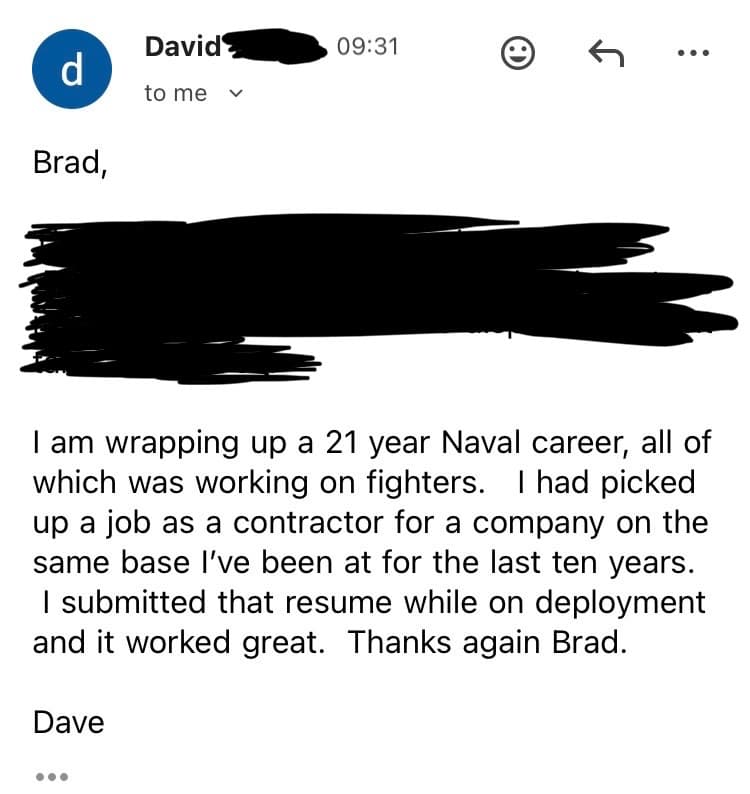
“I am wrapping up a 21 year Naval career, all of which was working on fighters. I had picked up a job as a contractor for a company on the same base I’ve been at for the last ten years. I submitted that resume while on deployment and it worked great. Thanks again Brad. Dave ”
Federal service rewards the exact discipline ABHs lived on the deck: equipment operations, transportation control, safety, and emergency response. Veterans'' Preference gives you a real edge here. A 5-point preference for honorable service or a 10-point preference for a service-connected disability moves you up the certificate, and many of these series hire heavily within the Department of Defense, where the airfield and flight-line vocabulary already makes sense to the hiring official.
The strongest direct matches are GS-2150 Transportation Operations and GS-1670 Equipment Services, which cover the movement and ground-support work you ran every cycle. GS-1601 General Facilities and Equipment fits airfield and hangar operations support. On the safety and emergency side, GS-0081 Fire Protection and Prevention maps directly to your crash and salvage and aviation-firefighting experience, and GS-0019 Safety Technician or GS-0018 Safety and Occupational Health Management reward deck-safety supervision. Equipment maintenance experience lines up with the GS-5803 Heavy Mobile Equipment Mechanic trade series for tow tractors and ground-support gear.
Grade placement depends on time in rate and the scope you supervised. A junior ABH typically qualifies around GS-4 to GS-6 in the operations and equipment series, while a flight-deck supervisor or LCPO-level handler often qualifies at GS-7 through GS-9 and competes for lead and supervisory positions. The federal hiring process runs on a detailed, accomplishment-driven resume that looks nothing like a private-sector one. Our federal resume builder formats your deck experience to USAJOBS standards, and pages like Air Force 2T2X1 Air Transportation and Army 88M Motor Transport Operator share several of these GS targets. When your federal resume is ready, you can start it here.
| GS Series | Federal Job Title | Typical Grades | Match | Explore |
|---|---|---|---|---|
| GS-1670 | Equipment Services | GS-5, GS-6, GS-7 | View Details → | |
| GS-2150 | Transportation Operations | GS-5, GS-7, GS-9 | View Details → | |
| GS-0081 | Fire Protection and Prevention | GS-5, GS-7, GS-9 | View Details → | |
| GS-1601 | General Facilities and Equipment | GS-5, GS-7, GS-9 | View Details → | |
| GS-0019 | Safety Technician | GS-5, GS-6, GS-7 | View Details → | |
| GS-5803 | Heavy Mobile Equipment Mechanic | WG-8, WG-10, GS-7 | View Details → |
Federal hiring uses keyword-matching and structured experience. BMR builds federal-format resumes (USAJobs-ready) with the right keywords, hours/week, and supervisor info — for any GS series above.
Free · No credit card · Federal + civilian resume formats included
Not everyone wants to stay in a related field. These career paths leverage your transferable skills — leadership, risk management, logistics, project planning — in completely different industries.
The crash and salvage instinct, staying precise when a life is on the line, is exactly what respiratory therapy demands at the bedside and in codes.
Running the operating-room floor is the same choreography you ran on the deck: anticipate, stay sterile, keep a fast operation moving without error.
Refineries, ports, and energy plants hire former shipboard firefighters because you already know fuel fires, confined-space rescue, and split-second decisions.
PMS on tow tractors, elevators, and ground-support gear is the same disciplined preventive-maintenance work that keeps a factory floor running.
Running boilers, chillers, and building systems is the same vigilant, never-let-it-fail equipment work the deck demanded, minus the jet blast.
You enforced foul lines, fueled-aircraft zones, and crash readiness every cycle. That hazard-control mindset is the core of civilian workplace safety.
Coordinating a deck full of moving aircraft during an emergency is real incident command. That experience maps to planning and running emergency operations.
The skills that made you a good Marine, Sailor, Airman, or Soldier transfer further than you think. BMR rewrites your bullets for any of the pivot careers above — without making you sound like you've never done the work.
Free · No credit card · Try unlimited career angles
If you are staying in airfield operations, ground handling, or aviation firefighting, your terminology already translates. Ramp managers and airport operations chiefs know what a director does and what positive aircraft control means. This section is for ABHs targeting careers outside aviation, where a hiring manager has never heard a single deck term and will pass on a resume full of them.
The goal is to convert deck language into the operations, safety, and equipment vocabulary that civilian recruiters scan for. A few examples:
For a deeper reference, our 50 military terms translated to civilian language glossary and the guide on turning evaluations into resume bullets both help. The military resume builder applies these translations automatically as you enter your deck experience.
BMR turns your ABH duties and accomplishments into civilian bullets that match the job you're applying for — no manual translation, no rewriting.
Free · No credit card · Tailored to each job posting
Which certifications you need depends on where you're headed. Find your target career path below.
The wrong placement can sink an otherwise strong application. BMR knows where each cert ranks, what to call it, and how to frame it for ATS keyword matching and hiring manager attention.
Free · No credit card · Built around your real certs and clearance
For staying in airfield operations and ground handling: Airline and cargo ramp operations, airport authorities, and fixed-base operators hire directly into ground-handling and airfield-coordination roles. The American Association of Airport Executives (AAAE) runs credentialing and a job board for airport operations careers. Several airlines and ground-handling companies run veteran hiring programs and partner with DoD SkillBridge, so you can start interviewing before you separate. See our SkillBridge guide and the list of top SkillBridge companies hiring in 2026 to line up a placement.
For careers outside aviation: Your crash, salvage, and firefighting background is a real on-ramp to municipal and industrial fire service and emergency medical work, both of which value veterans and often run veteran-preference hiring. The OSHA 30-hour and a Certified Safety Professional (CSP) track open safety roles in manufacturing and energy. For federal work, build a USAJOBS-standard resume and lean on Veterans'' Preference. American Corporate Partners (ACP) offers free one-on-one mentorship with corporate professionals to help map the jump. Manage the whole timeline with the SFL-TAP transition resources.
Build the resume: Start with the military resume builder for private-sector roles or the federal resume builder for GS positions, explore options on the career crosswalk, and when you are ready, build your resume now.
See also: ABE Launching and Recovery Equipment career paths, Air Force 2A6X2 Aerospace Ground Equipment, and Marine Corps 7041 Aviation Operations Specialist. For more reading, the military aviation careers guide covers the broader aviation job market.
Most veterans do this backwards — they wait until terminal leave to start, then panic. Here's the actual sequence that works.
Print this. Tape it to your monitor. Veterans who treat the transition like a 90-day op get hired faster than the ones who treat it like an emergency.
Stop rewriting from scratch every time you apply. BMR turns your military experience into civilian and federal resumes — tailored to each job.