Loading...
Loading...
The civilian and federal jobs that hire Navy Religious Program Specialists — with real salaries and the resume that gets callbacks.
Every RP has more options than a Google search will tell you. Below: career paths, BLS salary data, federal GS series, certifications by target career, and how to translate your experience without losing what made you valuable to the Navy in the first place.
Free · No credit card · Tailored resume in under 5 minutes
After the Navy I got hired into 6 federal career fields and tech sales, and sat on federal hiring panels along the way. I spent the last 2 years rebuilding everything I learned into BMR, tuned for how AI actually screens resumes today. This is the system I wish I'd had on day one.
As a Navy Religious Program Specialist (RP), you ran the administrative and logistical machinery behind the command religious program. You managed chaplain calendars and appointments, safeguarded the absolute confidentiality of privileged communication, maintained ecclesiastical supplies and chapel facilities, coordinated worship services and command ceremonies across every faith group aboard ship or at a shore command, and provided physical security for your chaplain in the field. RPs are also the only rating trained to bear arms to protect non-combatant chaplains, which means you balanced a clerical, people-facing role with a force-protection responsibility most office jobs never touch.
The training pipeline runs through RP "A" School at Naval Technical Training Center, Fort Leonard Wood, Missouri, where you learned religious ministry support, program administration, budgeting and fund management for the Religious Offering Fund, records management, and the security and confidentiality requirements unique to the chaplaincy. From there RPs serve afloat on carriers and amphibious ships, with Marine Corps units, at Navy chapels, in hospitals, and at brigs and chaplain schools. The work spans event coordination, financial accountability, counseling-adjacent intake, and the kind of discretion that comes from handling sensitive personal matters daily.
Civilian employers value this background because it is genuinely cross-functional. You are part program coordinator, part office manager, part community-outreach liaison, and part confidential-records custodian. Few entry-level civilian hires arrive having already managed a budget, scheduled a busy executive, coordinated large events, and kept privileged information airtight under inspection. If you want to see how your rating stacks up against other administrative and support paths, the military-to-civilian career crosswalk lets you compare directly, and the Navy Yeoman (YN) rating shares much of the same administrative DNA. For help putting it on paper, the military terms civilian glossary is a useful starting point.
BMR has built more than 60,000 resumes across every rating and MOS, and RPs are one of the more underestimated transitions we see. The instinct is to write "chaplain assistant" and stop there, but the resumes that land interviews translate the budget you managed, the events you coordinated, and the confidentiality you protected into language a nonprofit or office hiring manager actually scores. The rating is broad. The resume has to show it. — Brad Tachi, Navy Diver veteran & BMR founder
The number that matters when you're deciding what's next: how does civilian pay compare to what you make now?
Military comp is approximate (varies by location/dependents). Civilian is BLS median. Federal includes locality pay. Your real number depends on duty station, family status, GS step, and overtime.
The most direct civilian paths for RPs sit in administration, program coordination, and nonprofit operations, where your scheduling, budgeting, and event-coordination experience maps almost one-to-one. Salary figures below are from the U.S. Bureau of Labor Statistics Occupational Employment and Wage Statistics (BLS OEWS, May 2024).
According to BLS OEWS May 2024, secretaries and administrative assistants (excluding legal, medical, and executive) earn a median around $47,000, while executive administrative assistants reach a median near $73,000. Community and social service roles such as social and human service assistants report a median near $46,000, and the broader category of social and community service managers, a common next step for RPs with strong program experience, reaches a median near $78,000. Nonprofit and faith-based program coordination is a natural fit because you already understand mission-driven organizations, volunteer coordination, and tight budgets.
Be honest with yourself about the market. Administrative roles are plentiful but competitive at the entry level, and pay varies widely by metro and by employer type. Nonprofit and faith-based organizations often pay below corporate scale but value the mission alignment and the confidentiality discipline RPs bring. Larger hospitals, universities, and social-services agencies tend to offer better compensation and benefits for the same coordination skill set. Geography matters: program and office-management openings cluster in metro areas, while community-outreach roles track local nonprofit funding cycles.
RPs who want to lean into the communications side of the rating, the bulletins, ceremonies, and public-facing events you ran, share career ground with the Navy Mass Communication Specialist (MC) path, and the personnel-records side overlaps with the Navy Personnel Specialist (PS) rating. The Army equivalent on the personnel side is the Army 42A Human Resources Specialist. When you are ready to translate this into a civilian-readable document, our military resume builder walks you through it, or you can build your resume now.
| Civilian Job Title | Industry | BLS Median Salary | Outlook | Match |
|---|---|---|---|---|
Administrative / Program Coordinator O*NET: 43-6014.00 | Administration | $47,000 | 1% (Little or no change) | strong |
Nonprofit Program Manager O*NET: 11-9151.00 | Nonprofit / Social Services | $78,000 | 7% (Faster than average) | strong |
Community Outreach Coordinator O*NET: 21-1099.00 | Nonprofit / Social Services | $46,000 | 9% (Faster than average) | strong |
Office Manager O*NET: 11-3012.00 | Administration | $64,000 | 2% (Slower than average) | strong |
Social and Human Services Assistant O*NET: 21-1093.00 | Social Services | $46,000 | 8% (Faster than average) | strong |
Executive Assistant O*NET: 43-6011.00 | Administration | $73,000 | -8% (Decline) | strong |
Social and Community Service Manager O*NET: 11-9151.00 | Nonprofit / Social Services | $78,000 | 7% (Faster than average) | moderate |
BMR rewrites your RP experience for any of the civilian roles above — keywords, achievements, and language hiring managers actually scan for.
Free · No credit card · 2 tailored resumes included
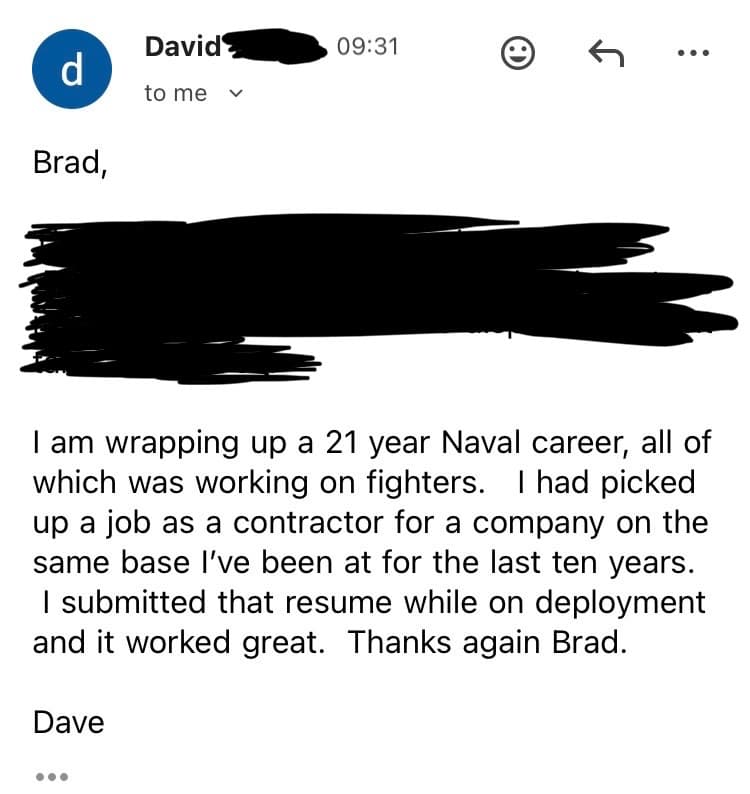
“I am wrapping up a 21 year Naval career, all of which was working on fighters. I had picked up a job as a contractor for a company on the same base I’ve been at for the last ten years. I submitted that resume while on deployment and it worked great. Thanks again Brad. Dave ”
Federal service rewards the exact administrative and program-support competencies RPs build, and Veterans' Preference (5 or 10 points depending on your eligibility) applies to most competitive-service openings. The strongest landing spots are the general administration and clerical series, where your records management, scheduling, and fund-accountability experience qualify you directly.
The GS-0303 Miscellaneous Clerk and Assistant series is a common entry point for RPs at the GS-4 to GS-6 range, building on your office and records work. The GS-0301 Miscellaneous Administration and Program series covers the program-coordination work you did supporting the religious program and typically targets GS-5 to GS-9 depending on education and experience. The GS-0341 Administrative Officer series fits RPs who managed budgets, facilities, and office operations, and usually starts around GS-7 to GS-9 with room to grow. The GS-0101 Social Science series can fit RPs who supported counseling intake and community programs, while the GS-0203 Human Resources Assistance series rewards the personnel-records and in-processing experience many RPs accumulate.
Qualification on USAJOBS comes down to how clearly your resume maps duties to the OPM standard for each series, which is far more detailed than a private-sector resume. Federal resumes need months and hours, specific accomplishments, and the right keywords from the job announcement. Our federal resume builder is built for that format, and the 2026 OPM federal resume format guide explains the requirements. RPs who built personnel-records experience often target the same GS series as the Navy Personnel Specialist (PS), so that page is worth a look. When you are ready, you can start your federal resume.
| GS Series | Federal Job Title | Typical Grades | Match | Explore |
|---|---|---|---|---|
| GS-0341 | Administrative Officer | GS-7, GS-9, GS-11 | View Details → | |
| GS-0101 | Social Science | GS-5, GS-7, GS-9 | View Details → | |
| GS-0203 | Human Resources Assistance | GS-4, GS-5, GS-6 | View Details → | |
| GS-0301 | Miscellaneous Administration and Program | GS-5, GS-7, GS-9 | View Details → | |
| GS-0303 | Miscellaneous Clerk and Assistant | GS-4, GS-5, GS-6 | View Details → | |
| GS-0305 | Mail and File | GS-3, GS-4, GS-5 | View Details → |
Federal hiring uses keyword-matching and structured experience. BMR builds federal-format resumes (USAJobs-ready) with the right keywords, hours/week, and supervisor info — for any GS series above.
Free · No credit card · Federal + civilian resume formats included
Not everyone wants to stay in a related field. These career paths leverage your transferable skills — leadership, risk management, logistics, project planning — in completely different industries.
RPs already managed funds, ran offering campaigns, and built trust across a community, which is the core of nonprofit fundraising.
RPs spent years supporting people through personal crises with discretion, which is the foundation of behavioral-health counseling.
Coordinating recurring services, memorials, and command ceremonies is event production under a different name.
RPs routinely trained lay leaders and facilitated group programs, which maps to corporate learning and development.
The personnel-records and confidential people-support side of the rating transfers cleanly into corporate HR.
RPs supported memorials and grieving families with the exact composure and coordination funeral service demands.
RP community-outreach and resource-referral work translates into public and community health education.
The skills that made you a good Marine, Sailor, Airman, or Soldier transfer further than you think. BMR rewrites your bullets for any of the pivot careers above — without making you sound like you've never done the work.
Free · No credit card · Try unlimited career angles
If you are staying in religious-ministry support or chaplaincy administration, your terminology already translates and the hiring side speaks your language. This section is for RPs targeting careers OUTSIDE the chaplaincy, where civilian hiring managers have never heard of an "RP" and need the work described in business terms.
The core move is to convert ministry-specific labels into standard office, program, and operations language. "Religious Offering Fund" becomes "departmental budget and fund accountability." "Command religious program" becomes "organization-wide program coordination." "Privileged communication" becomes "confidential and sensitive records management." Here is how a few RP duties read before and after translation for a non-chaplaincy resume:
The before-and-after pattern is the whole game for non-field roles. The 50 military terms translated to civilian language glossary covers more of these swaps, and how to explain military experience in a civilian interview helps you say it out loud. Our military resume builder handles a lot of this translation automatically.
BMR turns your RP duties and accomplishments into civilian bullets that match the job you're applying for — no manual translation, no rewriting.
Free · No credit card · Tailored to each job posting
Which certifications you need depends on where you're headed. Find your target career path below.
The wrong placement can sink an otherwise strong application. BMR knows where each cert ranks, what to call it, and how to frame it for ATS keyword matching and hiring manager attention.
Free · No credit card · Built around your real certs and clearance
For staying in ministry support and administration: Look at SkillBridge internships with nonprofits, hospital chaplaincy offices, and faith-based organizations during your final months of service. Professional associations worth knowing include the National Association of Veterans' Program Administrators and broader nonprofit-management networks. If you want to formalize the program-coordination side, an entry-level project or administrative certification (covered in the certifications section) signals seriousness to civilian hiring managers.
For careers outside the chaplaincy: American Corporate Partners (ACP) offers free veteran mentorship that is excellent for figuring out a non-field pivot. For federal paths, USAJOBS plus a properly formatted federal resume is the route, and Veterans' Preference is a real advantage. Lean on your security and confidentiality background as a differentiator. If you held a clearance, keep it current and say so.
BMR resources to use now: our military resume builder and federal resume builder for the document itself, the career crosswalk for exploring options, and the SFL-TAP transition resources for the broader timeline. When you are ready to commit, get started here.
See also related administrative and support paths: Navy Yeoman (YN), Marine Corps 0111 Administrative Specialist, and the Army 42A Human Resources Specialist. Helpful reading: informational interviews for veterans and the military-to-civilian cover letter template.
Most veterans do this backwards — they wait until terminal leave to start, then panic. Here's the actual sequence that works.
Print this. Tape it to your monitor. Veterans who treat the transition like a 90-day op get hired faster than the ones who treat it like an emergency.
Stop rewriting from scratch every time you apply. BMR turns your military experience into civilian and federal resumes — tailored to each job.