Home / Military resume examples / Logistician
Logistician resume example (military to civilian)
This is a logistician resume for someone leaving the military with about ten years in supply. Ryan is a fictional Army 92A, a Staff Sergeant who ran a supply warehouse, and every line on his page came from real 92A work. If you did supply, stock control, or warehouse work in any branch, this is the shape your resume can take. Under it you get the lines that changed, the words the job posts use, and a free score on your own resume.
The example
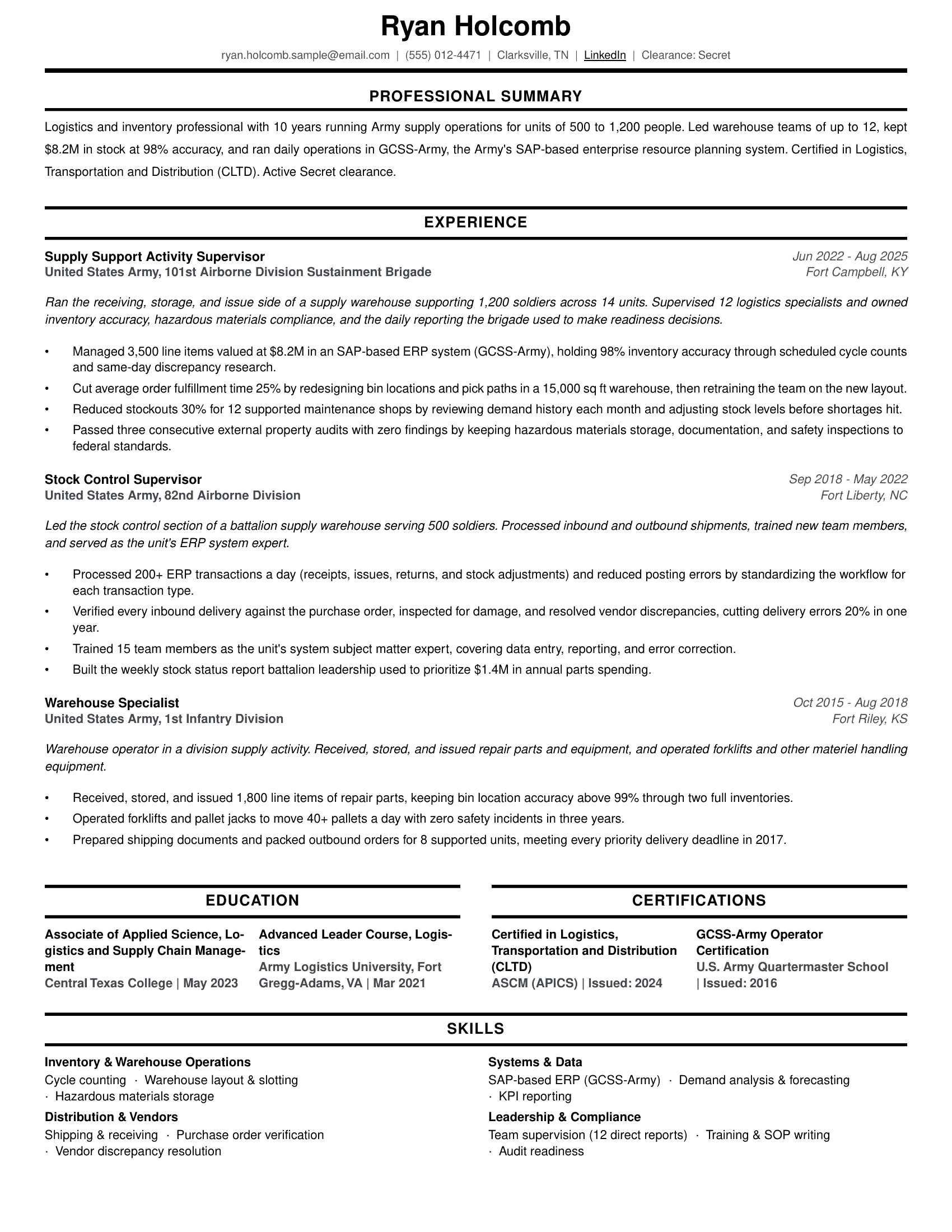
Fictional sample. The person, the units, and the numbers are illustrative. Rendered by BMR's Classic template, the same one a user's resume prints on.
Logistics and inventory professional with 10 years running Army supply operations for units of 500 to 1,200 people. Led warehouse teams of up to 12, kept $8.2M in stock at 98% accuracy, and ran daily operations in GCSS-Army, the Army's SAP-based enterprise resource planning system. Certified in Logistics, Transportation and Distribution (CLTD). Active Secret clearance.
Ran the receiving, storage, and issue side of a supply warehouse supporting 1,200 soldiers across 14 units. Supervised 12 logistics specialists and owned inventory accuracy, hazardous materials compliance, and the daily reporting the brigade used to make readiness decisions.
Managed 3,500 line items valued at $8.2M in an SAP-based ERP system (GCSS-Army), holding 98% inventory accuracy through scheduled cycle counts and same-day discrepancy research.
Cut average order fulfillment time 25% by redesigning bin locations and pick paths in a 15,000 sq ft warehouse, then retraining the team on the new layout.
Reduced stockouts 30% for 12 supported maintenance shops by reviewing demand history each month and adjusting stock levels before shortages hit.
Passed three consecutive external property audits with zero findings by keeping hazardous materials storage, documentation, and safety inspections to federal standards.
Led the stock control section of a battalion supply warehouse serving 500 soldiers. Processed inbound and outbound shipments, trained new team members, and served as the unit's ERP system expert.
Processed 200+ ERP transactions a day (receipts, issues, returns, and stock adjustments) and reduced posting errors by standardizing the workflow for each transaction type.
Verified every inbound delivery against the purchase order, inspected for damage, and resolved vendor discrepancies, cutting delivery errors 20% in one year.
Trained 15 team members as the unit's system subject matter expert, covering data entry, reporting, and error correction.
Built the weekly stock status report battalion leadership used to prioritize $1.4M in annual parts spending.
Warehouse operator in a division supply activity. Received, stored, and issued repair parts and equipment, and operated forklifts and other materiel handling equipment.
Received, stored, and issued 1,800 line items of repair parts, keeping bin location accuracy above 99% through two full inventories.
Operated forklifts and pallet jacks to move 40+ pallets a day with zero safety incidents in three years.
Prepared shipping documents and packed outbound orders for 8 supported units, meeting every priority delivery deadline in 2017.
Associate of Applied Science, Logistics and Supply Chain ManagementCentral Texas College | May 2023
Advanced Leader Course, LogisticsArmy Logistics University, Fort Gregg-Adams, VA | Mar 2021
Certified in Logistics, Transportation and Distribution (CLTD)ASCM (APICS) | Issued: 2024
GCSS-Army Operator CertificationU.S. Army Quartermaster School | Issued: 2016
Inventory & Warehouse OperationsCycle counting · Warehouse layout & slotting · Hazardous materials storage
Systems & DataSAP-based ERP (GCSS-Army) · Demand analysis & forecasting · KPI reporting
Distribution & VendorsShipping & receiving · Purchase order verification · Vendor discrepancy resolution
Leadership & ComplianceTeam supervision (12 direct reports) · Training & SOP writing · Audit readiness
Open the PDF (1 page, as the engine prints it).
Already have a resume? Get it graded straight.
Upload it and get a number in about a minute, plus the logistician lines a civilian hiring manager will not follow. No account. Sign up and tailor it like they did.
Free. We keep it 30 days so you never upload it twice.
Why this example works
- The summary says the civilian job in the first five words.
"Logistics and inventory professional." A recruiter filling a logistician seat knows in one second that this page is for them. Rank and MOS come later, where they belong.
- GCSS-Army gets explained every time it shows up.
"GCSS-Army, the Army's SAP-based enterprise resource planning system." Most civilian hiring managers have never heard of GCSS-Army. Almost all of them know SAP. Same fact, and now it counts.
- Every bullet has a number a manager can picture.
3,500 line items. $8.2M. 98% accuracy. 25% faster. 12 direct reports. Nobody has to guess how big the job was.
- The first bullet of each job is the one the post cares about most.
Inventory accuracy under the top job, transaction volume under the second, receiving under the third. Read only the first bullet of each block and you still get the story.
- The jargon is gone, and nothing was lost.
SSA reads as "supply warehouse." PLL stockage review reads as "reviewing demand history and adjusting stock levels." A CSDP inspection reads as "external property audit." Same work. Now a civilian can follow it.
- Compliance is shown as a result, not a duty.
"Passed three external property audits with zero findings" tells the reader what happened. "Responsible for CSDP compliance" tells them nothing.
- The skills block is grouped, not a pile.
Four short headings, three skills each. A recruiter can scan it in a few seconds, and a keyword scan finds "ERP," "cycle counting," and "demand forecasting" without hunting.
- One page, on purpose.
Ten years, three jobs, twelve skills, two certs, two schools, and it still fits. A civilian resume for a mid-career NCO usually does not need page two.
The translation, line by line
| How most 92As write it | What a logistician hiring manager reads |
|---|---|
| SSA NCOIC, 101st DSB | Supply Support Activity Supervisor, led a 12-person warehouse team |
| Managed SSA stockroom, 3,500+ lines, $8.2M | Managed 3,500 line items valued at $8.2M in an SAP-based ERP system |
| GCSS-Army Super User | ERP system subject matter expert; trained 15 users |
| Conducted cyclic inventories IAW AR 710-2 | Held 98% inventory accuracy through scheduled cycle counts |
| Adjusted PLL stockage levels for 12 shops | Reduced stockouts 30% by reviewing demand history monthly |
| Processed receipts, issues, turn-ins, adjustments | Processed 200+ ERP transactions a day |
| Verified shipments against DA Form 3161 / BOL | Verified deliveries against purchase orders, resolved vendor discrepancies |
| Hazmat storage IAW AR 710-2 and local SOP | Hazardous materials storage to federal standards |
| Passed CSDP inspection, zero findings | Passed external property audits with zero findings |
| MHE operator (forklift, pallet jack) | Operated forklifts and pallet jacks, zero safety incidents |
| 92A ALC | Advanced Leader Course, Logistics (Army Logistics University) |
The words the job posts use
The words logistician job posts use, and what the numbers look like right now.
Titles you will see
- Logistician
- Supply Management Specialist
- Production Planner
- Supply Chain Analyst
Work the posts describe
- Direct availability and allocation of materials, supplies, and finished products
- Review logistics performance against targets, benchmarks, and service agreements
- Redesign the movement of goods to maximize value and minimize costs
- Manage subcontractor and vendor activities
- Present solutions in written proposals and oral presentations
Systems
- ERP software (SAP, Oracle, Microsoft Dynamics)
- Microsoft Excel
- SQL or database software
- Microsoft Project
BLS Occupational Outlook Handbook, May 2025 data: median pay $82,320 a year; employment projected to grow 18% from 2025 to 2035, much faster than average. "Logisticians typically need a bachelor's degree, although less education may be sufficient for some jobs," and "in some cases, work experience may substitute for education."
Sources: O*NET 13-1081.00 Logisticians (tasks, reported titles, technology skills) and the BLS Occupational Outlook Handbook, Logisticians. Both read 2026-09-08.
Backgrounds that lead here
Logistician sits on 52 of BMR's military job guides. These are the closest matches; each guide shows the civilian titles, pay, and federal paths for that code.
- Army 92A Automated Logistical SpecialistThis example
- Navy LS Logistics Specialist
- Air Force 2S0X1 Materiel Management
- Air Force 2G0X1 Logistics Plans
- Marine Corps 3043 Supply Administration
- Marine Corps 0431 Logistics Embarkation Specialist
- Coast Guard SK Storekeeper
- Army 68J Medical Logistics Specialist
- Army 89A Ammunition Stock Control and Accounting Specialist
Keep going
- GS-0346 Logistics ManagementThe federal path for the same background
- GS-2001 General SupplyThe closest federal match to daily 92A work
- Military logistics to supply chain: 92A, 92Y and 88MThe resume guide
- Military resume examples: 25 before and after transformations
- Military resume samples by branch
Frequently asked questions
Do I need a bachelor's degree to get hired as a logistician?
Not always. BLS says most logistician jobs ask for a bachelor's degree. In the same breath it says less school can be enough for some jobs, and that work experience can stand in for it. Ten years running a supply warehouse is a lot of experience. An associate degree plus the CLTD, like Ryan's page shows, is a common path for NCOs. Apply first to the posts that say "or equivalent experience."
Should I put GCSS-Army on my resume, or just say SAP?
Both, in one phrase: "GCSS-Army, the Army's SAP-based enterprise resource planning system." The acronym proves you did the work. The plain-English part tells a civilian what it means. A keyword scan finds "SAP" and "ERP," and the hiring manager does not have to look anything up.
How long should a military-to-civilian resume be?
For about ten years of service, one page usually does it. That is what this example is. If you have 20 years and several very different jobs, two pages can be fine. Length matters less than this: the top third of page one says the civilian job you want and proves it with numbers.
Build your logistician resume the same way
BMR writes your supply experience the way this page reads, tailored to the job you pick. Free to start, 2 tailored resumes included.