CISSP for Veterans: Does Your Service Count, and Who Pays?
Michael got only rejections. Then a $100K facilities manager role.
Michael, E-7, Navy, tried a ton of outside help before BMR
ISC2's experience page for the Certified Information Systems Security Professional (CISSP) says candidates need "a minimum of five years cumulative, full-time experience in two or more of the eight domains." A qualifying degree or an approved credential can cover one year, and ISC2's exam outline adds, "Only one year of experience can be waived."
ISC2's CISSP pages do not mention military service. BMR's reading of the rule: the work you did in those domains is what counts.
Your worksheet is below. Map each billet to a domain, then count its months. Next comes your call on the Associate route. Last is the bill: the fees and which benefit may pay.
Does my military work count toward the five years?
ISC2 says your hours must "fall within two or more of the eight domains." The table below shows each domain and its exam weight. The weights come from the current outline, effective April 15, 2024.
BMR wrote the middle column. ISC2 names no military jobs, so these are sample duties only. Match what you did, whatever your rating or MOS was called.
| Domain (exam weight) | Military duties that are work in this domain | Your months |
|---|---|---|
| 1. Security and Risk Management (16%) | Kept the authority to operate (ATO) package current as an information system security officer (ISSO). Ran the unit's security awareness training. | [ ] |
| 2. Asset Security (10%) | Served as communications security (COMSEC) custodian. Tracked, marked and handled classified data and gear. | [ ] |
| 3. Security Architecture and Engineering (13%) | Built and hardened system images before they joined the network. Set up encryption on systems. | [ ] |
| 4. Communication and Network Security (13%) | Defended a unit or base network. Set up secure links, including satellite links in the field. | [ ] |
| 5. Identity and Access Management, or IAM (13%) | Created and removed user accounts. Set who could reach which systems and checked it. | [ ] |
| 6. Security Assessment and Testing (12%) | Ran vulnerability scans. Prepared for and passed cyber inspections or audits. | [ ] |
| 7. Security Operations (13%) | Watched logs on a watch floor. Ran incident response when something got through. | [ ] |
| 8. Software Development Security (10%) | Reviewed scripts or code for security flaws before release. | [ ] |
Fill the last column one billet at a time. BMR's reading: months in two or more rows meet the "two or more" part. A month counts once toward the five years, even if it touched three domains.
Why the SSCP page says something the CISSP pages don't
ISC2 does speak to military work for one cert. Its SSCP page for the Department of Defense (DoD) says "your military/DoD cybersecurity work qualifies." SSCP is Systems Security Certified Practitioner, a different cert with a one-year rule. That line is not on ISC2's CISSP pages. Don't quote it as a CISSP ruling.
How do I count my months?
ISC2 counts in months, and its experience page sets the math. Here is each rule as ISC2 words it:
- Full-time: "a minimum of 35 hours/week for four weeks in order to accrue one month."
- Part-time: "cannot be less than 20 hours a week and no more than 34 hours a week."
- Part-time totals: "1040 hours of part-time = 6 months" and "2080 hours of part-time = 12 months."
- Internships: "Paid or unpaid internship is acceptable." You need a letter on company or organization letterhead. A school internship can use the registrar's stationery.
Five years is 60 months. With a waiver, you need 48 months of work. ISC2 accepts a bachelor's or master's degree in computer science, IT or a related field. Its list of approved credentials also works. That list includes Security+, CySA+ and SecurityX. You get one year either way, never two.
A made-up example
Say you spent 30 months as an ISSO, full-time. Then 24 months on a network defense team. That's 54 months. Add Security+ for the one-year waiver, and you clear 48 months.
BMR's reading for Guard and Reserve: add up your hours. A month of drill weekends falls under ISC2's 20-hour weekly floor. Count full-time orders of four weeks or more, and civilian security jobs, instead.
Should I pass the exam now and become an Associate?
You can take the exam before you have the years. ISC2's page says a candidate short on experience "may become an Associate of ISC2 by successfully passing the CISSP examination." Then you "have six years to earn the five years required experience."
The Associate page sets the costs:
- You pay a first annual maintenance fee (AMF) of "U.S. $50."
- To stay an Associate, you pay "your AMF (U.S. $50)" and earn "15 CPE credits annually."
- Once you have the years, you submit the endorsement application.
- After approval, you "pay the upgrade AMF of U.S. $85" to start a three-year cycle.
CPE means continuing professional education. Your endorsement must be completed "prior to the last day of the last year" you can hold the Associate title.
When the Associate route makes sense
BMR's advice, not ISC2's:
- You're one to three years short, and you're ready to test now.
- You're still in a security billet, so the months keep adding up.
- You want a passed exam on your resume while you finish the years.
Wait if you can't study yet. The Associate route opens only once you pass the exam.
Who endorses me after the exam, and what proof should I keep?
The clock starts on exam day. ISC2's endorsement page says you must finish the application "within nine months of their exam date."
You need an endorser. That's "another ISC2 certified professional in good standing" who can vouch for your experience. You'll need their member ID and last name.
No CISSP in your circle? ISC2 says "you can opt for ISC2 to endorse you." It adds, "proof of employment is required when using ISC2 as your endorser."
ISC2 also audits. Some applicants are "randomly subjected for audit" and must send more information.
What to keep from your service
BMR's advice: build your proof file before you leave. ISC2 does not name any of these items. They're what shows the work if anyone asks:
- Your evaluations, with the bullets that name security work.
- Orders and appointment letters, such as an ISSO or COMSEC custodian letter.
- Position descriptions that list your security duties.
- Dates for each billet, so your months add up.
Your evaluations feed your resume too. See our guide to turning evals into bullets.
What will the exam and yearly fees run, and what can I get covered?
Start with the exam fee, then the yearly fee. Then check which benefit covers what.
| Fee | Amount | Source |
|---|---|---|
| CISSP exam, standard registration, Americas | $749 | ISC2 exam pricing |
| Rescheduling the exam | $50 | ISC2 exam pricing |
| Yearly fee once certified | $135 | ISC2 AMF page |
| Yearly fee as an Associate | $50 | ISC2 Associate page |
| Associate upgrade fee | $85 | ISC2 Associate page |
Prices are from ISC2's exam pricing page and fee page, checked November 2026. ISC2 says you must sit the exam within 365 days of purchase.
The GI Bill may cover the exam fee
The Department of Veterans Affairs (VA) test fees page pays "no more than $2,000 per test." It's for "a job that requires a license or certification." You file VA Form 22-0803 with your receipt and your results.
VA pays even if "You didn't score high enough." It also pays if "You need to take the same test more than once." Each payback uses up some of your GI Bill.
Search VA's approved-test list for CISSP before you pay. This page did not run that search. VA's rule is that it covers "only tests approved for the GI Bill." A missing test "may be a valid test that's just not yet approved," VA says, and it encourages you to apply.
Army Credentialing Assistance covers soldiers still in
If you're still serving in the Army, you can apply for Credentialing Assistance (CA). Its rules are on the Army benefits page. The yearly cap "decreased from $4,000 to $2,000." You get one credential a year, and three at most in 10 years. You must take the exam or pay back the training cost.
Hold a commission? Check the date on your goal. Since March 19, 2026, "Commissioned Officers (O1-10) are ineligible for CA." A goal sent in before that date can still be finished. Warrant officers are not named in that rule.
This page did not look for CISSP on Army Credentialing Opportunities On-Line (COOL) either. Search for it there. In another branch, check your own service's program. Our COOL guide covers each branch. For more GI Bill cert rules, see our GI Bill certification guide.
What is the exam like, and what changes on April 15, 2027?
ISC2's outline sets the format:
- Computerized Adaptive Testing (CAT) "for all exams."
- 100 to 150 items, multiple choice and advanced types.
- 3 hours.
- Passing grade: 700 out of 1000 points.
ISC2's CISSP page also posts a notice. "Effective April 15, 2027, the CISSP exam will be based on a new exam outline." Test before that date, and you test on the current outline. Test on or after it, and you test on the new one.
The weights in the table above are from the current outline. Testing on or after April 15, 2027? Check ISC2's outline page for the new domains before you fill your worksheet.
Is the security field worth the five years?
The Bureau of Labor Statistics (BLS) tracks the job, not the cert. Its page on information security analysts gives a median of $129,180 in May 2025. BLS projects 21% growth from 2025 to 2035.
Federal work is a second reason. A July 2024 ISC2 article says CISSP covers "44% of the approved work roles" in the DoD 8140 marketplace. That's ISC2's figure, not the Department of Defense's. Our DoD 8140 guide explains those roles.
Rules checked November 2026 on ISC2's experience, outline, Associate, endorsement and fee pages. Funding rules came from VA's and the Army's pages. Job data came from BLS.
What to Do Next
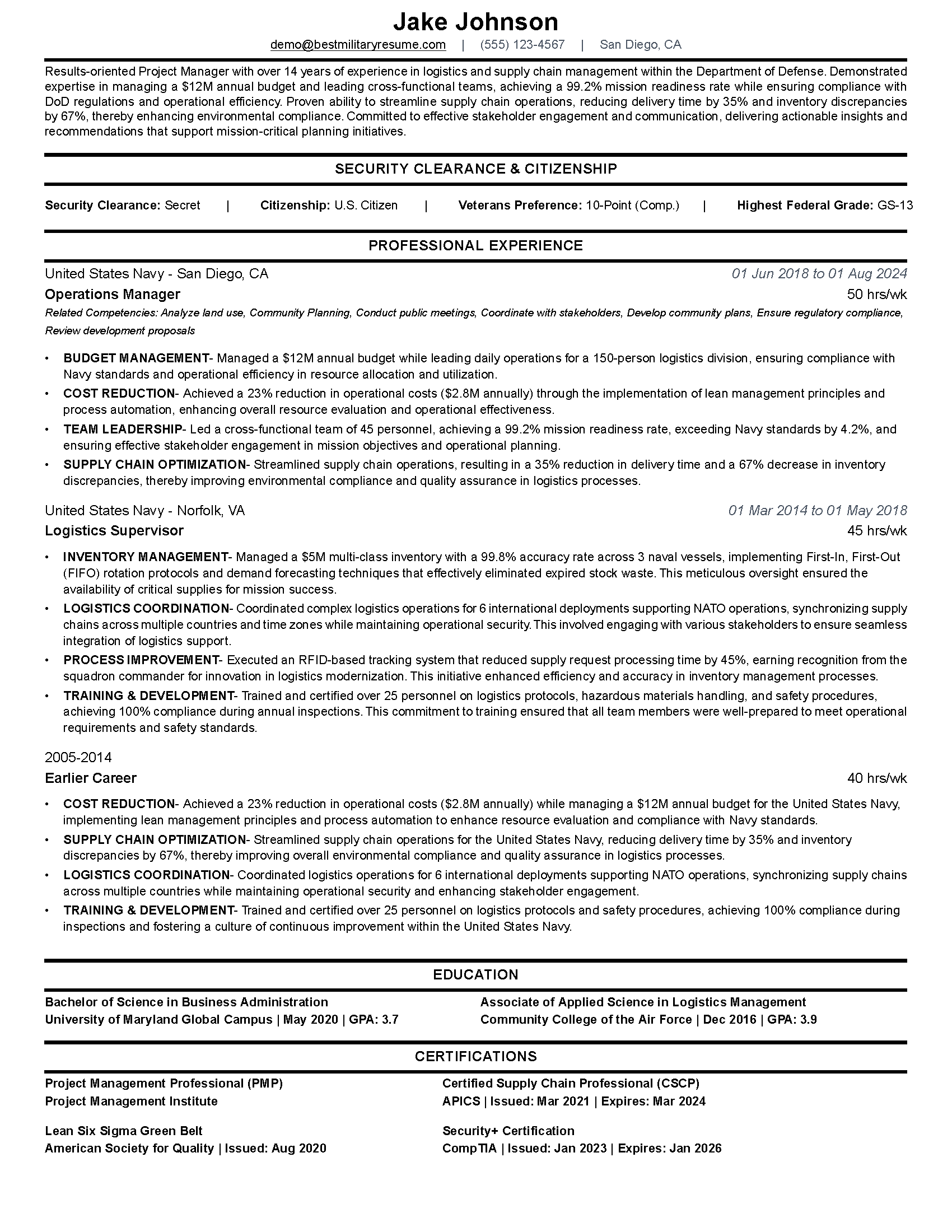
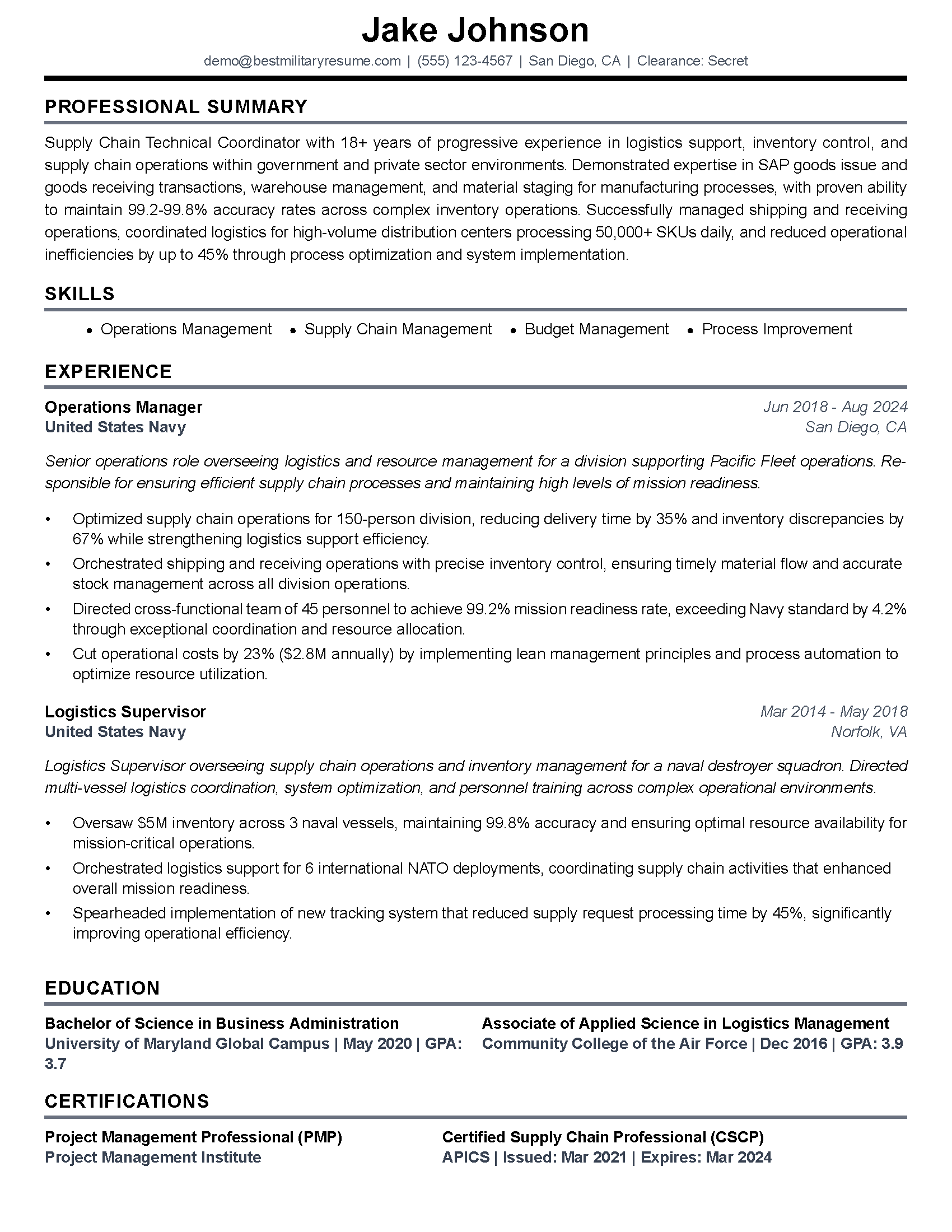
Turn each worksheet billet into one bullet that names the domain and its months. Then open BMR's Resume Builder with one security job in hand. The builder rewords your bullets to fit that job. It does not add work you never did. Christopher, an Air Force Master Sergeant (E-7), held a cyber master's unrelated to his Air Force jobs.
"I just wanted to say how great BMR was for me as a tool to refine and translate years of experience in conjunction with my MS Cybersecurity, which had nothing to do with both of my AFSCs. I cleared all the hurdles and was offered a position, which I accepted."
Frequently Asked Questions
Can I send my CISSP application before my exam results arrive?
Can I upgrade from Associate of ISC2 before the six years are up?
Does the Associate of ISC2 badge show I passed the CISSP exam?
Do I pay a second yearly fee if I already hold an ISC2 cert?
About the author
Brad Tachi is the CEO and founder of Best Military Resume and a 2025 Military Friendly Vetrepreneur of the Year award recipient for overseas excellence. A former U.S. Navy Diver with over 20 years of combined military, private sector, and federal government experience, Brad brings unparalleled expertise to help veterans and military service members successfully transition to rewarding civilian careers. Having personally navigated the military-to-civilian transition, Brad deeply understands the challenges veterans face and specializes in translating military experience into compelling resumes that capture the attention of civilian employers. Through Best Military Resume, Brad has helped thousands of service members land their dream jobs by providing expert resume writing, career coaching, and job search strategies tailored specifically for the veteran community.