Military Police to Law Enforcement: Resume & Career Guide
Michael got only rejections. Then a $100K facilities manager role.
Michael, E-7, Navy, tried a ton of outside help before BMR
Military Police veterans have one of the most direct career transitions in the entire military-to-civilian pipeline. Your training, certifications, and daily experience as an MP align closely with what civilian law enforcement agencies need. But "closely" doesn't mean "automatically." Agencies still want to see your qualifications presented in their language, and the hiring process for civilian law enforcement has its own requirements that military experience alone doesn't cover.
Here's how to translate your MP experience into a law enforcement career — whether you're targeting local police departments, federal agencies, state patrol, or specialized units.
Why Military Police Have a Major Advantage
MP veterans aren't starting from scratch. You've already done the job — the civilian version is just a different jurisdiction with different rules of engagement. Here's what makes your transition smoother than most.
MP Skills That Transfer Directly
- Patrol operations and traffic enforcement — you've done this daily
- Crime scene processing and evidence handling — chain of custody training
- Report writing — military police reports mirror civilian incident reports
- Use of force continuum — you understand escalation and de-escalation
- Investigations and interviews — especially if you worked CID or as a desk sergeant
- Physical security and access control — installation security operations
- Emergency response and crisis management — active shooter, natural disaster, force protection
- Firearms proficiency and qualification — documented and current
Many states also offer expedited certification or reciprocity for military police veterans. Some allow you to skip portions of the police academy or complete an abbreviated program, recognizing that your military training already covered much of the curriculum. Check your target state's Peace Officer Standards and Training (POST) board for specific policies.
Civilian Law Enforcement Career Paths for MPs
Local and Municipal Police
Best for: MPs who want patrol work, community engagement, and the potential for detective/investigative assignments. Local departments offer the widest variety of positions and the most geographic flexibility.
Salary range: $45,000-$85,000 depending on department size and location. Major metro departments (NYPD, LAPD, Chicago PD) pay significantly more, especially with overtime.
Veteran advantage: Many departments give preference points to veterans in hiring. Some departments, especially those struggling with recruitment, actively seek MP veterans because they require less training investment.
State Police / Highway Patrol
Best for: MPs who prefer working independently with less administrative overhead. State troopers cover highways and rural areas, conduct traffic enforcement, and handle major accident investigations.
Salary range: $50,000-$95,000 with strong benefits packages and retirement systems.
Federal Law Enforcement
Best for: MPs who want the highest pay, best benefits, and mission-oriented work similar to military service. Federal agencies offer the closest cultural fit to what you experienced in the military.
Federal Agencies Hiring MP Veterans
Criminal Investigation
- FBI Special Agent
- DEA Special Agent
- ATF Special Agent
- U.S. Marshals Service
- Secret Service
- HSI (Homeland Security Investigations)
Uniformed / Protective
- CBP Officers / Border Patrol
- Federal Protective Service
- VA Police
- U.S. Park Police
- Pentagon Force Protection
- Bureau of Prisons
Federal law enforcement positions are found on USAJOBS under the GS-1811 (Criminal Investigator) and GS-0083 (Police) series. Your veterans' preference applies to all of these, and many have maximum age limits (typically 37) — so don't wait too long to apply.
Specialized and Private Sector
Corporate security management — Major corporations hire former law enforcement and military police for security director and security manager positions. Companies like Amazon, Meta, Google, and major financial institutions have security teams that value MP experience. Salary range: $80,000-$150,000+.
Private investigation — MPs with CID or investigative experience can start their own PI firms or work for established agencies. Many states fast-track PI licensing for former military police.
Security consulting — Defense contractors and security firms hire MP veterans to advise on physical security, force protection, and vulnerability assessments. Companies like G4S, Allied Universal, and Securitas offer management-track positions for qualified veterans.

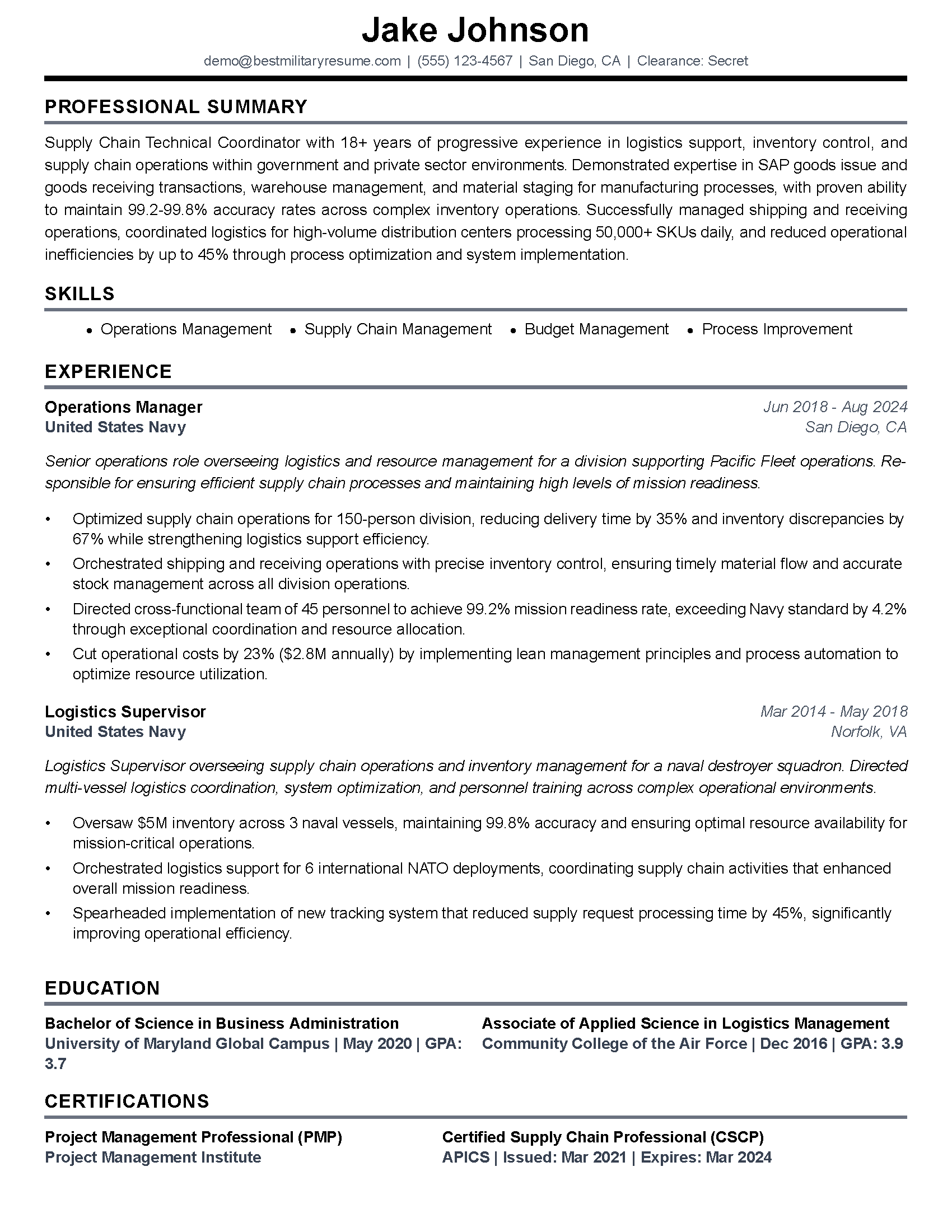
Building Your Law Enforcement Resume
Your MP resume needs to speak the language of civilian law enforcement — not the military version. Hiring managers at police departments and federal agencies know what MPs do, but your resume still needs to demonstrate specific competencies using terminology their HR departments recognize.
Resume Translation: Military Police to Civilian
- Conducted PMO operations
- Executed TCP and FP missions
- Processed DD Form 1408s
- Managed ACP operations
- MPI desk duties
✓ Civilian Translation
- Conducted patrol operations and community policing
- Managed traffic control and force protection
- Processed incident and traffic violation reports
- Supervised access control for secured facilities
- Managed dispatch and patrol coordination
Quantify everything. Law enforcement agencies want to see scale and results: "Patrolled a jurisdiction covering 15 square miles and 12,000 personnel." "Responded to an average of 8 calls for service per shift." "Conducted 200+ traffic stops with zero excessive force complaints." "Processed 45 crime scenes with 100% evidence chain-of-custody compliance."
The BMR Resume Builder translates military police terminology into civilian law enforcement language automatically, and you can tailor your resume for specific agencies and positions.
The Law Enforcement Hiring Process: What MPs Need to Know
Civilian law enforcement hiring is longer and more intensive than most civilian jobs. Here's what to expect.
Written Exam
Most departments require a written entrance exam covering reading comprehension, writing, basic math, and situational judgment. MP veterans typically score well because military training emphasizes report writing and decision-making under pressure. Study guides are available for most department-specific exams.
Physical Agility Test
Similar to military fitness tests — running, push-ups, sit-ups, and sometimes obstacle courses or scenario-based physical tasks. If you maintained your military fitness, you're already prepared. Check the specific department's standards since they vary.
Background Investigation
Thorough investigation covering your employment history, financial records, criminal history, social media, and personal references. Your military record will be reviewed. An honorable discharge and clean military record are major assets here. Be completely honest — dishonesty during the background investigation is the number one reason qualified candidates get disqualified.
Polygraph Examination
Many departments and all federal agencies require a polygraph. Answer truthfully. The polygraph is looking for deception, not perfection — everyone has something in their past. Attempting to hide information is what gets you eliminated.
Psychological Evaluation and Medical Exam
Standard evaluations to ensure fitness for duty. If you have documented PTSD or other service-connected conditions, be aware that these don't automatically disqualify you — each department evaluates on a case-by-case basis. Being under treatment and managing a condition demonstrates responsibility, not weakness.
Academy or Abbreviated Training
Even with military police experience, most departments require some form of academy training. Some states offer abbreviated academies for military police (12 weeks instead of 24, for example). Contact your target state's POST board to find out what credits your military training earns.
Start the application process 6-12 months before you need to be employed. Civilian law enforcement hiring from application to first day on the job can take 6-18 months depending on the agency. Apply to multiple departments simultaneously — there's no rule against it, and most departments expect it.
Certifications and Training to Get Before Applying
While your military training covers most fundamentals, a few additional certifications strengthen your application.
- State POST certification — If your state offers reciprocity for military police training, start this process immediately. Some states require you to complete an equivalency exam.
- CPR/First Aid/AED — Maintain current civilian certifications (American Heart Association or American Red Cross). Military certifications may need to be converted.
- Criminal justice degree — Not required by most departments but gives you an edge in competitive hiring pools and is often required for promotion. Your GI Bill covers this.
- Specialized training — Crisis intervention, de-escalation, community policing courses. Many departments prioritize candidates with this training, and it's widely available for free or low cost.
For federal law enforcement positions, you'll need a properly formatted federal resume and to apply through USAJOBS. The BMR Federal Resume Builder creates USAJOBS-ready resumes that include all required federal formatting elements — hours per week, supervisor information, salary history, and detailed duty descriptions that match OPM qualification standards.
Mistakes MP Veterans Make When Transitioning to Civilian Law Enforcement
Even with directly transferable experience, MP veterans make common errors that slow their transition or cost them job offers.
Assuming military experience speaks for itself. Civilian hiring boards include people who have never interacted with the military. Don't assume they know what an MP does. Your resume and interview answers need to explain your experience as if the reader has zero military knowledge. Spell out acronyms, describe your responsibilities in detail, and connect every bullet point to what the department needs.
Only applying to one department. The law enforcement hiring process is long and unpredictable. Departments freeze hiring, budgets get cut, and timelines slip. Apply to 5-10 departments simultaneously. There's no conflict — departments expect it and won't hold it against you. Cast a wide net and then choose the best offer.
Neglecting the oral board interview. Military veterans tend to be direct and concise. In a law enforcement oral board, that can hurt you. Panels want detailed answers that demonstrate your thought process, your awareness of legal constraints, your understanding of community policing principles, and your ability to de-escalate situations. Practice with someone who's been through civilian oral boards — the format is different from military boards.
Not preparing for scenario-based questions. Civilian law enforcement interviews include scenarios that test your judgment in civilian legal contexts. "You pull over a vehicle and the driver says they're a city council member" — how you handle that is different from handling a similar situation on a military installation where UCMJ applies. Study your target state's use-of-force laws, search and seizure rules, and Miranda requirements. The legal framework is different from what you operated under in the military.
Skipping networking with current officers. Reach out to veterans who've already made the transition. Most police departments have informal veteran networks, and current officers can tell you exactly what the department values in candidates, what the academy emphasizes, and what the culture is really like. A referral from a current officer carries significant weight in many hiring processes.
Building Your Career Beyond Patrol
Most MP veterans start in patrol, but civilian law enforcement offers extensive career progression paths. Planning for these early helps you make strategic choices.
Investigations/Detective. After 2-5 years in patrol, you can apply for detective or investigative positions. If you had CID experience in the military, you may be able to move into investigations faster. Specializations include homicide, narcotics, cyber crimes, financial crimes, and crimes against persons.
SWAT/Special Operations. Tactical units value military experience heavily. Your weapons proficiency, tactical training, and ability to operate under stress make you a strong SWAT candidate. Most departments require 2-3 years of patrol before you can try out for tactical teams.
K-9 Handler. If you were an MWD (Military Working Dog) handler (31K), you're immediately competitive for K-9 positions. Even without military K-9 experience, your patrol background qualifies you to apply once you meet the department's time-in-service requirement.
Training and Academy Instructor. Your military instructor experience (if you have it) positions you for training roles. Departments constantly need qualified instructors for firearms, defensive tactics, driving, and field training officer (FTO) programs.
Leadership and Administration. Military leadership experience accelerates your path to sergeant and beyond. Many departments look favorably on military leadership when evaluating promotional candidates. A criminal justice degree (covered by your GI Bill) plus your military leadership record can fast-track you to supervisory positions within 5-7 years.
Military police veterans have done the hard part — you've already built the skills, training, and experience that civilian law enforcement agencies need. The transition is about presenting those qualifications in the right format and navigating a hiring process that moves slower than you're used to. Stay patient, apply broadly, and leverage every advantage your military service provides.
Also see veterans in law enforcement careers.
Related: Top companies hiring veterans in 2026 and the complete military resume guide for 2026.
Frequently Asked Questions
Can military police become civilian police officers?
Do I still need to attend a police academy with military police experience?
What federal law enforcement agencies hire military police?
Is there an age limit for federal law enforcement?
How long does the law enforcement hiring process take?
What salary can military police expect in civilian law enforcement?
Do veterans get preference in police hiring?
How should I translate military police experience on my resume?
About the Author
Brad Tachi is the CEO and founder of Best Military Resume and a 2025 Military Friendly Vetrepreneur of the Year award recipient for overseas excellence. A former U.S. Navy Diver with over 20 years of combined military, private sector, and federal government experience, Brad brings unparalleled expertise to help veterans and military service members successfully transition to rewarding civilian careers. Having personally navigated the military-to-civilian transition, Brad deeply understands the challenges veterans face and specializes in translating military experience into compelling resumes that capture the attention of civilian employers. Through Best Military Resume, Brad has helped thousands of service members land their dream jobs by providing expert resume writing, career coaching, and job search strategies tailored specifically for the veteran community.
