Operations Manager Resume for Veterans: A Build Guide
Michael got only rejections. Then a $100K facilities manager role.
Michael, E-7, Navy, tried a ton of outside help before BMR
You ran operations in uniform. You just did not call it that.
Maybe you led a planning cell. Maybe you ran readiness for a company. Maybe you moved people, parts, and fuel on a clock that never stopped. That is operations management. But your resume does not say so.
Instead it lists billets and duties. It reads like a service record. A hiring team scanning for an operations manager sees words they do not use. So the resume ranks low and sinks down the stack.
This guide fixes that. You will learn how to build an operations manager resume as a veteran that gets you ranked. Real bullets. With scope, headcount, budgets, throughput, and process metrics. By the end you will know what to write and where to put it.
Why Does Your Ops Experience Disappear on Paper?
Command time is operations leadership. The problem is the language.
In the military you led by billet. S3 shop. Operations chief. Platoon sergeant. Company XO. Those titles carry huge weight inside the gate. Outside the gate they land flat.
A civilian operations manager runs the daily engine of a business. Staffing. Scheduling. Supply. Output. Safety. Cost. You did all of that. But your bullets talk about missions, not results.
Then the software steps in. Most resume systems rank each resume against the job posting. They do not throw yours in the trash. They score it and stack it. A weak keyword match means a low score. A low score means a low spot in the pile.
A human reads next. And they scan fast. Seconds, not minutes. If your top third does not show operations scope, they move on.
The software ranks, it does not reject
Applicant tracking systems score your resume against the job ad and sort the pile. They do not auto-delete you. Weak keyword match just buries you near the bottom. The fix is matching the words in the posting, not gaming a format.
What Do Operations Employers Actually Want to See?
Operations managers get hired on one thing. Can you run the engine and make the numbers better.
So the resume needs numbers. Not adjectives. Five kinds of proof do the heavy lifting.
The 5 Proof Points on an Ops Resume
Scope
What you were responsible for running
Headcount
How many people you led or directed
Budget and assets
The dollars or gear you were accountable for
Throughput
The volume you moved, produced, or processed
Process metrics
Rates you improved, like uptime, on-time, or safety
Every strong operations bullet hits at least one of these. The best hit two. A team size plus a result. A budget plus a savings. Volume plus a rate.
Two beats one for a reason. A single number is a fact. Two numbers together show cause and effect. "Cut turnaround 30% while running a 25-person shop" shows scale and impact at once.
The pay backs up the effort. General and Operations Managers earned a median wage of $102,950 in May 2024. That figure comes from the U.S. Bureau of Labor Statistics. It is a real destination for senior enlisted and officers. But the resume has to prove you belong there.

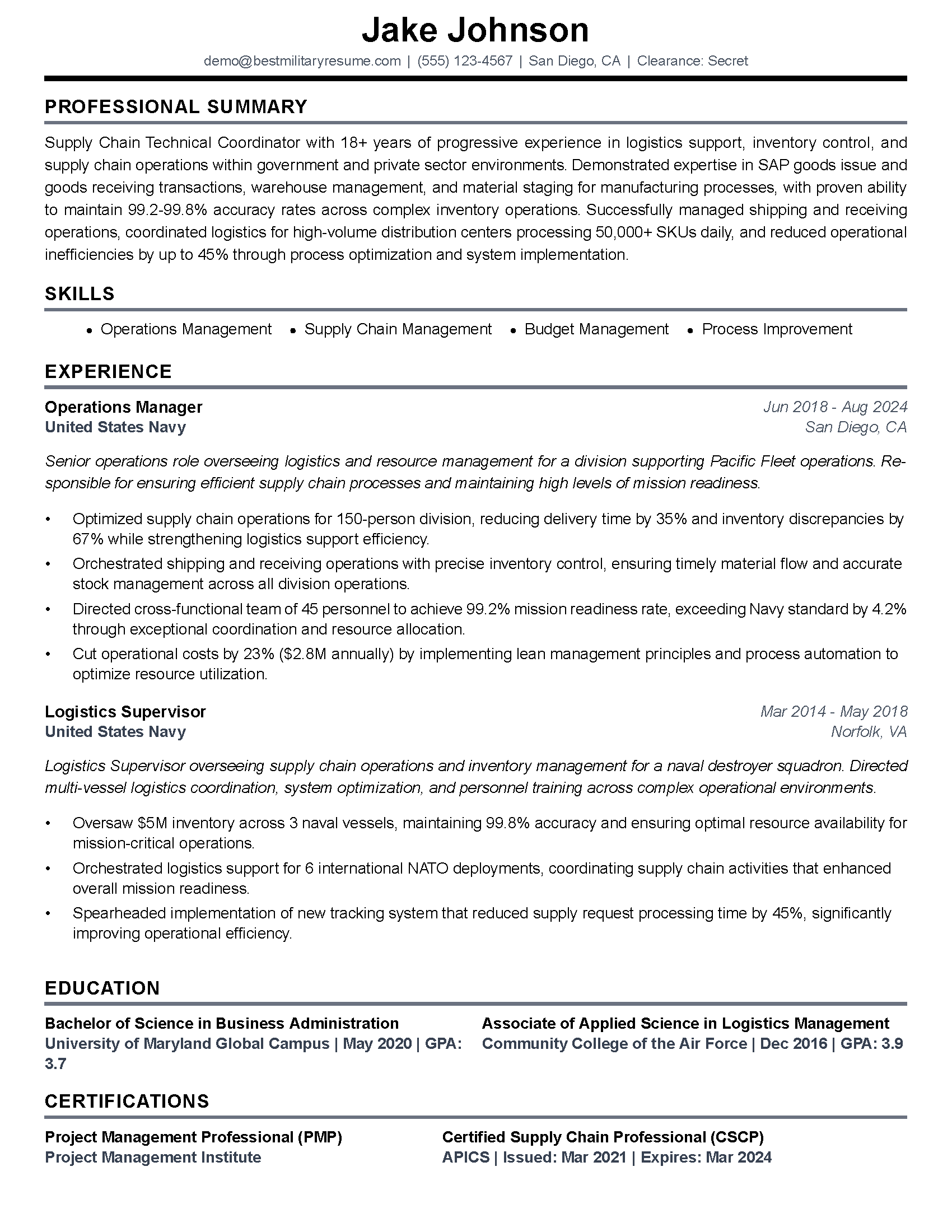
How Do You Turn Command Time Into Ops Bullets?
The method is simple. Take one thing you did. Add the scope. Add the number. Add the result.
Start with a plain verb. Led. Ran. Managed. Cut. Built. Then answer three questions. How big. How many. What changed.
Served as Company Operations NCO responsible for training and readiness.
Ran daily operations for a 130-person company across training, maintenance, and logistics, managing a $4M equipment set at 98% readiness.
How do you show scope and headcount?
Scope is the size of what you owned. Headcount is the people under it.
Do not write "led soldiers." Write the number. Try "led 42 personnel across three shifts." Numbers help a manager picture the job.
Count everyone you directed, not just direct reports. If you ran a watch floor with 20 people from four sections, that is 20.
Think in layers. A section is a handful. A platoon is dozens. A company is over a hundred. Name the layer you ran and the number attached to it.
How do you show budgets and resources?
You managed money and gear whether or not it felt like it. Vehicles. Weapons. Comms. Repair parts. Facilities.
Put a dollar value on it. A platoon equipment set is often worth millions. Look up the real figure if you can. If not, use a fair estimate and keep it honest.
Try this. "Accountable for $12M in vehicles and communications gear with zero loss." That is a manager sentence. It maps straight to asset and budget control.
Do not stop at gear. If you built a schedule that saved fuel or overtime, that is cost control too. Operations managers love a dollar saved.
How do you show throughput and process metrics?
Throughput is volume. How much moved, shipped, produced, or processed.
Process metrics are rates. On-time delivery. Uptime. Defect rate. Safety record. Turnaround time.
Try this. "Processed 400 work orders a month at a 96% on-time rate." That tells an operations story in one line. It is the language of the job.
Pick the rate that mattered most in your role. A motor pool lives on readiness. A supply shop lives on fill rate. A watch floor lives on response time. Lead with that one.
Need help pulling the numbers out of your service? Start by learning how to quantify your military experience. Your evaluations are gold here too. Here is how to convert an NCOER, OER, or FITREP into resume bullets.
"An operations manager reads your resume looking for one thing. Show them how big the job was and how much better you left it."
Which Military Jobs Map to an Operations Manager Role?
Operations leadership hides in a lot of billets. If you held any of these, you have the raw material.
Do not get stuck on your exact job code. Operations managers come from many backgrounds. What matters is that you planned work, ran people, and owned an outcome. Match your closest billet to the role and write the scope.
Officers ran the whole engine. S3 or G3 operations, executive officer, company commander, battle captain. You planned and directed operations for the unit.
Senior enlisted ran the day-to-day. Operations chief, platoon sergeant, first sergeant, readiness NCO, watch supervisor. You kept the numbers green.
Some jobs are operations by name. Marine MAGTF planning specialists live in the planning cell. Air Force All-Domain Command and Control Operations controllers (formerly Command Post) run the nerve center of a wing. The Navy Operations Specialist rating runs the ship tactical picture. And Air Force Operations Management puts the words right in the job title.
Combat arms leaders qualify too. Running a company or platoon in the field is high-stakes operations. See how to translate that in our guide to the army combat veteran resume.
The federal side wants this experience too. It maps to program and operations series like GS-0340 program manager roles. Veterans get real hiring advantages there. The USAJOBS veterans hiring paths page lays out how that works.
How Should You Structure the Whole Resume?
Good bullets need a good frame. This is the layout that works for operations roles.
1 Write a sharp summary
2 Add a skills band
3 Build experience around results
4 Translate the titles
5 Keep it to one or two pages
Reverse chronological wins. Your most recent operations role goes first. Lead each job with a one-line scope statement. Then add three to five result bullets.
Here is a summary that works. "Operations leader with 8 years running high-tempo military logistics. Directed up to 130 personnel and $4M in assets at 98% readiness. Targeting an operations manager role in supply chain or manufacturing."
Notice what it does. It names the target. It leads with people and dollars. It ends with direction. Three lines, all scope, no fluff.
Titles trip people up. A civilian will not know what a first sergeant runs. Learn how to list military rank on a civilian resume. And keep a glossary of military terms and civilian equivalents handy while you write.
Ops leaders land in more than one field. The same bullets work for a production supervisor resume or an emergency management resume. Build once, tailor per posting.
What Mistakes Sink an Operations Manager Resume?
A few habits tank an otherwise strong resume. Watch for these.
- Duties without results: "Responsible for logistics" says nothing. Show the outcome instead.
- Acronym soup: A reader will not decode MTOE, PMCS, or NCOIC. Spell it out in plain words.
- The everything dump: Do not list every task you ever touched. Pick the operations wins that hit the five proof points.
- No numbers: A bullet with no figure is a claim with no proof.
- Rank as a job title: "SFC" is not a role. "Operations Manager, Rifle Company" is.
The everything dump trips up the most people. You did a hundred jobs in the service. A resume pitches you for one role. So keep the operations wins and cut the rest hard.
When I got out of the Navy, I sent out a stack of applications. I heard nothing back for a long stretch. My resume described my billets. It did not show an employer what that work was worth. Once I started writing scope and results, the calls came. Operations experience carries over. You just have to write it in their words.
Key Takeaway
Every operations bullet should answer three things fast. How big the job was. How many people or dollars you ran. And what got better because of you.
Do You Need a Degree or Certifications for Operations?
A degree helps but it is not the whole story. Many operations managers rise on experience and results. Your command time counts as that experience.
Certifications can close the gap fast. A few carry real weight in operations.
- Lean Six Sigma: A Green Belt or Black Belt shows you can cut waste and fix a process. That is the core of the job.
- PMP or CAPM: Project management credentials from PMI. They signal you can run scope, schedule, and budget.
- APICS CPIM: Strong for supply chain and production operations.
- OSHA 30: Useful when the role touches a plant, warehouse, or field site.
You do not need all of them. Pick the one that fits your target job. Many are eligible for GI Bill or military credentialing assistance funding. List the ones you hold near the top so a scanner catches them.
What Should You Do Next?
Picture the resume that leads with a 130-person operation, a $4M budget, and a 98% readiness rate. That is the resume a hiring team pulls to the top of the pile.
You already did the work. Now you write it so it counts. Take one recent role and build five bullets on the five proof points. Then do the next role.
Do not wait for the resume to feel perfect. A good draft with real numbers beats a polished page of duties. You can tailor it for each posting after.
The BMR resume builder does the translation and formatting for you. Paste the operations manager job you want. It tailors your military experience to that posting and matches the keywords. Built by veterans who have sat on both sides of the hiring table. It is free to start.
Frequently Asked Questions
What is the best resume format for a veteran targeting operations manager?
How do I show budget experience if I never touched a bank account?
Which military roles count as operations management?
Do I need a degree to become an operations manager?
How long should my operations manager resume be?
What keywords should I use on an operations manager resume?
Does operations experience transfer if I was enlisted?
About the Author
Brad Tachi is the CEO and founder of Best Military Resume and a 2025 Military Friendly Vetrepreneur of the Year award recipient for overseas excellence. A former U.S. Navy Diver with over 20 years of combined military, private sector, and federal government experience, Brad brings unparalleled expertise to help veterans and military service members successfully transition to rewarding civilian careers. Having personally navigated the military-to-civilian transition, Brad deeply understands the challenges veterans face and specializes in translating military experience into compelling resumes that capture the attention of civilian employers. Through Best Military Resume, Brad has helped thousands of service members land their dream jobs by providing expert resume writing, career coaching, and job search strategies tailored specifically for the veteran community.
