Loading...
Loading...
The civilian and federal jobs that hire Air Force Operations Managements — with real salaries and the resume that gets callbacks.
Every 3E6X1 has more options than a Google search will tell you. Below: career paths, BLS salary data, federal GS series, certifications by target career, and how to translate your experience without losing what made you valuable to the Air Force in the first place.
Free · No credit card · Tailored resume in under 5 minutes
After the Navy I got hired into 6 federal career fields and tech sales, and sat on federal hiring panels along the way. I spent the last 2 years rebuilding everything I learned into BMR, tuned for how AI actually screens resumes today. This is the system I wish I'd had on day one.
If you worked 3E6X1, you ran the engine room of a Civil Engineer squadron without ever picking up a wrench. You stood up and managed the CE command and control center, took the service calls when a facility went down, prioritized work orders against legal cost limits and support agreements, tracked Class IV material acquisitions, and kept the work-order priority program moving from approval through completion. When a pipe burst on the flightline or a contingency tasking landed, you were the person deciding what got fixed first and who had the people, parts, and money to do it.
That work-control role is the part civilian employers underestimate until you explain it. You ran a CMMS-style work-order system, dispatched multi-trade crews, defended cost and reimbursement decisions to leadership, and produced the management data that told the squadron where its time and money actually went. Training started with the basic operations course and CE 3-level common core at Sheppard AFB, and the 7-level common core added the planning, scheduling, and resource-management depth that runs a base civil engineer operation.
I spent years in federal supply, logistics, and property management after the Navy, and the 3E6X1 skill set sits right next to that world. Work prioritization, material accountability, and cost-reimbursement tracking are the same muscles a federal facilities or supply program runs on. The clearance status is rarely the lever here. The lever is showing a hiring manager that you managed a service-call center, a work-order backlog, and a material pipeline at the same time, and can prove it with numbers. If you want to see how your record stacks against related fields, the military-to-civilian career crosswalk is a good place to start, and the sibling 3E5X1 Engineering and 3E9X1 Emergency Management pages cover the rest of the CE cluster.
I worked federal supply, logistics, and property for years, and the thing I wish more 3E6X1 airmen knew is that "operations management" undersells you on a resume. You ran work control. You decided what got fixed, what it cost, and who did it. Put the work-order volume, the cost figures, and the dispatch numbers on the page and a facilities or supply hiring manager reads you instantly. — Brad Tachi, Navy Diver veteran & BMR founder
The number that matters when you're deciding what's next: how does civilian pay compare to what you make now?
Military comp is approximate (varies by location/dependents). Civilian is BLS median. Federal includes locality pay. Your real number depends on duty station, family status, GS step, and overtime.
The 3E6X1 background maps cleanly onto facilities operations, work-order management, and program-coordination roles. Salary figures below are from the U.S. Bureau of Labor Statistics Occupational Employment and Wage Statistics (OEWS), May 2024.
Facilities Managers (BLS 11-3013, median $104,690). This is the closest civilian translation of running a base CE operation. Large facilities, hospitals, universities, and corporate campuses need someone who can manage a work-order backlog, prioritize service calls, coordinate trades, and control maintenance budgets. Your work-control center experience is the exact daily job.
Administrative Services Managers (BLS 11-3012, median $108,390). Many service-focal-point and resource-management functions fall under this title in the civilian world, where the role covers facility support services, contracts coordination, and the operational back office that keeps a site running.
Cost Estimators (BLS 13-1051, median $77,070). You defended work-order costs against legal limits and support agreements and tracked reimbursement. Estimating job costs for construction and facilities work is a direct extension of that, and it is a strong path if you liked the numbers side of the job.
Logisticians (BLS 13-1081, median $80,880). Class IV material acquisition, stock control, and keeping crews supplied is logistics work. This title is common in defense, construction, and manufacturing, and it links to the same world as Air Force 2S0X1 Materiel Management and Navy LS Logistics Specialist.
Project Management Specialists (BLS 13-1082, median $100,750). Coordinating multi-trade infrastructure work from request through completion is project coordination. With a PMP or CAPM, this becomes one of the higher-ceiling paths. Our guide on moving into project management without a PMP yet walks the entry routes.
Production, Planning, and Material-Coordination roles. The scheduling and dispatch core of work control also reads as production planning and material coordination in manufacturing and construction settings, where Material Recording Clerk roles (BLS 43-5071, median $46,120) are a common entry point that promotes into planning.
Be honest with yourself about geography and level. Facilities and project roles concentrate around metro areas, large institutions, and industrial corridors. You may enter a notch below your military responsibility and climb fast once you have a civilian title on the resume. The military resume builder is built to translate this background, and when you are ready to apply you can build your resume now.
| Civilian Job Title | Industry | BLS Median Salary | Outlook | Match |
|---|---|---|---|---|
Facilities Manager O*NET: 11-3013.00 | Facilities Operations | $104,690 | 7% (Faster than average) | strong |
Administrative Services Manager O*NET: 11-3012.00 | Operations | $108,390 | 5% (Faster than average) | strong |
Cost Estimator O*NET: 13-1051.00 | Construction & Facilities | $77,070 | 4% (As fast as average) | strong |
Logistician O*NET: 13-1081.00 | Logistics & Supply Chain | $80,880 | 6% (Faster than average) | strong |
Project Management Specialist O*NET: 13-1082.00 | Project Management | $100,750 | 7% (Faster than average) | moderate |
Management Analyst O*NET: 13-1111.00 | Business Operations | $101,190 | 11% (Much faster than average) | moderate |
Material Recording Clerk / Planner O*NET: 43-5071.00 | Manufacturing & Construction | $46,120 | -6% (Decline) | moderate |
Customer Service / Dispatch Center Lead O*NET: 43-4051.00 | Operations | $42,830 | -5% (Decline) | moderate |
BMR rewrites your 3E6X1 experience for any of the civilian roles above — keywords, achievements, and language hiring managers actually scan for.
Free · No credit card · 2 tailored resumes included
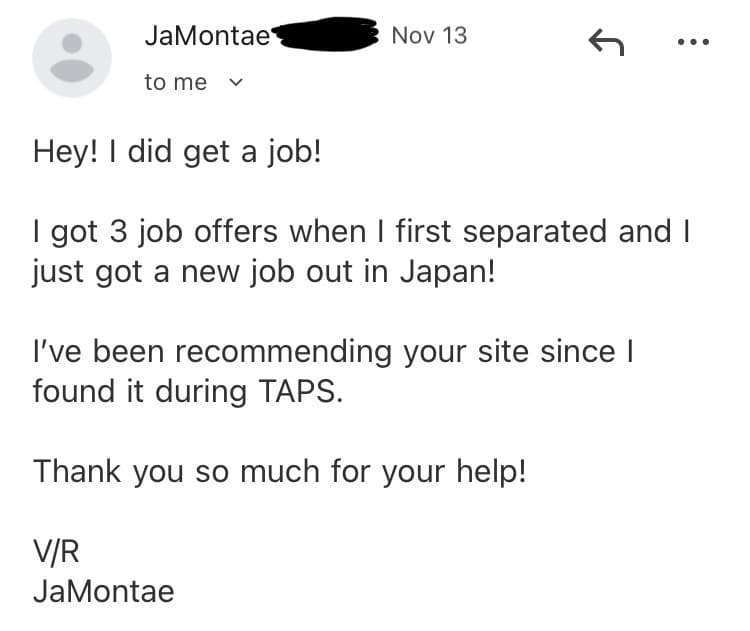
“Hey! I did get a job! I got 3 job offers when I first separated and I just got a new job out in Japan! I’ve been recommending your site since I found it during TAPS. Thank you so much for your help! V/R JaMontae ”
Federal facilities, engineering, and supply organizations hire this background steadily, and Veterans' Preference plus your work-control experience make you competitive. The federal hiring world rewards documented scope, so quantify the work orders, dollars, and crews you managed. Our federal resume format guide and the breakdown of specialized experience on a federal resume show how to phrase it so an HR specialist can rate you.
GS-1640 Facility Operations Services is the most direct match. It covers managing the operation of buildings and facilities, the same work-control and service-coordination role you ran in the CE squadron. Typical entry runs GS-7 through GS-11, with GS-12 and above for installation-level program work.
GS-1601 General Facilities and Equipment is the umbrella facilities series for roles that do not fit a single specialty. It captures the broad coordination, oversight, and program work that operations management covers.
GS-0343 Management and Program Analyst fits the quantitative side of the job. You produced management data on cost, reimbursement, work performance, and trends. That is exactly what a program analyst does, and it is one of the most portable federal series across agencies.
GS-2003 Supply Program Management and GS-2010 Inventory Management connect to the Class IV material acquisition and accountability side of your work, the part that overlaps directly with a federal supply career.
Round out your search with GS-0301 Miscellaneous Administration and Program for resource-management and focal-point roles, GS-0340 Program Management for higher-grade infrastructure program jobs, GS-0809 Construction Control Technical and GS-0802 Engineering Technician for the project-coordination and work-inspection side, and GS-1670 Equipment Services for equipment and material program work. Departments of the Air Force, Army, and Navy installations, the Army Corps of Engineers, GSA, and the VA all run facilities and CE-style operations. If you want to map shared series with other branches, the Navy UT Utilitiesman page targets several of the same facilities series. When you are ready, start your federal resume here.
| GS Series | Federal Job Title | Typical Grades | Match | Explore |
|---|---|---|---|---|
| GS-1173 | Housing Management | GS-9, GS-11 | View Details → |
Federal hiring uses keyword-matching and structured experience. BMR builds federal-format resumes (USAJobs-ready) with the right keywords, hours/week, and supervisor info — for any GS series above.
Free · No credit card · Federal + civilian resume formats included
Not everyone wants to stay in a related field. These career paths leverage your transferable skills — leadership, risk management, logistics, project planning — in completely different industries.
Healthcare facilities and clinical-operations departments run the same intake-prioritize-dispatch-bill cycle you managed in work control, just for patient and clinical services instead of buildings.
Your GeoBase and real-property-inventory work is hands-on geospatial asset management; civilian GIS teams need people who understand both the data and the physical infrastructure it represents.
Hotel and resort operations run a guest-request, dispatch, and property-upkeep loop that mirrors the CE service-call center; your work-control instincts transfer to a different customer.
Data-center critical-facilities teams live and die on uptime, work prioritization, and dispatch under pressure, the exact contingency-operations discipline you ran in the CE command and control center.
Your Class IV material pipeline and stock-control work is small-scale network planning; distribution and manufacturing firms need planners who can forecast, prioritize, and prevent stock-outs.
Activating and running a command and control center during contingencies is the core of emergency management; your wartime-operations discipline maps onto continuity and disaster-response roles.
If you liked the cost side of work control, construction estimating turns that into a specialty; you already defended costs against legal limits and tracked reimbursement.
The skills that made you a good Marine, Sailor, Airman, or Soldier transfer further than you think. BMR rewrites your bullets for any of the pivot careers above — without making you sound like you've never done the work.
Free · No credit card · Try unlimited career angles
If you are applying to facilities, base operations support, or supply organizations, the people reading your resume already know what a work-order priority program and a CE service call are. This section is for the careers OUTSIDE Air Force civil engineering, where a hiring manager has never heard "BCE," "service call," or "Class IV," and where the wrong words cost you the interview. Our glossary of 50 military terms translated to civilian language and the EPR/OPR-to-resume guide for Air Force veterans cover the broader translation.
"Managed the CE service call center and customer focal point" becomes "Operated a centralized work-intake and dispatch center fielding 1,200+ service requests monthly, routing each to the correct trade and tracking it to closure." The civilian reader hears a help-desk and dispatch operation, not Air Force jargon.
"Managed the work-order priority program" becomes "Administered the maintenance work-order system, prioritizing a backlog of 400+ open jobs against budget and deadline constraints to maximize uptime." That reads as CMMS and maintenance planning to a facilities or manufacturing manager.
"Monitored work costs against legal limits and support agreements" becomes "Tracked job costs and reimbursements against contractual and budget limits, flagging overruns before they posted." Now a finance or operations manager sees cost control, not appropriations law.
"Managed Class IV material acquisition" becomes "Forecast, ordered, and accounted for construction and maintenance materials supporting concurrent projects, preventing work stoppages from stock-outs." That is procurement and inventory language any employer recognizes.
The pattern is to lead with the civilian function, attach a number, and drop the acronym. Build these bullets once and they carry across every non-CE application. The military resume builder does this translation automatically from your inputs, and you can get started here.
BMR turns your 3E6X1 duties and accomplishments into civilian bullets that match the job you're applying for — no manual translation, no rewriting.
Free · No credit card · Tailored to each job posting
Which certifications you need depends on where you're headed. Find your target career path below.
The wrong placement can sink an otherwise strong application. BMR knows where each cert ranks, what to call it, and how to frame it for ATS keyword matching and hiring manager attention.
Free · No credit card · Built around your real certs and clearance
If you want to keep running operations, lean on credentials that civilian facilities and supply employers recognize. The International Facility Management Association (IFMA) offers the FMP and CFM. APICS/ASCM offers the CSCP and CPIM for the supply and planning side. Look at SkillBridge to land a civilian role before you separate. Our SkillBridge programs by industry guide and the SkillBridge vs CSP vs apprenticeships breakdown help you pick a path. For federal roles, study how to decode a USAJOBS announcement and how Veterans' Preference points work.
If you are done with facilities work, your project-coordination and cost-control experience opens project management (PMI's CAPM then PMP), Lean Six Sigma process roles, and analytics-leaning program work. American Corporate Partners (ACP) offers free veteran mentorship to help you map the move. For the federal side, the SFL-TAP resources at our SFL-TAP transition page are a solid starting point.
Start with the military resume builder for private-sector roles or the federal resume builder for GS positions, explore options with the career crosswalk, and when your record is ready build your resume now.
See also: Air Force 3E5X1 Engineering, Air Force 2S0X1 Materiel Management, and Navy UT Utilitiesman for related career paths.
Most veterans do this backwards — they wait until terminal leave to start, then panic. Here's the actual sequence that works.
Print this. Tape it to your monitor. Veterans who treat the transition like a 90-day op get hired faster than the ones who treat it like an emergency.
Stop rewriting from scratch every time you apply. BMR turns your military experience into civilian and federal resumes — tailored to each job.