Loading...
Loading...
The civilian and federal jobs that hire Navy Engineering Aides — with real salaries and the resume that gets callbacks.
Every EA has more options than a Google search will tell you. Below: career paths, BLS salary data, federal GS series, certifications by target career, and how to translate your experience without losing what made you valuable to the Navy in the first place.
Free · No credit card · Tailored resume in under 5 minutes
After the Navy I got hired into 6 federal career fields and tech sales, and sat on federal hiring panels along the way. I spent the last 2 years rebuilding everything I learned into BMR, tuned for how AI actually screens resumes today. This is the system I wish I'd had on day one.
If you held the EA rating, you ran the survey crew, the drafting table, and the materials lab for a Seabee battalion. You set control points and ran traverses, converted field notes into topographic maps, staked out excavations for roads, airfields, and waterfront structures, and computed earthwork and concrete quantities straight off the drawings. You designed and tested aggregate mixes for soil-cement, concrete, and bituminous paving, ran the soil and concrete cylinder tests, and signed off on quality control before a single yard got placed. Engineering Aide is the smallest rating in the Naval Construction Force, with only around 170 Sailors in the seat at any time, which means most civilian hiring managers have never seen the title and have no idea how much technical work sits behind it.
The pipeline is real training, not a weekend course. EA "A" school runs roughly 15 weeks at Fort Leonard Wood, Missouri, the joint engineer schoolhouse, where you learned plane and differential leveling, total station and GPS survey, CAD drafting, and ASTM-style materials testing. From there you deployed with a Naval Mobile Construction Battalion and did the work for real, surveying a site in the morning and running gradation and slump tests in the afternoon. That mix of field surveying, technical drafting, and lab testing is rare. Most civilian roles split those three skills across three different people.
Civilian employers value this background because it is measurable. A survey closes or it does not. A concrete cylinder breaks at the design strength or it fails. An EA spent years producing work where the standard was a number, not an opinion, and that discipline shows up in everything from civil engineering firms to manufacturing quality labs. If you are still mapping where your rating fits, the military skills crosswalk tool is a good starting point, and the other Seabee ratings like Equipment Operator and Builder share a lot of the same job sites.
After the Navy I spent a year and a half watching my applications get ignored. The work was never the problem. The problem was that "Engineering Aide" reads like nothing to a civilian recruiter, even though you ran surveys, CAD drawings, and a materials lab. The translation is what costs you interviews, not the experience. Name the survey instruments, the CAD software, and the ASTM tests in civilian terms and the same resume that got ignored starts getting calls. — Brad Tachi, Navy Diver veteran & BMR founder
The number that matters when you're deciding what's next: how does civilian pay compare to what you make now?
Military comp is approximate (varies by location/dependents). Civilian is BLS median. Federal includes locality pay. Your real number depends on duty station, family status, GS step, and overtime.
Your skill set maps cleanly onto the architecture and engineering occupations the Bureau of Labor Statistics tracks. The closest fit is the surveying and mapping technician role, where BLS reports a median wage of $51,940 (May 2024). That is the entry door, and most EAs are already over-qualified for it on day one because of the lab and drafting work the civilian job often does not include.
Drafting is the other obvious lane. Architectural and civil drafters had a median wage of $65,380 (BLS, May 2024), and your CAD plan-and-profile experience translates directly. If you move up into the analysis side, civil engineering technologists and technicians sat at $64,200 (BLS, May 2024), pairing your survey data with design support. The mapping and GIS world pays more for the same spatial skills. Cartographers and photogrammetrists reported a median of $78,380 (BLS, May 2024), and GIS roles fall inside that same category.
On job sites, your quality control background opens two strong roles. Construction and building inspectors had a median wage of $72,120 (BLS, May 2024), and your materials testing and code-compliance experience is exactly what the job is. Cost estimators earned $77,070 (BLS, May 2024), and the quantity takeoffs you did off Seabee drawings are the core of that work. For those who run the whole job, construction managers reported a median of $106,980 (BLS, May 2024).
Be honest with yourself about the market. Survey and civil-tech work is steady but cyclical and tied to construction spending, so it is strongest in growing metros and in states with heavy infrastructure programs. GIS and estimating roles are less tied to the local dirt and travel better if you want to relocate. The other branches run the same equipment, so it is worth seeing how the Army 12Y Geospatial Engineer and Marine Corps 1361 Engineer Assistant paths line up with yours. When you are ready to put it on paper, the military resume builder is built for exactly this translation, or you can build your resume now.
| Civilian Job Title | Industry | BLS Median Salary | Outlook | Match |
|---|---|---|---|---|
Surveying and Mapping Technician O*NET: 17-3031.00 | Surveying and Civil Engineering | $51,940 | 4% (As fast as average) | strong |
Architectural and Civil Drafter O*NET: 17-3011.00 | Engineering and Design | $65,380 | 0% (Little or no change) | strong |
Civil Engineering Technologist and Technician O*NET: 17-3022.00 | Engineering | $64,200 | 4% (As fast as average) | strong |
Cartographer and Photogrammetrist O*NET: 17-1021.00 | Geospatial and Mapping | $78,380 | 2% (Slower than average) | strong |
Construction and Building Inspector O*NET: 47-4011.00 | Construction | $72,120 | 0% (Little or no change) | strong |
Cost Estimator O*NET: 13-1051.00 | Construction | $77,070 | 1% (Little or no change) | strong |
Construction Manager O*NET: 11-9021.00 | Construction | $106,980 | 9% (Faster than average) | moderate |
BMR rewrites your EA experience for any of the civilian roles above — keywords, achievements, and language hiring managers actually scan for.
Free · No credit card · 2 tailored resumes included
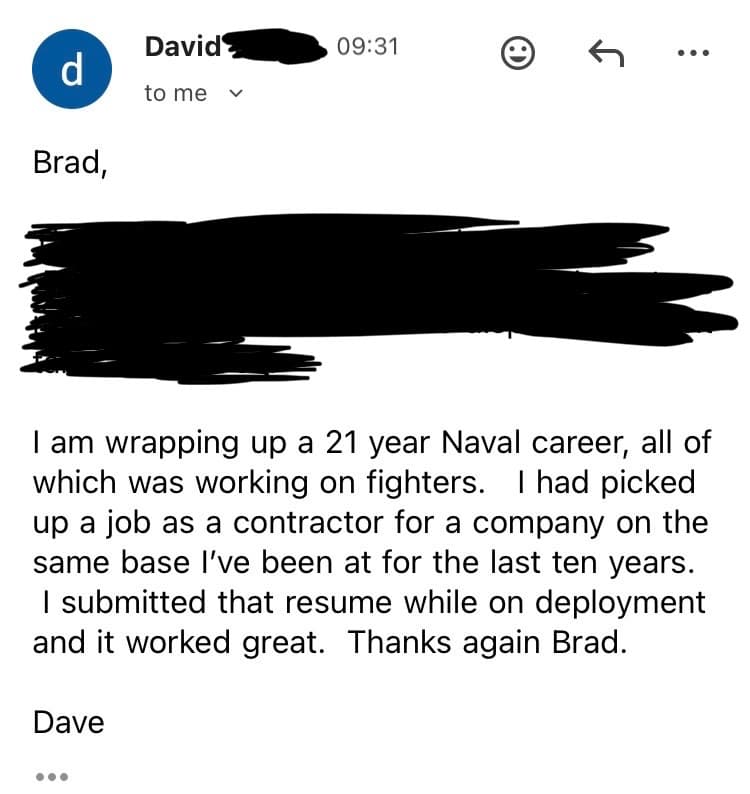
“I am wrapping up a 21 year Naval career, all of which was working on fighters. I had picked up a job as a contractor for a company on the same base I’ve been at for the last ten years. I submitted that resume while on deployment and it worked great. Thanks again Brad. Dave ”
Federal service is one of the strongest landing spots for an EA, because the government runs its own survey crews, drafting shops, and materials labs and writes job standards around the exact skills you already have. The most direct match is the GS-0817 family work captured under GS-0802 Engineering Technician and the GS-0809 Construction Control Technician series, where your survey, inspection, and quality control experience qualifies you at the GS-5 through GS-9 range depending on time in grade and any coursework.
Surveying and mapping have their own series. GS-1373 Land Surveying and GS-1370 Cartography are written for exactly what you did on the gun and at the drafting table, and they run across the Army Corps of Engineers, the Bureau of Land Management, NOAA, and the USGS. If you lean technical-engineering, the GS-0810 Civil Engineering and GS-0801 General Engineering series take EAs who finished a degree, while GS-0808 Architecture values the drafting and design-support side.
Two more series are worth a hard look. GS-0803 Safety Engineering rewards the quality control and site-inspection discipline an EA builds, and the GS-0850 Electrical Engineering series occasionally opens to construction-tech backgrounds on facilities teams. Veterans preference is real leverage here. It adds points to your rated score and, under VRA and VEOA authorities, opens appointment paths that are closed to non-veterans. Get the federal format right first. The 2026 OPM federal resume requirements and the specialized experience guide walk through how to phrase your EA duties to hit the qualification standard. You can federal resume builder draft it in the right structure, or start your federal resume when you are ready. The Equipment Operator page shares several of these same GS targets.
| GS Series | Federal Job Title | Typical Grades | Match | Explore |
|---|---|---|---|---|
| GS-0809 | Construction Control | GS-5, GS-7, GS-9 | View Details → | |
| GS-0819 | Environmental Engineering | GS-7, GS-9 | View Details → | |
| GS-0893 | Chemical Engineering | GS-7, GS-9 | View Details → | |
| GS-0028 | Environmental Protection Specialist | GS-7, GS-9 | View Details → | |
| GS-0802 | Engineering Technician | GS-5, GS-7, GS-9 | View Details → | |
| GS-0810 | Civil Engineering | GS-7, GS-9, GS-11 | View Details → | |
| GS-1370 | Cartography | GS-5, GS-7, GS-9 | View Details → | |
| GS-0457 | Soil Conservation | GS-7, GS-9 | View Details → | |
| GS-0808 | Architecture | GS-7, GS-9, GS-11 | View Details → | |
| GS-1315 | Hydrology | GS-7, GS-9 | View Details → | |
| GS-1373 | Land Surveying | GS-5, GS-7 | View Details → | |
| GS-0029 | Environmental Protection Assistant | GS-7, GS-9 | View Details → | |
| GS-0454 | Rangeland Management | GS-7, GS-9 | View Details → | |
| GS-0801 | General Engineering | GS-7, GS-9, GS-11 | View Details → | |
| GS-0803 | Safety Engineering | GS-7, GS-9, GS-11 | View Details → | |
| GS-0896 | Industrial Engineering | GS-7, GS-9 | View Details → | |
| GS-1008 | Interior Design | GS-7, GS-9 | View Details → | |
| GS-0020 | Community Planning | GS-7, GS-9 | View Details → |
Federal hiring uses keyword-matching and structured experience. BMR builds federal-format resumes (USAJobs-ready) with the right keywords, hours/week, and supervisor info — for any GS series above.
Free · No credit card · Federal + civilian resume formats included
Not everyone wants to stay in a related field. These career paths leverage your transferable skills — leadership, risk management, logistics, project planning — in completely different industries.
The same CAD drafting and dimensional precision an EA uses to draw a road profile drives product and industrial design, just aimed at consumer and industrial products instead of construction.
Crime-scene and lab forensics run on the same instinct an EA lives by: measure precisely, test by the standard, and document so a result holds up to scrutiny. The materials-lab and survey-documentation discipline transfers directly.
EA soil sampling, field testing, and instrument work map straight onto geological and petroleum field technician roles, where the daily job is collecting samples and running standardized tests in the energy and mining sectors.
Building a crown or lens to a fraction of a millimeter is the same dimensional precision an EA brings to layout and drafting, applied to medical appliances instead of construction. The tolerance mindset transfers cleanly.
An EA already runs quality control: test to the standard, document the result, reject what fails. In manufacturing that is the entire inspector job, just applied to parts and products instead of soil and concrete.
Measuring a property, reading its plans, and computing a defensible value from the numbers is close to what an EA does taking quantities off a drawing. The measurement and documentation discipline carries over to real estate valuation.
The skills that made you a good Marine, Sailor, Airman, or Soldier transfer further than you think. BMR rewrites your bullets for any of the pivot careers above — without making you sound like you've never done the work.
Free · No credit card · Try unlimited career angles
If you are staying in surveying, drafting, or materials testing, skip this section. The hiring managers in those fields already speak EA. They know what a traverse and a slump test are. This section is for EAs targeting careers OUTSIDE the engineering-tech specialty, where the reader has never heard of a Seabee and needs your work described in plain civilian language.
The trap is using rating shorthand on a resume aimed at a manufacturing, design, or real estate hiring manager. "Ran control survey and staked out the site" means nothing to them. "Established precise reference points and dimensional layout to within tolerance" lands. Same work, civilian words. The 50 military terms glossary and the guide on explaining military experience without jargon are worth reading before you write a single bullet.
A few before-and-after examples for non-field roles:
The pattern is the same every time. Lead with the measurable outcome and the standard you held, not the rating jargon. Our military resume builder handles this translation automatically, or you can get started here.
BMR turns your EA duties and accomplishments into civilian bullets that match the job you're applying for — no manual translation, no rewriting.
Free · No credit card · Tailored to each job posting
Which certifications you need depends on where you're headed. Find your target career path below.
The wrong placement can sink an otherwise strong application. BMR knows where each cert ranks, what to call it, and how to frame it for ATS keyword matching and hiring manager attention.
Free · No credit card · Built around your real certs and clearance
Use these resources to build the next step, whether you are staying technical or pivoting out.
Most veterans do this backwards — they wait until terminal leave to start, then panic. Here's the actual sequence that works.
Print this. Tape it to your monitor. Veterans who treat the transition like a 90-day op get hired faster than the ones who treat it like an emergency.
Stop rewriting from scratch every time you apply. BMR turns your military experience into civilian and federal resumes — tailored to each job.