Operations Research Analyst Resume for Veterans (GS-1515)
Christopher was selected for GS-13 on his first-ever USAJOBS application.
Christopher, E-7, Coast Guard, now writes policy for the work he did on active duty
OPM’s 1515 qualification standard asks for a “Degree: in operations research; or at least 24 semester hours in a combination of operations research, mathematics, probability, statistics, mathematical logic, science, or subject-matter courses requiring substantial competence in college-level mathematics or statistics.” That rule shapes a veteran’s operations research analyst resume for a 1515 job. So show the degree or the hours. The same OPM standard adds one hard line: “At least 3 of the 24 semester hours must have been in calculus.”
If you served as an FA49 or ORSA, you can explain the modeling work in your sleep. Proving the hours on paper is the part that takes digging.
You may need two versions of this resume, one federal and one private. 79,689 resumes have been built on BMR to date, and it can write both kinds. The federal version needs this education block. The private one can keep just the degree. For the series overview, see BMR’s GS-1515 career page.
Example education block:
- Degree: Bachelor of Science, Industrial Engineering
- Courses toward the 1515 rule: Calculus, Optimization, Mathematical Modeling, Probability and Statistics, Econometrics
- Hours: copy the hours for each course from your transcript. Put the calculus hours on their own line
Swap in your own degree and courses. The point is that a reader can add up your hours without guessing.
Which college courses count toward the 24 hours?
OPM says the courses “may have been taken in departments other than Operations Research, e.g., Engineering (usually Industrial Engineering), Science, Economics, Mathematics, Statistics, or Management Science.” OPM lists “optimization; mathematical modeling; queueing theory” among acceptable courses, along with “econometrics” and “computer science”. So that econ class you took at night may count.
OPM says probability and statistics courses “are highly desirable, but are not specified as minimum educational requirements”. A stats class helps you, but calculus is the one OPM makes a must. We didn’t find a source that says a military school course counts toward the 24 hours. So count only the college credit on your transcripts.
Pull every transcript you have and add up the hours before you write a word. Counting hours instead of an OR degree? Without 3 calculus hours, you don’t meet the rule yet. Fix that before you apply.
OPM says the main need is “competence in the rigorous methods of scientific inquiry and analysis rather than in the subject matter of the problem.” That line works in your favor. Your problems were military ones, but OPM weighs the methods. Check each job announcement too, since it says what proof to upload.
Your staff work in O*NET’s task words
O*NET lists this task first: “Present the results of mathematical modeling and data analysis to management or other end users.” In the military, that was the brief you gave your commander or staff.
O*NET says analysts “Formulate mathematical or simulation models of problems” and “Perform validation and testing of models to ensure adequacy, and reformulate models, as necessary.” O*NET says analysts “Study and analyze information about alternative courses of action to determine which plan will offer the best outcomes.” They also “Prepare management reports defining and evaluating problems and recommending solutions.” The courses of action line may sound familiar. It reads a lot like the course of action work you did on staff.
Use these task words only where they match work you did. If someone checks your record, they’ll find the same work there.
FA49, ORSA and the veteran title list
My Next Move for Veterans says analysts work for “the Department of Defense” and “Positions with the military are usually filled by military veterans.” It adds “a bachelor’s degree is sufficient for most entry-level positions.”
My Next Move for Veterans lists sample military titles for this job, including “Operations Analyst”, “Operations Research and Data Analytics”, “Operations Analysis Officer, Helicopter or EWO” and “Assessment Analyst”. The list names titles, not codes. If you served as an FA49 or ORSA, your exact title may not be on it. Match your duties to the O*NET tasks above instead.
Did your job lean more toward reports and dashboards? Then the data analyst resume guide may fit you better. If you ran processes more than models, see the operations manager resume guide.
Federal 1515 entries under a bold header
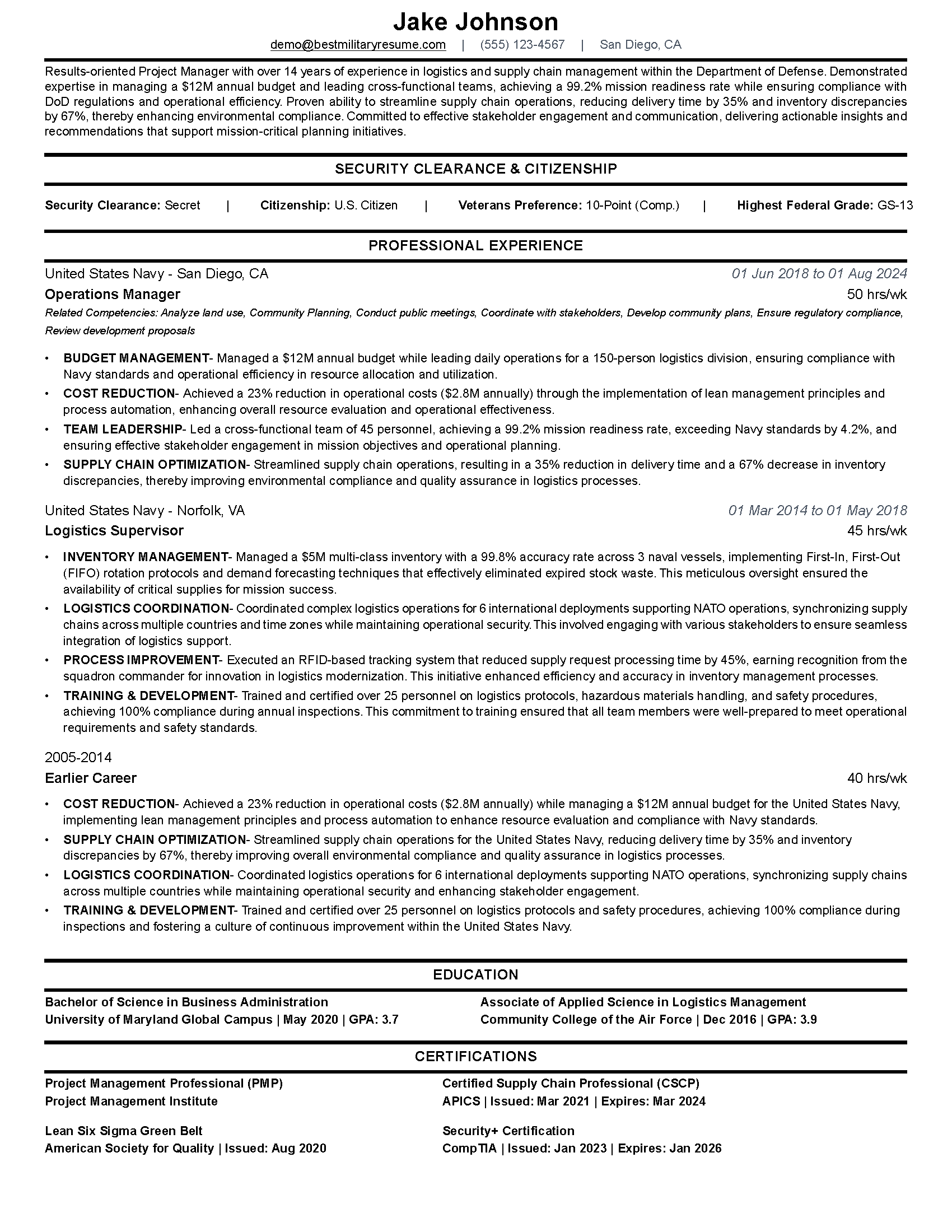
BMR’s federal method turns each duty into a full entry. These are the steps it takes:
- Start with a header: BMR’s tool sets each entry under a bold header. It names a skill in caps, like MODEL DEVELOPMENT.
- Write 2 to 4 sentences: say what you did and how big the job was. Name the systems you used.
- Spell out acronyms: write the full name first, then the short form.
- Keep numbers real: use a metric only if your records hold it. Never invent one.
- Match words honestly: use a posting’s keywords only where they connect to your real work.
- Drop the jargon: swap unit terms for plain words.
The examples below show only the first sentence of each entry. A full entry adds 1 to 3 more sentences on scope, systems and real results. The examples have no numbers, so you can swap in your own facts.
- MODEL DEVELOPMENT: Built a simulation model of convoy schedules, tested it against past moves, and briefed the results to the commander and staff.
- DECISION ANALYSIS: Compared each course of action for a training exercise on cost, time and risk, and wrote the staff report that recommended a plan.
- DATA ANALYSIS: Pulled readiness data from units with Structured Query Language (SQL), checked it for errors, and presented the trends to senior leaders.
Keep the education block near these entries so a reviewer sees both. Did you run programs more than models? Then see the federal management analyst guide.
How does the private analyst version change?
For a private job, BMR’s method uses Challenge, Action, Result. Each bullet is one or two sentences, about 25 to 45 words. Lead with a strong verb, like Led, Delivered, Achieved or Optimized.
Show what changed because of your work, not just your duties. Use your own numbers where your records hold them. The examples leave out numbers and scope, so they run short. With yours added, each should reach 25 to 45 words.
- Example bullet: Optimized the repair parts supply line after delays hurt readiness, using a queueing model in R that showed leaders where parts waited longest.
- Example bullet: Led a review of a forecasting model that missed field results, reformulated it, and delivered forecasts leaders used to set training schedules.
- Example bullet: Delivered Tableau dashboards after assessment data sat in separate reports, so senior leaders could compare options on one screen and choose a plan faster.
Asked what a new hire needs, O*NET shows “43%” said “Master’s degree required”, “14%” said “Doctoral degree required” and “33%” said “Bachelor’s degree required”. That was a survey of what new hires need, not a hiring rule. My Next Move for Veterans says a bachelor’s is enough for most entry-level jobs.
O*NET lists “Median wages (2025)” of “$42.76 hourly, $88,940 annual” and “Projected growth (2025-2035)” of “Much faster than average (7% or higher)”. It also lists the “Military Operations Research Society” as a professional association. The wage is a national median, so your offer may land above or below it.
If you have no degree yet, the data analyst career guide shows other paths in.
Your modeling tools and summary line
Your summary should name the job and the core task in one line.
- Example summary: Operations research analyst who builds and tests models and briefs the results to senior leaders.
O*NET’s software list for the role names “The MathWorks MATLAB”, “Minitab”, “Structured query language SQL”, “Tableau” and “R”. List only the tools you have used. If a posting names a tool you know, use its exact name.
- Example skills line: Mathematical modeling, Simulation, Optimization, Data analysis, SQL, R, Tableau
Are you a member of the society O*NET names? List it under Memberships.
The transcript check before you apply
Counting hours? Do one last transcript check for 24, with 3 in calculus.
Once your degree or hours check out, open BMR’s Resume Builder with a GS-1515 job post. Use a private analyst job post for your second version. A free account lets you tailor one federal resume and one private one.
Sources: OPM’s Operations Research Series 1515 standard, O*NET OnLine for 15-2031.00, and My Next Move for Veterans. We checked them in November 2026.
Frequently Asked Questions
Can I qualify for a GS-1515 job without an operations research degree?
Do military schools count toward the 24 semester hours?
Should I put FA49 or ORSA on my resume?
Do I need a master’s degree for a private operations research job?
About the author
Brad Tachi is the CEO and founder of Best Military Resume and a 2025 Military Friendly Vetrepreneur of the Year award recipient for overseas excellence. A former U.S. Navy Diver with over 20 years of combined military, private sector, and federal government experience, Brad brings unparalleled expertise to help veterans and military service members successfully transition to rewarding civilian careers. Having personally navigated the military-to-civilian transition, Brad deeply understands the challenges veterans face and specializes in translating military experience into compelling resumes that capture the attention of civilian employers. Through Best Military Resume, Brad has helped thousands of service members land their dream jobs by providing expert resume writing, career coaching, and job search strategies tailored specifically for the veteran community.