Where Do You See Yourself in 5 Years? A Veteran's Answer
Taylor sent 200+ applications for 5 interviews. With BMR, 20 resumes all hit.
Taylor, E-7, Army, defense industry
Social Security's Ticket to Work blog says employers ask "where do you see yourself in five years" to see if you're "a good match" and to "assess your motivation." Its first tip works for a veteran, too: "Connect the position to your career goals." Below, build that answer from your service planning habit, with three examples.
That sounds easy. But in the service, the next step was often mapped out for you. Now you have to map it yourself, out loud, for a stranger.
Why employers ask a veteran, "Where do you see yourself in five years?"
The Social Security blog says your answer "can demonstrate how much you've thought about your career path and how this job fits into your plans." So they want a plan, and they want this job inside it.
Military.com gives another reason. Interviewers ask it "to gain insight into your self-awareness and communication skills." They are also listening to how clearly you talk.
A University of Houston career center blog reposted an article first published by Forage. It quotes a career coach, Jan Tegze. He says employers want to "see if you have a clear career path in mind." They also check if your goals "align with the opportunities within the organization."
Why the question can land harder on a veteran
In 2014, Military Times reported on a survey by VetAdvisor and Syracuse University. The school's part was its Institute for Veterans and Military Families (IVMF). The survey drew responses from "nearly 1,500 veterans."
It found that "roughly 44 percent of veterans who responded to the survey left their first civilian job within a year of employment." Another 21 percent of those who responded left after one to two years.
The veterans who left gave reasons. They named "a lack of advancement opportunity," "tedious work requirements" and a job that was "a poor match with their military skills." Also, "more than 43 percent of veterans surveyed said they left their job for another, better position."
That survey is from 2014, and it counted only the veterans who answered. It doesn't say what you will do. But an interviewer may still worry that you won't stay. So your answer should show you plan to grow inside this job.
Building your answer from how you planned in the service
Our advice: use the planning habit the service gave you. You likely thought ahead about your next school, your next qualification and your next job. Do the same thing here, but point every step at this employer.
Use three moves. Each one starts with a tip from a source, then adds what you do with it.
- Start with their problem. Military.com says, "Be employer-centered. The employer is looking for someone to come in and solve problems." Your step: pick a duty from the posting you've already done in uniform. Say you want to own it here.
- Name what this job will teach you. The Social Security blog's example is a chance "to receive a certification in specific software." Your step: name a skill or certificate this job builds, one that grows from your military work.
- Break the plan into short steps. Military.com says, "Begin by setting short-term goals." Your step: say what you want to learn first, then what bigger work you want after that.
Keep it real. The Social Security blog's tips include "Be realistic" and "Be honest." It also says, "Write down your answer and practice your response." Say it out loud until it sounds like you. Practice your answer on your biggest weakness the same way.
Tie it to your story. Our guide to tell me about yourself covers the opening question. Your five-year answer should point the same way. So should your answer to why should we hire you.
Answers to skip, even when they are true
Military.com shares one candidate's plan "to earn my MBA and have my own consulting business one day." It warns that "the employer is looking for someone to stick around for the long run." An exit plan, said in the interview, works against you.
The Social Security blog flags the other end. "Telling an interviewer that you plan to oversee the company in five years may not be realistic." Aim high, but stay inside this job's reach.
Planning school on the GI Bill? Military.com said that MBA answer "could turn the interview in the wrong direction very quickly." So frame the training as skills you'll use in this job.
The Social Security blog gives the fix for any short-stay plan. "Instead of saying you plan to move on quickly, answer by saying what you hope to accomplish related to the type of work you'll be doing."
Worried they'll think you're too senior to stay? Our guide on the overqualified question covers that worry.
Three example answers for three veteran situations
These are made up to show the shape. They are not real people. Change the duties to your own.
Leaving the service for a first civilian job
Example (made up): "I ran the supply section for my unit, so this coordinator job uses what I already do well. Down the road, I want to know your systems cold and handle your hardest vendor problems. I'd like to earn the inventory certificate your team values. Then I'd like to grow into leading a shift here."
Moving into a federal job
Example (made up): "I planned training and tracked readiness for my command. In this analyst job, I want to start by learning your agency's budget and reporting rules. After that, I'd like to take on harder projects and the training your office offers. I want to be the person here others ask when a report has to be right."
Making a later move after a civilian job
Example (made up): "Since I left the Army, I've run projects at a plant. I want to bring that to a bigger team here. Over the next few years, I'd like to earn a project management credential. I'd like to lead larger projects for your clients. I'd rather grow here than start over somewhere else."
Questions to ask that show you plan to stay
At the end, you can ask questions. The Department of Labor (DOL) has a Transition Assistance Program guide on interview skills. Its participant guide, dated February 2026, says, "Prepare six to seven questions but ask two or three during the interview."
Three from DOL's list point at a future with the company. Each one below comes with a note on when to use it.
- "What opportunities will I have to learn those skills?" Ask it after they name a skill gap. It shows you want to close it here.
- "What further education or training does the company consider important for my future progress?" It shows you plan to grow, not leave for school.
- "What do you expect me to accomplish in the first six months?" Listen to the answer. Then tie it back to your five-year plan.
The DOL guide also covers "Why do you want to work here?" It says, "In your answer, mention the aspects of the company that appeals to you and align with your career goals." That fits right beside your five-year answer.
The resume step that backs up your five-year answer
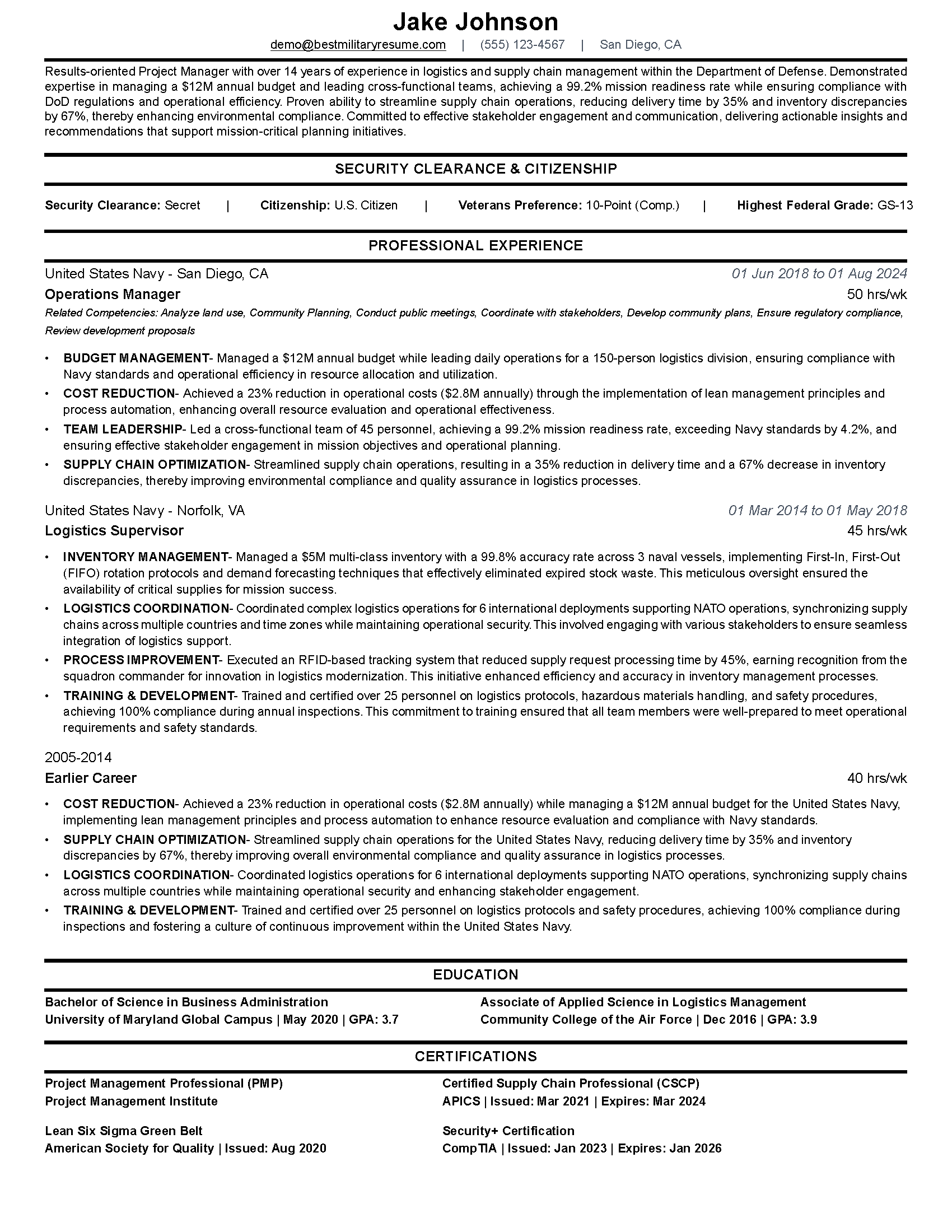
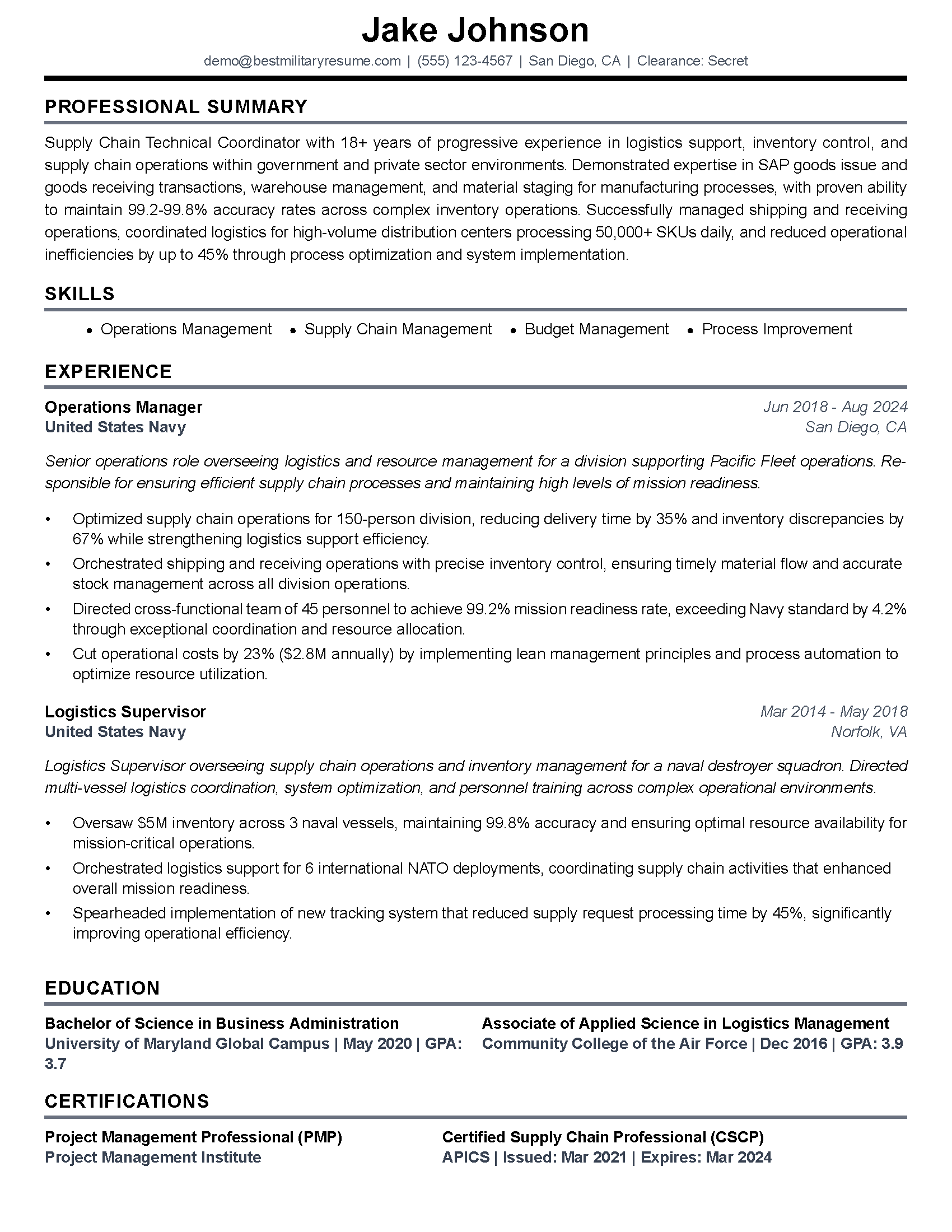
Your five-year answer promises growth. Your resume should show where that growth starts. If you say you'll lead a shift, show where you trained or led people.
Your resume should tell the same story as your answer. By November 22, 2026, BMR was on resume number 79,689. BMR's Resume Builder can help you match a resume to the job you're interviewing for. Make it show the skills your five-year answer names. The free plan gives a veteran one tailored resume per sector, federal and private.
All five outside pages loaded on November 24, 2026.
Frequently Asked Questions
Is it okay to say I don't know where I'll be in five years?
Can I make a joke when they ask where I see myself in five years?
Should I name the exact job title I want in five years?
About the author
Brad Tachi is the CEO and founder of Best Military Resume and a 2025 Military Friendly Vetrepreneur of the Year award recipient for overseas excellence. A former U.S. Navy Diver with over 20 years of combined military, private sector, and federal government experience, Brad brings unparalleled expertise to help veterans and military service members successfully transition to rewarding civilian careers. Having personally navigated the military-to-civilian transition, Brad deeply understands the challenges veterans face and specializes in translating military experience into compelling resumes that capture the attention of civilian employers. Through Best Military Resume, Brad has helped thousands of service members land their dream jobs by providing expert resume writing, career coaching, and job search strategies tailored specifically for the veteran community.