Laid Off as a Veteran: How to Bounce Back Fast
"Still getting interviews left and right. Now I have to say no."
Taranjeet, E-5, Army, optimized her LinkedIn and resume with BMR
Why Layoffs Hit Veterans Differently
Getting laid off stings no matter who you are. But for veterans, there is an extra layer. You spent years in a structure where your role was clear, your team had your back, and your mission was defined. Then you separated, fought through the transition, finally landed a civilian job, and now the rug gets pulled out from under you again.
The frustration is real. You did everything right. You tailored your resume, practiced your interview answers, and earned your spot. And none of that mattered when headcount reductions came down from leadership you never met.
Here is what I want you to understand before we get into tactics: a layoff is not a reflection of your performance. Companies cut roles for financial reasons, restructuring, mergers, and market shifts. The person who gets laid off on Tuesday might have been the top performer on Monday. Knowing that intellectually is one thing. Believing it when you are staring at a severance agreement is another.
After helping 15,000+ veterans through BMR, I have seen this pattern repeatedly. Veterans who get laid off often spiral into self-doubt faster than their civilian peers because military culture ties identity to mission. When the mission disappears, it feels personal. It is not. And the faster you separate your worth from your employer's financial decisions, the faster you will recover.
This guide covers what to do in the first 48 hours, how to rebuild your job search without starting from scratch, and where to find veteran-specific support that actually moves the needle.
What Should You Do in the First 48 Hours?
The first two days after a layoff set the tone for your entire recovery. Panic is natural. Acting on panic is costly. Here is a priority list that keeps you moving without making mistakes you will regret later.
Secure Your Finances First
File for unemployment immediately. Every state has an online portal, and most process claims within two to four weeks. Do not wait because you feel embarrassed. Unemployment insurance exists for exactly this situation, and you paid into it with every paycheck.
Review your severance package carefully before signing anything. If you have questions, many state bar associations offer free consultations for employment law questions. Pay attention to non-compete clauses, benefits continuation timelines, and any language about waiving your right to future claims.
Check your COBRA options for health insurance, but also look at VA healthcare eligibility. If you have a service-connected disability rating, you may already have coverage you forgot about. The VA healthcare system is not perfect, but it is free or low-cost for eligible veterans.
Protect Your Professional Network
Do not disappear. The instinct to go quiet and lick your wounds is strong, but silence costs you opportunities. Within the first 48 hours, message your closest professional contacts directly. Not a mass LinkedIn post. Personal, one-on-one messages to people who know your work.
"Hey, just wanted to let you know I was laid off. Let me know if you hear of anything."
"Hi Sarah, my role at Acme was eliminated in a restructuring. I am looking for operations management positions in logistics or supply chain. Would you be open to a 15-minute call this week?"
The difference is specificity. The strong version tells your contact exactly what you need, which makes it easy for them to help. Vague asks get vague results.

How Do You Update Your Resume Without Starting Over?
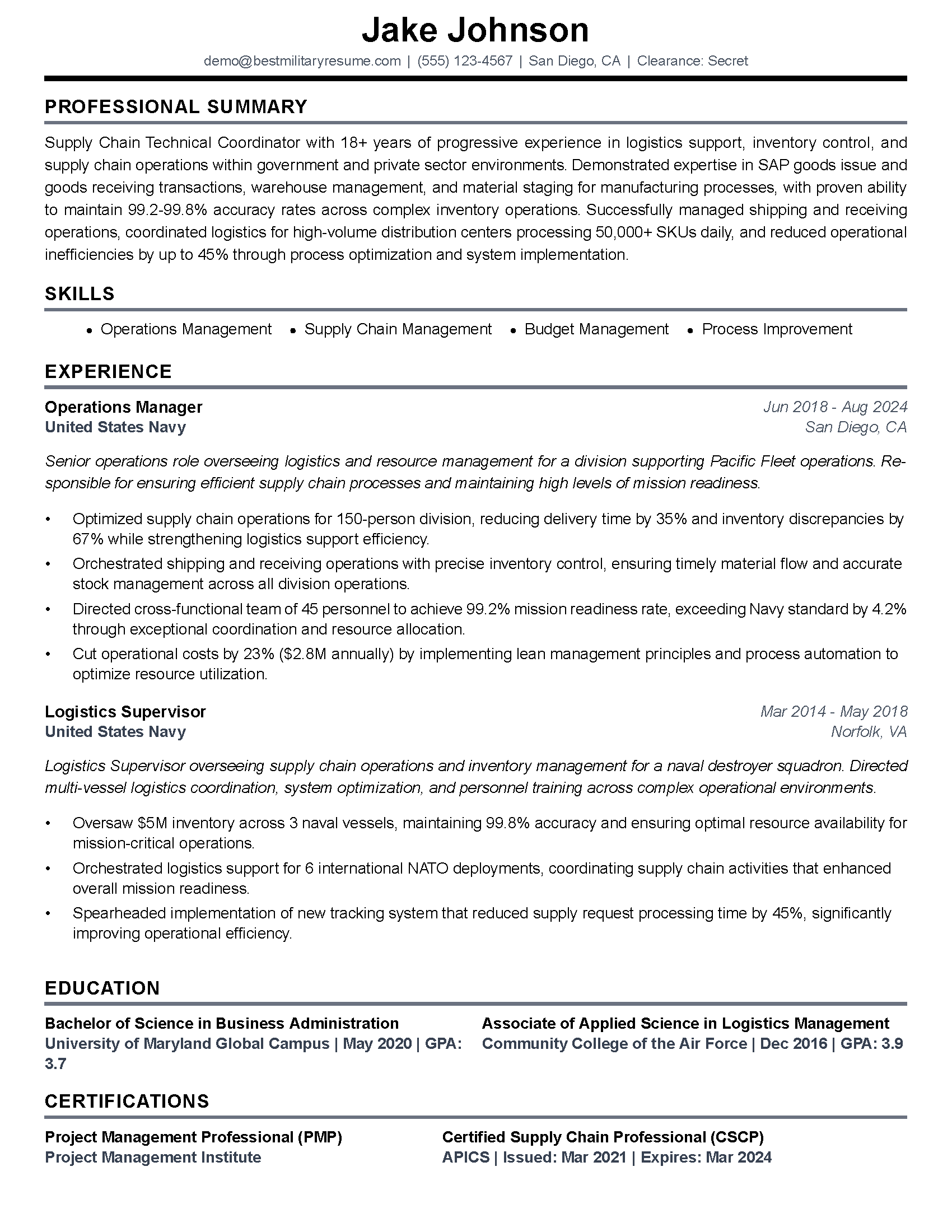
Good news: if you built a solid resume when you got this job, most of the heavy lifting is already done. You do not need to start from scratch. You need to update, refresh, and retarget.
Start by adding your most recent role with specific accomplishments. Do not just list duties. Quantify what you delivered. If you managed a team of 12, say that. If you reduced processing time by 30%, include that number. Hiring managers want to see impact, not job descriptions.
Next, look at your target roles. Are you going after the same type of position, or is this an opportunity to pivot? If you are staying in the same field, your resume updates are minimal. Swap in your latest experience, refresh your summary, and make sure your keywords match current job postings.
If you are considering a change, you will need to reframe your experience for a new industry. This is where most veterans get stuck. They try to write one resume for every job, and it works for none of them.
Key Takeaway
Every job posting you apply to deserves a resume tailored to that specific role. BMR's free tier gives you two tailored resumes, which is enough to target your top-priority positions right now.
Should You Take the First Offer You Get?
This is the question that keeps laid-off veterans up at night. Bills are real. Savings are finite. The pressure to say yes to the first offer is enormous. But taking the wrong job because you panicked can set your career back years.
Here is a framework. If the offer meets two of these four criteria, it is worth serious consideration: it pays at least 80% of your previous salary, it builds skills you want on your resume, the company has a track record of stability, or it moves you closer to your long-term career goal.
If it only meets one, think carefully. If it meets zero, keep looking unless you are genuinely about to miss rent. There is a difference between being strategic and being reckless with your finances.
One pattern I have seen repeatedly: veterans take a job out of desperation, then spend a year miserable before starting the search again. That year of misery also means a year of not building the right experience, not growing your network in the right direction, and not progressing toward where you actually want to be.
If you need income while searching for the right role, consider contract work or consulting. Staffing agencies like Robert Half, Adecco, and military-specific firms like Bradley-Morris can place you in temporary roles within weeks. You earn money, keep your skills sharp, and stay in the game without committing to the wrong full-time position.
What Veteran-Specific Resources Actually Help?
Not all veteran resources are created equal. Some are genuinely useful. Others are well-meaning but produce nothing beyond a handshake and a pamphlet. Here is what actually moves the needle when you are laid off.
VA Vocational Rehabilitation (VR&E / Chapter 31)
If you have a service-connected disability rating, VR&E can fund retraining, education, and even job placement assistance. The program covers tuition, books, and a monthly living stipend. It is underused because many veterans do not know they qualify or assume it is only for people who cannot work at all. That is not how it works. If your disability creates a barrier to employment in your current field, you may be eligible.
American Job Centers (CareerOneStop)
Every state has American Job Centers funded by the Department of Labor. They offer free resume reviews, interview coaching, and job leads. Veterans get priority of service, which means you go to the front of the line. Find your nearest center at careeronestop.org.
Veteran Service Organizations
Organizations like Hire Heroes USA, American Corporate Partners, and the Veterans Employment Trajectory program offer free one-on-one career coaching. These are not generic job boards. They pair you with a dedicated advisor who helps with your specific situation.
1 File for Unemployment
2 Check VA Healthcare Eligibility
3 Contact Your Network
4 Update Your Resume
5 Explore VR&E Benefits
How Do You Handle the Employment Gap on Your Resume?
Here is the truth about employment gaps in 2026: they are far less stigmatized than they were five years ago. Mass layoffs at major tech companies, federal workforce reductions, and economic shifts have normalized gaps in a way that works in your favor.
That said, you still need to address the gap strategically. On your resume, list your end date honestly. Do not try to fudge dates or extend your employment. Background checks will catch it, and getting caught in a lie is far worse than having a gap.
In interviews, keep your explanation brief and forward-focused. "My role was eliminated in a company-wide restructuring. I have spent the time since then focusing on [specific skill, certification, or job search activity]." That is it. No long stories. No bitterness about your former employer. No over-explaining.
If your gap extends beyond a couple of months, fill it with something tangible. Volunteer work, freelance projects, certifications, or even helping other veterans with their transitions. The goal is not to pretend you were busy every second. The goal is to show you stayed engaged and kept building skills.
"I spent 18 months applying for government jobs after I separated with zero callbacks. The gap was not the problem. The resume was the problem. Once I fixed the resume, the gap stopped mattering."
Is a Layoff Actually an Opportunity to Change Direction?
I know this sounds like motivational poster garbage. But hear me out, because this one is backed by my own career history, not theory.
When I moved from federal logistics into tech sales, it was not part of some grand plan. The timing just lined up, and I was willing to take the shot. That willingness to pivot opened up a completely different career trajectory that eventually led to building BMR.
A layoff forces a reset. And a reset gives you permission to ask questions you were too comfortable to ask before. Questions like: Was I actually happy in that role? Was I growing? Was I heading somewhere I wanted to go?
If the answers are yes, great. Get back on the same path with a better resume. But if the answers are no, this is your window. Use the same timeline planning approach you would use for any career transition. Map out your target industry, identify the skills gap, and start closing it.
Veterans have an advantage here that most civilians do not. You have already reinvented yourself at least once, when you transitioned out of the military. You know what it feels like to start fresh in a world that does not speak your language. You did it before. This time is easier because you already have civilian experience, a professional network, and a track record that translates.
How Do You Stay Motivated During a Long Job Search?
Job searching after a layoff is a grind. Especially when weeks turn into months. The rejection emails pile up. The ghosting gets old. And the well-meaning friends who say "something will come along" start to feel like they are speaking a different language.
Here is what actually works for staying productive during a long search. Structure your days like a job. Set a start time, block off hours for applications, networking, and skill-building, and give yourself an end time. The worst thing you can do is spend 14 hours a day refreshing job boards. That is not effort. That is anxiety disguised as productivity.
Set weekly goals, not daily ones. Apply to 10 targeted positions per week. Have two networking conversations per week. Learn one new skill or earn one certification per month. These numbers keep you moving without burning out.
Connect with other veterans who are job searching. Organizations like Hire Heroes USA run virtual networking events, and simply talking to someone who understands your situation makes the grind more bearable. Your LinkedIn profile should be active during this time too. Share articles, comment on industry posts, and let your network know you are looking.
Avoid Mass-Apply Burnout
Sending 50 generic applications per day feels productive but produces almost nothing. Ten tailored applications with customized resumes will outperform 100 generic ones every time. Quality over volume.
What If You Want to Go Federal After Being Laid Off?
Federal employment is appealing after a layoff for obvious reasons: job stability, benefits, veterans preference, and structured pay scales. If you have been thinking about going federal, a layoff might be the push you needed.
But federal hiring moves slowly. Expect 60 to 120 days from application to offer, sometimes longer. Plan your finances and job search timeline around that reality. You might want to take contract work or a temporary position while your federal applications process.
Your resume needs to be formatted specifically for federal applications. Federal resumes include details that private sector resumes do not, like hours worked per week, supervisor contact information, and detailed duty descriptions. But keep it to two pages. The old advice about writing a 4-6 page federal resume is outdated. Check out our federal resume guide for the current best practices.
Veterans preference gives you a real edge in federal hiring. If you have a disability rating, you get additional preference points. Make sure your USAJOBS profile is complete and that you are selecting the right appointment eligibilities when you apply.
Moving Forward After a Layoff
Getting laid off as a veteran feels like a second transition. And in some ways, it is. But this time you are not starting from zero. You have civilian work experience, professional contacts, and a much clearer picture of what you want from your career.
The veterans who recover fastest from layoffs share a few traits. They act quickly but not frantically. They ask for help without shame. They treat the job search as a mission with daily objectives. And they refuse to let a corporate budget decision define their worth.
Your military service gave you the ability to operate under pressure, adapt to changing circumstances, and execute when the plan falls apart. A layoff is not the end of your career. It is an interruption. And interruptions end when you decide to move forward with a plan.
BMR's Resume Builder can help you retarget your resume for new positions quickly. The free tier includes two tailored resumes, cover letters, and LinkedIn optimization. Built by a veteran who has been laid off, pivoted careers, and rebuilt from scratch more than once.
Browse openings: Search veteran-friendly job postings on the BMR Job Board.
Frequently Asked Questions
Should I mention I was laid off in my resume?
How long does it take veterans to find a new job after a layoff?
Can I use my GI Bill benefits after being laid off?
Does veterans preference still apply after I have been in the civilian workforce?
Should I take a lower-paying job just to have income?
What veteran organizations help with layoff recovery?
How do I explain a layoff in an interview?
About the Author
Brad Tachi is the CEO and founder of Best Military Resume and a 2025 Military Friendly Vetrepreneur of the Year award recipient for overseas excellence. A former U.S. Navy Diver with over 20 years of combined military, private sector, and federal government experience, Brad brings unparalleled expertise to help veterans and military service members successfully transition to rewarding civilian careers. Having personally navigated the military-to-civilian transition, Brad deeply understands the challenges veterans face and specializes in translating military experience into compelling resumes that capture the attention of civilian employers. Through Best Military Resume, Brad has helped thousands of service members land their dream jobs by providing expert resume writing, career coaching, and job search strategies tailored specifically for the veteran community.
