79R Recruiter Resume: Corporate Recruiter and Talent Acquisition Guide
Desiree landed a $135K hybrid senior financial consultant role.
Desiree, E-5, Army National Guard, the interviewer loved the resume from the top down
A recruiter on station lives by a number. The mission comes down at the start of the month. By the end of it, you either made it or you explain why. That pressure sits behind every contract you wrote. Much of it never makes it onto a resume.
After the Navy, I spent a stretch carrying a number in private-sector tech sales. I didn't hire anyone there. I was a rep with a quota, and that's the point. Recruiting duty is quota work too. You find people, you qualify them, and you get them to yes. Corporate recruiting teams do that same work every day.
This guide is for the Army 79R Recruiter. It also covers the Navy, Marine Corps, and Air Force versions. You'll get the civilian titles that fit and the codes that count. You'll also get bullets to fill in, keywords, and a summary. It stays on the recruiting resume. For a general HR resume, see the HR resume guide for veterans.
Which civilian jobs fit a 79R recruiter?
A 79R recruiter civilian jobs resume starts with the title at the top of the page. Three lanes fit recruiting duty best. A fourth works if you'd rather sell.
- Corporate recruiter: You fill open jobs for one company. You source people, screen them, and move them to an offer. This is the closest match to station work.
- Talent acquisition specialist: Same core work, often with more focus on the full hiring plan. Postings may mention employer brand, events, and campus hiring.
- Recruiting coordinator: You run the process behind the recruiter. Think interviews, paperwork, and keeping candidates on track to a start date.
- HR business partner: A broader role that advises managers on people issues. It's usually a later step, and we cover it below.
The Bureau of Labor Statistics (BLS) groups recruiters with human resources specialists. It says these workers recruit, screen, and interview applicants. The median annual wage for the group was $75,940 in May 2025. That's a median, so your offer may land above or below it.
If you'd rather keep a quota and sell a product, that works too. Our sales resume guide for veterans covers that lane. Army health care recruiters have a medical sales guide of their own. The rest of this guide stays on recruiting and talent acquisition.
Which recruiting jobs count, branch by branch?
The Army isn't the only service with a full-time recruiter job. Each branch names it a little differently. They do the same core work, so this guide fits each one.
Army: 79R and 42T
The 79R is the Army's career recruiter MOS (military occupational specialty). In 2023, Stars and Stripes reported on the Army's 8,000 recruiters. About two-thirds held the job on a temporary tour. The rest were permanent 79Rs.
That same year, the Army said it would build a new full-time recruiting MOS. It's the 42T Talent Acquisition Specialist. The first soldiers were picked for it in 2024. Notice the title. The Army now uses the same words a civilian posting uses. So a 42T can often keep the title on the resume.
Recruited on a temporary tour outside your MOS? The work still counts. Put it in its own entry with its own dates and numbers.
Navy: the Navy Counselor rating
The Navy Counselor (NC) rating covers two jobs. One side is the Career Recruiting Force, which brings civilians into the Navy. The other side works inside commands as a career counselor for sailors already serving. MyNavy HR's rating page lists both kinds of work. It names interviews, career counseling, talks to groups, and recruiting civilians.
Know which side you worked. Recruiting force time maps to recruiter and talent acquisition jobs. Command counselor time maps better to retention, career coaching, and HR business partner work.
Marine Corps: 8411 and 8412
Marines go to recruiting duty under the 8411 billet MOS after Basic Recruiters School. Strong recruiters can apply to become career recruiters, MOS 8412. The Marine Corps Recruiting Command says 8412s get long-term assignments in key manager billets. They usually move to a new key billet after each 3-year tour. One of those billets is substation SNCOIC (staff noncommissioned officer in charge). If you ran a substation, you managed recruiters. Write it that way.
Air Force: 3G0X1 Talent Acquisition
The Air Force now has a recruiting career field of its own, 3G0X1 Talent Acquisition. Its official summary says the field runs programs to recruit enough people for the Air Force. Many recruiters still come from other career fields for a recruiting tour. As with the Army 42T, the title already matches civilian postings.
What does station work look like in civilian words?
Your daily work has a civilian name. The words just changed. The big pieces line up like this.
- Prospecting: Civilian teams call this sourcing. School lists, phone blocks, social media, and walk-ins are all sourcing channels.
- Mission: Your monthly mission was a hiring goal. Corporate teams talk about filling open jobs against a target and a deadline.
- Centers of influence: Teachers, coaches, and counselors who sent you leads. Civilian teams call these partner or referral relationships.
- Processing at MEPS: MEPS is the Military Entrance Processing Station. Getting applicants through testing and medical screening is candidate screening and process management.
- Waivers: A waiver packet is an exception request with documents behind it. That's compliance work, and it shows judgment.
- Conversion rates: Leads to appointments to contracts is a hiring funnel. Recruiting teams track the same kind of ratios.
- Delayed Entry and Future Soldier pipeline: You kept people ready between contract and ship date. That's pre-start candidate care. Civilian teams worry about people who accept an offer and never show up.
Your pool of future soldiers, sailors, or poolees had to stay ready for months. You kept them in touch, trained, and on track. Fewer losses before ship date is a real result. Count them if you tracked them.
How do you write recruiter bullets that carry your numbers?
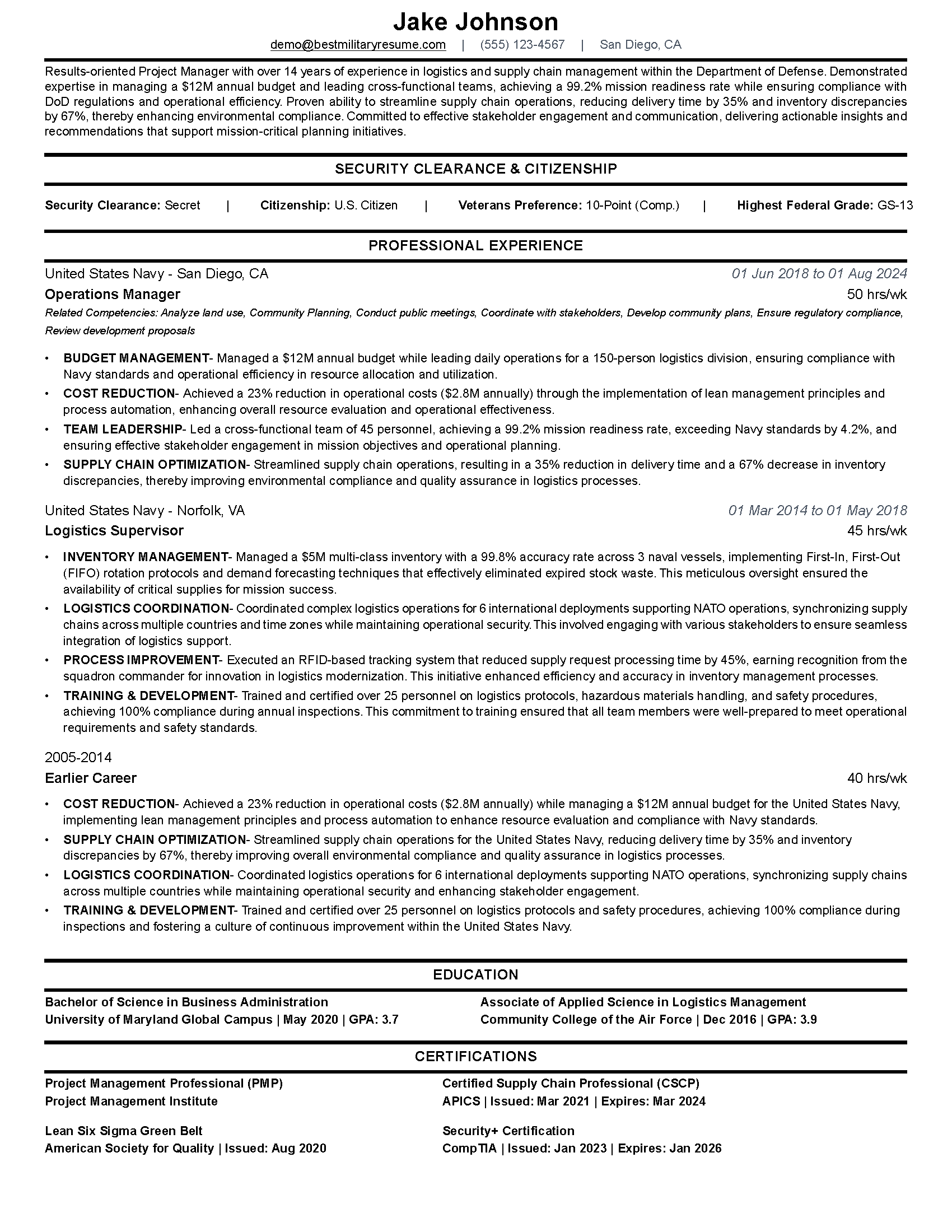
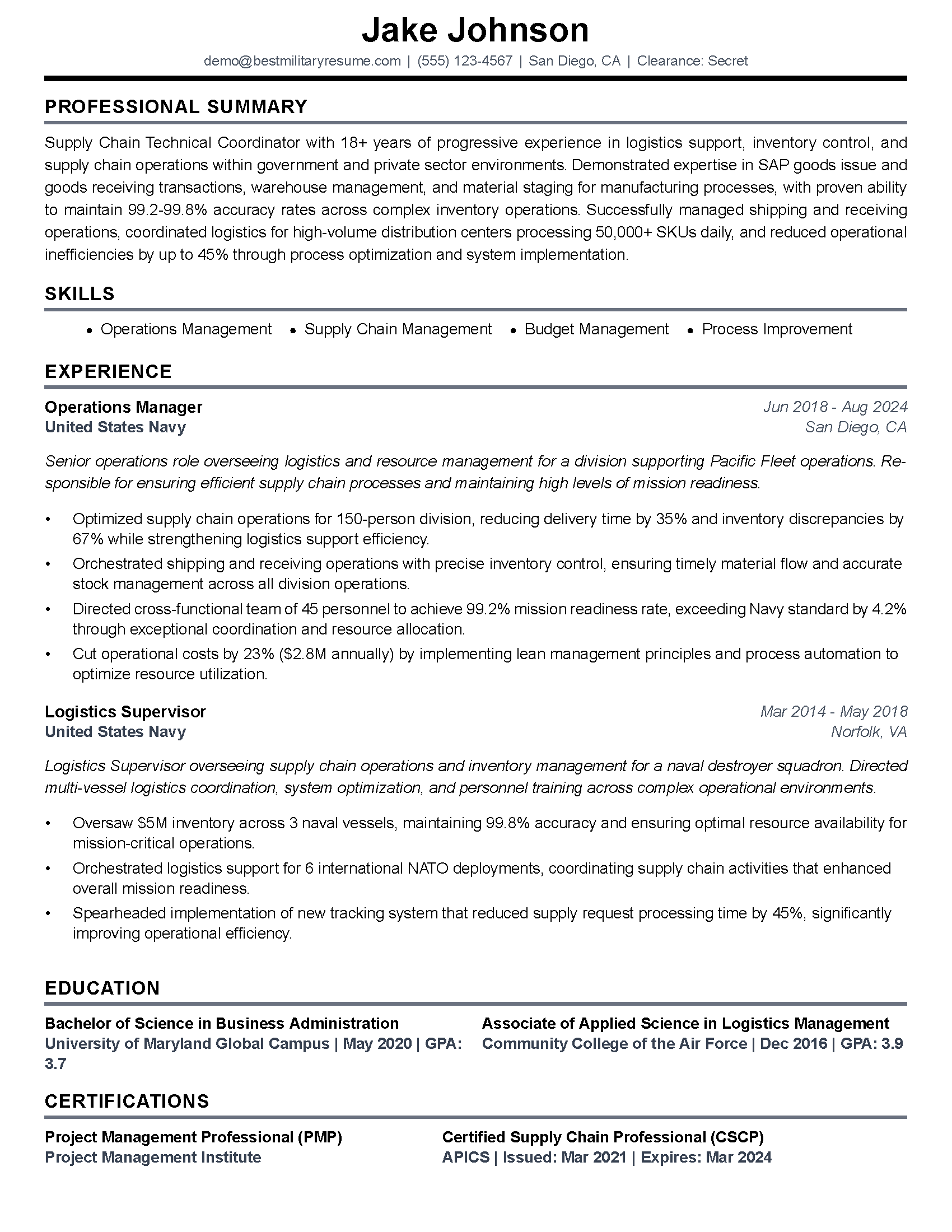
BMR builds bullets one way, and you can use the same method by hand. Each bullet shows the challenge, the action you took, and the result. Each one runs about 25 to 45 words. It opens with a strong verb. It carries the scope: how many people, how big the area, how many contracts.
The numbers have to be yours. Pull them from your evaluations, your awards, and your station reports. Our guide to turning evaluations into resume bullets shows where those numbers hide.
The examples below put sample numbers in brackets. They are not real results. Swap in your own, and cut any bullet you can't back up.
One bullet, before and after
Here's a line many station resumes carry. It lists a duty and stops there.
Before: Responsible for prospecting, processing applicants at MEPS, and maintaining the Future Soldier program.
Now the same work with the challenge, the action, and the result in it.
After: Worked a [2]-county territory with [no] prior school partners and a [10]-contract monthly goal. Built [6] school partnerships and guided [41] applicants through entrance testing and medical exams. Kept [31] of [33] signed recruits on track to their start dates.
The second version tells a recruiting manager what you faced and what you got done. Every number in it is a placeholder. Yours go in the brackets.
Corporate recruiter bullets
- Built a sourcing plan across [9] high schools and [2] community colleges in a [3]-county territory. Signed [14] enlistment contracts against a [12]-contract monthly goal.
- Screened [60] applicants a month for medical, legal, and test score standards. Moved [22] qualified candidates through testing and medical exams with [zero] packets returned for errors.
- Raised the lead-to-appointment rate from [8] to [15] percent in [6] months. Did it by shifting phone blocks to evenings and adding [2] new referral partners at local schools.
- Prepared [11] exception request packets for applicants who needed approval to enlist. Gathered records and statements for each one, and [9] were approved on first submission.
Talent acquisition and team lead bullets
- Led a team of [5] recruiters covering [4,000] square miles and a [40]-contract monthly goal. Coached each recruiter on weekly plans, and the station hit goal in [10] of [12] months.
- Managed a pool of [35] candidates waiting [3] to [9] months for start dates. Ran monthly meetings and check-ins that cut losses before start from [6] to [2] people a year.
- Tracked weekly funnel numbers for [6] recruiters, from first contact to signed contract. Found a drop at the testing step and added prep sessions that raised pass rates by [12] percent.
See how none of these say "recruiter of the quarter" or name a station? An award can still go on the page. Put it inside the job that earned it, and say what you did to earn it.
Which keywords should come from the posting?
Your keywords are the posting's own words for the work you've actually done. Every posting has a different set. That's why one resume can't cover them all. Read the posting first, then mark every phrase that matches real work.
Here are words that often show up in recruiter and talent acquisition postings. Use one only when you did that work.
- Full-cycle recruiting: Fits if you took people from first contact to signed contract.
- Sourcing and pipeline: Fits your prospecting and lead tracking.
- Candidate screening: Fits your interviews and eligibility checks.
- Hiring goals or requisitions: Fits your monthly mission, if the posting uses those words.
- Candidate experience: Fits the care you gave applicants from first call to ship date.
- Background checks and compliance: Fits your waiver and records work.
- Recruiting metrics: Fits your conversion rates and weekly reports.
- Campus recruiting and events: Fits school visits, job fairs, and community events.
Some postings name a recruiting software you never used. Leave it off. Put the posting's words next to real proof, and the page works for the software and the person. Our keyword guide by industry has more lists to check against.
How do you write the professional summary?
The summary sits at the top. It's three or four sentences, about 60 to 100 words. The first sentence names the job you want. After that, it shows your scope and your best result.
A few things stay out. Skip openers like "results-driven," "proven," or "dynamic." Leave out unit names, commands, and acronyms. Don't use the words "military" or "transition" here. Your work history already shows where you served, so the summary can talk like the job you want.
Here's a sample for a corporate recruiter posting. The brackets are placeholders for your own facts.
Corporate recruiter with [6] years of full-cycle recruiting in a quota-driven territory. Sourced, screened, and signed [150] candidates while hitting a monthly hiring goal in [20] of [24] months. Led a team of [5] recruiters and raised lead-to-appointment conversion by [7] points with better weekly planning. Brings candidate screening, pipeline tracking, and compliance work to a talent acquisition team.
Change the first sentence for each posting. A talent acquisition specialist posting gets that title. An HR business partner posting gets that title. For more on the shape, see our professional summary formula.
What changes for an HR business partner posting?
An HR business partner advises managers on their people. That can mean hiring plans, performance issues, retention, and team changes. Recruiting is one piece of it. So the resume has to show more than contracts signed.
Look at the posting's duties, then find your matching work. A station leader who coached recruiters and planned coverage has advising and workforce planning to show. A Navy command career counselor who ran a retention program has strong material here. A recruiter with only canvassing time may fit a recruiter job better first.
Many HR business partner postings ask for general HR experience too. Read the requirements before you apply. If you're short, a recruiter or talent acquisition job can be the first step. Our guide to HR career paths for veterans covers that ladder.
The pay can change too. The BLS reports a median annual wage of $149,280 for human resources managers in May 2025. BLS doesn't list HR business partner as its own job. Many people see it as a step toward HR management.
What should come off the recruiter resume?
Some things on a station resume slow a civilian reader down. Cut or change these.
- Rank: Take it off. Bring the scope with you. The size of what you ran shows your level.
- Station and unit names: A civilian reader may not know them. Use the city and the size of your territory.
- Unexplained acronyms: Spell out each acronym the first time it shows up. MEPS is Military Entrance Processing Station on first use. After that, MEPS can stand.
- Duty lists: "Responsible for prospecting" tells them nothing about results. Swap it for a bullet with a number.
- Your separation paperwork: The DD-214 confirms your dates and discharge. It isn't a source for resume bullets.
Keep everything in your base resume, even old jobs. Then cut a tighter version for each posting. The base holds every fact, so a number doesn't get lost between versions.
What to Do Next
Pick one real posting for a corporate recruiter or talent acquisition specialist. Mark the duties and phrases you've actually done. Pull your numbers from your evaluations and reports. Then write four bullets and a summary for that one job.
Putting my own Navy years into civilian words was a hard step. I'm an ex-diver who built the tool I wish I had.
The BMR military resume builder turns your recruiting record into a civilian resume. Then it tailors a version to the posting's own words. The free tier covers 2 tailored resumes, one federal and one private sector. Want to see the finished shape first? Browse our resume examples.
Brad Tachi
Navy Diver veteran, BMR founder
Frequently Asked Questions
What civilian jobs can a 79R recruiter get?
Should a 79R recruiter list mission numbers on a resume?
How do I explain MEPS on a civilian resume?
Does a temporary recruiting tour count as recruiting experience?
What civilian jobs fit a Navy Counselor?
How much do corporate recruiters make?
Should my resume say military recruiter or corporate recruiter?
About the author
Brad Tachi is the CEO and founder of Best Military Resume and a 2025 Military Friendly Vetrepreneur of the Year award recipient for overseas excellence. A former U.S. Navy Diver with over 20 years of combined military, private sector, and federal government experience, Brad brings unparalleled expertise to help veterans and military service members successfully transition to rewarding civilian careers. Having personally navigated the military-to-civilian transition, Brad deeply understands the challenges veterans face and specializes in translating military experience into compelling resumes that capture the attention of civilian employers. Through Best Military Resume, Brad has helped thousands of service members land their dream jobs by providing expert resume writing, career coaching, and job search strategies tailored specifically for the veteran community.