92Y Unit Supply Specialist: Logistics Resume Guide
Desiree landed a $135K hybrid senior financial consultant role.
Desiree, E-5, Army National Guard, the interviewer loved the resume from the top down
Why Is the 92Y MOS So Valuable to Civilian Employers?
The 92Y Unit Supply Specialist is one of the most transferable MOSs in the Army. Every civilian company with a warehouse, distribution center, or supply chain needs people who can manage inventory, process orders, and keep accountability over millions of dollars in assets. You already do that. The challenge is proving it on paper with language a civilian hiring manager actually recognizes.
I worked in federal supply and logistics myself — it was one of six federal career fields I was hired into after separating as a Navy Diver. The terminology gap between military supply operations and civilian logistics is real, but it is smaller than most MOS translations. Your daily work in GCSS-Army, property book management, and supply requisitions maps almost perfectly to civilian warehouse management and procurement roles. You just need the right vocabulary on your resume.
This guide breaks down exactly how to translate your 92Y experience into a resume that gets you interviews for warehouse manager, inventory specialist, supply chain coordinator, and federal logistics positions. Every recommendation comes from what actually works — not theory.
Key Takeaway
92Y specialists manage inventory, procurement, and asset accountability every day. Civilian employers need the exact same skills — you just need to swap the military terminology for industry-standard language on your resume.
What Are the Best Civilian Jobs for a 92Y Veteran?
Your 92Y experience qualifies you for a wide range of civilian roles. The logistics and supply chain industry is massive, and employers are actively hiring people who can manage inventory at scale. According to the Bureau of Labor Statistics, logisticians earn a median salary of $79,400 per year, and employment in logistics is projected to grow 18% through 2032 — much faster than average.
Here are the civilian roles that align most directly with 92Y duties. You do not need to pick just one — many veterans move between these roles as they build civilian experience.
Private Sector Roles
Warehouse Manager — You ran a supply room. Civilian warehouses need the same skills: receiving, storing, issuing, and tracking inventory. Warehouse managers typically earn $50,000 to $80,000 depending on the size of the operation and your location. Amazon, FedEx, UPS, and major retailers all hire aggressively for these positions.
Inventory Control Specialist — If your 92Y experience leaned heavily toward property book accuracy and cyclic inventories, this is a natural fit. These roles focus on tracking stock levels, identifying discrepancies, and optimizing reorder points. Expect salaries in the $45,000 to $65,000 range at mid-level.
Supply Chain Coordinator — This role sits between procurement and distribution. You coordinate the movement of goods from vendor to warehouse to end user. Your experience processing supply requests through GCSS-Army translates directly. Salaries range from $55,000 to $75,000.
Procurement Specialist — If you handled ordering, vendor coordination, or contract management in your unit, procurement is a strong path. Companies need people who can source materials, negotiate with vendors, and manage purchase orders. Salaries range from $50,000 to $70,000 at entry to mid-level.
Logistics Analyst — For 92Y veterans who want to move into data-driven roles, logistics analysts use supply chain data to improve efficiency. If you tracked metrics, ran reports in GCSS-Army, or identified patterns in supply shortages, this is worth pursuing. These roles often pay $60,000 to $85,000.
Use BMR's career crosswalk tool to see the full list of civilian jobs mapped to your MOS, including salary ranges and growth projections.
Federal Government Positions
Federal agencies hire supply specialists constantly. The GS series that match 92Y experience include 2003 (Supply Program Management), 2005 (Supply Clerical and Technician), 2010 (Inventory Management), 2030 (Distribution Facilities and Storage Management), and 2032 (Packaging). Most of these positions start at GS-5 through GS-9 and promote quickly with your military background. With veterans preference points, you get a real advantage in federal hiring.

How Do You Translate 92Y Duties Into Civilian Resume Language?
The biggest mistake 92Y veterans make on their resumes is using Army-specific terms that mean nothing outside the military. A hiring manager at a logistics company has never heard of a "hand receipt holder" or "GCSS-Army." They know what an ERP system is. They know what inventory accountability means. Your job is to bridge that gap with the right military-to-civilian translations.
Maintained property book for BN-level supply operations using GCSS-Army. Processed DA Form 3161 hand receipts and conducted 10% cyclic inventories IAW AR 710-2.
Managed $4.2M inventory using enterprise resource planning (ERP) software. Processed asset transfers and equipment issue documentation. Conducted quarterly cycle counts maintaining 98% inventory accuracy.
Here is a translation reference for the most common 92Y duties. Use these as starting points, then customize with your actual numbers and scope.
Property book management becomes "inventory control and asset management." Always include the dollar value of assets you were responsible for. A battalion property book can easily be $5M to $50M+ depending on the unit. That number belongs on your resume.
Supply requests and requisitions become "procurement and purchasing." If you processed supply requests, you were essentially creating purchase orders. Mention the volume — how many requests per week or month — and any cost savings you achieved by sourcing alternatives or consolidating orders.
Hand receipts become "asset tracking and accountability documentation." The concept of sub-hand receipts maps directly to custody transfer records in civilian warehouses. Mention how many items or sub-accounts you tracked.
GCSS-Army becomes "enterprise resource planning (ERP) system." This is critical because ERP experience is a top requirement for logistics roles. SAP, Oracle, and other ERP platforms work on the same principles as GCSS-Army. You have legitimate ERP experience — call it that.
Cyclic inventories and change of command inventories become "cycle counts and physical inventory audits." Include your accuracy rates. If you maintained 98%+ accuracy on inventories, that is a strong selling point for any warehouse or inventory role.
What Certifications Should a 92Y Veteran Get?
Certifications accelerate your transition because they prove your skills in civilian-recognized terms. You do not need all of these, but picking one or two based on your target role makes a measurable difference in callback rates. After helping 15,000+ veterans through BMR, the pattern is clear: veterans with at least one industry certification get more responses from employers.
Top Certifications for 92Y Veterans
APICS CPIM (Certified in Logistics, Transportation and Distribution)
Industry standard for inventory and production management. Directly validates your 92Y experience in civilian terms.
APICS CSCP (Certified Supply Chain Professional)
Broader supply chain certification. Best if you want to move into supply chain coordinator or analyst roles.
Six Sigma Green Belt
Shows you can improve processes and reduce waste. Highly valued in warehouse and distribution center management.
OSHA Forklift Certification
Quick, affordable, and often required for warehouse roles. If you operated MHE in the Army, this validates it civilly.
Certified Logistics Associate (CLA) / Certified Logistics Technician (CLT)
Entry-level credentials from the Manufacturing Skill Standards Council. Good stepping stone if you are early in your transition.
Many of these certifications are covered by the GI Bill or employer tuition reimbursement programs. Check with your VA education benefits office before paying out of pocket. Some SkillBridge programs also include certification prep as part of their curriculum.
How Should You Structure Your 92Y Resume for Maximum Impact?
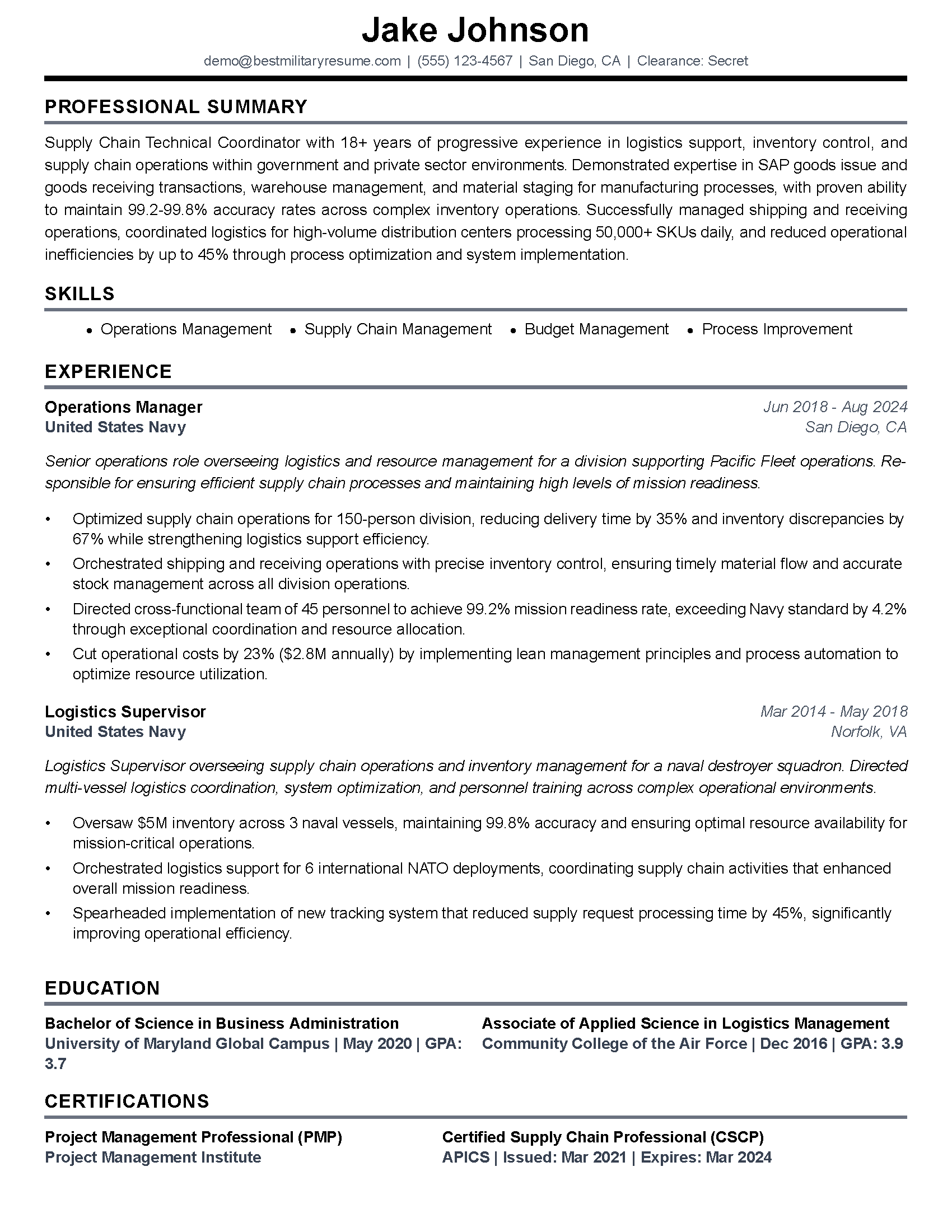
Your resume structure matters as much as the content. A hiring manager scanning logistics resumes wants to see relevant experience, quantified results, and industry keywords — fast. The 6-second scan is real. I have sat on the other side of that desk, and if your resume does not immediately signal "this person can manage a warehouse," it goes to the bottom of the stack.
Start with a professional summary that positions you as a logistics professional, not a soldier. Two to four sentences that include your years of experience, the scope of what you managed, and your target role. Skip the objective statement — hiring managers do not care what you want. They care what you can do for them.
Dedicated Army veteran seeking a position in logistics where I can use my military experience to contribute to team success.
Inventory and logistics professional with 6 years of experience managing $12M+ in assets across distribution operations. Skilled in ERP systems, procurement, cycle count programs, and vendor coordination. Maintained 99% inventory accuracy across 4,200+ line items.
For your work experience section, lead every bullet point with a strong action verb and follow it with a measurable result. "Managed inventory" is weak. "Managed $8.3M equipment inventory across 12 sub-hand receipt accounts, maintaining 98.5% accuracy during two change-of-command inventories" tells a hiring manager exactly what you can do and at what scale.
Keep your resume to two pages maximum. Federal resumes need more detail — hours per week, supervisor information, specific duties — but the target length is still two pages. The old advice about 4-6 page federal resumes is outdated.
Which Companies Are Actively Hiring 92Y Veterans?
The logistics industry is one of the largest employers in the country, and many companies specifically recruit military veterans for their supply chain operations. Here are the employers where 92Y experience translates most directly.
Amazon — Their fulfillment center operations mirror military supply operations at scale. Amazon actively recruits veterans and has a dedicated military hiring program. Roles include area manager, operations manager, and inventory control specialist. Starting salaries for operations managers range from $60,000 to $85,000.
FedEx and UPS — Both companies have massive distribution networks and value the discipline and logistics training military veterans bring. Package handler to operations supervisor is a common promotion path, and many 92Y veterans start in hub management roles.
Defense Contractors — Companies like Lockheed Martin, Raytheon, General Dynamics, and BAE Systems need logistics specialists who already understand military supply chains. If you have a security clearance, these positions pay significantly more. A cleared logistics specialist at a defense contractor can earn $70,000 to $100,000+. Consider building a defense contractor resume alongside your civilian version.
Federal Agencies — DLA (Defense Logistics Agency), GSA, Army Materiel Command, and nearly every DoD installation have civilian supply positions. You already speak the language and understand the systems. Federal supply positions in the GS-2003 and GS-2010 series typically start at GS-7 to GS-9 for veterans with 92Y experience, which translates to $40,000-$60,000 depending on locality pay.
Major Retailers — Walmart, Target, Home Depot, and Costco all have distribution center operations that need experienced warehouse and inventory professionals. These companies have veteran hiring initiatives and often promote from within.
Pro Tip: Tailor for Each Application
Do not send the same resume to Amazon and DLA. A private sector logistics resume emphasizes speed, efficiency, and cost savings. A federal resume emphasizes compliance, accountability, and detailed duty descriptions. BMR's resume builder handles this translation automatically — paste the job posting and get a resume tailored to that specific employer.
Ready to Build Your 92Y Civilian Resume?
Your 92Y experience is genuinely valuable to civilian employers. You have managed millions in assets, operated ERP systems, maintained strict inventory accuracy under pressure, and handled procurement from request to receipt. Those are exactly the skills logistics companies pay well for.
The only thing standing between you and interviews is translation. Military jargon on your resume makes hiring managers skip past you — not because your experience is weak, but because they cannot parse it quickly enough during that initial scan. Fix the language, add your numbers, and target each application to the specific role.
BMR was built for exactly this situation. Paste a job posting into the resume builder, and it translates your 92Y experience into the language that specific employer is looking for. Two free tailored resumes, cover letters, and LinkedIn optimization included. Built by a veteran who went through the same transition and figured out what actually gets callbacks.
Frequently Asked Questions
What civilian jobs can I get with a 92Y MOS?
How do I list GCSS-Army on a civilian resume?
What certifications help a 92Y veteran get hired faster?
Should I include my property book value on my resume?
How long should a 92Y veteran resume be?
Do 92Y veterans qualify for federal logistics positions?
What salary can a 92Y veteran expect in civilian logistics?
How do I translate hand receipts on my resume?
About the Author
Brad Tachi is the CEO and founder of Best Military Resume and a 2025 Military Friendly Vetrepreneur of the Year award recipient for overseas excellence. A former U.S. Navy Diver with over 20 years of combined military, private sector, and federal government experience, Brad brings unparalleled expertise to help veterans and military service members successfully transition to rewarding civilian careers. Having personally navigated the military-to-civilian transition, Brad deeply understands the challenges veterans face and specializes in translating military experience into compelling resumes that capture the attention of civilian employers. Through Best Military Resume, Brad has helped thousands of service members land their dream jobs by providing expert resume writing, career coaching, and job search strategies tailored specifically for the veteran community.
