Battalion Staff Officer Resume: Translate XO, S3, S1, S4
Desiree landed a $135K hybrid senior financial consultant role.
Desiree, E-5, Army National Guard, the interviewer loved the resume from the top down
You spent two years as a battalion S3. You wrote the training plan, ran the operations center, and briefed the boss every week. Now your resume says "Battalion S3 Operations Officer" at the top of the job block. A recruiter for an operations manager role may read it and move on to the next one.
That's the problem with staff jobs on a civilian resume. The work was big, but the title is a code. You might be asking, "How do I explain S3 to someone who never served?" You don't explain it. You swap the code for the civilian job it already was, and you bring the numbers with it.
I've sat on hiring panels for federal jobs. A title with no scope under it gave me nothing to score. Private hiring often works the same way. So this battalion staff officer resume guide goes billet by billet: the XO, S3, S1, and S4. For each one, you get what the job is and the civilian titles that fit. You also get the numbers to pull and before and after bullets. They're aimed at program, operations, and project manager postings.
For rank and command time in general, read how to translate military leadership for a civilian resume. That post covers command. This one covers the staff job itself.
Why does a staff job need its own translation?
Command is easy to picture. You led a company, so you led people. Staff work is harder to see from the outside. Your title was a letter and a number. The work was mostly planning, tracking, and moving things between other people.
The Army's own manual on staffs, FM 6-0, Commander and Staff Organization and Operations, lays it out. The 2022 edition says XO at battalion and brigade. At division and above, the title is chief of staff. It lists the S1 for personnel and the S2 for intelligence. The S3 covers operations, and the S4 covers logistics. Units led by field grade officers use S codes. Units led by generals use G codes.
None of that goes on a private sector resume. The rank comes off and the billet code comes off. What stays is the size of what you ran: how many people, how much gear, how much money. That's what tells a reader your level. If it's gone from the sentence, you've translated yourself down.
Numbers matter more on staff than in command, too. A commander's scope is the unit. A staff officer's scope is spread across plans, reports, and other sections. So you have to go find it. The post on how to quantify military leadership covers scope by rank. Here we do it by billet.
Program, project, or operations manager: which one fits you?
Before you translate a single bullet, pick the posting you're aiming at. Staff jobs map to more than one civilian title. The title you choose decides which bullets go first.
These titles get mixed up a lot. Companies use them in different ways, so read each posting closely.
- Operations manager: Runs the day to day. Keeps people, schedules, and work moving on time.
- Project manager: Owns one effort with a start and an end. Think of a fielding, a move, or a big exercise.
- Program manager: Owns a group of related efforts over a long stretch. Often holds the budget and reports up.
- Chief of staff or deputy: Runs the staff for a leader. Sets the meeting rhythm and keeps every team pulling the same way.
Take an S3 as an example. An S3 who ran a training calendar for a full year fits an operations manager posting. Say the same S3 led one big exercise from plan to final review. That fits a project manager posting. You can build both versions from one master resume.
One rule holds for every title. Pick it based on the posting and your scope. A battalion title doesn't set your civilian level. A wide XO job may fit a director posting. A narrow one may fit a manager posting.

What numbers should you pull before you write?
Staff officers often undersell because the numbers sit in other people's files. Go get them now, while you can still reach your old unit. Your evaluations are a good place to start. This guide shows how to convert an NCOER, OER, or FITREP into resume bullets.
1 People you supported.
2 Money you tracked.
3 Gear you were responsible for.
4 Events you planned.
5 Results you can show.
Use only numbers you can back up in an interview. If you don't know the exact figure, use a safe floor like "more than 400." A hiring manager may ask how you got it, so keep your notes.
How do you translate a battalion XO?
FM 6-0 calls the XO the commander's principal staff officer. At battalion level the XO is usually the second in command too. The manual lists the core duties. The XO directs the staff's work and sets the battle rhythm, the cycle of meetings and reports. When authorized, the XO also represents the commander. The XO oversees support for the headquarters too.
In civilian terms, that's a chief of staff. You ran the staff for a senior leader. You kept every section on the same plan and the same clock. Some companies call that a deputy director or a director of operations. Others call it a program manager, because the XO often owns the big efforts that cross every section.
Titles that often fit a battalion XO:
- Chief of Staff: Best when the posting supports one senior executive.
- Deputy Director or Deputy Program Manager: Best when the posting says "second in charge."
- Director of Operations: Best when the posting is about running the business day to day.
- Program Manager: Best when the posting is about budgets and cross-team efforts.
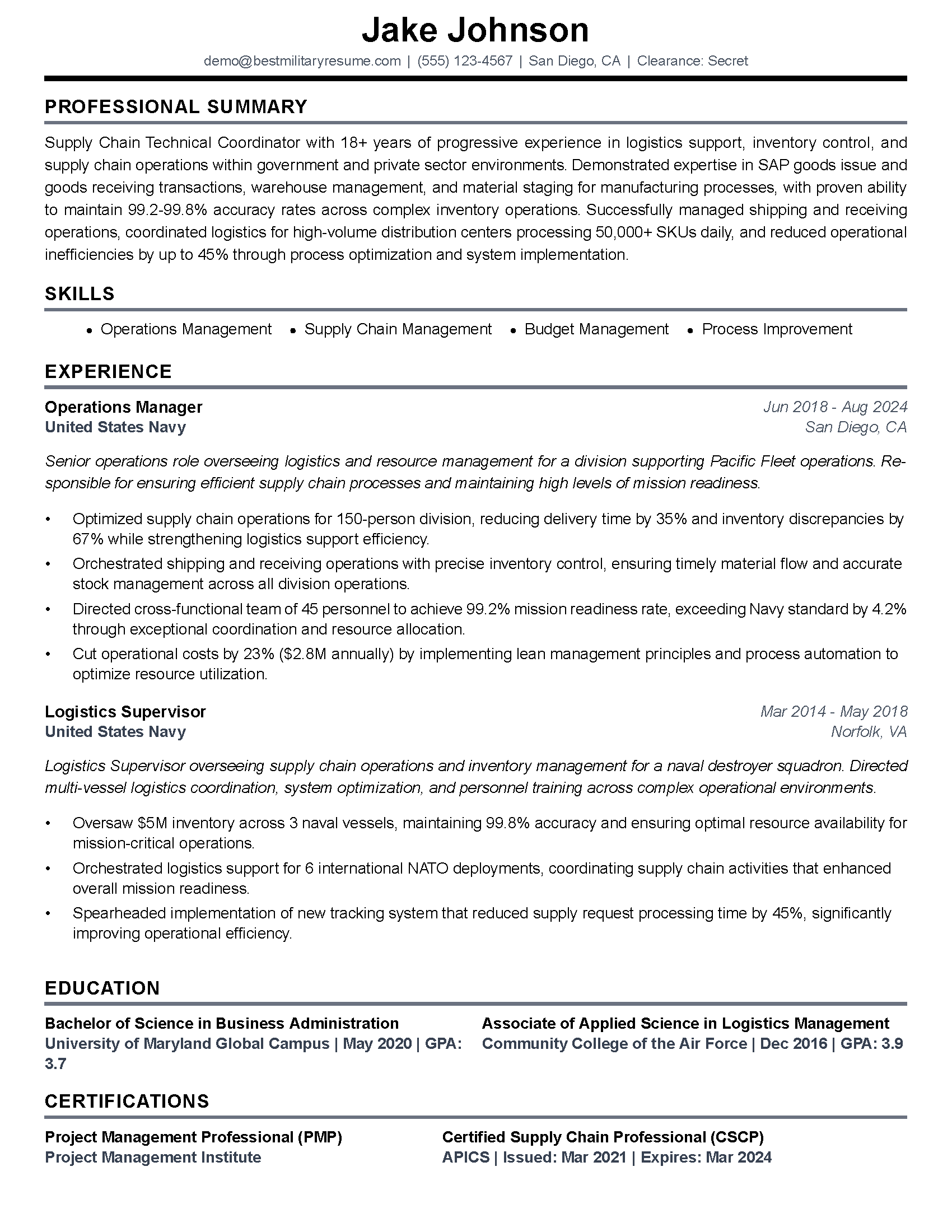
Every before and after in this guide, and every sample bullet, uses made-up numbers to show the shape. Swap in your own.
Served as Battalion XO. Supervised the staff and ran the BUB and CUB.
Chief of staff for a 600-person organization. Led six staff teams of 45 people. Set a weekly meeting rhythm that cut report time by two days.
Two more XO bullets you can model:
- Managed a $2.1M annual operating budget across six departments. Closed the year within 1% of plan.
- Acted as the senior leader for a 600-person organization during the director's absences, totaling 70 days.
Maybe you were a company XO and a battalion staff officer later. List both jobs on your master resume. The officer resume guide for O-3 to O-6 shows how to lay out a long career.
How do you translate the S3 operations officer?
The S3 runs operations. FM 6-0 calls the S3 the commander's main staff officer for training, operations, and plans. The S3 prepares plans and orders and drafts training guidance. The S3 also splits up training resources and tracks unit readiness.
That's an operations director. It's also a project manager. Every exercise has a start, an end, a budget, and a team pulled from many shops. Pick the angle the posting asks for.
- Operations Manager or Director of Operations: For postings about schedules, people, and keeping work on track.
- Project Manager: For postings built around one product, launch, or rollout.
- Training Manager: For postings that focus on learning programs and readiness.
- Program Manager: For postings with a multi-year plan and many moving parts.
The S3 shop also has the S3 operations sergeant major or NCOIC. That job often runs the operations center and the people in it. It translates well to an operations center manager or a senior operations supervisor.
S3 for an infantry battalion. Wrote OPORDs and ran the TOC.
Directed operations for a 600-person organization. Planned 14 multi-week field projects a year. Ran a 24-hour operations center with a 22-person team.
More S3 bullets, again with sample numbers:
- Built and ran a 12-month training plan for 600 people. Raised the share of fully trained teams from 70% to 92%.
- Led planning for a 30-day, 400-person field project from scope to final review. Delivered on schedule and under budget.
- Built a shared plan template for six teams. Cut the time to publish plans from 72 hours to 36.
For an operations posting, put the 24-hour operations center and the training plan up top. For a project posting, lead with the field project and its timeline. The operations manager resume build guide walks through the rest of that resume.
How do you translate the S1?
FM 6-0 calls the S1 the main staff officer for human resources, both military and civilian. At battalion, the S1 plans and delivers HR support to everyone in the unit. In practice that often means strength reports, awards, evaluations, leave, and personnel records.
That's an HR manager or HR operations lead. Many S1 jobs also look like a people operations role. The work is getting the right person in the right seat on time.
- Human Resources Manager: For postings that cover the whole HR function.
- HR Operations Manager: For postings about records, systems, and processing.
- People Operations Lead: Common at newer and smaller companies.
- Talent or Workforce Manager: For postings about staffing levels and hiring plans.
The S1 NCOIC often ran the actual processing. That job translates to an HR operations supervisor or HR team lead. Count the actions your team processed in a year. That number may surprise you.
Battalion S1. Handled awards, evals, and strength reporting.
Led HR for a 600-person workforce with a team of 8. Processed 1,100 personnel actions a year. Cut late performance reviews from 30% to 4%.
One more S1 bullet to model, with sample numbers: "Managed onboarding and offboarding for 250 people a year. Built a checklist that cut first-week delays in half." If HR is your target, the military to human resources career guide covers certifications and entry points.
How do you translate the S4?
FM 6-0 calls the S4 the main staff officer for supply, maintenance, transportation, and services. The S4 builds the logistics plan with the S3. The Army's sustainment manual, FM 4-0, Sustainment Operations, adds a detail worth using. The battalion S4 moves supplies between companies and sends one combined supply report up to brigade.
That's a logistics manager. If you also tracked a budget or bought services, it's a supply chain manager too. Moving stock to where it's short is what civilian supply chain teams do every day.
- Logistics Manager: For postings about moving people, gear, and stock.
- Supply Chain Manager: For postings about planning, buying, and inventory.
- Fleet or Maintenance Manager: If vehicle and equipment readiness was your big number.
- Program Manager: If you owned a budget and a long effort, like fielding new equipment.
The S4 NCOIC often ran the supply room and the property books. That's an inventory control manager or a warehouse operations supervisor. Write the dollar value of the property and the result of your last inventory.
S4 OIC. Responsible for LOGSTAT, Class IX, and the motor pool.
Managed logistics for a 600-person organization and $45M in equipment. Kept a 140-vehicle fleet above 90% ready. Ran a $1.3M parts budget.
Spell out the military terms when they matter. "Class IX" is repair parts, so say repair parts. "LOGSTAT" is a daily supply status report, so call it that. The guide on moving from the military to logistics management covers where those jobs are.
Key Takeaway.
On a battalion staff officer resume, lead each staff job with a civilian title from the posting. Then give the scope of what you ran and a result with a number.
What about the S2, S6, staff NCOs, and other branches?
This guide covers the XO, S3, S1, and S4 in depth. The other sections translate cleanly too.
- S2, intelligence: FM 6-0 says the S2 gives the commander the most complete and timely intelligence. Civilian fits include intelligence analyst lead, risk analysis manager, or security manager.
- S6, signal: The S6 owns communications and the network. Civilian fits include IT manager, network operations manager, or IT project manager.
- Staff NCOs: The senior NCO in each section often ran the people and the daily work. Use supervisor, team lead, or manager titles, scaled to the size of the team.
Marine battalions use the same S1 through S4 numbers, so the same translations apply. Navy staffs often use N codes. N1 is usually personnel, N3 operations, and N4 logistics. Map them the same way. Air Force squadrons are set up differently and often don't use S codes. Find the job that did the same work, then use that section here.
Stuck on a term? The list of 50 military terms with civilian equivalents covers the common ones. You can also browse the military to civilian jobs pages for your career field.
Federal resumes play by different rules.
A federal resume needs more detail on each job. It's two pages for most federal jobs, but check the announcement for exceptions. For program work, see the guide to the GS-0340 program manager series.
How do you choose which billet goes first?
Many field grade officers held two or three staff jobs in a row. You might have been the S4, then the S3, then the XO. On a civilian resume, each one is its own job with its own title and dates.
Put the most recent job first. Then give the most bullets to the job that best matches the posting. Say you're going after a logistics posting. Your S4 job may get four bullets, and your XO job may get two. That's fine. The order stays by date, but the weight follows the target.
Keep everything in your master resume, even jobs that don't fit today. A logistics job from years back can still matter for a posting that asks for it. Then cut a tailored version for each posting you'd actually take. The tailored one is where it gets tight.
Pull your numbers.
Use the checklist above for every staff job you held.
Pick one real posting.
Choose a program, project, or operations manager job you'd take.
Swap each code for a title.
Use the posting's words and the title lists in this guide.
Rewrite the bullets.
Lead with scope and end with a result you can back up.
What to Do Next
Open your last two evaluations tonight. Pull the numbers for one staff job: people, money, gear, and events. Then find one real posting for a program, operations, or project manager role you'd take.
That's the hard part, and only you can do it. The rewrite is where a tool helps. In the BMR Resume Builder, you build one master resume with every staff job on it. Then you paste the posting. BMR copies your base and rewrites your summary, work bullets, and skills in the posting's own words. It doesn't add work you never did, and your base stays untouched.
The free tier gives you one federal tailored resume and one private. So you can build an operations manager version tonight. You'll see your XO or S3 job in civilian words. Start with the billet you held last. Get that one right, then do the rest.
Frequently Asked Questions
Should I put S3 or XO on my civilian resume?
What civilian job title fits a battalion executive officer?
Is a battalion S3 an operations manager or a project manager?
What civilian jobs fit a battalion S4?
What civilian title fits a battalion S1?
How do Navy and Air Force staff jobs translate?
What if I don't know the exact budget or headcount?
About the Author
Brad Tachi is the CEO and founder of Best Military Resume and a 2025 Military Friendly Vetrepreneur of the Year award recipient for overseas excellence. A former U.S. Navy Diver with over 20 years of combined military, private sector, and federal government experience, Brad brings unparalleled expertise to help veterans and military service members successfully transition to rewarding civilian careers. Having personally navigated the military-to-civilian transition, Brad deeply understands the challenges veterans face and specializes in translating military experience into compelling resumes that capture the attention of civilian employers. Through Best Military Resume, Brad has helped thousands of service members land their dream jobs by providing expert resume writing, career coaching, and job search strategies tailored specifically for the veteran community.
