CFP® Certification on a Financial Advisor Resume: Write It Right
Desiree landed a $135K hybrid senior financial consultant role.
Desiree, E-5, Army National Guard, the interviewer loved the resume from the top down
Put CFP® after your name and in your Certifications line, written CFP Board's way, BMR advises. CFP Board's page on using the CFP® marks sets the rule: "Always use capital letters. Never use periods. Always use the ® symbol."
People often search for a "CFP designation." CFP Board's Guide to Use of the CFP Board Certification Marks says those it authorizes "have earned a “Certification,” not a “Designation.”" Seven common mistakes follow, each with its fix and the CFP Board line behind it.
Which ways of writing CFP® are right and which are wrong?
Every row comes from CFP Board's marks page or its marks guide. Each wrong form breaks one of the lines in the last column.
| Wrong | Right | CFP Board's line that decides it |
|---|---|---|
| C.F.P. | CFP® | "Never use periods." |
| cfp or Cfp | CFP® | "Always use capital letters." |
| CFP with no symbol | CFP® | "Always use the ® symbol." |
| Experienced CFP® with a military finance background | Experienced CFP® professional with a military finance background | "Always use with one of CFP Board's approved nouns ("certificant," "professional," "practitioner," "certification," "mark" or "exam")" |
| [FIRST LAST] CFP® with no comma | [FIRST LAST], CFP® | CFP Board's marks guide: "When the mark immediately follows the certificant’s name, a comma must be inserted between the name and the mark, even if the mark falls on the line below the certificant’s name." |
| Certified Financial Planner (CFP) | CFP® certification | "The CFP® mark must not be used as a parenthetical abbreviation for the CERTIFIED FINANCIAL PLANNER® mark." |
| The mark inside your email address or profile link | An email address and profile link with no mark in them | "Certificants are strictly prohibited from using the CFP® mark and the CERTIFIED FINANCIAL PLANNER® mark in domain names/URLs and email addresses used by them." |
The two sources word the name rule differently. The marks page says the mark goes "on the same line directly following the name." The guide allows the mark on the line below, if a comma follows your name. This table follows the guide, and "[FIRST LAST], CFP®" on one line passes both.
The last row matters for your header. If your email or profile link has CFP in it, set up a new one before you apply.
What goes in my resume header and credential lines?
Copy this block and swap every bracket for your own words. The summary names one job, financial advisor, so tailor it to that role.
[FIRST LAST], CFP®
[City, State] | [Phone] | [Email with no mark in it]

FINANCIAL ADVISOR

SUMMARY
Financial advisor and CFP® professional who builds client plans around income, expenses, insurance, taxes and risk tolerance.
Brings military financial readiness work to advisor roles, from budgets to pay problems.
Explains each plan in plain words and reviews it as a client's life changes.

SKILLS
Financial planning process | Cash flow and budgets | Insurance review | Client meetings | Plan reviews

LICENSES
[Series name] registration, [Month Year]
[Series name] registration, [Month Year]

CERTIFICATIONS
CFP® certification, CFP Board, [Month Year]
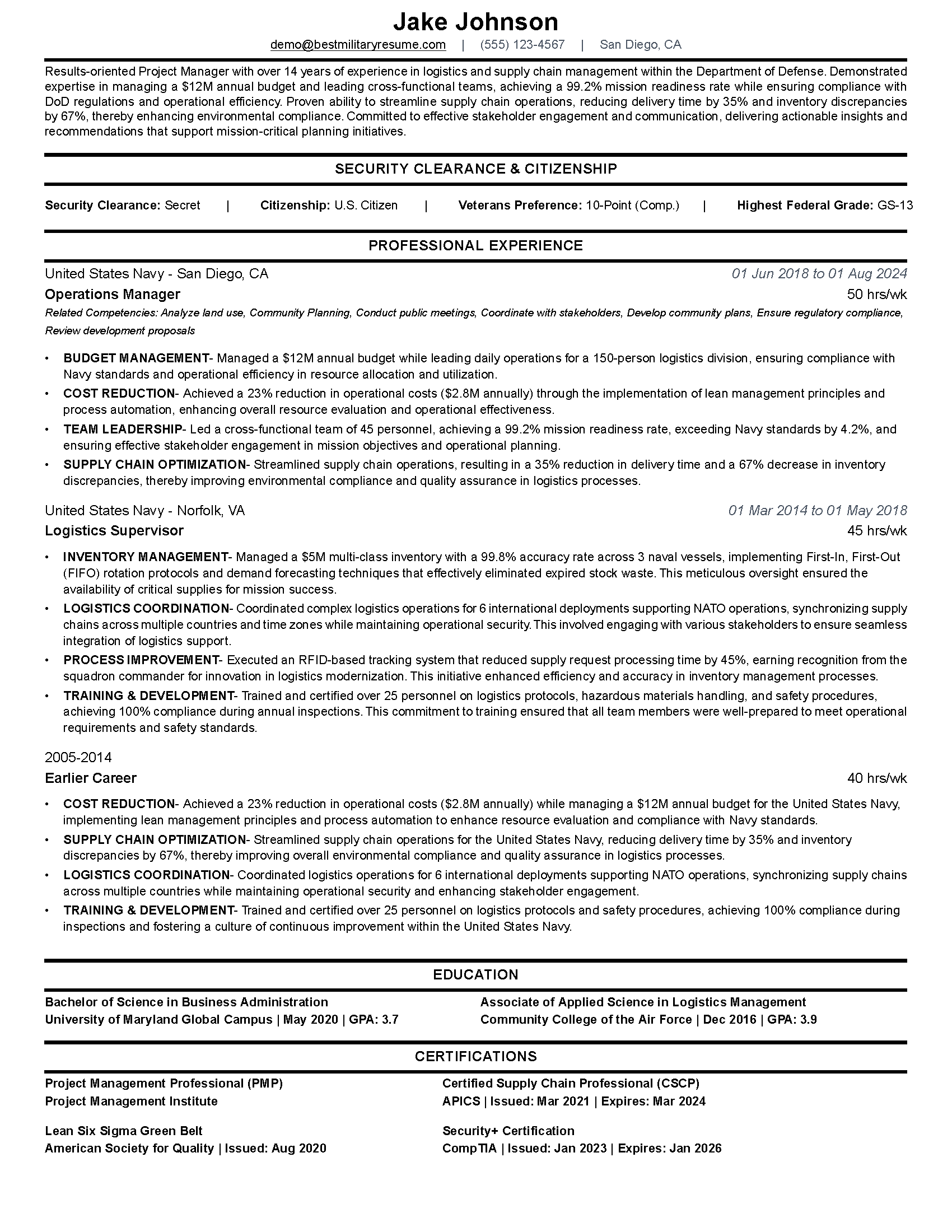
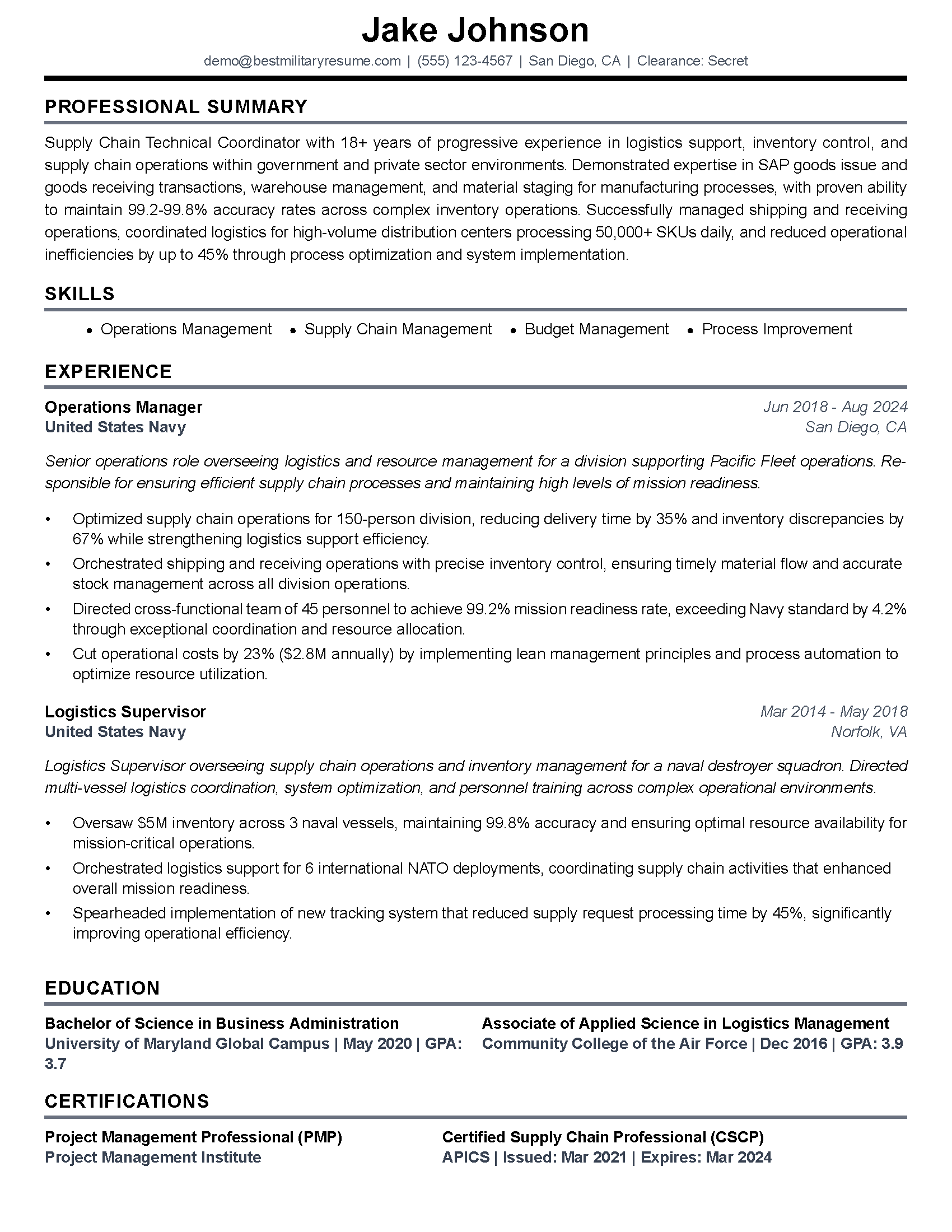
Keep Licenses and Certifications as two headings. The reason is in the next section. For where these headings sit among your jobs, see our guide to chronological, functional and hybrid formats.
Where do my FINRA licenses go?
FINRA is the Financial Industry Regulatory Authority. Its qualification exams page says, "To become registered, securities professionals must pass qualifying exams administered by FINRA to demonstrate their competence in the particular securities activities in which they will work."
So passing a Series exam is part of becoming registered. CFP® certification comes from CFP Board. BMR advises a Licenses heading for registrations and a Certifications heading for CFP®. Write each registration by its full name, the way FINRA lists it. A hiring manager can then see each one at a glance.
If you want a CPA license too, our CPA pathway guide for veterans covers that route.
What if I am not certified yet?
CFP Board's marks page says the marks "indicate you have met CFP Board’s initial and ongoing certification requirements." So CFP® does not go after your name until you are certified.
The marks guide makes one exception for job materials. It says "if you have fully completed your education requirement within the previous five years, you may refer to yourself as a “Candidate for CFP® certification” on your resume."
Write it in exactly those words, as in "[FIRST LAST], Candidate for CFP® certification." The guide lists "John Doe, CFP® Candidate" as a misuse. The use must stop if you are not certified within five years of finishing the education requirement.
Your work can still count. CFP Board's experience requirement page says "experience may be gained before or after you take the CFP® exam." List the coursework you finished under Education by its course name. Put the job you hold now under Experience.
For the hours, degree and exam steps, see our military to financial advisor career guide.
Can an employer check my CFP® certification?
Yes. CFP Board runs a public verification search. It says, "Search results will also identify individuals who are not currently certified but who held CFP® certification at one time."
The same page points to FINRA's BrokerCheck. It also points to the Investment Adviser Public Disclosure database of the Securities and Exchange Commission (SEC). Both cover advisors that FINRA or the SEC oversees.
BMR advises that your resume match those records. Use the name and the status the record shows. If your certification has lapsed, do not list it as current.
Which O*NET task lines can my military work claim?
O*NET OnLine's page for personal financial advisors lists the tasks of the civilian job. The left column holds four of its task lines, word for word. The right column is military work that can claim each line.
| O*NET task line | Military work that fits (BMR advice) |
|---|---|
| "Interview clients to determine their current income, expenses, insurance coverage, tax status, financial objectives, risk tolerance, or other information needed to develop a financial plan." | Sitting down with a service member about pay, debt or a family budget |
| "Analyze financial information obtained from clients to determine strategies for meeting clients' financial objectives." | Budget work in a finance or comptroller office |
| "Answer clients' questions about the purposes and details of financial plans and strategies." | Explaining pay, allowances and benefits to troops at the finance office |
| "Review clients' accounts and plans regularly to determine whether life changes, economic changes, environmental concerns, or financial performance indicate a need for plan reassessment." | Checking back with a member after a move, a new baby or a pay change |
Use a task's words only for work you did. If you ran budgets but never met with members, claim the budget line and skip the interview line. Our guide to translating budget and comptroller work goes deeper on finance duties.
Rules checked November 2026 on CFP Board's and FINRA's sites and O*NET OnLine.
What to Do Next
"I used Best Military Resume to tailor my resume for a Financial Advisor position at First Command Financial Services."
Byron, Petty Officer First Class (E-6), Navy
Move your new CFP® lines into BMR's Resume Builder. Next, tailor a version to one financial advisor opening. BMR rewords your summary, skill list and job bullets in that opening's terms. It never adds duties you didn't hold. Once the AI writes, a check drops any line giving an old role this job's work. Your saved resume stays the same.
Frequently Asked Questions
Should CERTIFIED FINANCIAL PLANNER carry the ™ symbol?
Do I need CFP Board's legal tagline on my resume?
Can I put the CFP® mark logo on my resume?
How much continuing education keeps CFP® certification current?
About the author
Brad Tachi is the CEO and founder of Best Military Resume and a 2025 Military Friendly Vetrepreneur of the Year award recipient for overseas excellence. A former U.S. Navy Diver with over 20 years of combined military, private sector, and federal government experience, Brad brings unparalleled expertise to help veterans and military service members successfully transition to rewarding civilian careers. Having personally navigated the military-to-civilian transition, Brad deeply understands the challenges veterans face and specializes in translating military experience into compelling resumes that capture the attention of civilian employers. Through Best Military Resume, Brad has helped thousands of service members land their dream jobs by providing expert resume writing, career coaching, and job search strategies tailored specifically for the veteran community.
