Collateral Duties on a Resume: How to Write the Bullets
Desiree landed a $135K hybrid senior financial consultant role.
Desiree, E-5, Army National Guard, the interviewer loved the resume from the top down
I'm a Navy Diver veteran. If you served, you likely carried extra jobs beyond your rating, MOS, or AFSC title. Someone hands you a binder and a set of keys. Now that program is yours, on top of your real job.
Then you sit down to write a resume. That duty ate hours every week. It had inspections, and a commander who asked about it. But on paper it shrinks to one line, like "Unit Safety NCO." Or it vanishes.
The question usually sounds like this: "It was just an extra duty. Does it even count?" It counts. A Unit Deployment Manager tracked people and gear for a whole squadron. A hand receipt holder signed for property and answered for every piece. In the civilian world, that's HR, compliance, training, and inventory work.
This guide shows you how to write collateral duties on a resume. You'll get a simple formula and before-and-after bullets grouped by civilian job type. You'll also see how to match each duty to a posting, and which mistakes to skip.
Still deciding which duties to keep at all? Start with our guide on what goes in your experience section and what stays out. The short version is simple. Keep every duty in your master resume. On the version you send, keep the ones that match the posting. This post picks up after that choice.
What Counts as a Collateral Duty on a Resume?
A collateral duty is any job you held on top of your main one. The Navy usually calls it a collateral duty. The Air Force usually says additional duty. The Army and Marine Corps use both terms. Your commander put your name on it, often in writing, and you answered for it.
Titles change, too. The Army's July 2023 edition of AR 385-10 renamed the additional/collateral duty safety officer. The new title is unit safety officer. Your orders may carry either name. Either way, the work is what sells you.
Here are common duties, grouped by the civilian work they look like.
- HR and admin: Unit Deployment Manager (UDM), an Air Force role, plus admin and personnel duties.
- Safety and compliance: Safety NCO (noncommissioned officer), unit safety officer, and unit safety rep.
- Training: Training NCO, and the Navy's Command Fitness Leader (CFL).
- Inventory and accountability: Hand receipt holder, key control custodian, communications security (COMSEC) custodian, and armorer.
- Finance and travel: Defense Travel System (DTS) approver and Government Purchase Card (GPC) holder.
- People support: Unit Victim Advocate, Equal Opportunity (EO) rep, and Voting Assistance Officer.
Your list will look different. Every command builds its own. If you served in the Navy, our Navy resume guide covers translating the rating itself. This post covers the extra jobs stacked on top of it.
Where Do Collateral Duties Go on Your Resume?
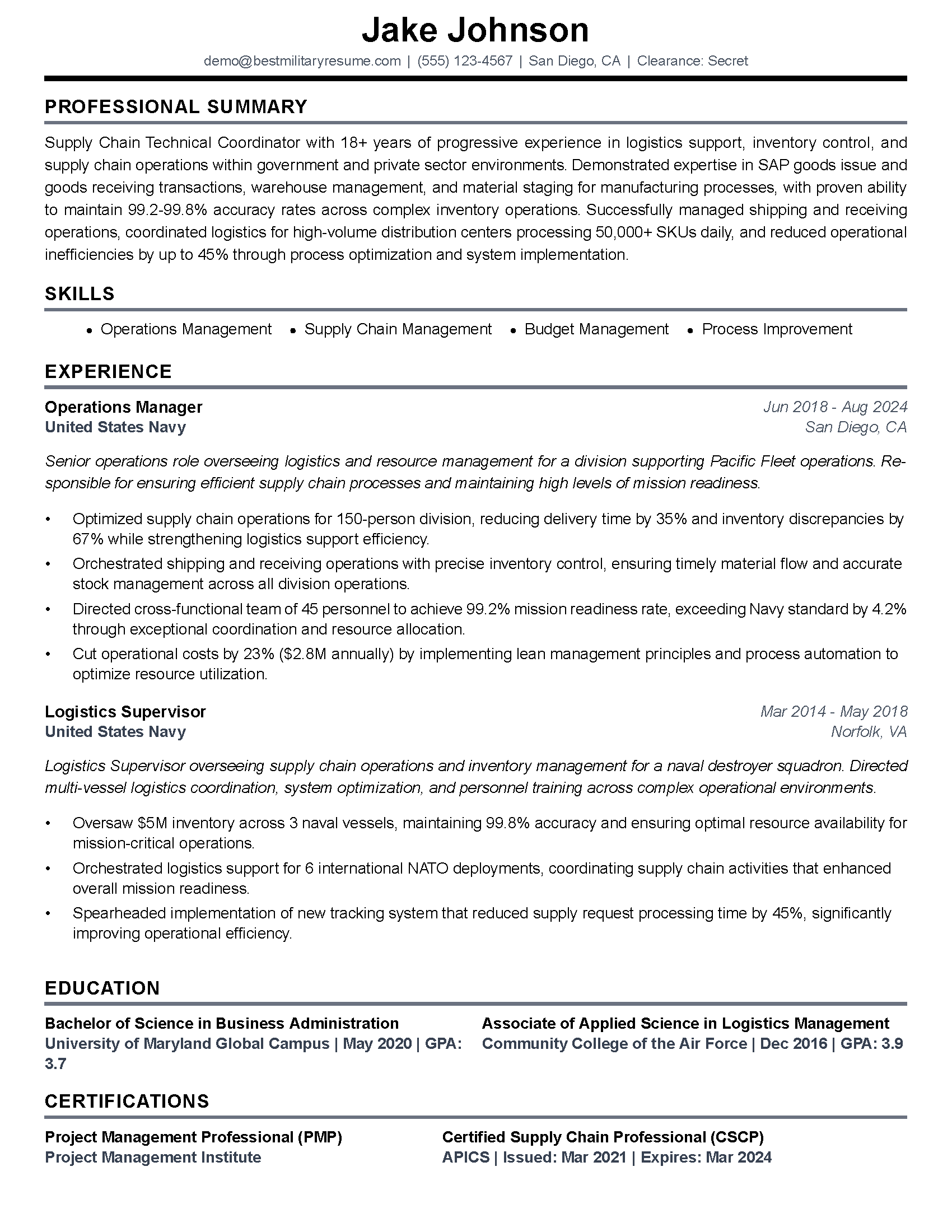
On a private-sector resume, the default is simple. The duty goes under your main job as a bullet. It shares the same dates, because you did both at once.
A big duty can earn a little more room. Add a short line inside the job entry, then two or three bullets under it. It looks like this, using made-up details:
- Logistics Specialist, U.S. Army: January 2021 to March 2025.
- Main job bullets: Two to four lines on your primary work.
- Additional duty line: "Additional duty: Unit Safety Officer, 90-person company."
- Duty bullets: Two or three lines on that program.
Try not to list a collateral duty as its own private-sector job with its own dates. It overlaps your main job. A reader may think you're counting the same years twice.
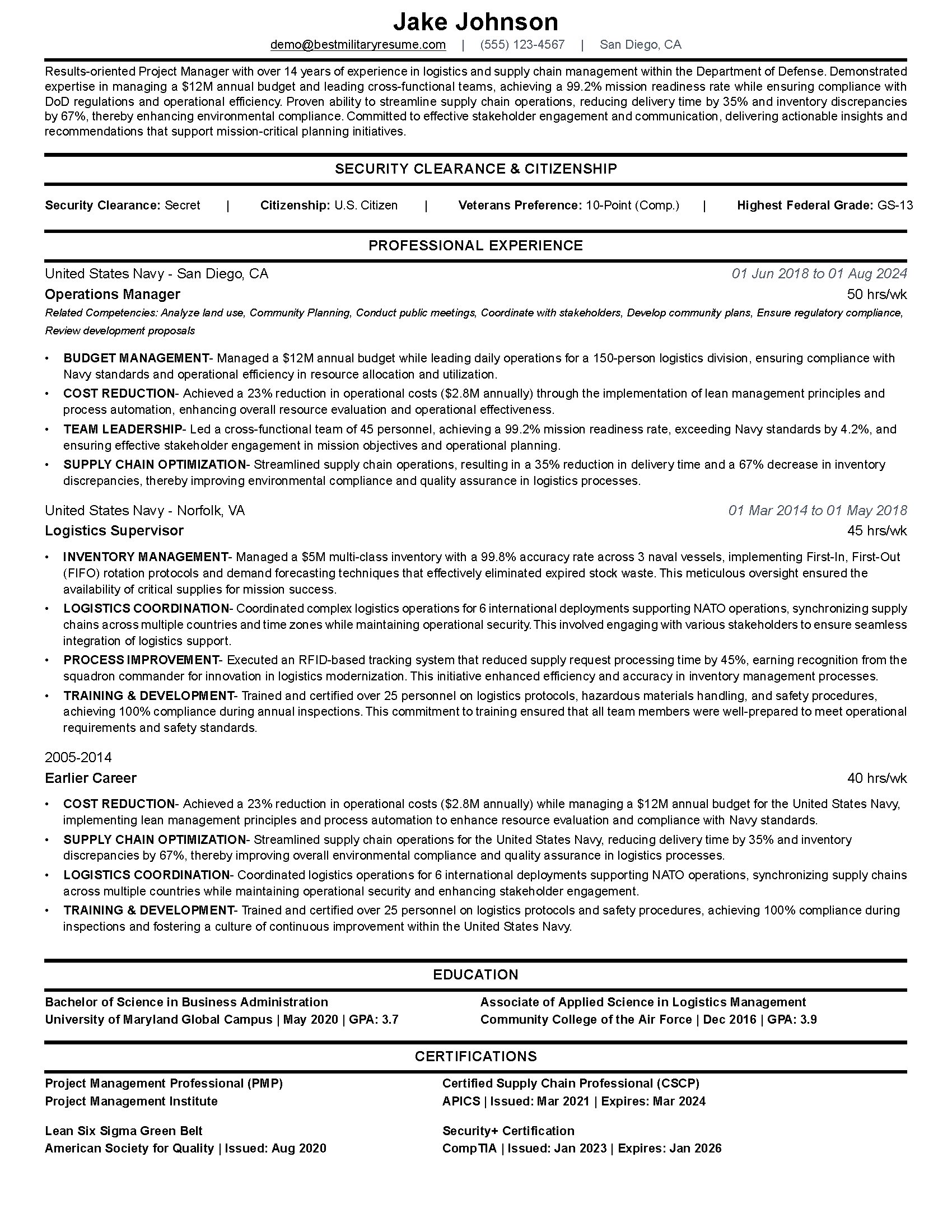
Federal is different. A federal resume can split a big duty into its own entry with its own hours. Our federal resume hours per week guide shows exactly how to split them. Reservists stack drill duties the same way, and our reserve resume guide covers blending two careers.
- •Put the duty under your main job.
- •Use the same dates as the main job.
- •Give one to three bullets, result first.
- •Drop the duty title if the work says enough.
- •A big duty can get its own entry.
- •Split your weekly hours between the entries.
- •Write enough detail to match the announcement.
- •Stay inside the page limit the announcement sets.
How Do You Turn a Collateral Duty Into a Bullet?
Every strong collateral duty bullet answers four questions. What would a civilian call this work? How big was it? What standard did you work to? What changed because you did it?
Name the civilian work.
Safety program, inventory control, travel approval, or training records. Pick the words a civilian job uses.
Count the scope.
How many people, how many items, how much money, or how many buildings.
Name the standard.
An inspection, an audit, a deadline, or a rule you had to meet.
Show the result.
Findings closed, items found, time saved, or an inspection passed.
Put those together and you get the formula. Start with an action verb. Add the civilian work, then the scope, then the result. One or two lines is plenty on a private-sector resume.
The rank comes off. The size of what you ran stays on. Scope is what tells a reader your level, so don't leave it out.
Where Do You Find the Numbers?
You probably have more proof than you think. Check your evaluations first, because raters often mention extra duties. Our guide to turning NCOERs, OERs, and FITREPs into bullets shows how to pull them out.
Then look at your appointment orders, inspection results, turnover binder, and award write-ups. Hand receipts list line items and dollar values. Training trackers show completion rates. If you can't find a number, estimate low and keep it honest. Our post on quantifying military accomplishments has more ways to count.
Key Takeaway.
A duty title tells a reader you were assigned something. The scope and the result tell them you did it well.
What Do Collateral Duty Bullets Look Like?
Below are before-and-after bullets for each civilian job type. Every number is made up to show the shape. Use your own numbers, and only ones you can back up.
How Do You Write HR and Admin Duties Like UDM?
A Unit Deployment Manager keeps people ready to go. That means records, medical tracking, training status, and reports to the commander. In civilian terms, that's personnel readiness and HR coordination.
Unit Deployment Manager. Responsible for deployment readiness.
Tracked medical, training, and records readiness for 140 employees. Briefed leadership monthly. Cut overdue items from 31 to 4 in six months.
Civilian jobs that use these words include HR coordinator, HR assistant, and workforce readiness roles.
How Do You Write a Safety NCO Duty?
Safety duties map well to environmental, health, and safety (EHS) jobs. AR 385-10 lists unit safety officer tasks like safety surveys, hazard analyses, and advising the commander. Those are civilian safety words already.
A common line: "Unit Safety NCO. Gave safety briefs."
Written for a safety manager: "Ran the safety program for a 90-person company. Kept the hazard log and led quarterly inspections. Closed 22 of 25 findings within 30 days."
If federal safety work is your target, our GS-0018 safety and occupational health resume guide covers that series.
How Do You Write a Training Duty?
Training NCOs schedule courses, track who's current, and chase the people who aren't. That's training coordination.
A common line: "Training NCO. Maintained training records."
A stronger version: "Scheduled and tracked mandatory training for 65 people across 14 courses. Raised completion from 78% to 97% before a major inspection."
A Navy Command Fitness Leader works the same way. "Ran fitness testing and remedial sessions for 120 Sailors" reads like a wellness or training coordinator.
How Do You Write Hand Receipt and Key Custodian Duties?
Accountability duties are some of the easiest to translate. Civilian companies call it inventory control or asset management.
A common line: "Hand receipt holder for section equipment."
Same duty, with the scope and result: "Signed for and managed 310 line items worth $1.2 million. Ran monthly inventories. Finished a change-of-command inventory with zero losses."
A key control custodian might write: "Controlled 180 keys across six buildings using sign-out logs and monthly audits. No lost keys in two years."
Keep COMSEC and other security duties general. Our guide on what you can say about cleared work shows where the line sits.
How Do You Write DTS Approver and Purchase Card Duties?
Money duties tell a reader you can be trusted with funds. That's accounts payable, expense audit, or purchasing work.
The usual line: "DTS approving official."
Written for the reader: "Reviewed and approved travel claims for 75 people in the Defense Travel System. Returned errors before payment. Kept approvals under five days."
A purchase card holder might write: "Bought about $40,000 a year in supplies on a Government Purchase Card. Kept every receipt ready for audit."
How Do You Write Victim Advocate and EO Duties?
People-support duties show judgment and trust. They map to employee relations, case management, and HR work.
A common line: "Unit Victim Advocate."
Written for the reader: "Trained victim advocate for a 300-person unit. Gave confidential support and connected people to medical, legal, and counseling help."
Keep sensitive work private.
Never list case counts or case details for advocate or EO work. Stick to your training, the unit size, and the kind of help you gave.
A Voting Assistance Officer can keep it short: "Helped 200 service members register and request absentee ballots."
How Do You Match a Collateral Duty to the Job Posting?
A good bullet still needs the right words. Your keywords are the posting's own words for the work you've actually done. Every posting has a different set, so one version can't cover them all.
Say you're applying for an EHS coordinator job. The posting asks for hazard identification, incident investigation, and safety training. OSHA is the federal workplace safety agency. Now look at its Recommended Practices for Safety and Health Programs. Its core pieces include hazard identification and assessment, and education and training. Your safety duty did that work. So your bullet can use those words, as long as they're true.
Work in this order:
- Read the posting and mark the words that describe the work.
- Find the collateral duty that did that work.
- Rewrite the bullet in the posting's words, with your scope and result.
- Move that bullet to the top of the job entry.
- Cut any phrase you can't back up with real work.
Step four matters more than people think. Sometimes the extra duty fits the target job better than your main job does. A diesel mechanic who ran the shop's hazmat program can have a real shot at an EHS role. Lead with the hazmat work on that version.
Our guide to tailoring a military resume to a job posting walks through the full process.
Do Collateral Duties Count on a Federal Resume?
Yes, and the rules from the Office of Personnel Management (OPM) say why. OPM's General Schedule Qualification Policies say the work actually performed by the applicant must be reviewed. The work you describe is what counts.
The same policy caps credit at one year of experience for any 12-month period. So a collateral duty won't add extra years to your record. What it adds is a different kind of work. That can help you show the specialized experience an announcement asks for.
Say a Navy maintainer also served as the shop's quality assurance inspector. That duty can line up with a series like GS-1910 quality assurance. Written well, it might matter more than the main job.
Federal bullets carry more detail than private ones. Even so, the space is tight. Federal resumes run two pages for most jobs. Always check the announcement, because some of them are exceptions. Our 2-page federal resume examples show how to fit it all. On a tailored resume in BMR, Condense to 2 Pages folds older roles into one short section.
What Mistakes Sink Collateral Duty Bullets?
These five show up again and again. Each one has a quick fix.
Five collateral duty mistakes.
The title with no work.
"Key Custodian" tells a reader nothing. Add the scope and the result.
Acronyms nobody explains.
Spell out UDM, DTS, and COMSEC the first time. Then say what the work was.
Stretching the time.
A duty that took five hours a week wasn't a full-time job. Don't write it like one.
Calling a course a certification.
Write the course name you finished. Use "certified" only for a credential with that name.
Sharing too much.
Leave out case details, classified details, and other people's names.
Acronyms trip up a lot of people. A military term just needs a translation the first time it appears. Our military jargon decoder has 100 terms with civilian versions you can borrow.
One more check. Read each bullet out loud and ask a simple question. Would someone who never served know what you did, and how big it was? If not, add the scope.
What to Do Next
Pick your two biggest collateral duties. Run each one through the formula: civilian work, scope, standard, and result. Write those bullets into your master resume tonight, under the job where you held them.
Then find one posting you'd actually take. Mark the words it uses for the work. Check which of your collateral duties did that work, and move those bullets up.
That last step is where BMR's Resume Builder saves you time. Paste in the posting. BMR copies your base resume and rewrites your summary, work bullets, and skills in the posting's own words. It doesn't add work you never did. Your base resume stays untouched.
The free account includes one federal tailored resume and one private-sector tailored resume. So you can test your new collateral duty bullets against a real posting today.
Frequently Asked Questions
Should I put collateral duties on my resume?
Where do additional duties go on a resume?
How do I write a collateral duty as a resume bullet?
What civilian jobs match a Safety NCO duty?
How do I describe a hand receipt holder job on a resume?
Do collateral duties count as experience on a federal resume?
Should I list my Unit Victim Advocate or EO duty?
About the Author
Brad Tachi is the CEO and founder of Best Military Resume and a 2025 Military Friendly Vetrepreneur of the Year award recipient for overseas excellence. A former U.S. Navy Diver with over 20 years of combined military, private sector, and federal government experience, Brad brings unparalleled expertise to help veterans and military service members successfully transition to rewarding civilian careers. Having personally navigated the military-to-civilian transition, Brad deeply understands the challenges veterans face and specializes in translating military experience into compelling resumes that capture the attention of civilian employers. Through Best Military Resume, Brad has helped thousands of service members land their dream jobs by providing expert resume writing, career coaching, and job search strategies tailored specifically for the veteran community.
