Industrial Maintenance Technician Resume for Veterans
Desiree landed a $135K hybrid senior financial consultant role.
Desiree, E-5, Army National Guard, the interviewer loved the resume from the top down
I'm a Navy Diver veteran. The job stays with you long after you pack your bag. So does the habit of fixing things right. You work the card, you sign the card, and you don't skip a step. A plant needs that habit. But it rarely shows up on the resume.
A plant posting for an industrial maintenance technician asks for preventive maintenance, CMMS work orders, troubleshooting, and lockout/tagout. Your record says PMS checks, PMCS, and tag-outs. It's the same work in a different language. So you stare at a blank page. "How do I make eight years of fixing gear look like plant work?"
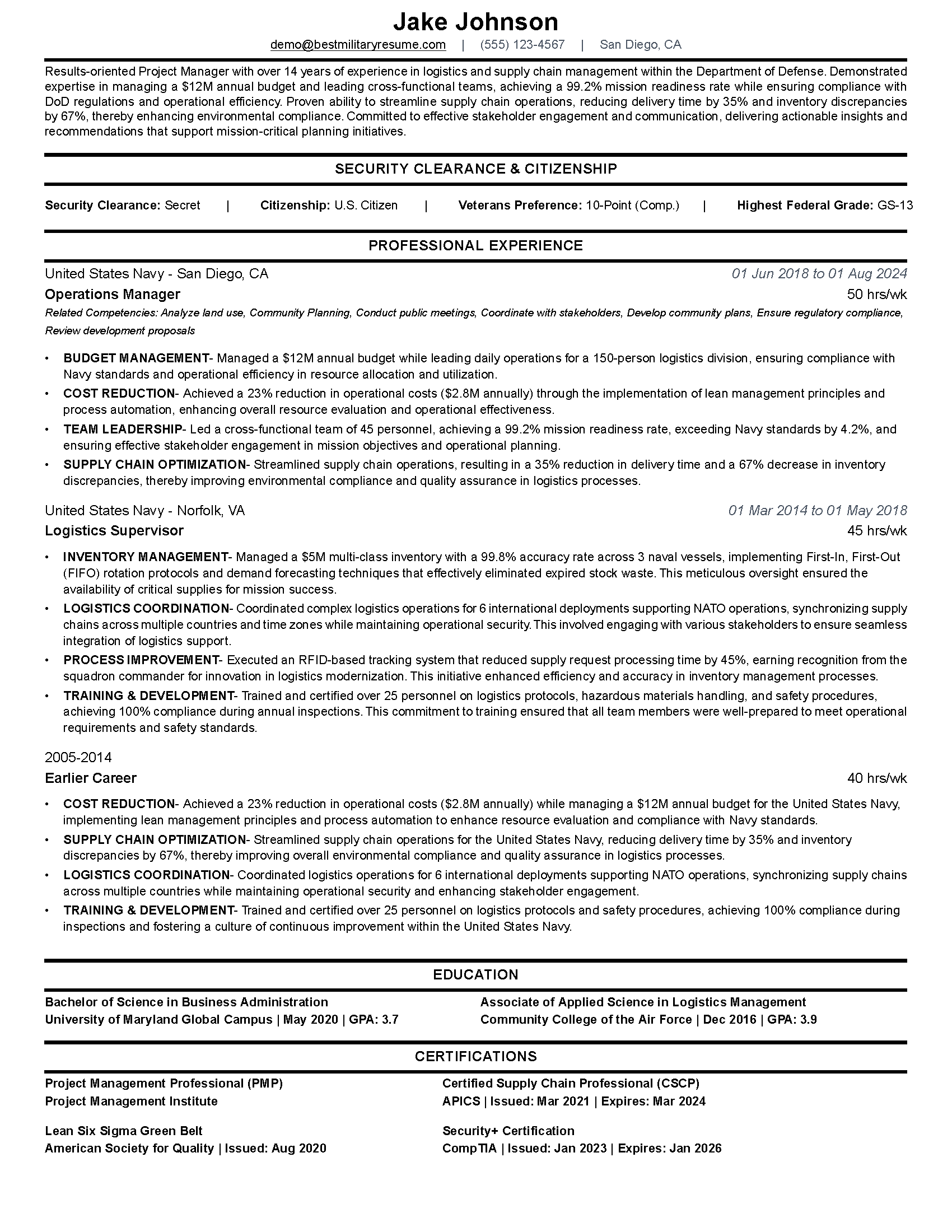
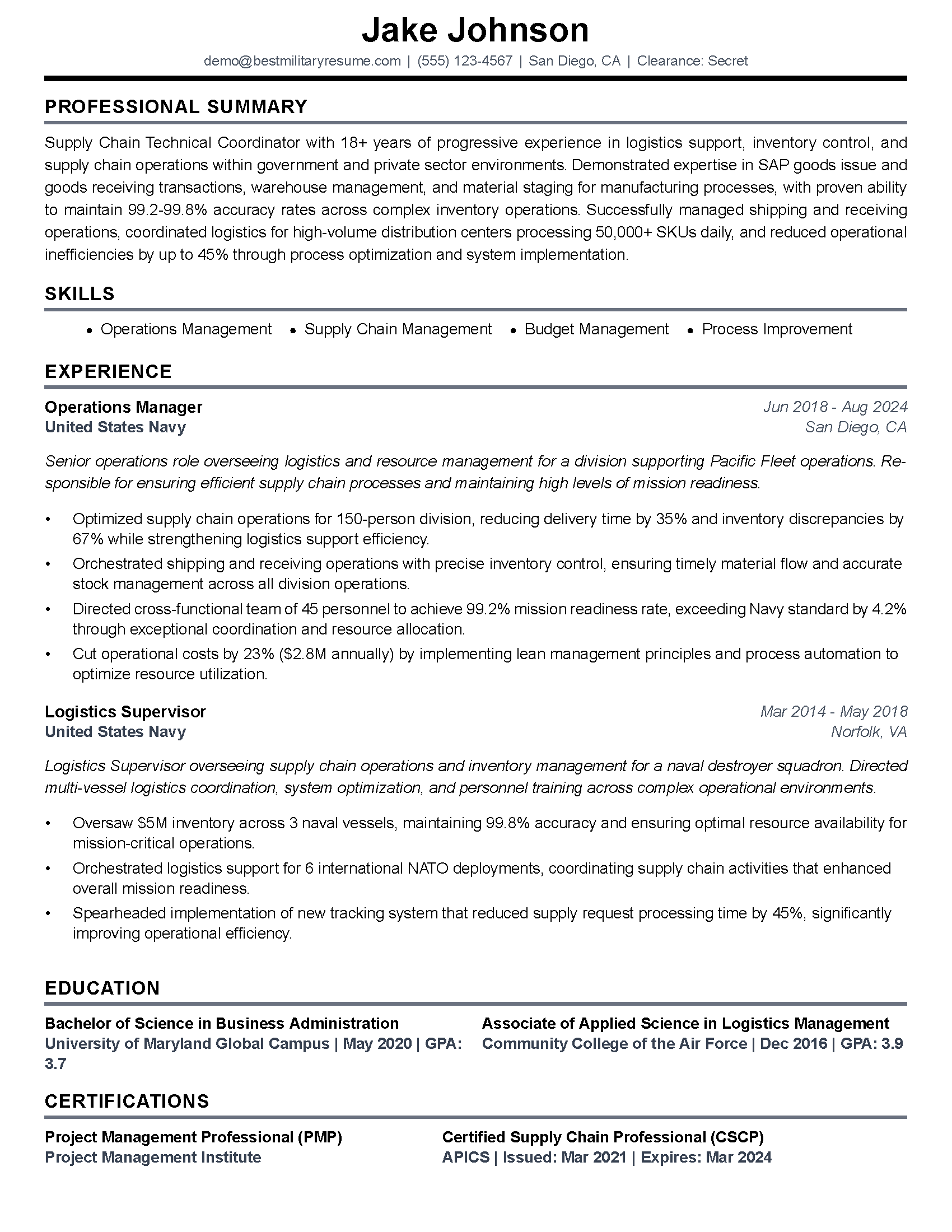
This guide builds your industrial maintenance technician resume one section at a time. You'll get a word swap list and before-and-after bullets by branch. You'll also get two sample summaries, a skills list, and where certs fit.
It's for technician jobs, the people who turn the wrench. If you're aiming one rung up, read the facilities maintenance manager resume guide. Still picking a career lane as a Navy MM? Start with the Machinist's Mate civilian career guide.
What does an industrial maintenance technician job ask for?
Start with the job itself. The Bureau of Labor Statistics files this work under industrial machinery mechanics, machinery maintenance workers, and millwrights. Its duty list reads a lot like a day in an engine room or motor pool.
- Read the manual: Use tech manuals to learn how the gear and controls work.
- Find the fault: Run tests and decide if the machine needs a big repair.
- Fix it: Take machines apart, then repair or replace the broken parts.
- Prove it: Test the machine and run first batches to make sure it runs right.
- Keep it running: Clean, lube, adjust, and calibrate the gear to spec.
BLS says these workers typically need a high school diploma. They usually need a year or more of training on the job, too. If you turned wrenches in uniform, you may have years of it. The resume just has to show it.
The demand is real. BLS puts the median annual wage at $64,100 in May 2025. It projects 14 percent job growth from 2025 to 2035. That's much faster than the average job. BLS also expects about 51,900 openings each year. Many of those come from workers who retire or change jobs.
Now pull up four or five real postings near you. Highlight every skill they repeat. Your keywords are the posting's own words for the work you've actually done. Every posting has a different set, which is why one resume can't cover them all.
How do you translate PMS, PMCS, and 3-M into plant language?
Your shop had its own names. A plant's system has names too. The work underneath is the same, so change the label and keep the proof.
In the Navy, the 3-M system stands for Maintenance and Material Management. Its Planned Maintenance System, or PMS, puts each check on a Maintenance Requirement Card. The Army calls operator and crew checks PMCS, short for preventive maintenance checks and services. Air Force maintainers work from technical orders. A plant boss may not know these terms. So swap them out.
- PMS checks off an MRC: Preventive maintenance (PM) on a set schedule, done by written steps.
- PMCS: Preventive maintenance checks before, during, and after operation.
- Logging jobs and parts: Work orders and gear history in a computerized maintenance management system (CMMS).
- Tag-outs: Lockout/tagout (LOTO) and hazardous energy control.
- Tech manuals and tech orders: OEM manuals, schematics, and standard work steps.
- Fault isolation: Troubleshooting and root cause analysis.
- Calibrated test gear: Precision measuring tools and test gear.
- Qualified on a system: Trained and signed off to run and fix that system. Name it.
If a posting names a CMMS, like Maximo or SAP, use their word only if you used it. If you didn't, write that you logged work orders in a computerized maintenance system. That's true, and it shows you know how the work flows.
Spell it out once.
Spell out every acronym the first time it appears. Then say what it means in plain civilian words. After that, the acronym can stand, and it should when the posting uses it.
Our guide on how to translate military terms into civilian equivalents covers rank, billets, and admin words. This list covers the shop words, because those are what a plant posting asks for.
How do you write maintenance bullets a plant supervisor wants to read?
A strong bullet answers four questions. What did you do? On what gear? How? And what happened because of it? Build every bullet in that order.
The four-part bullet.
Action verb.
Repaired, troubleshot, rebuilt, inspected, replaced, calibrated.
The gear, named.
Pumps, air compressors, diesel generators, motor controls, hydraulics.
How you did it.
Schematics, a meter, written steps, vibration checks, lockout/tagout.
The result.
Hours of downtime saved, checks done on time, gear count, zero findings.
The samples below use made-up numbers. Swap in your own. Your evals are a good place to find them. Our guide to turning evaluations into resume bullets shows how to dig them out.
Navy Machinist's Mate
Many MM resumes carry a line like the military one below. The plant version says the same thing in the words a plant uses. Compare them against the Navy MM career page for more civilian matches.
Performed PMS on main and auxiliary equipment IAW 3-M.
Did scheduled PM on 14 pumps and 2 air compressors by written steps. Missed zero checks in 18 months.
IAW means "in accordance with." Cut it. The plant version names the gear, counts it, and proves you stayed on schedule.
Navy Electrician's Mate
A common version: "Responsible for electrical PMS and troubleshooting in assigned spaces."
Now write the same job for a plant.
"Troubleshot 440-volt motor controllers and three-phase motors with schematics and a meter. Closed 62 electrical work orders in one year."
See the Navy EM career page for the electrical roles this background fits.
Army 91-series and Air Force maintainers
An Army 91D power generation soldier might write: "Conducted PMCS on tactical generators." Try this: "Ran preventive checks and repairs on 22 diesel generators. Kept power on for a 400-person site through a 9-month field rotation."
An Air Force 2A6X2 aerospace ground equipment airman might write: "Maintained AGE IAW tech data." Try this: "Inspected and fixed 40 pieces of powered ground gear. That included generators, air compressors, heaters, and hydraulic test stands."
If you mostly ran heavy equipment, not plant gear, the heavy equipment operator resume guide fits you better.
Where does lockout/tagout go on your resume?
Safety is a big deal in plant work, and you can prove you've lived it. OSHA's lockout/tagout rule is 29 CFR 1910.147. It covers servicing and maintenance where a machine could start up by surprise or release stored energy.
The rule has a term worth knowing. An "authorized employee" is a person who locks out or tags out machines to service them. Did you hang tags on ship systems or lock out a generator before you worked it? Then you've done that kind of work.
The rule covers general industry. It leaves out some fields, such as construction and agriculture.
Put it on the page in two places. First, a bullet with proof (made-up numbers): "Locked and tagged out pumps, motors, valves, and breakers before repair. Zero safety incidents in 3 years." Second, a skills line: "Lockout/tagout (LOTO) and hazardous energy control."
An OSHA card is not a cert.
OSHA says none of its Outreach Training courses count as a cert. List the 10-hour or 30-hour card under training. Don't call it "OSHA certified."
You can check that wording yourself on OSHA's Outreach Training page. A plant safety lead will know the difference, so get it right.
Which skills and keywords belong in your skills section?
Your skills section is a quick scan list. Every line should match a posting and tie back to a bullet above it. Here are the skills that show up on a lot of tech postings.
- Preventive maintenance (PM): Set checks, lube routes, and inspections done by written steps.
- CMMS and work orders: Opening, working, and closing jobs with parts and hours logged.
- Electrical troubleshooting: Schematics, multimeters, motor controls, and three-phase power.
- Hydraulics: Pumps, cylinders, hoses, valves, and pressure testing.
- Pneumatics: Air compressors, actuators, regulators, and air lines.
- PLCs (programmable logic controllers): Only if you've worked on them.
- Lockout/tagout (LOTO): Hazardous energy control before every repair.
- Root cause analysis: Finding why it broke, not just what broke.
- Precision measuring: Micrometers, dial indicators, and alignment tools.
- Welding and fabrication: List the process, like stick or MIG, if you've done it.
You may not have PLC time from the military. That's fine. Don't list it just to match a posting. A plant may test you on it in the interview.
Does PLC work show up on every posting you want? Then look at training. BLS notes that some mechanics and millwrights finish a two-year degree in industrial maintenance. Those programs may include courses in welding, math, hydraulics, and pneumatics. If you go that route, check whether the program teaches PLCs too.
Did you run a root cause team or a process fix? Our process improvement bullets guide shows how to write it up.
What should your professional summary say?
Your summary is three or four lines at the top. It names the job you want, your years, your gear, and one piece of proof. The rank comes off. The size of what you ran stays, because it tells them your level.
Here's a sample for a Navy EM. The details are made up.
"Industrial maintenance technician with 8 years of electrical and mechanical repair on Navy ships. Troubleshoots motors, motor controllers, and switchboards using schematics and test gear. Did scheduled PM on 120+ pieces of gear with zero missed checks. Trained in lockout/tagout and hazardous energy control."
Here's one for an Army 91D. These details are made up too.
"Maintenance technician with 6 years repairing diesel generators and power distribution gear. Kept power on for remote sites of up to 400 people. Skilled in preventive maintenance, electrical troubleshooting, and logging work orders in a maintenance system."
For more summary formats by branch, see our professional summary examples. If you led a crew and want the supervisor seat, read the production supervisor resume guide next.
Which certifications help, and where do they go?
You don't need a stack of certs to get hired as a tech. But the right one can help a resume stand out. Here are a few real ones and how they fit.
CMRT from SMRP
The Certified Maintenance and Reliability Technician (CMRT) comes from the Society for Maintenance and Reliability Professionals. The exam covers four areas. SMRP lists them as Maintenance Practices, Preventative and Predictive Maintenance, Troubleshooting and Analysis, and Corrective Maintenance.
To sit for it, you send SMRP an application and pay its fees. You also can't have taken it in the last six months. Years of military PM work may cover a lot of what it tests.
EPA Section 608
If the job touches refrigeration or HVAC, look at EPA Section 608 technician certification. EPA says you need it for certain work with refrigerants, and the credential doesn't expire. Our military to HVAC guide goes deeper.
A state electrical license
Some plant jobs lean hard on electrical work. License rules change from state to state, so check yours. Our electrician licensing guide walks through it.
Put certs in their own section under skills. Give the full name and the issuer, plus the year you earned it. If you're working on one, write "exam scheduled" with the month and year. Never list it as earned before you pass.
Key Takeaway.
Your bullets carry the proof. A cert backs it up. But it can't stand in for a bullet that names the gear and the result.
Should you apply for federal Wage Grade mechanic jobs too?
Yes, if you'd take one. The federal government hires trades under the Federal Wage System. A few of its job series match this work well.
The WG-5352 Industrial Equipment Mechanic series covers plant support gear like bridge cranes, conveyors, compressors, pumps, and valves. Production machines fall under a different series, WG-5350 Production Machinery Mechanic. OPM's job grading standard says the work needs mechanical, hydraulic, and pneumatic know-how. Most jobs below grade 10 carry the title Industrial Equipment Repairer.
The WG-5378 Powered Support Systems Mechanic series covers powered ground equipment for aircraft servicing. It also covers standby and emergency power generators. That's familiar ground for AGE airmen and 91D soldiers.
A federal resume follows its own rules. It's two pages for most federal jobs. Always check the announcement, because some are exceptions. On a tailored resume, BMR can condense older roles to fit two pages. Our Wage Grade federal resume guide covers the format.
If you'd take either job, run federal and private at the same time. The base is the same. Only the shape changes.
What to Do Next
You've got the words. Now build your industrial maintenance technician resume in this order.
- Pull your postings: Save four or five tech jobs you'd actually take.
- Build one base resume: Put every job and every piece of gear in it. Don't trim the base.
- Translate the terms: Use the list above to swap PMS, PMCS, and tag-outs for plant words.
- Write four-part bullets: Action, gear, method, and result on every line.
- Tailor to each posting: Match the summary, bullets, and skills to that posting's words.
Step five is where most of the time goes. BMR's Resume Builder does that step with you. Paste a maintenance tech posting. BMR copies your base resume and rewrites your summary, work bullets, and skills in that posting's words. It doesn't add work you never did, and your base stays untouched.
I got out of the Navy with no plan and no answers. BMR is the tool I wish I'd had. The free account includes one private-sector tailored resume and one federal. Picture the plant supervisor reading your page. She sees pumps, motors, LOTO, and a PM schedule you never missed. That's the call you want, so go build it.
Frequently Asked Questions
How do I write an industrial maintenance technician resume with military experience?
What skills should go on an industrial maintenance technician resume?
Is an OSHA 10 card a certification?
What certifications help a maintenance technician?
How much do industrial maintenance technicians make?
Should I list PLCs if I never worked on them?
Can veterans apply for federal maintenance mechanic jobs?
About the author
Brad Tachi is the CEO and founder of Best Military Resume and a 2025 Military Friendly Vetrepreneur of the Year award recipient for overseas excellence. A former U.S. Navy Diver with over 20 years of combined military, private sector, and federal government experience, Brad brings unparalleled expertise to help veterans and military service members successfully transition to rewarding civilian careers. Having personally navigated the military-to-civilian transition, Brad deeply understands the challenges veterans face and specializes in translating military experience into compelling resumes that capture the attention of civilian employers. Through Best Military Resume, Brad has helped thousands of service members land their dream jobs by providing expert resume writing, career coaching, and job search strategies tailored specifically for the veteran community.
