Instructional Design for Military Spouses: Titles, Pay, Degree Rules and Portfolio
Luana, a military spouse, landed a Staff Policy and Procedures Analyst role.
Luana, military spouse, policy and procedures analyst
Instructional designers build training and courses, and O*NET lists "Instructional Designer" as an Instructional Coordinator title. That job's 2025 median wage is $77,440. One Air Force spouse made the switch during a permanent change of station (PCS).
Hiring Our Heroes profiled her in Clovis, New Mexico, designing online courses for medical students. You get the titles to search, the degree rules, three portfolio samples and resume lines.
Instructional design for military spouses: the titles and the pay
O*NET splits this work into two jobs. Search both sets of titles.
| O*NET job | Titles to search | Median wage (2025) | Job Zone line |
|---|---|---|---|
| Instructional Coordinators | Instructional Designer, Instructional Systems Specialist, Instructional Technologist, Learning Development Specialist | $77,440 a year ($37.23 an hour) | Job Zone Five: "Most of these occupations require graduate school." |
| Training and Development Specialists | Corporate Trainer, Learning and Development Specialist, Training Specialist, Trainer | $69,280 a year ($33.31 an hour) | Job Zone Four: "Most of these occupations require a four-year bachelor's degree, but some do not." |
O*NET rates growth from 2025 to 2035 as "Slower than average" for coordinators. For training specialists it says "Much faster than average."
Which row fits you? A teacher who wrote lessons and tests reads closest to Instructional Designer. A spouse who ran classes for adults, or unit training in uniform, reads closest to Training Specialist. That split is BMR's advice, not O*NET's.
Want other jobs that move with you? Our list of careers that survive a PCS names more.
How much school do these jobs ask for?
It depends on the job and the employer. O*NET puts Instructional Coordinators in Job Zone Five. It says they "may require a master's degree." Training and Development Specialists sit in Job Zone Four. Most of those jobs need a bachelor's, "but some do not."
So a bachelor's and strong samples can open the trainer door. Designer jobs ask for grad school more often. Read each posting's education line before you apply.
The federal rule is stricter
Many federal design jobs use the General Schedule (GS) 1750 series. The Office of Personnel Management (OPM) calls it Instructional Systems. Our federal careers hub covers how GS series work. OPM's 1750 qualification standard asks for a degree that "included or was supplemented by at least 24 semester hours appropriate to the work."
Those hours must cover at least four of these five areas:
- Learning theory, psychology of learning or educational psychology.
- Instructional design practices.
- Educational evaluation, such as writing tests and survey tools.
- Instructional product development.
- Computers in education and training.
The OPM page lists a degree as its only basic route. It shows no experience-only path. If you hold an education degree, pull your transcript. Match each course to one of the five areas. That count tells you if you meet the rule.
If you fall short, OPM lets added course work supplement the degree. Then you only buy the classes you are missing.
How one Air Force spouse moved from teaching to course design
This is one person's path, from a Hiring Our Heroes profile. Kaitlyn Vogel taught third grade for eight years. She was finishing a master's degree in instructional design when she left the classroom.
- A local meetup. At a Military Spouse Professional Network (MSPN) event, she met a volunteer. The volunteer told her about Freedom Learning Group (FLG) and its jobs for military spouses.
- A contract first. "Shortly after graduating with my master's degree, Freedom Learning Group selected me for an instructional design contract position."
- The full-time job. A role at Adtalem Global Education opened, and she applied. "Since I was already a contractor, Adtalem treated me like an internal candidate."
- The work now. The profile lists her title as "Designer, Learning Experience." She says, "I design online courses for medical students."
The contract was her bridge.
FLG's spouse hiring has been in the news before. A November 29, 2019 eLearningInside report said FLG had employed 210 military spouses. They were hired to work remotely on digital education contract work. That's 2019 reporting, so check FLG's current openings yourself. Our remote work guide for military spouses covers where else to look.
Portfolio pieces a teacher can make with no client
BMR's advice is to build three samples before you pitch anyone. You can build each one alone, with no client.
- A short self-paced module. Pick one skill you have taught, like a math unit or a safety brief. Write two or three learning objectives. Build the lesson so a learner can finish it alone, with no teacher in the room.
- A job aid. Make a one-page guide for a task you trained people to do. Use numbered steps, short words and one picture or chart. A job aid is what someone checks while doing the task.
- A quiz with a scoring key. Write questions tied to each objective in your module. Add the key and a note on what a passing score means. OPM lists test writing under "Educational evaluation." The sample shows that skill, but only course work counts toward the 24 hours.
Our advice: add a short design note to each sample. Name the learner, the goal and how you would know it worked. That note shows your thinking, which a finished file alone does not.
How classroom and unit training read on a resume
Your teaching or training already uses design words. A lesson plan is instructional material. Students are learners. A unit test is an assessment. Fill the brackets with your own facts.
For a teacher aiming at Instructional Designer posts:
- Designed [subject] units for [grade level] learners, each with written objectives and an assessment.
- Rebuilt a [subject] unit after test results showed a gap in [skill], then measured the change.
- Built online lessons that [number] students finished on their own during [school year].
For a spouse who ran unit training in uniform, aiming at Training Specialist posts:
- Planned and taught [training topic] to [number] service members, with a written test for each class.
Staying in the classroom instead? Read our guide to teaching license transfer and Department of Defense Education Activity (DoDEA) jobs. Our guide for companies hiring veterans into training roles shows how employers read a trainer's resume.
Put your lesson plans in a designer's words
Your samples prove the skill. Your resume has to say it the way a design listing does. Save one Instructional Designer or Training Specialist listing first.
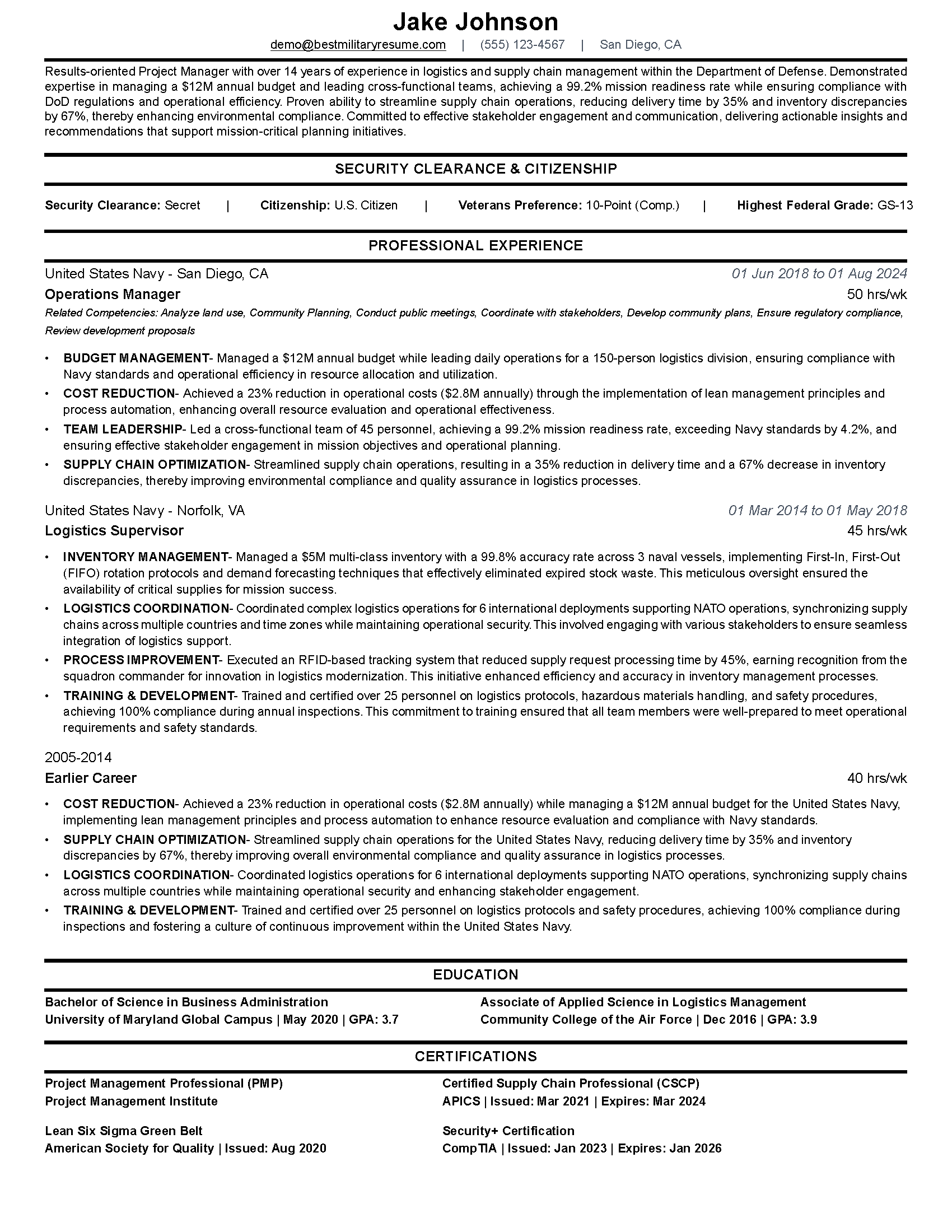
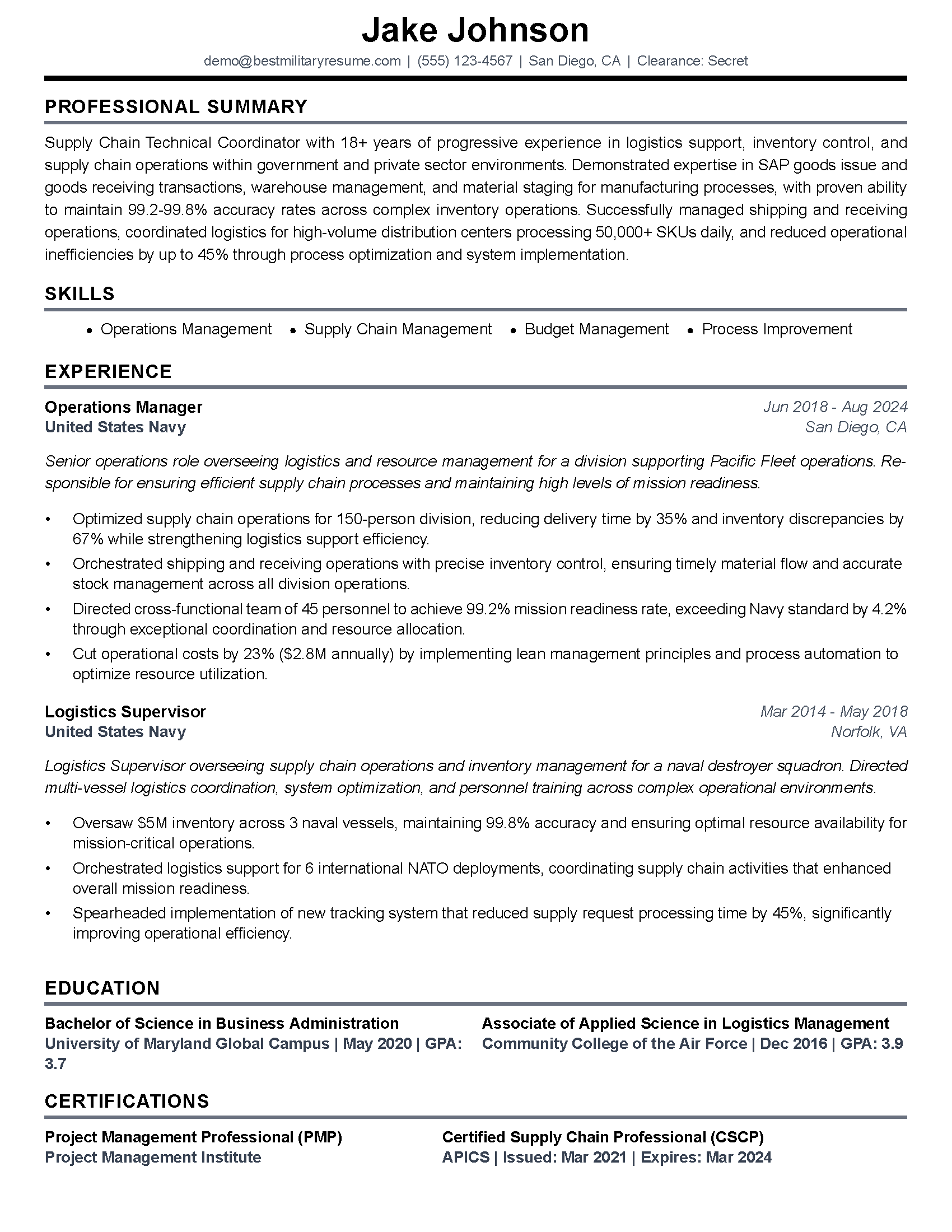
79,061 resumes have been built on BMR. Your lesson plans already hold the design work. BMR's Resume Builder recasts them in that listing's own words. A military spouse tailors two resumes free, one federal and one private.
Pay is O*NET OnLine's 2025 wage data, and the Job Zone lines are O*NET's too. The degree rule is OPM's 1750 standard. Each source was read in November 2026.
Frequently Asked Questions
Which other job titles does O*NET list under Instructional Coordinators?
Can a federal 1750 job ask for one specific course area?
How big is the Military Spouse Professional Network?
About the author
Brad Tachi is the CEO and founder of Best Military Resume and a 2025 Military Friendly Vetrepreneur of the Year award recipient for overseas excellence. A former U.S. Navy Diver with over 20 years of combined military, private sector, and federal government experience, Brad brings unparalleled expertise to help veterans and military service members successfully transition to rewarding civilian careers. Having personally navigated the military-to-civilian transition, Brad deeply understands the challenges veterans face and specializes in translating military experience into compelling resumes that capture the attention of civilian employers. Through Best Military Resume, Brad has helped thousands of service members land their dream jobs by providing expert resume writing, career coaching, and job search strategies tailored specifically for the veteran community.
