Loading...
Loading...
The civilian and federal jobs that hire Air Force Aircraft Fuel Systemss — with real salaries and the resume that gets callbacks.
Every 2A6X4 has more options than a Google search will tell you. Below: career paths, BLS salary data, federal GS series, certifications by target career, and how to translate your experience without losing what made you valuable to the Air Force in the first place.
Free · No credit card · Tailored resume in under 5 minutes
After the Navy I got hired into 6 federal career fields and tech sales, and sat on federal hiring panels along the way. I spent the last 2 years rebuilding everything I learned into BMR, tuned for how AI actually screens resumes today. This is the system I wish I'd had on day one.
If you held AFSC 2A6X4, you spent your career keeping aircraft fuel systems airworthy. That means removing, repairing, inspecting, installing, and modifying integral fuel tanks, bladder cells, and external tanks, plus the lines, pumps, valves, gauges, and boost systems that move fuel through the airframe. You climbed inside wing tanks to reseal them, ran leak-detection on pressurized systems, stripped and reapplied protective coatings, and inspected cells for corrosion, deterioration, and foreign objects. Much of it happened in confined space under respirators, on the flight line in extreme heat and cold, around flammable vapors and hazardous chemicals.
The training pipeline runs through 8.5 weeks of Basic Military Training and then technical school at Sheppard AFB, Texas, taught by the 82nd Training Wing. Coursework covers fuel cell repair, tank sealing, pump and boost systems, and complex troubleshooting. At the 3-skill level you handle basic technical tasks under supervision. At the 5-skill level the scope broadens, and 7-skill level technicians pick up supervisory, administrative, and managerial work. The field rolls up into 2A690 at the senior NCO level.
Civilian employers value this background because aircraft fuel work is unforgiving. A missed leak or a bad reseal can ground an aircraft or worse, so the discipline you built around confined-space entry, hazardous-material handling, and documented inspection carries directly into civilian aviation maintenance, industrial component repair, and environmental and safety roles. If you want to see how this skill set maps across fields, the military career crosswalk lays out the options. Related Air Force maintenance fields like 2A6X1 Aerospace Propulsion and 2A5X1 Aerospace Maintenance share many of the same civilian destinations.
I came up through federal environmental and engineering work after the Navy, and I can tell you 2A6X4 is one of the cleaner technical translations out there. Aircraft fuel systems is component-level maintenance plus hazardous-environment discipline, and that exact pairing is what depot aircraft-mechanic shops, FAA technical roles, and federal equipment and engineering-technician series are built around. The work is real and verifiable. The only thing that costs people interviews is a resume that buries it. — Brad Tachi, Navy Diver veteran & BMR founder
The number that matters when you're deciding what's next: how does civilian pay compare to what you make now?
Military comp is approximate (varies by location/dependents). Civilian is BLS median. Federal includes locality pay. Your real number depends on duty station, family status, GS step, and overtime.
The strongest direct match is staying in aviation maintenance. According to BLS OEWS (May 2024), Aircraft Mechanics and Service Technicians (O*NET 49-3011.00) earned a median of $78,680, with employment projected to grow 5% from 2023 to 2033 and about 13,400 openings a year. Airlines, MROs (maintenance, repair, and overhaul shops), and OEMs hire fuel-systems experience specifically. An FAA Airframe and Powerplant (A&P) certificate is the credential that unlocks the higher end of this range.
Avionics Technicians (49-2091.00) earned a median of $81,390 (BLS OEWS May 2024). If your work touched fuel quantity indicating systems, gauges, and the sensors tied to boost pumps, that electrical-and-instrumentation exposure is the bridge into avionics, though it usually takes additional training.
Outside the airframe, your component-repair and inspection skills carry into industrial settings. Industrial Machinery Mechanics (49-9041.00) earned a median of $63,510 with strong 15% projected growth (BLS OEWS May 2024), and Quality Control Inspectors (51-9061.00) earned $47,460. The sealant, stripping, and corrosion-control side of the job maps to Coating, Painting, and Spraying Machine Operators (51-9124.00) at a $47,590 median, and broad facility upkeep fits Maintenance and Repair Workers, General (49-9071.00) at $48,620.
Be honest with yourself about geography. Aviation maintenance pay and openings cluster around major airline hubs, MRO centers, and aircraft-manufacturing regions. The industrial-repair and inspection roles are spread more evenly. If you are open to a complete change of field, the career-change paths below show where the underlying skills travel. Cross-branch aviation maintainers like Navy Aviation Machinist's Mate (AD) and Coast Guard Aviation Maintenance Technician compete for the same civilian aviation jobs. For pay benchmarking, the military-to-civilian salary guide is a useful starting point, and you can draft your translated resume in the military resume builder.
| Civilian Job Title | Industry | BLS Median Salary | Outlook | Match |
|---|---|---|---|---|
Aircraft Mechanic and Service Technician O*NET: 49-3011.00 | Aviation Maintenance | $78,680 | 5% (As fast as average) | strong |
Avionics Technician O*NET: 49-2091.00 | Aviation Maintenance | $81,390 | Varies (BLS does not project this SOC separately from aircraft mechanics) | moderate |
Industrial Machinery Mechanic O*NET: 49-9041.00 | Manufacturing | $63,510 | 15% (Much faster than average) | strong |
Quality Control Inspector O*NET: 51-9061.00 | Manufacturing | $47,460 | Varies by industry | moderate |
Coating, Painting, and Spraying Machine Operator O*NET: 51-9124.00 | Manufacturing | $47,590 | Varies by industry | moderate |
Maintenance and Repair Worker, General O*NET: 49-9071.00 | Facilities | $48,620 | Varies by industry | moderate |
BMR rewrites your 2A6X4 experience for any of the civilian roles above — keywords, achievements, and language hiring managers actually scan for.
Free · No credit card · 2 tailored resumes included
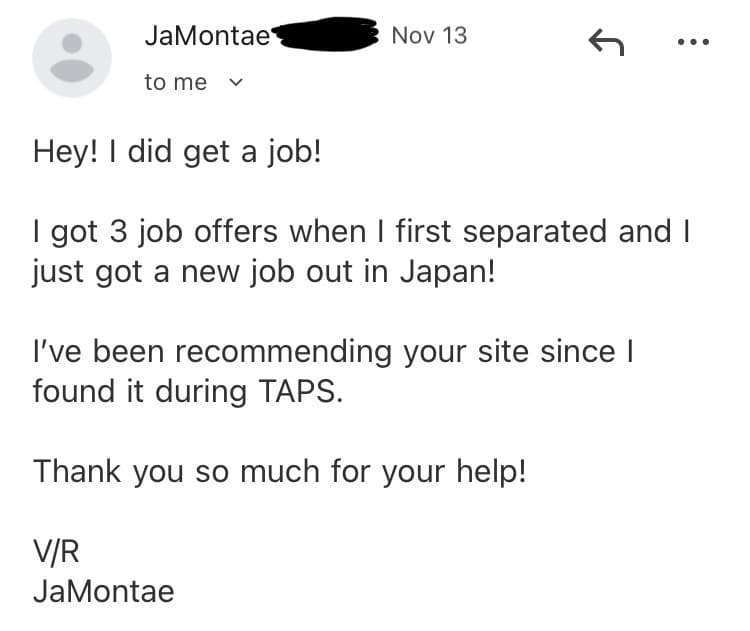
“Hey! I did get a job! I got 3 job offers when I first separated and I just got a new job out in Japan! I’ve been recommending your site since I found it during TAPS. Thank you so much for your help! V/R JaMontae ”
Federal aircraft maintenance is one of the most direct landing spots for a 2A6X4 background, and the work happens at Air Logistics Complexes, Fleet Readiness Centers, and Army depots that overhaul the same systems you maintained in uniform. The anchor series is GS-8852 Aircraft Mechanic, a Wage Grade and GS classification covering airframe and fuel-system repair. Fuel-systems specialization is recognized work inside this series, and many positions sit at the WG-10 through WG-12 journeyman range.
Adjacent technical series widen the search. GS-8602 Aircraft Engine Mechanic covers powerplant and fuel-feed components. GS-0802 Engineering Technician fits inspection, test, and modification work where you support engineers rather than turn wrenches full time. If you spent time servicing ground support and fuel-handling equipment, GS-1670 Equipment Services and GS-5806 Mobile Equipment Servicing are realistic, and heavy maintenance experience can qualify you for GS-5803 Heavy Mobile Equipment Mechanic.
Qualification in the trades series is built on demonstrated experience, not a degree, which works in your favor. Your training records, qualification logs, and performance reports document the hands-on hours these jobs require. Veterans' Preference applies on top of that, and for the 8852 and 8602 series your specific aircraft and component experience is exactly what rating officials look for. To translate your evaluations into the structured federal format, the federal resume format guide and the USAJOBS announcement decoder walk through the details. You can build the document itself in the federal resume builder. Maintainers from other branches such as Army 15B Aircraft Powerplant Repairer chase these same GS series.
| GS Series | Federal Job Title | Typical Grades | Match | Explore |
|---|---|---|---|---|
| GS-8852 | Aircraft Mechanic | WG-10, WG-11, WG-12 | View Details → | |
| GS-0802 | Engineering Technician | GS-5, GS-7, GS-9 | View Details → | |
| GS-8602 | Aircraft Engine Mechanic | WG-8, WG-10, WG-11 | View Details → | |
| GS-1670 | Equipment Services | WG-8, WG-10 | View Details → | |
| GS-5803 | Heavy Mobile Equipment Mechanic | WG-8, WG-10 | View Details → | |
| GS-5806 | Mobile Equipment Servicing | WG-6, WG-8 | View Details → |
Federal hiring uses keyword-matching and structured experience. BMR builds federal-format resumes (USAJobs-ready) with the right keywords, hours/week, and supervisor info — for any GS series above.
Free · No credit card · Federal + civilian resume formats included
Not everyone wants to stay in a related field. These career paths leverage your transferable skills — leadership, risk management, logistics, project planning — in completely different industries.
Fuel cell work is essentially regulated confined-space remediation in hazardous atmospheres, the exact conditions abatement and spill-response crews operate in.
Diagnosing fuel-system contamination and leaks is the same investigative skill environmental techs use to sample and trace contaminants in soil and water.
You spent years managing flammable fuel and vapor hazards and running documented inspections, which is the core of fire inspection and origin investigation.
Repairing complex, safety-critical equipment to exact tolerances using technical manuals is exactly how biomedical equipment is maintained, just in a clinical setting.
Treatment plants run on pumps, valves, and monitored fluid systems, the same hardware you maintained, under similar regulatory and safety controls.
You lived inside permit-required confined-space and hazmat programs as a worker. Moving to the program side is a natural step into industrial safety oversight.
The skills that made you a good Marine, Sailor, Airman, or Soldier transfer further than you think. BMR rewrites your bullets for any of the pivot careers above — without making you sound like you've never done the work.
Free · No credit card · Try unlimited career angles
If you are applying to an aviation MRO, an airline, or a depot aircraft-mechanic shop, your terminology already fits. Hiring managers in those shops know what a bladder cell, a boost pump, and a tank reseal are. This section is for 2A6X4 veterans targeting careers OUTSIDE aircraft maintenance, where a hiring manager has never read a fuel-systems work card and needs the value spelled out in their language.
The translation problem is specific. Terms that are precise inside the Air Force read as jargon everywhere else, so the goal is to convert the task into a business or industrial outcome the reader recognizes.
Here is how that looks in resume bullets aimed at a non-aviation employer. Before: "Performed fuel cell entry and resealed integral wing tanks on assigned aircraft." After: "Executed permit-required confined-space maintenance under documented safety protocols, completing component reseals with zero recordable safety incidents." Before: "Ran leak checks on aircraft fuel systems." After: "Diagnosed and isolated failures in pressurized fluid systems, reducing rework through root-cause troubleshooting." For a deeper walkthrough, the guide to explaining military experience without jargon and the EPR-to-civilian translation guide are built for exactly this. You can apply the patterns directly in the military resume builder.
BMR turns your 2A6X4 duties and accomplishments into civilian bullets that match the job you're applying for — no manual translation, no rewriting.
Free · No credit card · Tailored to each job posting
Which certifications you need depends on where you're headed. Find your target career path below.
The wrong placement can sink an otherwise strong application. BMR knows where each cert ranks, what to call it, and how to frame it for ATS keyword matching and hiring manager attention.
Free · No credit card · Built around your real certs and clearance
The credential that moves the needle is the FAA Airframe and Powerplant (A&P) certificate. Military aircraft maintenance experience can qualify you to test under FAA authorization, and the time you logged on fuel systems counts toward the airframe side. SkillBridge is the cleanest on-ramp while still in uniform. Aviation MROs, airlines, and OEMs run approved programs, and the top SkillBridge companies list and programs by industry are good places to start. Industry groups like the Aviation Technician Education Council track workforce demand and training pathways.
If you are pivoting into safety, environmental, or industrial work, target the OSHA 30-Hour, a confined-space or HAZWOPER certification, and for the management track the CSP (Certified Safety Professional). For federal jobs, learn the USAJOBS system and Veterans' Preference rules cold. American Corporate Partners (ACP) offers free veteran mentorship that helps map a path into a new field. Use your GI Bill deliberately rather than defaulting to a generic degree.
Start with the military resume builder or the federal resume builder depending on your target, explore options with the career crosswalk, and lean on SFL-TAP transition resources. When you are ready, build your resume now.
See also: Navy Aviation Structural Mechanic (AM), Air Force 2A7X1 Aircraft Metals Technology, and the career paths by branch guide.
Most veterans do this backwards — they wait until terminal leave to start, then panic. Here's the actual sequence that works.
Print this. Tape it to your monitor. Veterans who treat the transition like a 90-day op get hired faster than the ones who treat it like an emergency.
Stop rewriting from scratch every time you apply. BMR turns your military experience into civilian and federal resumes — tailored to each job.