Loading...
Loading...
The civilian and federal jobs that hire Coast Guard Musicians — with real salaries and the resume that gets callbacks.
Every MU has more options than a Google search will tell you. Below: career paths, BLS salary data, federal GS series, certifications by target career, and how to translate your experience without losing what made you valuable to the Coast Guard in the first place.
Free · No credit card · Tailored resume in under 5 minutes
After the Navy I got hired into 6 federal career fields and tech sales, and sat on federal hiring panels along the way. I spent the last 2 years rebuilding everything I learned into BMR, tuned for how AI actually screens resumes today. This is the system I wish I'd had on day one.
The Coast Guard MU rating is one of the smallest and most selective enlisted careers in the service. There is exactly one MU billet pool: the United States Coast Guard Band in New London, Connecticut. You did not get here through a recruiter quota. You auditioned for a specific chair against professional-caliber players, and you won it. That distinction matters when you start translating this experience for civilian employers who have never seen a military resume.
As a Coast Guard MU you performed at the level of a full-time professional orchestra. The Band's mission runs from ceremonial honors and change-of-command ceremonies to concert tours, recordings, and recruiting performances that represent the entire service. Depending on your instrument and assignment you may have played in the concert band, the ceremonial unit, a chamber ensemble, the brass quintet, or a small jazz or popular-music group. You read complex scores, rehearsed under a conductor, maintained your own instrument, and performed live with zero margin for error in front of flag officers, foreign dignitaries, and the public.
The pipeline is audition-first, not score-first. Unlike most ratings there is no large "A" School class. You competed in a live audition (and often a follow-on interview), and only after winning a position did you ship to basic training and report to the Band. Because the Band is a fixed-station unit, MUs typically spend long, stable assignments in New London rather than rotating through the cutters and stations that define most Coast Guard careers. That stability gave you something most performers never get early in their careers: years of steady, salaried, full-time playing with a world-class ensemble.
Civilian employers value this background for reasons that go well beyond music. You delivered flawless work in high-pressure, no-retake settings. You sight-read and adapted on short notice. You spent years inside a disciplined rehearsal-and-performance cycle that demands preparation, precision, and teamwork. Those are the same traits that make people effective in classrooms, recording studios, event production, corporate training, and client-facing roles. If you want to see how performing-arts skills map across fields, start with the military-to-civilian career crosswalk, and if you worked alongside the Band's public-facing mission you will find common ground with the Coast Guard PA Public Affairs Specialist path. For a broader look at skills civilians overlook, the blog post on hidden military skills civilians do not know you have is a good starting point.
When I separated from the Navy I spent 18 months applying with no callbacks. My experience was real, but the way I described it read like a foreign language to civilian hiring managers. Musicians carry that problem in an especially sharp form. "Coast Guard Band" sounds like a hobby to someone who has never sat in a concert hall, when the truth is you held a full-time professional performance job most conservatory graduates never land. The work is not the obstacle. Getting a civilian to see what the work actually proves is the obstacle, and that is exactly what a translated resume fixes. — Brad Tachi, Navy Diver veteran & BMR founder
The number that matters when you're deciding what's next: how does civilian pay compare to what you make now?
Military comp is approximate (varies by location/dependents). Civilian is BLS median. Federal includes locality pay. Your real number depends on duty station, family status, GS step, and overtime.
The professional-music labor market is honest about one thing: full-time, salaried playing jobs are scarce, and competition for them is intense. The Bureau of Labor Statistics groups your core craft under Musicians and Singers (O*NET 27-2042), and because the work is so often part-time, freelance, and per-engagement, BLS reports a median hourly wage of $42.45 (May 2024) rather than an annual median. That structure is the reality of the field. Many working musicians piece together income from performing, teaching, recording, and arranging. Coming out of the Coast Guard Band, you have an advantage most freelancers lack: years of documented full-time professional experience and a steady-income mindset that helps you build a sustainable portfolio rather than chase one-off gigs.
Music direction and arranging. If you led sections, conducted small ensembles, or arranged charts, Music Directors and Composers (O*NET 27-2041) is a direct path. BLS reports a median annual wage of $63,670 (May 2024) for this group, which covers church and community-ensemble directors, arrangers, and composers. Your conducting and score-preparation reps from the Band translate cleanly here.
Music education. Teaching is one of the most stable destinations for a professional player. K-12 music teaching pays a median of $62,340 for elementary teachers and $61,430 for kindergarten teachers (BLS May 2024), though public-school positions require state teacher licensure. Private studio and community instruction is the lower-barrier entry point and is grouped by BLS under self-enrichment and other teaching categories. Your performance credentials carry real weight with parents and program directors.
Audio engineering and production. Players who handled recording sessions, live sound, or studio work move into Sound Engineering Technicians and the broader Broadcast, Sound, and Video Technicians group, where BLS reports a median annual wage of $56,600 (May 2024). The Band's recording and broadcast output gives you legitimate session experience. For a wider view of media and production careers, see how the Navy MC Mass Communication Specialist path overlaps with audio and broadcast work.
Producing and creative direction. Experienced performers with an eye for putting a show together move toward Producers and Directors (O*NET 27-2012), median annual wage $83,480 (BLS May 2024), in concert production, theater, and event entertainment. This is a build-up role, not an entry point, but the Band's tour and ceremony production schedule is exactly the operational experience that justifies it.
Geography drives this market more than almost any other field. The densest markets for performing, recording, and teaching jobs sit around major metro and entertainment hubs, while ceremonial and community-ensemble work spreads more evenly. Be realistic about relocation. If you would rather build a resume that opens doors in adjacent fields too, our military resume builder lets you frame the same experience for multiple targets. When you are ready to apply, you can build your resume now.
| Civilian Job Title | Industry | BLS Median Salary | Outlook | Match |
|---|---|---|---|---|
Professional Musician O*NET: 27-2042.00 | Performing Arts | $88,296 | 7% (Faster than average) | strong |
Music Director / Arranger O*NET: 27-2041.00 | Performing Arts | $63,670 | 4% (As fast as average) | strong |
Music Teacher (K-12) O*NET: 25-2021.00 | Education | $62,340 | 1% (Little or no change) | strong |
Audio Engineer O*NET: 27-4014.00 | Media & Recording | $56,600 | 2% (Slower than average) | strong |
Music Producer / Director O*NET: 27-2012.00 | Media & Entertainment | $83,480 | 8% (Faster than average) | moderate |
Arts Administrator O*NET: 27-3031.00 | Nonprofit & Cultural | $69,780 | 6% (Faster than average) | moderate |
Private Studio Music Instructor O*NET: 25-2021.00 | Education | $62,340 | 1% (Little or no change) | strong |
BMR rewrites your MU experience for any of the civilian roles above — keywords, achievements, and language hiring managers actually scan for.
Free · No credit card · 2 tailored resumes included
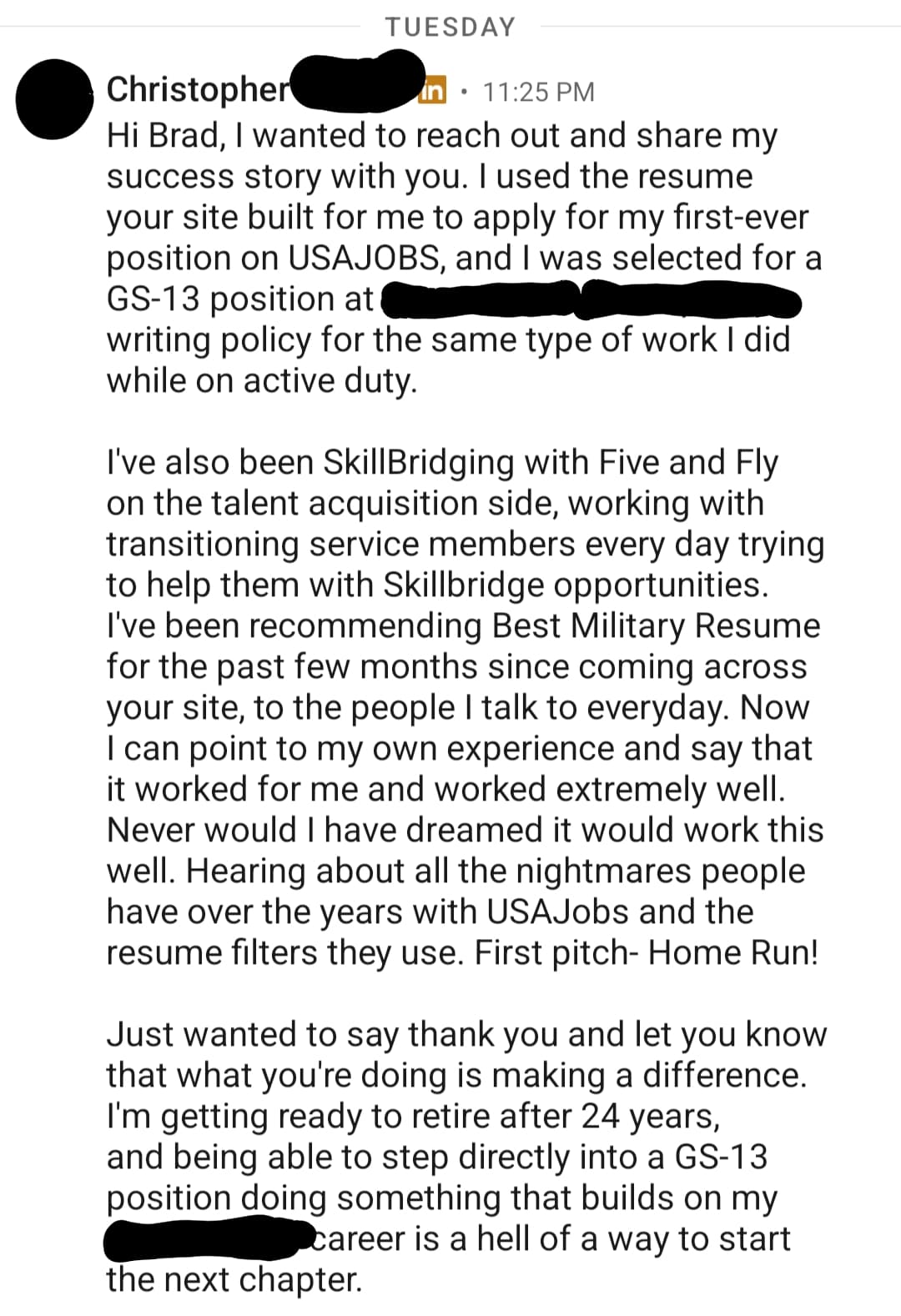
“I'm not working in the career field I want to be in. But the services provided has helped me land an interview with the Government. Now I wait to see if they select me for the position.”
The federal government employs full-time musicians, but the door is narrow and almost entirely audition-based, the same way the Coast Guard Band hired you. The military service bands (Army, Navy, Air Force, Marine Corps, and the Coast Guard Band itself) are the primary federal employers of career performers, and entry to the premier bands is by audition, not by GS application. That said, your years inside the Band built a federal-ready record across several General Schedule series that have nothing to do with holding an instrument.
GS-1001 General Arts and Information. This is the arts-and-culture program series, covering roles in cultural programming, arts administration, and public-facing creative work at agencies and federal cultural institutions. Your ensemble-coordination and performance-program experience maps here. Grades commonly run GS-7 through GS-11 at entry and developmental levels.
GS-1071 Audiovisual Production. If you handled recording, live sound, or broadcast for the Band, this series covers federal audiovisual and media production work. It is one of the cleaner translations for an MU with studio or live-sound reps. Entry developmental grades commonly sit at GS-5 through GS-9, with journey work at GS-11.
GS-1035 Public Affairs. The Band's recruiting and community-relations performances are public affairs work. If you briefed audiences, coordinated appearances, or supported outreach events, this series is in reach, and it shares hiring targets with the Coast Guard PA and Army 46S Public Affairs Specialist communities.
GS-1701 General Education and Training and GS-1702 Education and Training Technician. Years of sectional coaching, clinics, and instruction inside the Band support an education-and-training path, particularly with federal training commands and education offices.
GS-0301 Miscellaneous Administration and Program. The catch-all program series fits MUs who ran the Band's scheduling, logistics, tours, or unit administration. It is a common bridge series for veterans whose strongest documented work is coordination and program management.
Veterans' Preference applies across all of these. Your service time adds 5 or 10 points to your competitive rating, and certain appointment authorities let agencies hire eligible veterans outside the standard competitive process. Federal hiring runs on the written application more than any private employer does. A federal resume is long, detailed, and keyword-matched to the job announcement. Our federal resume builder is built for exactly that format, and the blog post on the SkillBridge program covers how to line up a federal internship before you separate. When you are ready, you can start your federal resume.
| GS Series | Federal Job Title | Typical Grades | Match | Explore |
|---|---|---|---|---|
| GS-1001 | General Arts and Information | GS-7, GS-9, GS-11 | View Details → | |
| GS-1071 | Audiovisual Production | GS-5, GS-7, GS-9, GS-11 | View Details → | |
| GS-1035 | Public Affairs | GS-7, GS-9, GS-11 | View Details → | |
| GS-0301 | Miscellaneous Administration and Program | GS-7, GS-9, GS-11 | View Details → | |
| GS-1701 | General Education and Training | GS-7, GS-9 | View Details → | |
| GS-1702 | Education and Training Technician | GS-5, GS-7 | View Details → |
Federal hiring uses keyword-matching and structured experience. BMR builds federal-format resumes (USAJobs-ready) with the right keywords, hours/week, and supervisor info — for any GS series above.
Free · No credit card · Federal + civilian resume formats included
Not everyone wants to stay in a related field. These career paths leverage your transferable skills — leadership, risk management, logistics, project planning — in completely different industries.
Years of coaching sections and running clinics inside the Band is exactly the skill corporate training rewards. You already teach people to perform a difficult task to standard under pressure.
Planning and running Band tours and ceremonies is event production. You already manage venues, schedules, and live execution where the show cannot start late.
Performers who command a stage tend to thrive in client-facing sales. The poise and preparation that make a live performance land are the same traits that close deals.
The Band's recruiting and community-relations mission is public relations. If you fronted appearances and outreach events, you already do the public-facing work PR teams hire for.
Arts organizations run on development. A musician who understands the value of the work and can speak to donors with credibility is a natural fit for fundraising.
Evaluating talent through auditions and developing players is people work. That experience reading and growing talent transfers into recruiting, onboarding, and talent development.
Section leaders who set the standard and coached others to hit it already run the playbook a sales manager runs. The leadership transfers; the product knowledge is learned.
The skills that made you a good Marine, Sailor, Airman, or Soldier transfer further than you think. BMR rewrites your bullets for any of the pivot careers above — without making you sound like you've never done the work.
Free · No credit card · Try unlimited career angles
If you are applying to a music ensemble, a recording studio, or a school music program, you do not need to translate anything. Those employers speak your language. They know what first chair, principal, section leader, and audition mean. This section is for MUs targeting careers outside professional music, where a hiring manager has never heard of the Coast Guard Band and reads "musician" as "not a real job."
The fix is to describe what the work proves, not what instrument you played. A civilian recruiter cares that you delivered flawless results under pressure, prepared relentlessly, and operated inside a disciplined team. Here is how to reframe the language:
A before-and-after resume bullet, aimed at a corporate training or client-facing role:
Before: "Played trumpet in the ceremonial unit and performed at official functions."
After: "Executed live presentations at over 100 official functions annually with zero performance failures, preparing and rehearsing new material on short notice for audiences that included flag officers and foreign dignitaries."
The second version never mentions the trumpet, and it lands with someone hiring for poise, preparation, and reliability. For a full reference, the 50 military terms translated to civilian language glossary and the guide on explaining military experience in a civilian interview without jargon walk through the same translation in interview form. Our military resume builder applies this reframing automatically, or you can get started here.
BMR turns your MU duties and accomplishments into civilian bullets that match the job you're applying for — no manual translation, no rewriting.
Free · No credit card · Tailored to each job posting
Which certifications you need depends on where you're headed. Find your target career path below.
The wrong placement can sink an otherwise strong application. BMR knows where each cert ranks, what to call it, and how to frame it for ATS keyword matching and hiring manager attention.
Free · No credit card · Built around your real certs and clearance
If you are building a performance, teaching, or recording career, lean on the credential you already earned. Years in the Coast Guard Band is a reference that opens doors with community ensembles, conservatory programs, and school districts.
If you are leaving performance behind, your transferable strengths are preparation, precision, and composure under pressure. Build the resume around those.
See also: the Coast Guard IS Intelligence Specialist and Marine Corps 4341 Combat Correspondent career paths share the media-and-presentation skill base. To explore every option, use the full career crosswalk, and when you are ready to apply, build your resume now.
Most veterans do this backwards — they wait until terminal leave to start, then panic. Here's the actual sequence that works.
Print this. Tape it to your monitor. Veterans who treat the transition like a 90-day op get hired faster than the ones who treat it like an emergency.
Stop rewriting from scratch every time you apply. BMR turns your military experience into civilian and federal resumes — tailored to each job.